Test NetSuite Food and Beverage Requirements with a Short Life Lot
Food and beverage inventory carries more than a quantity and a cost. Lot identity, date information, release status, and customer shelf-life requirements can determine whether goods may be used or shipped. A correct stock total can therefore coexist with a serious operational problem.
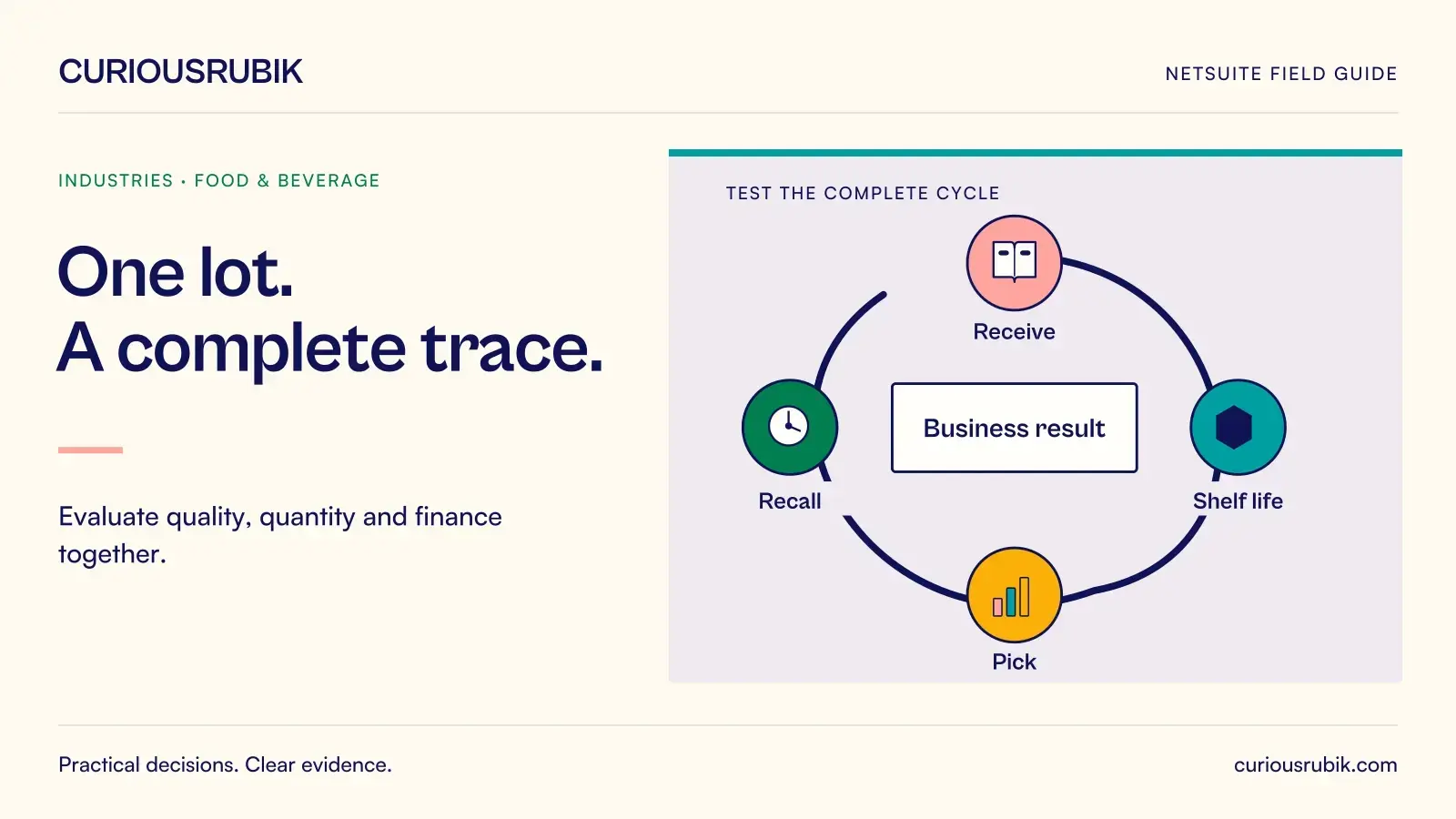
A NetSuite food and beverage ERP evaluation should test a short-life lot from receipt through picking, customer shipment, recall investigation, and financial review. The aim is to establish reliable evidence for the business's requirements. Software functionality alone does not establish food safety or regulatory compliance.
Define the lot and date model with quality
Agree which supplier and internal lot identifiers must be retained. Specify manufacturing, receipt, expiry, or other relevant dates and what each means for the product. Avoid treating different date labels as interchangeable.
The quality lead should define release, hold, rejection, rework, and disposal rules. The commercial team should identify customer requirements such as minimum remaining shelf life at delivery. These decisions should be documented before item and warehouse configuration begins.
Confirm the NetSuite features, item setup, inventory statuses, warehouse processes, and additional traceability tools required by the design. Verify what is enforced automatically, what generates a warning, and what still requires a procedural check.
Receive a lot with known quantities
Consider a hypothetical receipt of 1,000 cases in lot L88 on 1 November, with an expiry date of 30 November under the test's product rules. Each case has an illustrative carrying value of 12 currency units, giving total value of 12,000.
The receiving process should capture the correct item, lot, quantity, unit, and date information. Test an unreadable supplier label, a missing date, and a mismatch between the delivery paperwork and physical label.
Decide whether the lot is usable immediately or requires quality release. A receipt recorded in the system should not automatically be interpreted as approval to ship. Demonstrate the intended restriction through the actual picking and production workflows.
Test remaining shelf life at the right point
Suppose a customer requires at least ten days of remaining shelf life at delivery. A proposed shipment on 23 November that would arrive the same day leaves seven days until 30 November under this simplified date calculation. It fails the hypothetical customer rule even though the goods have not reached their expiry date.
If transport takes two days, the delivery-based test is stricter still. Define the calculation boundary and inclusive-day convention explicitly so sales and the warehouse use the same rule.
Do not assume an expiry field automatically enforces every customer-specific requirement. Test the actual available selection, warning, and blocking behaviour. Where a manual check remains, assign an owner and preserve the evidence.
Check picking when several lots are available
Add a second lot with a later date and enough quantity to fulfil the order. Ask the warehouse to select stock under the approved rotation rule, considering customer requirements and any holds.
The oldest or earliest-expiring lot may be unsuitable for a particular customer while remaining eligible for another approved use. The selection policy needs to reflect those constraints rather than applying one date sort without judgement.
Test a picker selecting the wrong lot, a mixed-lot shipment, and a partial pick. Confirm that the final fulfilment record shows the actual lots and quantities shipped. A correct recommendation is insufficient if the operator can confirm a different physical lot without detection.
Run a mock recall from the original receipt
Extend the hypothetical lot history. Of the 1,000 cases, Customer A received 400 and Customer B received 200. Another 350 remain on hand, 20 were used as samples, and 30 were damaged and disposed of through the approved process.
The quantity bridge is complete: 400 plus 200 plus 350 plus 20 plus 30 equals 1,000. The recall exercise should identify the 600 shipped cases, the 350 remaining cases, and the recorded disposition of the other 50.
Ask the quality team to retrieve the supplier receipt, current stock locations, shipment references, customer recipients, sample records, and disposal evidence. Time the exercise and record gaps. A known test answer allows the team to distinguish a fast incomplete search from a complete trace.
The scope of a real recall and any required external communication must be determined by authorised quality and regulatory owners. The rehearsal should test evidence and controls without creating unintended real-world notices.
Place affected stock under effective control
Demonstrate how the 350 on-hand cases are placed on hold and how the restriction affects sales fulfilment, transfers, and production use. Include an attempted alternate workflow to verify that the hold is not merely a label on a report.
Identify stock already picked or staged for dispatch. If the hold process affects only storage bins, a shipment may still leave from the loading area. The incident procedure needs a physical and system response across the whole warehouse.
For customer returns, preserve lot identity and prevent resale until the appropriate disposition is authorised. Returned quantity should update the recall bridge without being counted again as a new original receipt.
Review the financial effect separately
The 350 cases on hand represent 4,200 of illustrative carrying value at 12 per case. If the approved decision is to write off all of them, that amount is the starting value exposure in this simplified example.
The actual accounting treatment depends on policy, condition, recoverability, and the configured costing process. Customer credits, returned goods, disposal costs, supplier recoveries, and insurance claims may create separate entries and timing differences.
Do not combine those items into one net loss before the underlying facts are established. A potential supplier recovery does not eliminate the need to explain the inventory disposition, and a customer credit does not prove physical goods have been returned.
Reconcile the final quantity disposition with the related valuation and ledger movements. Keep unresolved claims and unknown quantities visible with responsible owners.
Define the acceptance evidence
Before relying on the process, retain:
- Approved definitions for lot identity, dates, and quality status
- Receipt tests for missing and conflicting information
- Customer shelf-life tests based on the agreed delivery rule
- Picking evidence showing actual lot and quantity selection
- A balanced mock recall with shipment and disposition records
- Verified hold behaviour across warehouse routes
- Reviewed inventory-value and accounting effects
- Named owners for gaps, customer communication, and final disposition
Repeat the exercise after material changes to products, warehouses, integrations, or production processes. A traceability process can become incomplete even when the original setup was sound.
Frequently asked questions
Does an expiry date automatically prevent shipment?
Do not assume it does. Verify the specific workflow's warning and blocking behaviour and any required configuration. Customer shelf-life rules may need additional controls.
Is first-expiring stock always the correct pick?
Only when it also satisfies release status, customer requirements, and the approved product rules. Test exceptions rather than relying solely on date order.
Can a recall report prove compliance?
It can contribute evidence, but compliance depends on applicable requirements and validated processes. Quality and regulatory owners must assess the complete control environment.
Should returned recalled goods go straight back into inventory?
Their identity, condition, ownership, and approved disposition must be established. Use a controlled return and hold process, with accounting treatment reviewed separately.
Evaluate quality and finance together
CuriousRubik can discuss a scoped food and beverage requirements workshop using a short-life lot, a mock recall, and the related cost evidence. The useful outcome is a tested process with explicit limits and clear responsibility for unresolved requirements.