How to Choose a NetSuite Partner Using Delivery Evidence
Choosing a NetSuite implementation partner means choosing the people and working arrangements that will help turn business requirements into a system your teams can operate. A persuasive presentation is useful, but it does not tell you who will reconcile the migration, resolve a design dispute or stay accountable when a critical workflow fails testing.
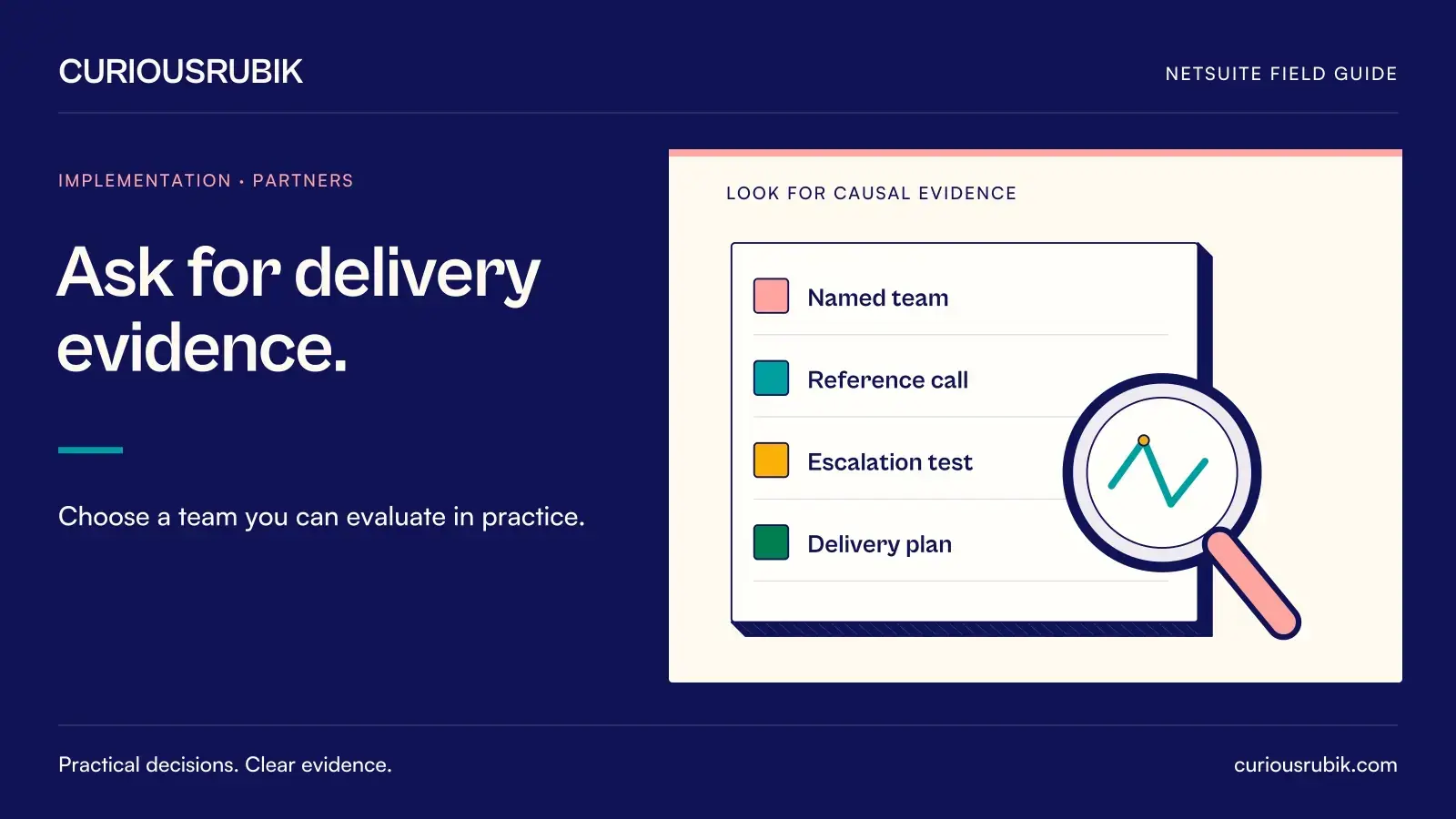
Build the shortlist around evidence of delivery fit. Ask providers to explain comparable work, introduce the proposed team and demonstrate how they handle uncertainty. Then assess those answers against your own scope, internal capacity and operating constraints.
This approach makes the selection more defensible for both finance and IT. It also reveals what the business itself must contribute before any partner can deliver effectively.
Describe the assignment before judging experience
Write a brief describing your entities, locations, transaction patterns, critical processes, integrations and migration expectations. Include the business deadline and the internal resources you can realistically provide. Share the same brief with every shortlisted provider.
Then define what “comparable” means. Industry familiarity can matter, but a project in your sector may have little in common with your operational complexity. A provider's experience with multi-entity reconciliation, warehouse exceptions or a difficult integration may be more relevant than a broad sector label.
Ask which parts of your project resemble previous assignments and which are less familiar. A specific explanation of a gap, together with a credible plan to address it, can be more informative than a claim to have seen everything.
Examine the delivery model
Request a practical walkthrough from discovery to stabilization. For each stage, identify the deliverables, customer inputs, review points and responsible roles. Ask how decisions are recorded and how the plan changes when assumptions prove wrong.
Pay particular attention to handoffs. Who converts workshop findings into approved design? Who turns design into test scenarios? Who investigates a discrepancy between migrated open items and the ledger? Unclear handoffs create work that everybody expects somebody else to own.
Also discuss your team's expected workload. A delivery model that depends heavily on customer-led configuration or training may be suitable if you have the capability and time. It becomes risky when that assumption remains hidden until the project starts.
Request proof of the named team
Ask for the intended project manager, solution lead and specialists for material workstreams. Request their relevant experience, expected allocation, location or working-hour overlap, and availability for the proposed schedule. Verify any credentials that matter to your selection rather than relying on unqualified marketing language.
Clarify which people are confirmed and which are illustrative. Ask how substitutions are handled, who approves them and how knowledge is transferred. A strong organization can still offer a poor fit if the proposed team is unavailable or spread across too many commitments.
Meet the people who will do the work. Give them a representative scenario and listen to how they ask questions, identify assumptions and explain trade-offs. You are evaluating a working relationship as well as technical knowledge.
A reference-call script that produces useful answers
Request references with permission to discuss genuinely comparable assignments. Respect confidentiality and avoid asking for another customer's sensitive commercial or operational information. A short, structured call can cover the following questions:
- What scope did the provider deliver, and how did it compare with the initial proposal?
- Which members of the delivery team were most important to the outcome?
- How much internal time did your organization need to contribute?
- What happened when data or requirements differed from the original assumptions?
- How were defects distinguished from additional scope?
- What evidence supported the decision to go live?
- How did the team handle the first close or other important stabilization milestone?
- What would you clarify earlier if you were starting again?
Ask follow-up questions about process rather than seeking a simple recommendation. “They were responsive” is encouraging; an explanation of how a serious issue was escalated and resolved is more decision-useful.
Reference calls are one input, not a guarantee. They describe a particular team, customer and assignment. Record the similarities and differences before applying the lesson to your own project.
Run an escalation test before selection
Use a hypothetical problem to test the working model. For example, imagine that the first migration rehearsal reconciles at total level, but customer balances are assigned incorrectly and user testing is scheduled to begin the next morning.
Ask the proposed team who investigates, who decides whether testing proceeds, what evidence they need and when the sponsor becomes involved. A useful answer distinguishes technical correction, financial validation and business decision authority. It should also explain how the issue enters the plan and affects dependent work.
There is no single script every provider must follow. Look for clear ownership, sensible evidence requirements and transparent consequences. Be cautious when the answer is simply that the team will “work harder” without explaining how correctness will be established.
A hypothetical shortlist decision
Consider a business comparing two illustrative providers for finance and inventory work. Provider A has presented several sector references but has not confirmed the migration lead. Provider B has fewer directly comparable sector examples but introduces a named team and demonstrates a clear reconciliation and escalation approach.
The buyer should avoid turning this into a simplistic ranking. It asks A to confirm staffing and test the migration approach. It asks B to demonstrate the industry's important operational exceptions. Both providers receive the same decision deadline and evidence requests.
The final recommendation records which risks have been resolved, which remain and how the selected contract and governance arrangements address them. This creates a better audit trail than an unexplained weighted score based mainly on presentation quality.
Review the contract questions with the right advisers
Check that the statement of work reflects the proposed delivery model, responsibilities and acceptance evidence. Review assumptions about migration cycles, training, integration boundaries, support coverage and change control. Ask your commercial and legal advisers to assess the actual agreement and its consequences.
Clarify the escalation route and access to project records. Understand how unfinished work, staffing changes and unresolved defects are handled. These discussions are easier before selection, when expectations can be reconciled without an active delivery dispute.
Keep commercial terms and relationship quality connected. Friendly conversations are valuable, but the written scope needs to support the work both sides believe they have agreed.
Questions buyers ask
Should we choose the largest provider?
Size alone does not establish fit. Consider relevant capability, the actual team, continuity arrangements and the attention your project will receive. Match the delivery organization to the assignment's complexity and your own resources.
Are certifications enough?
They can be useful evidence of knowledge where verified, but they do not replace relevant delivery experience, business understanding or a clear operating model. Evaluate how the proposed team applies its knowledge to your scenarios.
What if a provider cannot share customer details?
Respect confidentiality. Ask for permitted references, appropriately anonymized examples or a scenario-based demonstration. Be clear about the evidence you need without demanding private client information.
What should the final recommendation contain?
State the scope fit, staffing evidence, reference findings, unresolved risks, commercial assumptions and reasons for the choice. Include the conditions that must be satisfied before mobilization.
Choose a team you can evaluate in practice
Use these questions to make your NetSuite partner selection specific and evidence-led. Bring your scope and delivery concerns to CuriousRubik for a conversation about the working arrangements your implementation will need.
Related reading