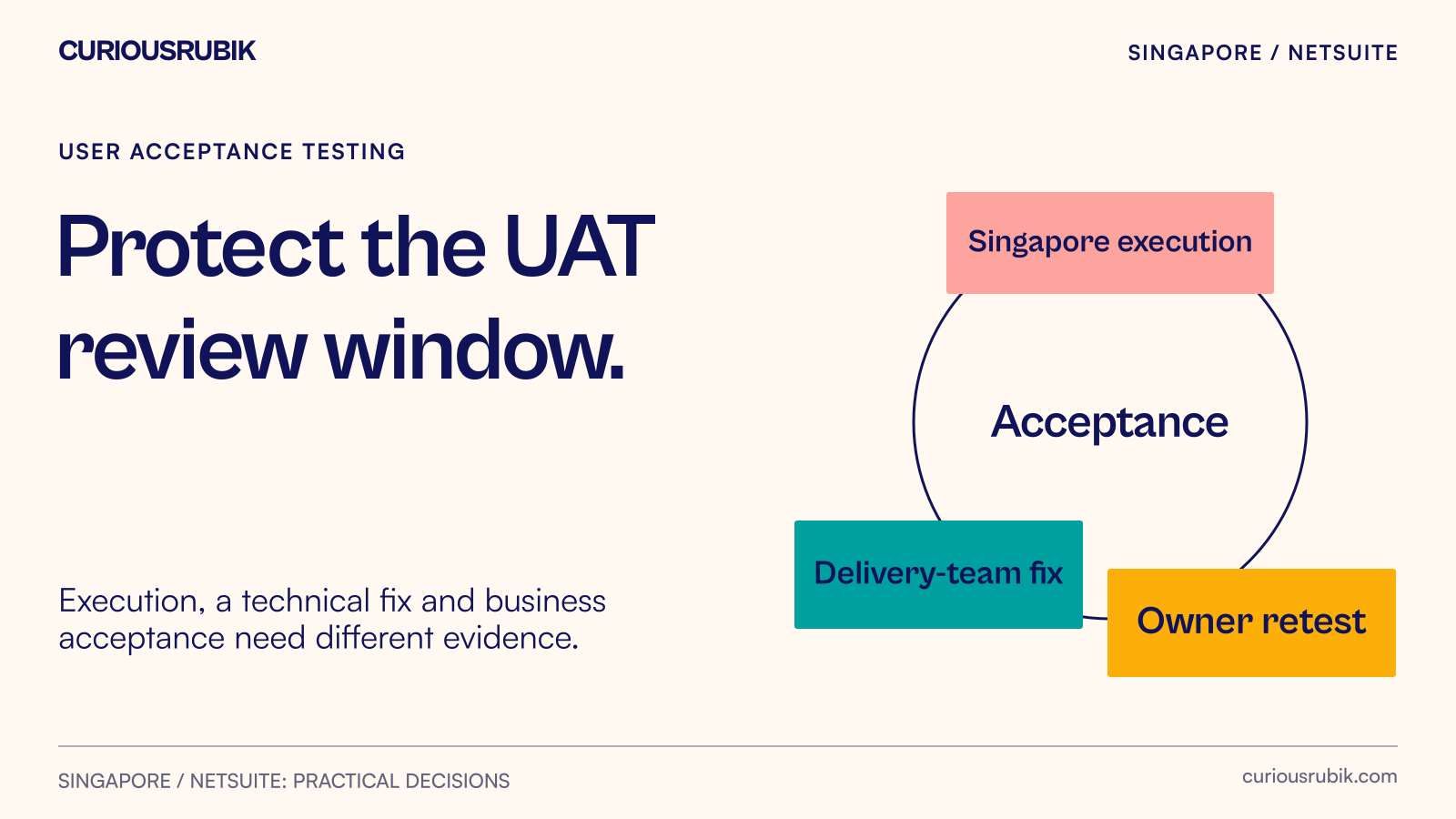
Protect the review window as carefully as the build window.
NetSuite user acceptance testing works across time zones when business owners and delivery consultants share a clear daily handoff. The record should show what was tested, what happened, what the business expected and who is available to review the next result. A passed technical script is one piece of evidence; acceptance also depends on whether the intended users can operate the agreed process.
Singapore finance teams coordinating regional entities often have a second constraint: the people needed for UAT are still running the current business. A testing plan must reserve their preparation and review time, including retests. An overseas team completing a fix overnight is useful only if the right owner can evaluate it the following day.
A two-week example with explicit assumptions
The following schedule is illustrative. Two weeks is the chosen review window for this fictional exercise, not a typical NetSuite UAT duration or a promise that a project can finish testing in that period.
A Singapore controller coordinates finance acceptance for headquarters and a regional trading entity. Country owners supply local transaction evidence. An overseas delivery team investigates configuration defects. The release includes a purchasing approval process and a warehouse receipt interface. The group has agreed its requirements, prepared a controlled test environment and identified the external provider's testing contact.
For this example, Singapore owners reserve 09:00–11:00 SGT for execution, 14:00–14:30 for defect decisions and 16:00–16:30 for handoff. The delivery team confirms its actual overlap with those windows. Do not infer consultant availability from an office location or assume every overseas team observes the same working week.
The plan also reserves a deputy for the controller. That matters when a close obligation competes with UAT. A diary full of named testers is still fragile if only one person can interpret the financial outcome.
Give each day one reviewable output
Day 1: establish the baseline. Confirm the test environment, configuration version, approved requirements, user roles and evidence location. Execute one complete sample together. Correct misunderstandings about the expected result before distributing scripts.
Days 2–3: execute the important paths. Business users run normal transactions and the agreed exceptions. Capture failed steps as they occur. The delivery team distinguishes a configuration defect from incomplete test data or a question about the requirement. The business owner resolves requirement ambiguity.
Day 4: review the first fixes. Retest corrected cases and the related paths that might have changed. Update the tested version. A fix without a business review slot remains awaiting acceptance, even when the consultant's own check succeeds.
Day 5: inspect unresolved decisions. The project lead presents blocked scenarios, missing external evidence and owner availability for the following week. The sponsor resolves capacity or scope questions. This is a checkpoint, not an automatic halfway approval.
Days 6–7: test handoffs and exceptions. Follow the same sample across purchasing, receiving and finance. Include the rejected or repeated interface message selected in the agreed test scope. Confirm who handles the exception during normal operations.
Day 8: assess regression and working instructions. Repeat affected accepted cases, review changed user guidance and ask a deputy to perform a critical task. Capture any remaining dependence on the consultant's undocumented knowledge.
Day 9: assemble the acceptance proposal. Each owner reviews the evidence for their process, open conditions and operating alternatives. The delivery lead confirms the exact build represented by the evidence.
Day 10: make the decision. The authorized owners accept, accept with explicit conditions where appropriate, or withhold acceptance. If required evidence remains unavailable, the schedule changes or scope is reconsidered. The calendar does not decide the outcome.
What belongs in the overnight handoff
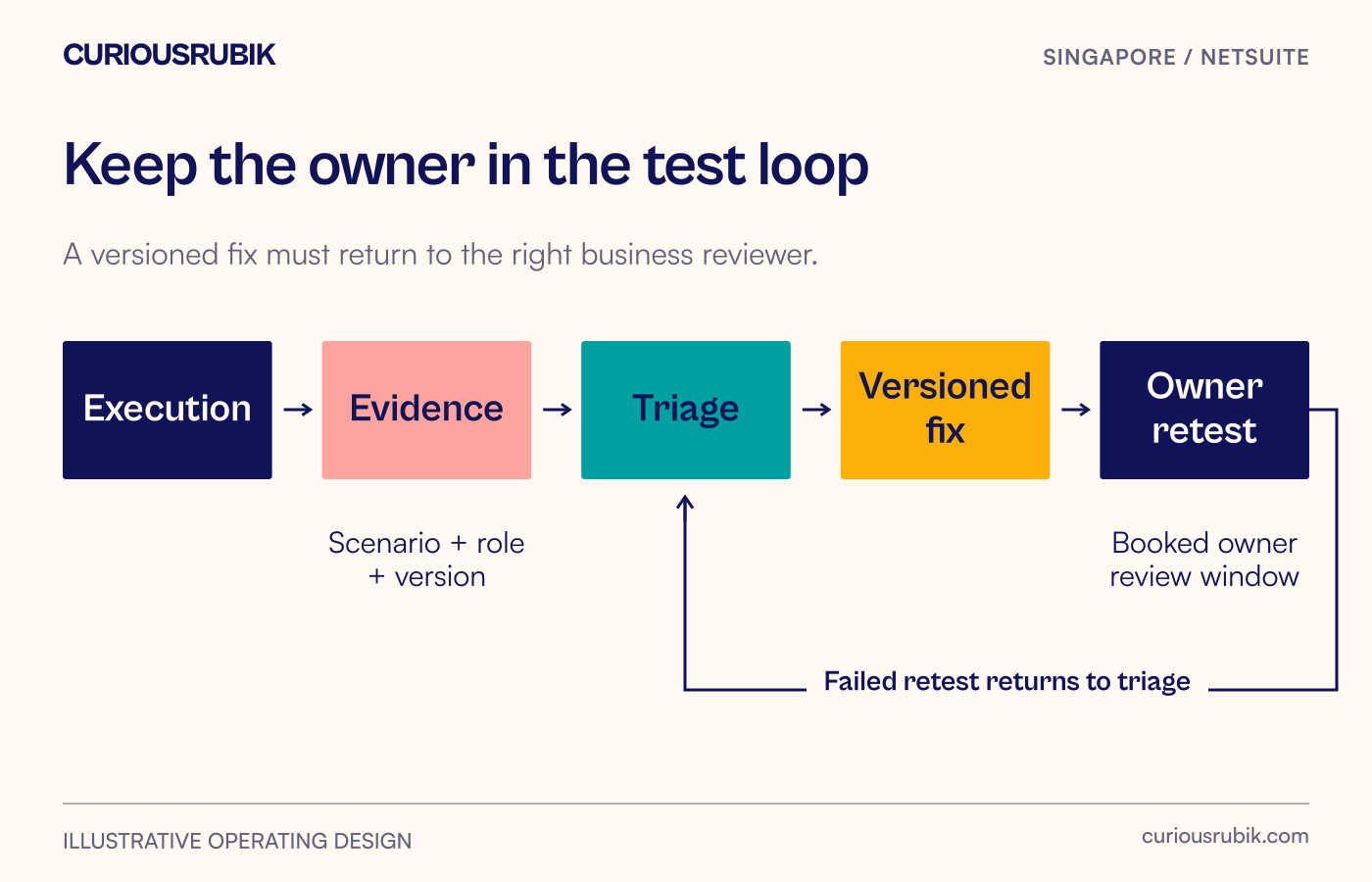
A useful defect record includes the scenario identifier, environment, tested version, user role, sample record reference, expected result and observed result. Attach only the evidence needed for diagnosis, with sensitive details handled under the organization's approved access rules.
Add the affected business decision. “Approval failed” is less useful than “The intended reviewer cannot release the purchase, so receiving cannot proceed under the agreed workflow.” The latter tells the delivery team why the failed step matters and helps the owner judge a proposed workaround.
Every handed-off issue also needs a next-review appointment. Record who will be available, what evidence they need and which related cases should be repeated. If the fix arrives after the review window, leave its state visible as awaiting retest rather than treating the missed window as business approval.
Use a short live overlap for unclear cases. A lengthy comment thread can become slower than a focused demonstration, especially when the two teams use the same label for different business events.
A decision diary separates passing from accepting
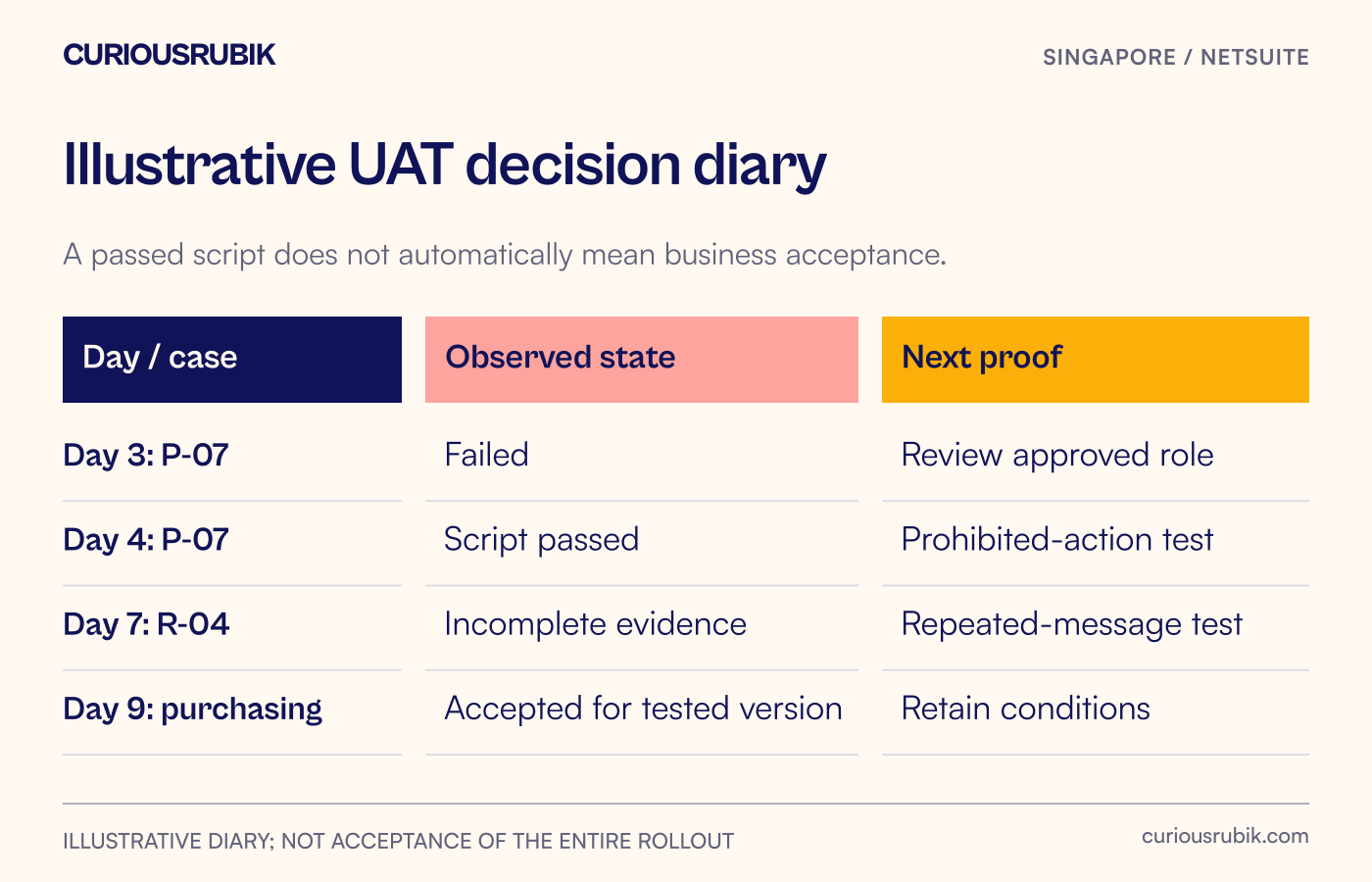
Here is a filled diary from the fictional exercise:
- Day 3, purchasing case P-07: the intended approver cannot see the test transaction. State: failed. Action: delivery consultant investigates the approved role configuration; security owner reviews any access change.
- Day 4, P-07 retest: the approver completes the step. State: script passed. Remaining condition: test that another user without the approved authority cannot perform the same action.
- Day 5, P-07 boundary test: the unauthorized action is blocked in the tested setup. State: owner acceptance proposed. Finance still needs to confirm the downstream transaction follows the approved treatment.
- Day 7, receiving case R-04: the normal message succeeds, but the external provider has not supplied the agreed repeated-message test. State: incomplete evidence. No acceptance inferred from the successful normal path.
- Day 9, process review: finance accepts the completed purchasing evidence for the tested version. Warehouse-interface acceptance remains withheld pending R-04 and the named exception-owner exercise.
NetSuite permissions are associated with roles, but a role's name does not establish the effective access a user has. Test the intended and prohibited actions in the actual configuration. Keep security approval separate from a tester's desire to get past a blocked step.
Keep the environment and the evidence aligned
Oracle documents sandbox use for testing and training, with limitations for some features. Confirm that the environment supports the test and that external connections, email recipients and provider endpoints have been checked. A non-production account does not by itself prove that an external action is harmless.
Agree who can change the environment during UAT. When a correction alters shared configuration, the delivery lead should identify the affected evidence and owners before another tester assumes the old result still applies. Avoid unannounced changes simply to make the current case pass.
Preserve the distinction between customer responsibilities and delivery work. Consultants diagnose and implement approved changes within scope. Business owners define acceptable outcomes and review operating consequences. The project lead keeps the queue moving but cannot substitute for a missing finance or operational decision.
At the end of the illustrative window, the team may have accepted purchasing while leaving a warehouse dependency open. That is a meaningful result when recorded honestly. Bring the availability grid and decision diary to the implementation discussion, especially when Singapore regional finance depends on people and providers working elsewhere.