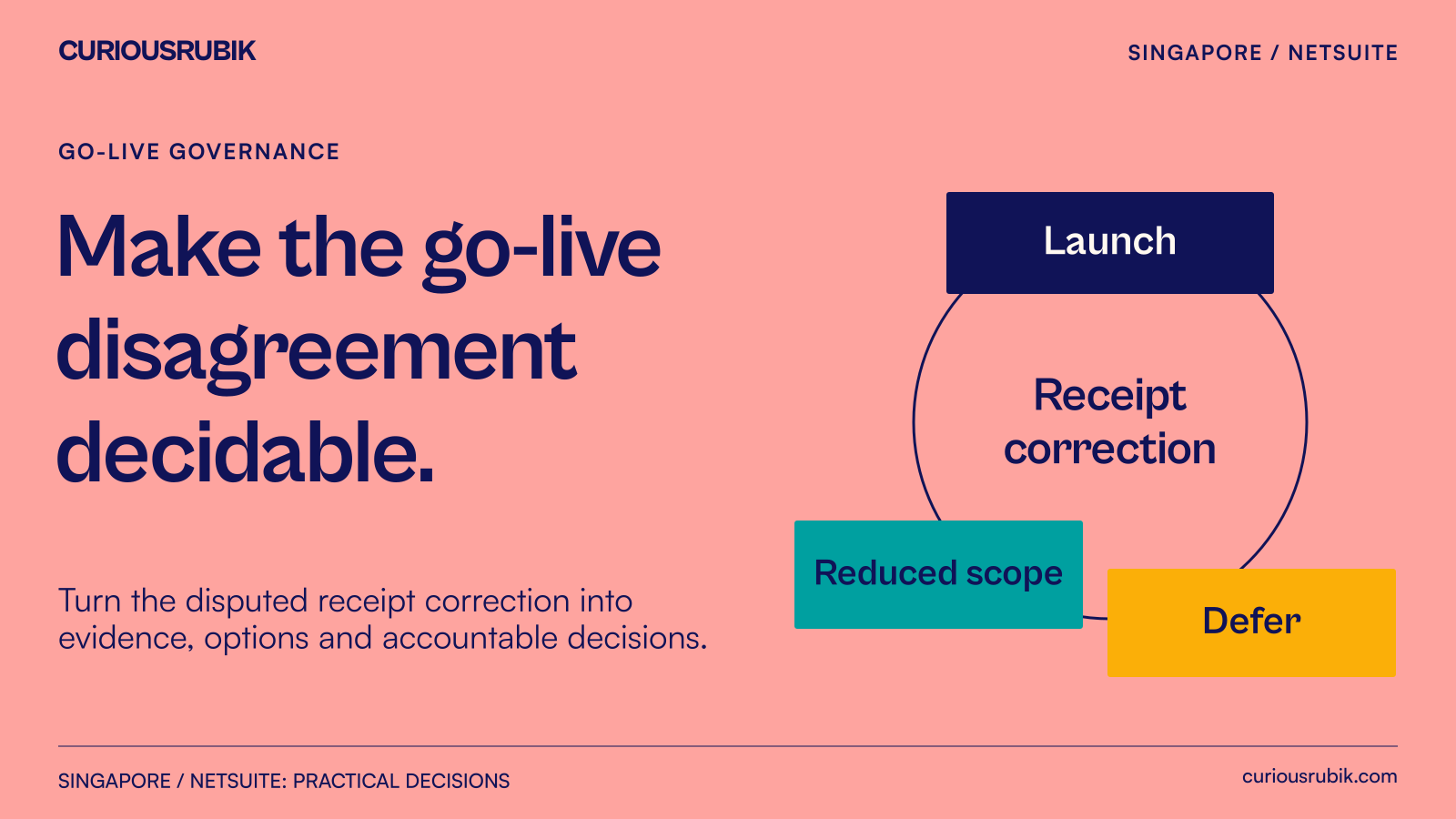
Make the disputed risk concrete before asking for approval.
When a Singapore sponsor wants to launch and a regional owner objects, the project needs an explicit decision about the disputed risk. A majority vote on a readiness dashboard is unlikely to resolve it. Describe the affected process, the evidence still missing and the consequences of launching, reducing scope or deferring. Then establish who has authority to accept each consequence.
The aim is to give the disagreement a useful shape. A local owner's concern may expose a real operational dependency. A sponsor's urgency may reflect a genuine business constraint. Both need to appear in the same decision pack, without turning uncertainty into an unsupported green status.
Begin with the event that could go wrong
In this fictional example, a Singapore headquarters plans a NetSuite rollout with a regional trading entity. The sponsor wants to retain the agreed launch window. The country finance owner objects because a warehouse receipt correction has not been reconciled through the local ledger and the group report.
Normal receipts passed their tests. The disputed case occurs when the warehouse corrects a previously accepted quantity. The country owner cannot yet explain whether the proposed operating process will detect the correction, route it to finance and preserve the references needed for reconciliation. The configuration and transaction details are illustrative, not a statement of how every NetSuite deployment behaves.
Write the unresolved question narrowly: “Can the owner identify and reconcile a corrected receipt before the affected reporting decision?” This is more useful than “country finance is not ready.” It gives the delivery team a testable question and preserves the business significance of the objection.
Also state what is already established. The normal-path evidence remains valid for its tested version unless the correction work changes it. Keeping established facts separate from unresolved cases prevents the discussion from becoming an argument about whether the whole project has succeeded or failed.
Assemble a short decision pack
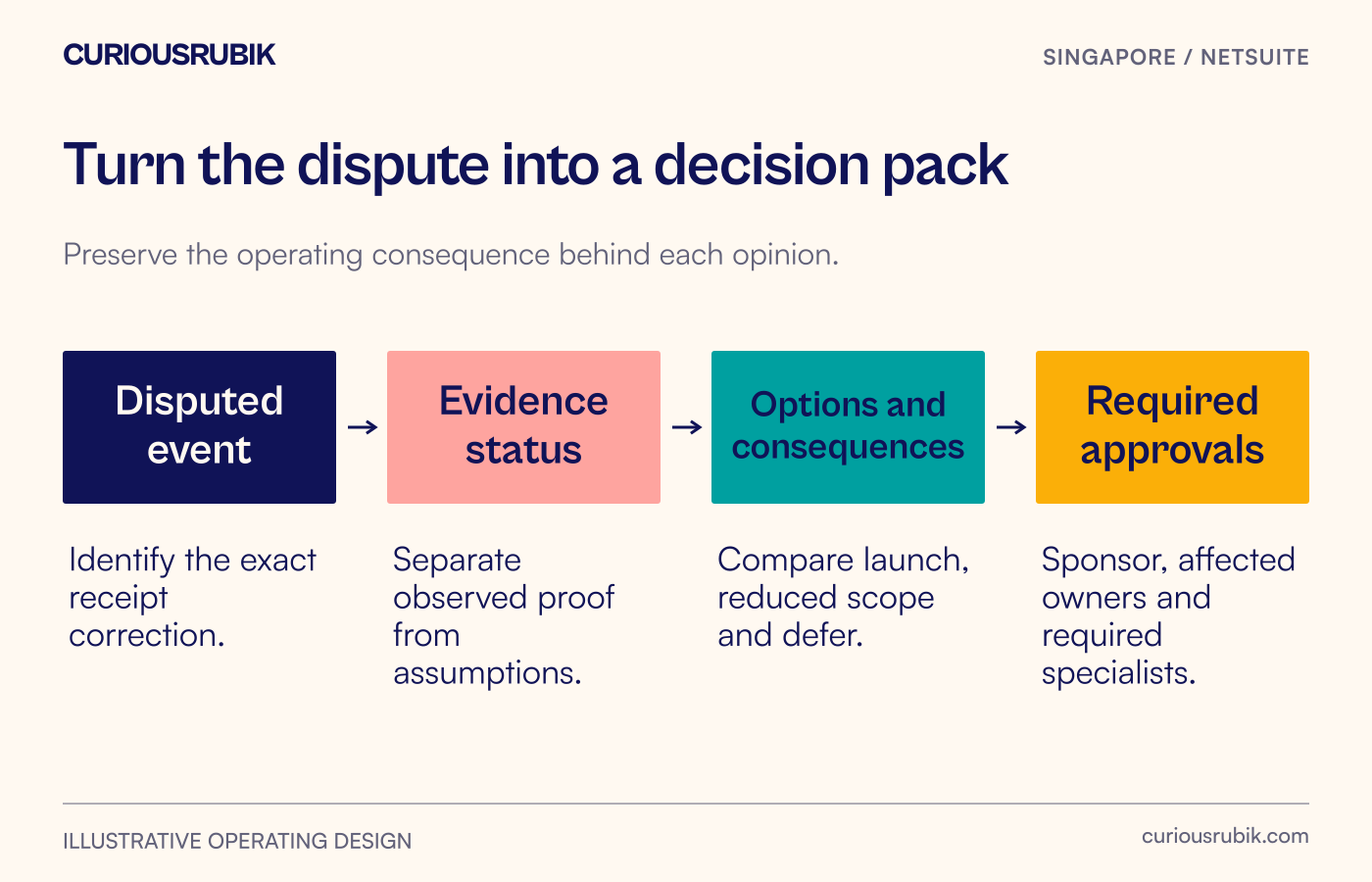
Use five sections, each with a named producer:
- Observed issue: the country finance owner supplies the sample and explains the business consequence. Include the affected population and the point at which the problem becomes material to operations.
- Evidence status: the test lead identifies completed cases, missing cases and the version reviewed. Separate unavailable evidence from an observed failure.
- Options: the delivery lead and business owners describe launch, reduced scope and deferral using the same assumptions.
- Authority: the sponsor records who can approve schedule, operating boundaries, financial treatment and technical changes. Specialist approvals remain necessary where applicable.
- Decision and conditions: the authorized owner records the chosen option, remaining conditions, expiry or review point and the consequence if a condition is missed.
Keep disputed interpretations visible. If finance and the delivery lead disagree about whether a workaround is usable, record both views and the evidence that would resolve them. Do not rewrite the country owner's objection as agreement merely because the sponsor prefers a particular option.
Compare three options on the same facts
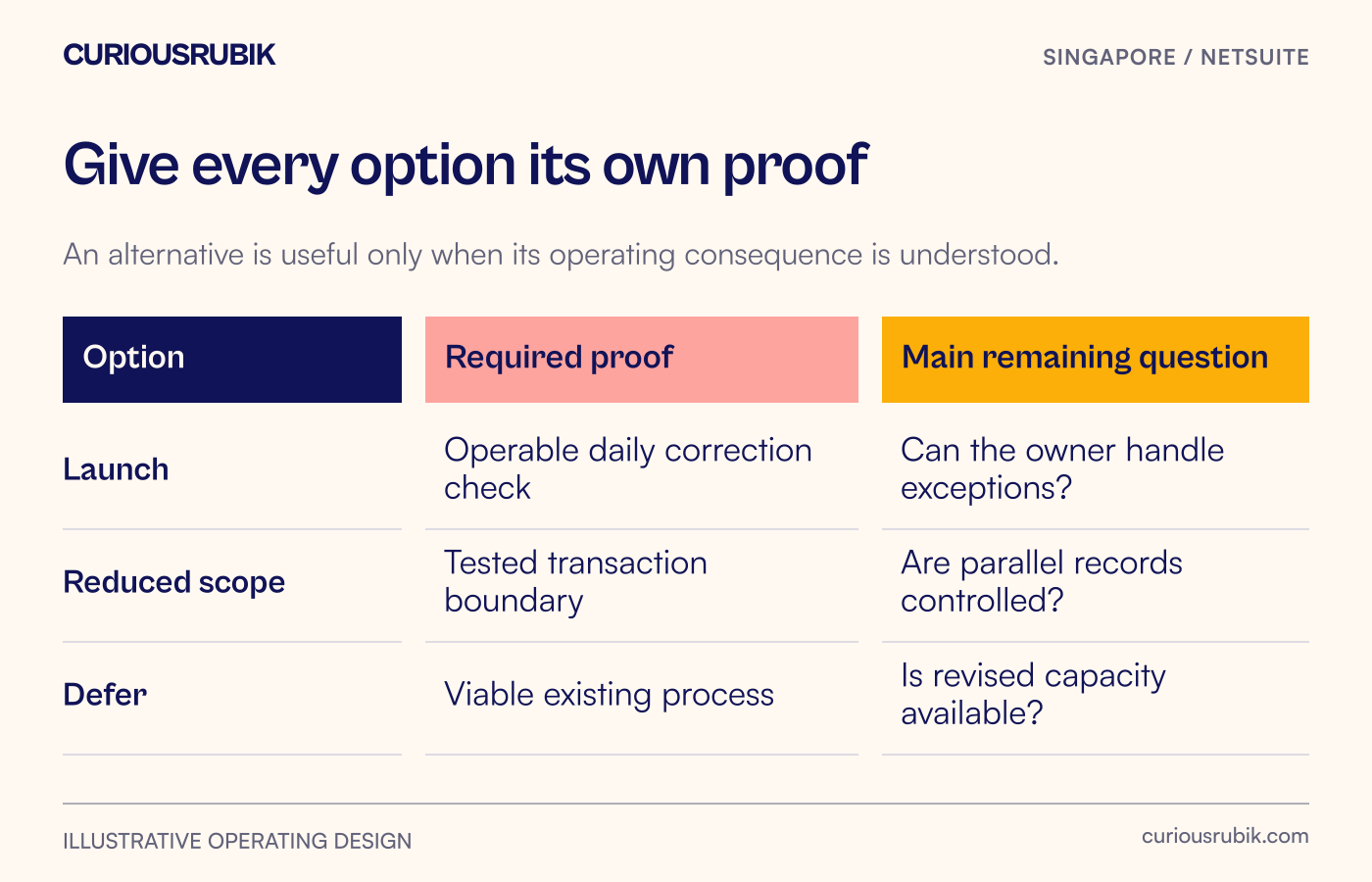
Option 1: launch the planned scope. The proposed temporary control is a daily review of warehouse corrections before the related finance review. Evidence required: the correction population can be identified, the assigned owner can perform the check, and the financial treatment has been approved by the appropriate reviewer. Remaining risk: an exception may be missed or exceed the reviewer's capacity. This option is not ready merely because somebody volunteers to “watch it.”
Option 2: launch a genuinely separable reduced scope. The team considers delaying the trading-entity warehouse flow while another approved process launches. Evidence required: the split can preserve transaction ownership, reporting boundaries and reconciliations without creating an uncontrolled duplicate process. Remaining risk: the temporary boundary may create manual work and additional cutover dependencies. A phased launch is a design decision to test, not an automatically safer compromise.
Option 3: defer the launch. The team retains the existing operating process while completing the correction test. Evidence required: the existing arrangements can continue for the proposed period and the revised project plan has available business and provider capacity. Remaining risk: delay may affect business plans, contractual commitments or other work. The actual commercial consequences must be checked in the relevant agreements.
These descriptions allow a real comparison. “Launch is risky” and “delay is expensive” are too vague to approve. Each option needs an operating boundary, evidence, an accountable owner and a consequence that the approver understands.
Resolve the disagreement with a bounded test
In the example, the country owner requests one end-to-end correction rehearsal. The team agrees to use an approved test environment and representative data. The warehouse provider supplies the correction; the intended user identifies it; finance traces the effect through the agreed outputs. The test also checks what happens when the correction arrives after the planned daily review.
Oracle documents sandbox support for testing, with feature limitations. The team must verify the external provider's test endpoint and any messaging behavior rather than assume all connected activity is isolated.
Suppose the fictional rehearsal shows that the proposed review depends on a report only the consultant can interpret. That result weakens Option 1. It does not prove that every aspect of the rollout has failed. The team can improve the operating procedure and repeat the test, assess a genuinely separable Option 2, or select deferral.
The sponsor now has a decision supported by observed evidence. The country owner's objection has produced a specific readiness condition rather than an indefinite veto.
Do not confuse technical deployment with risk acceptance
A successful deployment cannot decide whether the business can operate the result. For example, SuiteCloud Development Framework can deploy supported customizations and overwrite matching components. That technical mechanism does not supply business acceptance or a complete recovery plan.
If a late correction changes shared components, identify the affected tests and the production consequences before approving it. Recovery may involve configuration, data, external records and work already performed by people. Avoid a broad assurance that the team can simply revert if the first day is difficult.
The sponsor can accept consequences within their authority. They cannot make an unverified control effective by signing a form, waive obligations they have no authority to waive or substitute for a qualified accounting or legal judgment. Record the specialist input required rather than concealing it within general project approval.
Close the decision without erasing the concern
The final record should preserve the issue, options considered, chosen route, approvers and outstanding conditions. Give each condition an owner and a review trigger. If the decision changes after new evidence, retain the earlier reasoning so people can understand what changed.
Use the existing NetSuite change-control guidance to manage the resulting work. For a Singapore-led regional rollout, this decision pack adds the missing link: it shows how an unresolved country concern becomes an explicit, evidence-based launch choice.