Evaluate SuiteSuccess Against Your Actual NetSuite Requirements
A packaged implementation approach can give a NetSuite project a useful starting point. It can also create confusion if the business assumes that an industry label guarantees every workflow, report and exception it needs. The practical question is whether the proposed SuiteSuccess scope fits the way your organization must operate.
SuiteSuccess is presented around industry-oriented practices and a staged approach to adopting NetSuite. Your purchase and implementation, however, depend on the exact edition, quoted entitlements and agreed services scope. A fit-gap workshop should connect those commercial boundaries to tested business scenarios.
The outcome is a decision workbook: what fits, what requires a process change, what needs additional design and what can wait.
Confirm the proposed starting point
Before the workshop, obtain the current proposal, edition description, included capabilities and implementation deliverables. Ask the relevant Oracle or delivery contacts to confirm the scope in writing. Do not use a generic product presentation as the definitive description of your contract.
List the proposed roles, workflows, reports, data assumptions and rollout stages. Record what is included, optional, excluded or unresolved. If a demonstration uses functionality outside the quoted scope, identify it clearly so the business does not mistake availability in a demo for entitlement.
The workshop can then assess a real proposal rather than an abstract idea of what SuiteSuccess means.
Choose scenarios that represent the business
Ask each process owner for an ordinary transaction, a frequent exception and a material edge case. Focus on the outcomes that affect cash, inventory, accounting, customer commitments and control evidence.
For example, an order-to-cash review might include an ordinary order, a partial delivery and a customer credit. Purchasing might include a standard bill, a quantity difference and a request requiring special approval. Finance might include a period-end adjustment and a reporting reconciliation.
Bring sample data and the policy behind the expected result. Without those inputs, participants can agree that a screen “looks right” while disagreeing about the underlying requirement.
Build a fit-gap workbook
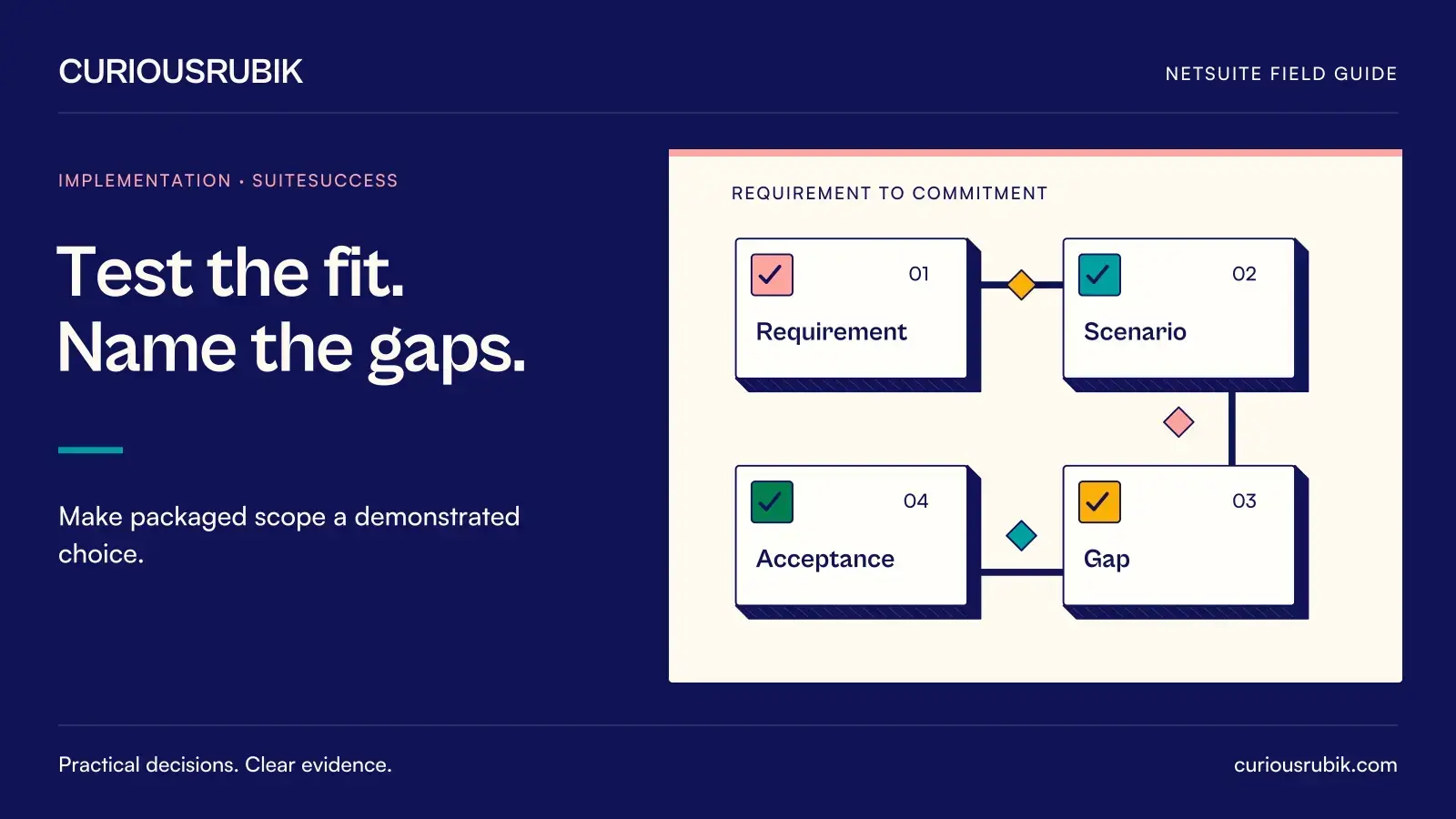
Create a record for each scenario with the following fields:
- Requirement ID, process owner and business reason.
- Preconditions, sample data and expected outcome.
- Proposed standard or packaged process.
- Evidence from the demonstration or test.
- Fit status and the precise gap, if any.
- Proposed response, dependency and delivery owner.
- License or commercial implication requiring confirmation.
- Acceptance method, approving owner and target phase.
Use statuses that distinguish demonstrated fit from assumed fit. A capability that has not been tested should remain unverified. An item can fit functionally while still having an unresolved entitlement or implementation responsibility.
Keep the workbook editable and traceable to the proposal. When the design changes, update the affected scenarios rather than treating the workshop as a one-time sales exercise.
Separate four kinds of gap
A policy gap exists when the business has not decided how the process should work. The first action is a business decision, not customization.
A process-adoption gap exists when the proposed approach can meet the requirement but asks users to work differently. Assess the control implications, training and operational burden before accepting or rejecting that change.
A configuration or extension gap exists when additional design is required. Have the solution team confirm the technical route, maintenance implications and commercial scope. Do not assume every exception requires code or that every requirement is available through configuration.
A timing gap exists when the requirement is valid but does not need to be in the first release. Record the future trigger and any foundational data or architecture work needed now.
A hypothetical fit-gap workshop
Consider a services business evaluating a proposed SuiteSuccess package. This is an illustrative scenario, not a description of a particular edition or a real client.
The finance team presents three requirements. First, standard supplier bills must follow the approved review process. Second, one contract type needs a specific billing and accounting treatment. Third, leadership wants profitability by a newly defined service category.
For the supplier-bill scenario, the team demonstrates the proposed process with representative roles. It records a fit only after confirming that the routing, evidence and commercial scope align with the requirement. A small procedural change is documented for training.
For the unusual contract, the controller has not yet approved the accounting treatment. The workbook records a policy gap and assigns a decision owner. The solution architect cannot responsibly classify the process as standard or custom until the expected result is defined.
For service-category reporting, the proposed design may support the required analysis, but the source records do not contain consistent categories. The immediate dependency is data ownership and classification. The workshop assigns a cleanup action and a report-reconciliation test rather than treating an attractive report preview as completion.
These three outcomes lead to different next steps. A blanket conclusion that the package either “fits” or “does not fit” would conceal the actual work.
Evaluate extensions over their operating life
When additional configuration, integration or customization is proposed, ask why it is needed and what alternatives were considered. Evaluate a process change, a narrower requirement and a later phase alongside the technical extension where those options are realistic.
Record who will maintain the solution, how it will be tested after changes and how incidents will be diagnosed. Include documentation and handover in the scope. An extension's cost is not limited to the initial build.
Avoid using “standard” as a substitute for judgment. A standard process still needs to meet the business requirement, while a justified extension should have a clear owner and acceptance evidence. The goal is a supportable operating design.
Create an acceptance plan from the workbook
Every accepted fit and approved gap response should produce an acceptance scenario. State the user role, data, expected operational result and relevant financial impact. Include negative tests for important controls and exceptions.
Trace those scenarios to the implementation plan. If a gap is deferred, identify the interim procedure and test it. If the business adopts a different process, include user training and operational ownership as readiness conditions.
Before contracting or approving a material scope change, reconcile the workbook with the current quote and statement of work. Confirm that all first-release requirements have an agreed route and that proposed additions have not silently become assumed inclusions.
Questions buyers ask
Does SuiteSuccess guarantee a particular launch duration?
Your timeline depends on the actual scope, readiness, dependencies and agreement. Ask for a plan supported by your project conditions rather than treating a general packaged approach as a timetable commitment.
Should we avoid all customization?
Evaluate each requirement on its merits. Unnecessary extensions create maintenance work, but a legitimate business need may require additional design. Document the reason, alternatives and ongoing ownership.
Can we decide fit from a demonstration?
A demonstration is useful evidence when it uses relevant scenarios and roles. Final acceptance needs the agreed design, representative data, verified entitlements and business review.
Who should attend the workshop?
Include accountable process owners, finance, operations and the solution team, with procurement involved in commercial questions. The people who can resolve policy and scope decisions should be available.
Make packaged scope a tested choice
Take your proposed edition, commercial scope and important exceptions to CuriousRubik. A practical fit-gap discussion can show where the starting point serves your business and where further decisions are needed.
Related reading