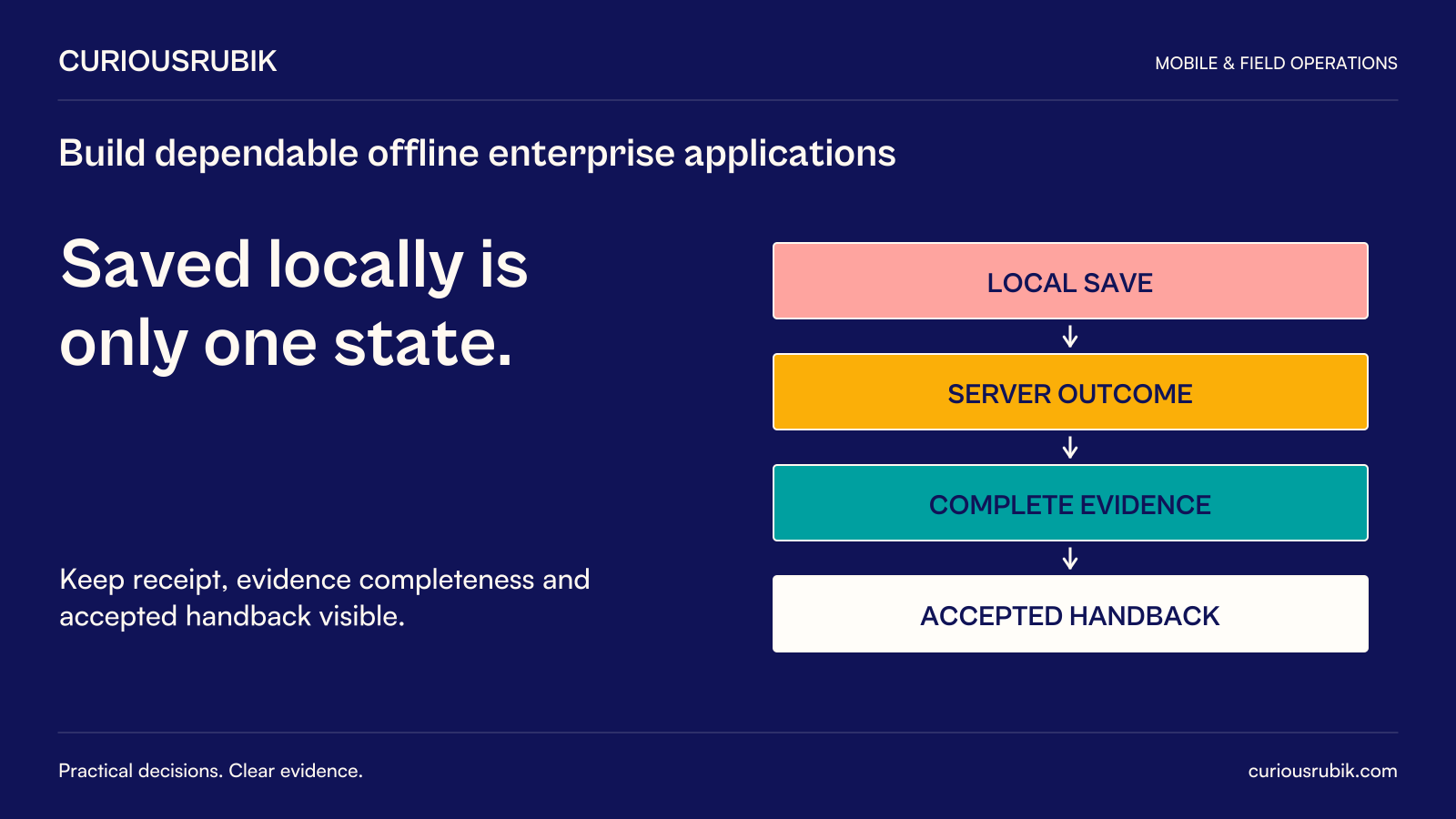
Offline-first applications matter when a loss of connectivity must not destroy work or leave employees guessing what the organization has received. Their defining design choice is to make permitted local work dependable, then reconcile it with an authoritative service. That requires explicit rules for data freshness, duplicate submissions, conflicts, authorization, and recovery.
For a technology leader supporting remote field teams, the decision is which operations may proceed without a live connection and what risks the business accepts while disconnected. “The app works offline” is too broad a requirement. Reading yesterday’s reference material, recording a new observation, and authorizing an irreversible business action have different consequences.
A good design begins with an offline capability contract. For each operation, state what information is available locally, how old it may be, what the user may do, when the server must validate the result, and what happens if that validation fails. The application can then communicate an honest promise rather than treating a network icon as an explanation.
Separate availability from authority
Local availability means that the device can display or save information without contacting a server. It does not mean the information is current, the user’s permissions remain unchanged, or a business transaction has been accepted elsewhere. These distinctions must appear in both the architecture and the interface.
Classify operations by consequence. Reading a reference document may be allowed with a visible revision date. Capturing an observation may be allowed as a pending submission. Allocating a scarce shared resource may require live confirmation unless the business has deliberately partitioned authority or reserved capacity in advance.
Some organizations can assign exclusive work packages to devices for a defined period. That can reduce conflicts, but it introduces its own responsibilities: assignment expiry, reassignment, abandoned devices, and recovery of unsubmitted work. It is an operating policy rather than a magic property of offline storage.
Define the maximum disconnected interval the design supports. A day of preloaded assignments and photographs differs from several weeks of independent work. Storage, authorization, reference updates, and support procedures must match the intended interval. Beyond that boundary, the app should provide a controlled explanation and recovery route.
Make local persistence a business promise
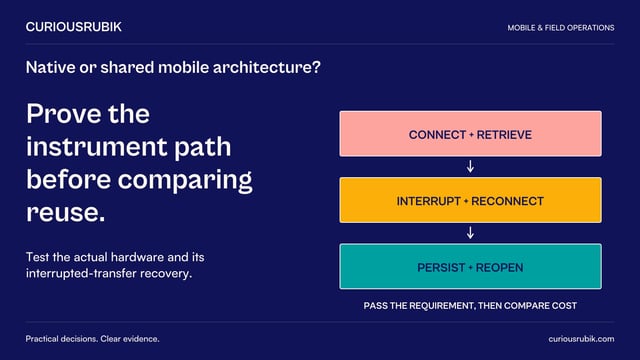
A useful offline design stores permitted input durably before telling the user that it is saved. The implementation should be tested against application termination, device restart, low storage, and interrupted attachment writes. A success animation cannot substitute for evidence that the record survives those conditions.
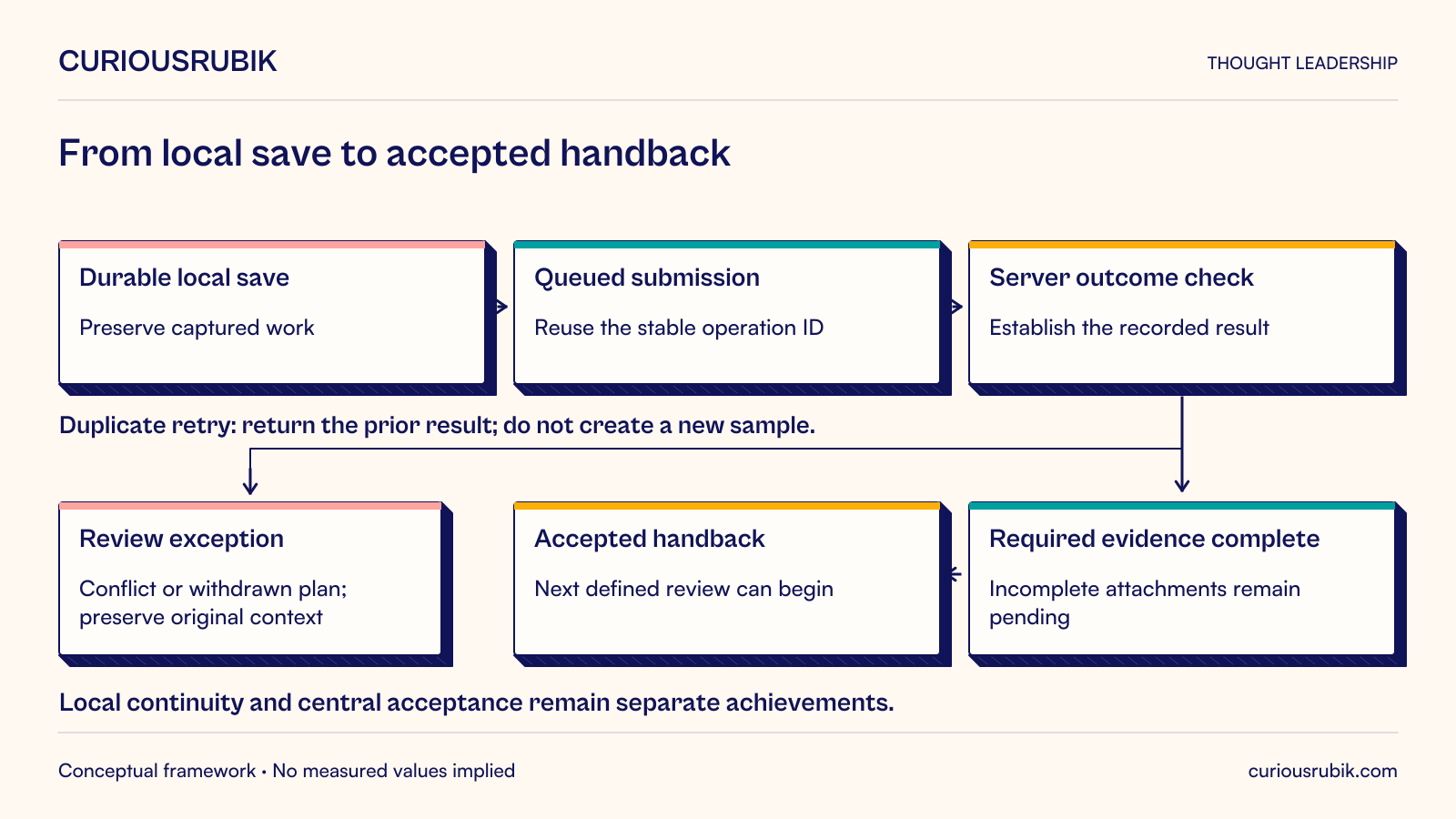
Keep a local submission queue whose entries have stable operation identifiers. A queued entry should carry the relevant business identity, data version, payload, and attachment references. Its lifecycle may include locally saved, awaiting transmission, being processed, accepted, and needs attention. Use states whose meaning support can explain.
Treat attachments explicitly. A record and its photographs may upload separately. The server should know whether the required set is complete, and the user should know which files remain pending. Otherwise, a record can appear submitted while the evidence needed to act on it never arrives.
Plan local storage cleanup around acknowledgment and retention policy. Removing a record merely because transmission started risks losing the only complete copy. Retaining everything indefinitely creates device capacity and data-exposure problems. Define when a verified server receipt permits cleanup and what minimal local history is still useful.
A hypothetical remote sampling team
Imagine a hypothetical environmental consultancy collecting water samples from remote sites. Before leaving, a team downloads site identifiers, an approved collection plan, and the relevant reference revision. At each site, staff record a sample-container identifier, collection time, observations, and measurements with units. This scenario illustrates data handling, not a prescribed scientific or regulatory sampling procedure.
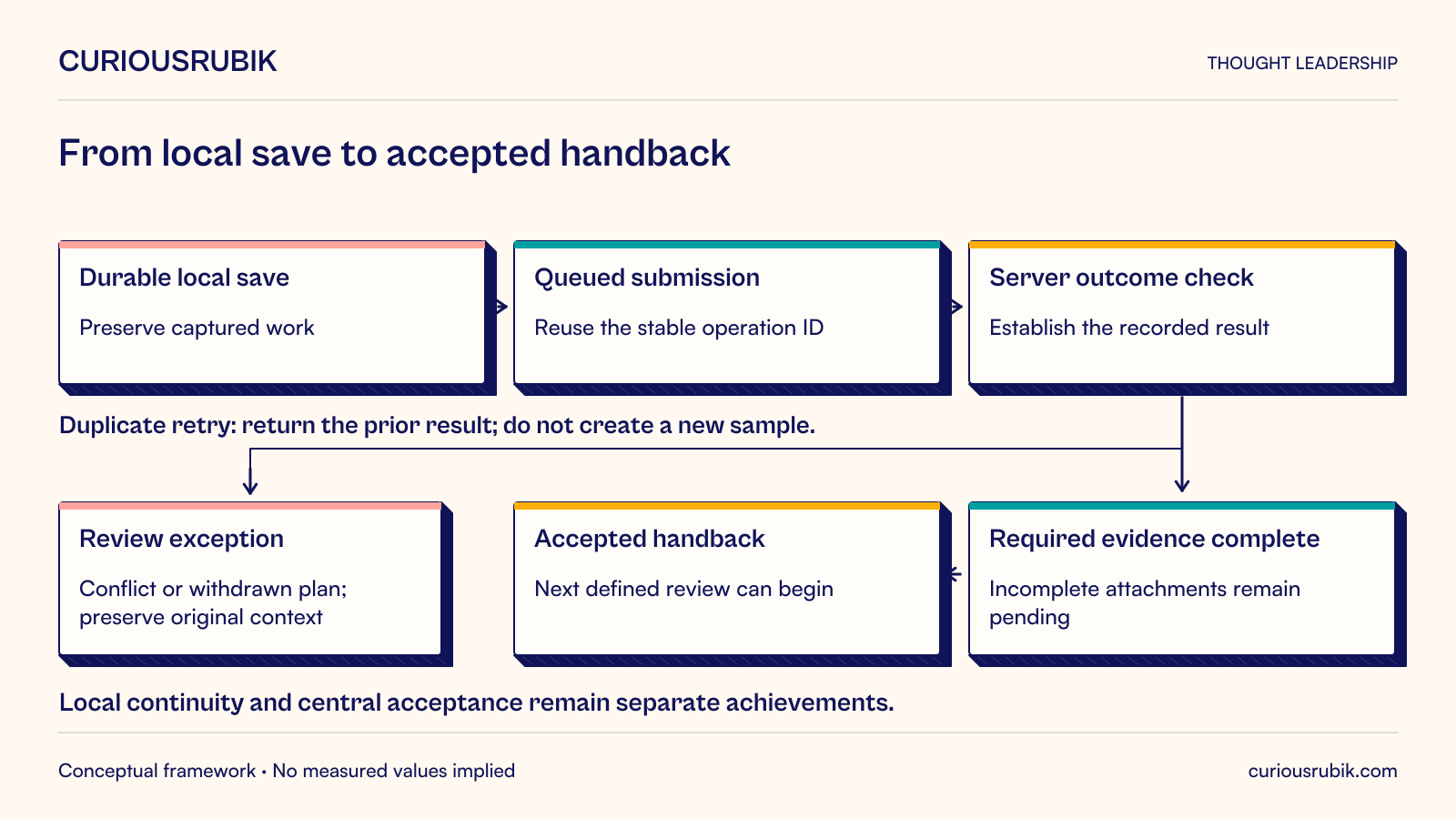
At 09:20, one worker saves sample S-204 locally. The device loses connectivity before receiving a server response. At 11:10, the connection returns and the application resends the same operation identifier. The server must establish whether it already accepted that operation instead of creating a second sample merely because another request arrived.
Now assume a required photograph is still uploading. The record can be acknowledged as received but evidence incomplete. A coordinator should not mistake that state for a complete handoff. When the attachment is accepted, the record becomes ready for the next defined review.
A different problem occurs when two workers amend the access note for the same site. One records that a gate was locked; the other records an updated contact number. If both replace the entire site record, the later upload may erase useful information. A design that retains distinct observations and routes edits to controlled fields reduces that risk.
Suppose the downloaded plan was withdrawn while the team was disconnected. The server should not silently transform the team’s recorded observations into claims that they followed the replacement plan. Preserve which revision was actually available and route the submission for review. Whether work may continue under an older plan is a decision for the responsible operational or scientific owner.
This example shows why offline behavior needs a business contract. The device can reliably retain a sample record while the organization still needs to decide whether its plan, identity, evidence, and timing are acceptable. Local continuity and central acceptance remain separate achievements.
Design retries around uncertain outcomes
A timeout does not tell a client whether the server performed the requested action. The response may have been lost after a successful commit. An application that blindly treats every timeout as failure can create duplicates or instruct the user to repeat completed work.
HTTP defines idempotence as repeated identical requests having the same intended server effect. It cautions against automatic retries of non-idempotent requests without knowledge that retrying is safe or the original was not applied. Offline submission therefore needs explicit application semantics. RFC 9110, Section 9.2.2
For a sample submission, a stable operation identifier can let the service return the original result on retry. Define its scope, retention period, and behavior when the same identifier arrives with different content. A server that forgets the identifier before a device reconnects may no longer provide the duplicate protection the user expects.
Distinguish retryable transport problems from business rejection. A temporarily unavailable service may justify a delayed retry. An unknown sample identifier, revoked assignment, or conflicting version needs another action. Repeatedly sending invalid data consumes capacity without moving the work toward resolution.
Use bounded retry delays and an observable pending queue. Employees should not need to keep reopening the application to guess whether it has progressed. At the same time, background behavior must be tested on the actual supported devices and operating-system versions; the design should not promise uninterrupted execution that its environment cannot provide.
Choose conflict rules by data meaning
A conflict occurs when concurrent changes cannot all be accepted under the business rules. The appropriate response depends on the field. Two independent observations can often coexist. Two edits to the same controlled identifier may require review. Two competing claims to a unique resource require authoritative arbitration.
Avoid a universal last-write-wins policy. Device clocks may differ, and the latest arrival may describe an earlier event. More importantly, choosing one value can discard meaning even when clocks are accurate. Use version checks, append-only observations, ownership boundaries, or review queues according to the consequence of losing a change.
Preserve enough context for resolution: the original version, proposed change, actor, device or session reference, relevant timestamps, and rejection reason. Do not expose confidential data simply to make debugging easier. Support needs targeted operational evidence rather than unrestricted access to every cached record.
Test conflicts before production with deliberate concurrent changes. Ask the business owner to resolve them using the information the app actually provides. If the reviewer needs a telephone explanation every time, the conflict record may be incomplete or the permitted offline operation may be too ambitious.
Balance continuity with data protection
Offline capability increases the amount of information that may reside on a device. Cache only what the task needs, restrict access appropriately, and use suitable platform storage protections. Define what happens when the user signs out, changes role, shares the device, or reports it lost.
Remote revocation cannot guarantee immediate control over a device that cannot receive the instruction. The business must choose an acceptable offline access window and the conditions under which the app stops allowing further work. A longer window supports continuity but can extend exposure after authorization changes.
Requiring live authentication for every local read can defeat the purpose of offline operation. Allowing indefinite local access can create unacceptable risk. Evaluate this tradeoff by information sensitivity, device control, and business consequence rather than selecting one policy for every mobile application.
Protect recovery as carefully as ordinary operation. A support process that exports the entire local database to an unapproved channel can undermine otherwise strong storage controls. Define how authorized personnel diagnose a failed queue and recover permitted records without casually copying sensitive material.
Prove the recovery path
An offline acceptance test should interrupt each important boundary: before local persistence, after local persistence, during upload, after server commit but before response, and during attachment transfer. Then restart the app, change connectivity, and verify the final business records.
Reconcile counts and identities, not just visible screens. For a controlled test set, establish how many operations were created locally, accepted centrally, rejected, or still pending. Every operation should have an explainable destination. Include duplicate retries and a device returning after the supported offline interval.
The practical decision is whether the business can describe and support those outcomes. If only reference reading needs continuity, a limited offline cache may be enough. If field teams must create records, fund durable storage, synchronization, conflict handling, and support together. Approve offline-first development only with an explicit list of permitted actions and a demonstrated route from disconnected work to trustworthy central records.