The native versus cross-platform decision should follow the application’s hardest operating requirement. A shared implementation can reduce duplicated work, while platform-specific development can give teams more direct control over platform behavior. Neither approach guarantees lower lifetime cost, reliable performance, or a better employee experience without evidence from the intended application.
For an engineering executive commissioning an enterprise mobile product, the decision is how much implementation to share and which platform responsibilities to own separately. Treating the choice as a contest between two labels hides useful middle options: shared business logic with platform-specific interfaces, a shared interface with selected native components, or a responsive web application when installation adds little value.
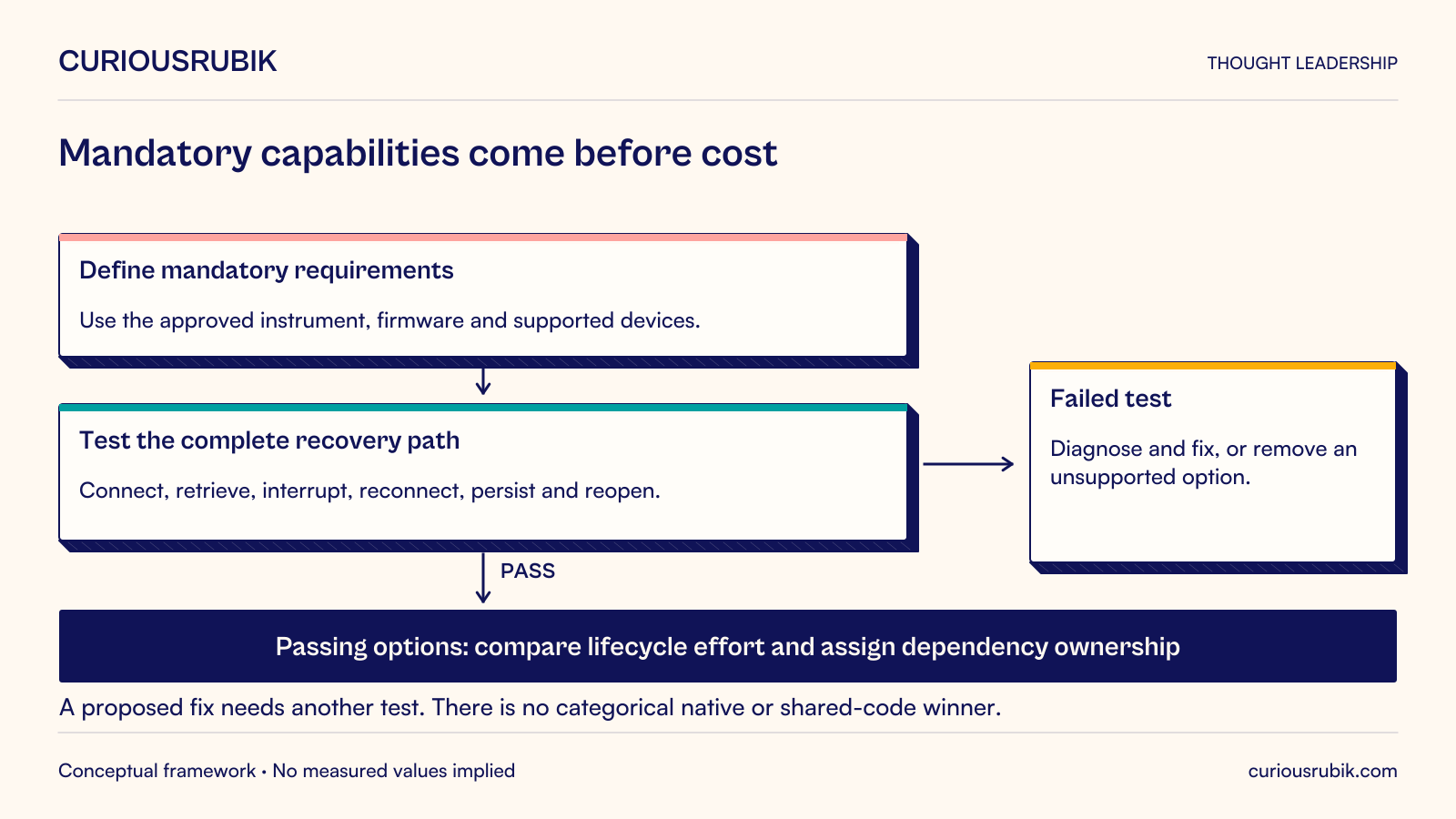
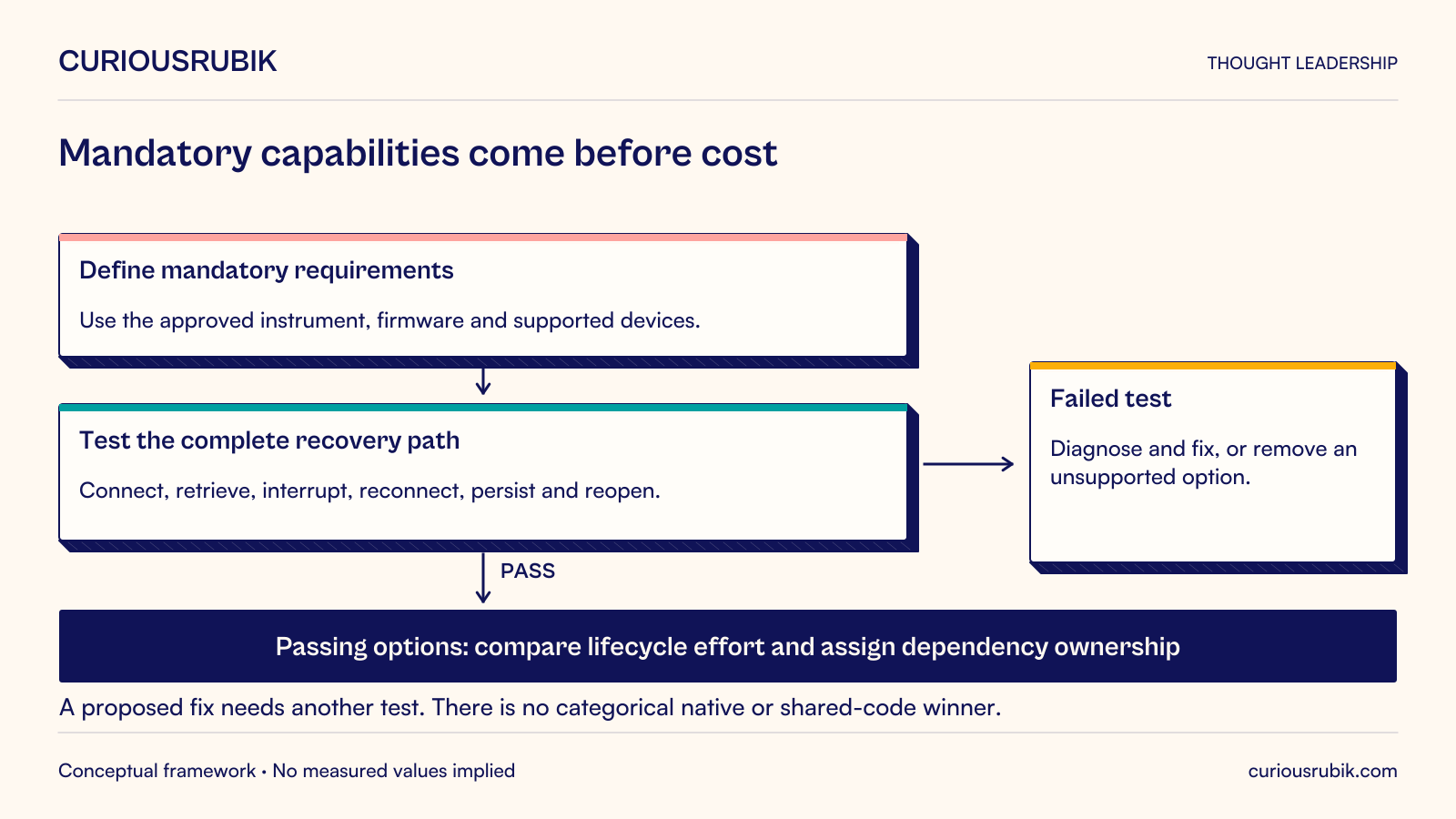
The practical recommendation is to establish disqualifying constraints first, prototype the riskiest interactions, and compare the ongoing cost of the surviving options. A weighted feature score should not compensate for failure on a mandatory device capability or security requirement.
Define what each option actually shares
In this discussion, native development means building separately for the target operating systems with their platform toolchains and interfaces. Cross-platform development means sharing a material part of the implementation through a framework or shared runtime. These are working definitions; individual products combine approaches in different ways.
Ask which layers would be shared: domain rules, networking, local storage, interface components, automated tests, or release tooling. A proposed “single codebase” may still contain platform-specific plugins, configuration, signing, permissions, and release procedures. Count those responsibilities explicitly rather than assuming they disappear.
Native development also does not require duplicating every business rule. A common service can enforce authoritative decisions for both applications. Shared specifications, contract tests, design assets, and generated client code may reduce divergence even when the user interfaces are separate.
The architectural boundary matters more than the headline reuse percentage. Shared code that contains stable business logic may be economical. Shared code that repeatedly adapts around incompatible platform behavior may become difficult to maintain. Estimate the nature of the shared work rather than celebrating its volume.
Identify requirements that can eliminate an option
Create a short list of non-negotiable capabilities. Examples include a particular peripheral, dependable local storage, accessible interaction, secure authentication, deployment to the supported device fleet, or operation within an approved performance envelope. Define a test for each requirement before reviewing vendor demonstrations.
A peripheral requirement should identify the actual device, communication method, manufacturer support, supported operating-system versions, and recovery behavior. A demonstration with a different accessory is weak evidence. If the proposed framework depends on a plugin, establish who maintains it and who will fix it when the platform or accessory changes.
Performance requirements should describe work the user experiences. “Fast” is not testable. A requirement might concern opening a prepared job, displaying a large local record set, or recovering an interrupted attachment upload on the slowest supported device. Use thresholds justified by the operation, and measure comparable builds under comparable conditions.
Accessibility is another acceptance gate. Test focus order, screen-reader announcements, text scaling, input alternatives, and error recovery in the actual implementation. Sharing interface code does not prove equivalent accessibility across devices. Separate implementations can also diverge, so both approaches need an explicit test obligation.
A hypothetical engineering instrument application
Consider a hypothetical company whose technicians use a mobile application to collect results from an inspection instrument. The first release must support two approved device families, retrieve instrument readings, save them locally, and prepare a reviewed service report. The example does not prescribe an inspection method or claim that any named framework supports the instrument.
The team considers three designs. Option A builds separate platform applications. Option B shares the interface and most application logic, with a platform-specific instrument adapter. Option C uses a web application for reporting while a separately supported utility handles instrument transfer.
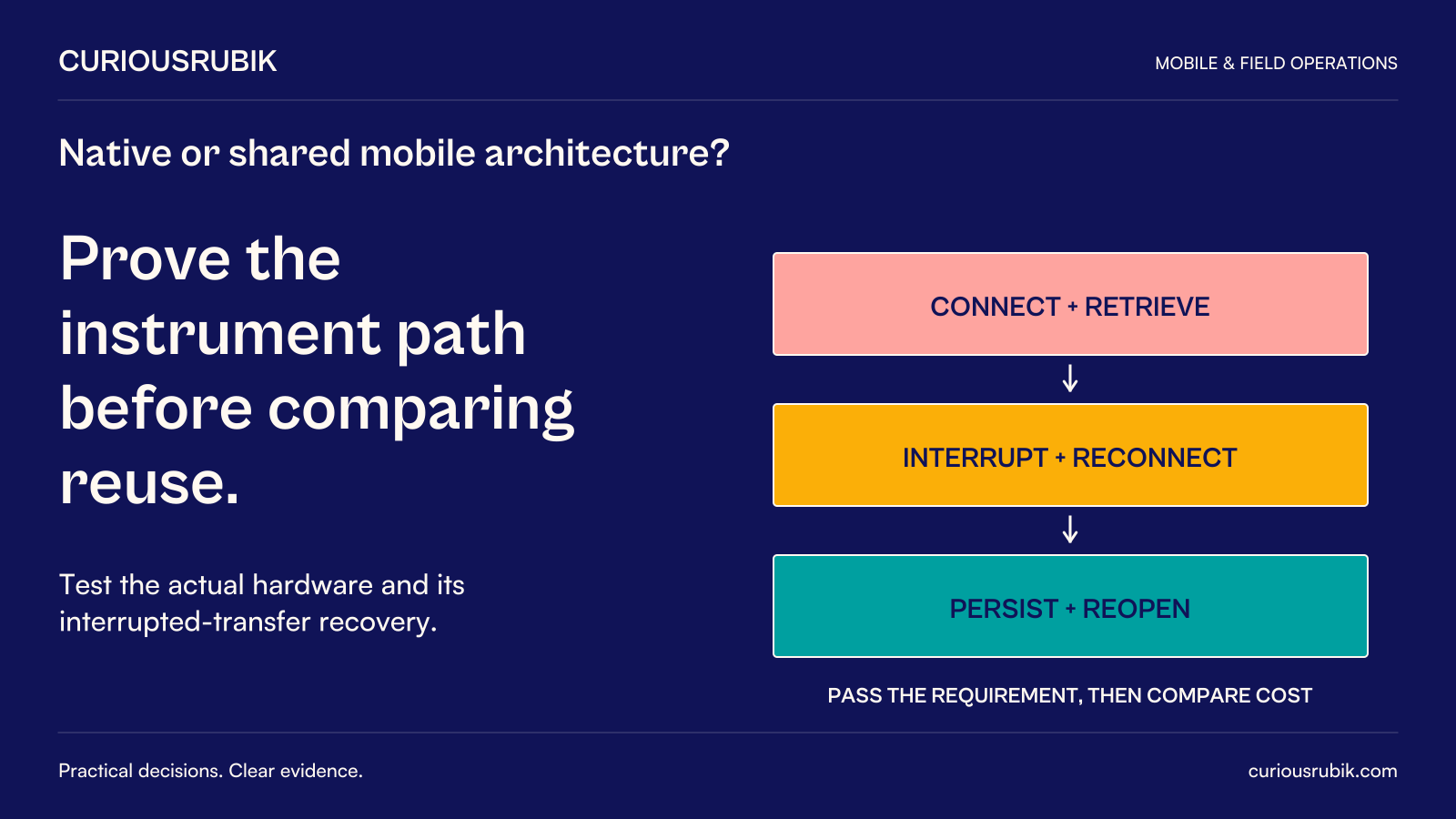
The critical unknown is the instrument connection. The team builds a thin vertical prototype for each credible option: connect, retrieve a reading, lose the connection, reconnect, persist the result, and reopen it after application termination. It uses the actual approved instrument firmware and the oldest devices the business plans to support.
Suppose, purely for this teaching scenario, Option B passes the normal transfer but loses the adapter’s completion callback after one interruption. That is not automatically a reason to reject cross-platform development. The team must determine whether the problem is a fixable adapter defect, a framework limitation, or an unsupported device combination, and who will own the remedy.
Option A might provide clearer access to the relevant platform behavior but require two teams to maintain equivalent recovery logic. Option C may simplify reporting while burdening technicians with file transfer between applications. The operating cost of that extra step belongs in the comparison, even if the web implementation is cheaper to build.
The resulting decision could reasonably favor any option depending on the evidence. The important output is a supported instrument path with a tested recovery contract, not a general declaration that native or shared development is superior.
Compare lifetime effort without fictional precision
Break the estimate into initial implementation, platform-specific work, integration testing, release maintenance, security updates, support, and eventual replacement. Ask each option’s owner to explain assumptions and uncertainty. A single headline development quote cannot reveal where work has been omitted.
Use ranges and scenario changes. In a hypothetical estimate, separate applications might require 24 person-weeks initially and eight per year for three years of maintenance. A shared design might require 17 initially, four for platform adapters, and seven per year. The resulting planning totals are 48 and 42 person-weeks respectively, before common backend and operating costs.
Those invented figures demonstrate arithmetic, not a market benchmark. If the shared adapter then requires nine additional person-weeks across the period, its total rises to 51. The decision turns on a specific dependency rather than a presumed percentage saving from reuse. Conversely, stable adapters and frequent shared business changes could strengthen the shared option.
Keep effort distinct from elapsed time. Two staffed teams may deliver separate applications in parallel, while one specialist becomes the bottleneck for a shared adapter. Person-weeks also omit differences in rates, recruitment, licenses, devices, and disruption. Translate the estimate into the organization’s actual financial model before making a commitment.
Assess team capability and dependency ownership
An architecture should fit a team the enterprise can sustain. Ask who can diagnose platform-specific problems, review third-party components, manage signing and release processes, and support production incidents. A shared framework does not remove the need to understand the underlying operating systems.
Examine critical dependencies individually. For each plugin or library that sits on a required path, record its purpose, maintenance owner, update process, license review, test coverage, and replacement plan. A large dependency count is not automatically bad, but an unowned dependency that blocks the entire operation is a material risk.
Separate supplier capability from technology suitability. A vendor experienced in one approach may recommend it because it can deliver it well. That can be a legitimate benefit, provided the proposal acknowledges constraints and the enterprise can maintain or transfer the result. Avoid turning a supplier’s skills into a universal architecture claim.
Require access to understandable build and release procedures. The organization should know how to reproduce a supported release, identify included components, and respond to an urgent defect. These capabilities matter whether the product contains one shared project or two platform projects.
Keep security obligations independent of framework preference
The application architecture still needs secure identity, server-side authorization, appropriate local data protection, and an update process. Shared code can spread a well-designed control across platforms; it can also spread a defect. Separate code can isolate some implementation choices while increasing the chance of inconsistent policy behavior.
For native OAuth clients, RFC 8252 specifies external-user-agent authorization and PKCE for public clients. These protocol obligations are not waived by a cross-platform framework. Evaluate the actual authentication integration and redirect handling, not the appearance of the sign-in screen. RFC 8252, Sections 5, 6 and 8.5
Ask how secrets and tokens are handled on each supported platform. Do not treat a value embedded in a distributed application as a confidential server credential. The security review should include the actual compiled application, relevant dependencies, and backend checks rather than relying on architecture labels.
Security acceptance should also cover updates. Establish which team responds when a platform, library, or business service changes. The cheapest design at launch may be expensive if a critical update cannot be delivered without a scarce contractor or a replacement of an abandoned component.
Make the decision reversible where practical
Keep authoritative business rules in clearly owned services when that fits the operation. Define clean boundaries around platform-specific capabilities and use contract tests for those boundaries. This does not make future migration free, but it reduces the chance that every interface change requires rewriting core business behavior.
Document why the chosen approach won and what would trigger reconsideration. Relevant triggers could include a new required peripheral, a major change in the device fleet, unacceptable support effort, or a dependency losing support. Revisit the decision when those conditions occur rather than repeatedly debating preferences without new evidence.
The next step is a short architecture trial with a written exit decision. Name the mandatory capabilities, select the two or three most uncertain interactions, test them on representative devices, and assign lifecycle ownership. Then choose the option whose demonstrated behavior and sustainable operating cost fit the business. Native and cross-platform development are implementation choices; the enterprise is buying a dependable capability over time.