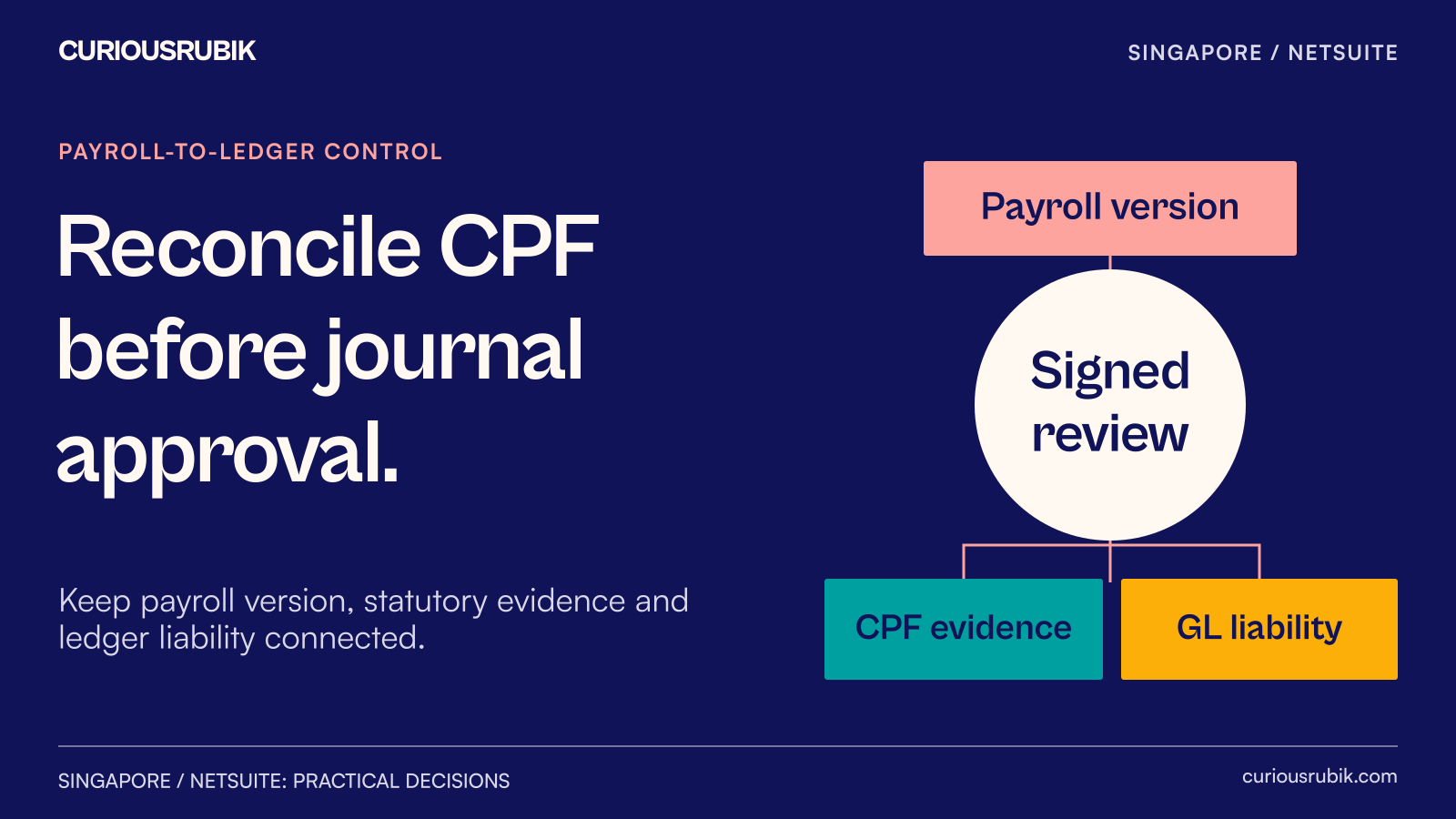
Reconcile the payroll register, employee and employer CPF components, submission evidence and general-ledger liability before approving the NetSuite payroll journal. Explain any timing difference explicitly. A balanced journal can still contain the wrong contribution amount or duplicate a correction already included in payroll.
This control does not calculate CPF entitlements or contribution rates. Those decisions remain with the payroll specialist using current official rules and employee-specific facts. Its purpose is to preserve the approved payroll result as it moves into accounting and subsequent payment reconciliation.
Keep payroll calculation, statutory evidence and ledger posting connected through a signed reconciliation.
Define the population before comparing totals
Identify the employing entity, payroll month, pay-run version, currency and CPF Submission Number where applicable. A consolidated payroll export may contain more than one employer or a correction from an earlier month. Those populations need to remain distinguishable.
Keep employee contributions separate from employer contributions in the bridge. They reach the CPF liability through different parts of the payroll calculation. Combining them too early makes it harder to find an incorrect deduction or an employer-cost adjustment.
Record which additional deductions or levies appear in the payroll output and give them their own reviewed mappings. Do not hide them inside a generic CPF total merely because some payments or reporting processes are related.
The accounting team should receive the approved register version and a summarized control total, with access to employee-level detail limited to the people who need it. A payroll integration can move values consistently without proving that the underlying calculations were approved.
Work through a filled journal bridge
This original fictional example uses aggregate SGD amounts solely to demonstrate reconciliation. The figures are not CPF rates, employee calculations or a claim that every worker has the same contribution treatment. The scenario assumes the payroll specialist has separately approved all underlying calculations.
The first approved register contains gross wages of SGD 100,000, employee CPF deductions of SGD 14,000 and employer CPF cost of SGD 12,000. Other deductions, levies and reimbursements are excluded from this simplified example. Net wages payable are SGD 86,000.
Under the fictional controller's approved account mapping, the draft journal contains:
- Debit wages expense: SGD 100,000
- Debit employer CPF expense: SGD 12,000
- Credit net wages payable: SGD 86,000
- Credit CPF payable: SGD 26,000
Debits and credits both total SGD 112,000. This proves the arithmetic of the draft, but the reviewer still needs to establish that the correct register version and components were used.
Before posting, payroll approves correction C-49. It increases employee CPF deductions by SGD 100 and employer CPF cost by SGD 50, without changing gross wages. The approved revised register therefore has employee deductions of SGD 14,100, employer cost of SGD 12,050 and net wages payable of SGD 85,900.
The revised journal's CPF liability is SGD 26,150. Debits are SGD 112,050, and credits are SGD 85,900 plus SGD 26,150, also SGD 112,050. The reconciliation points to C-49 and marks the earlier draft as superseded. It must not post both full versions.
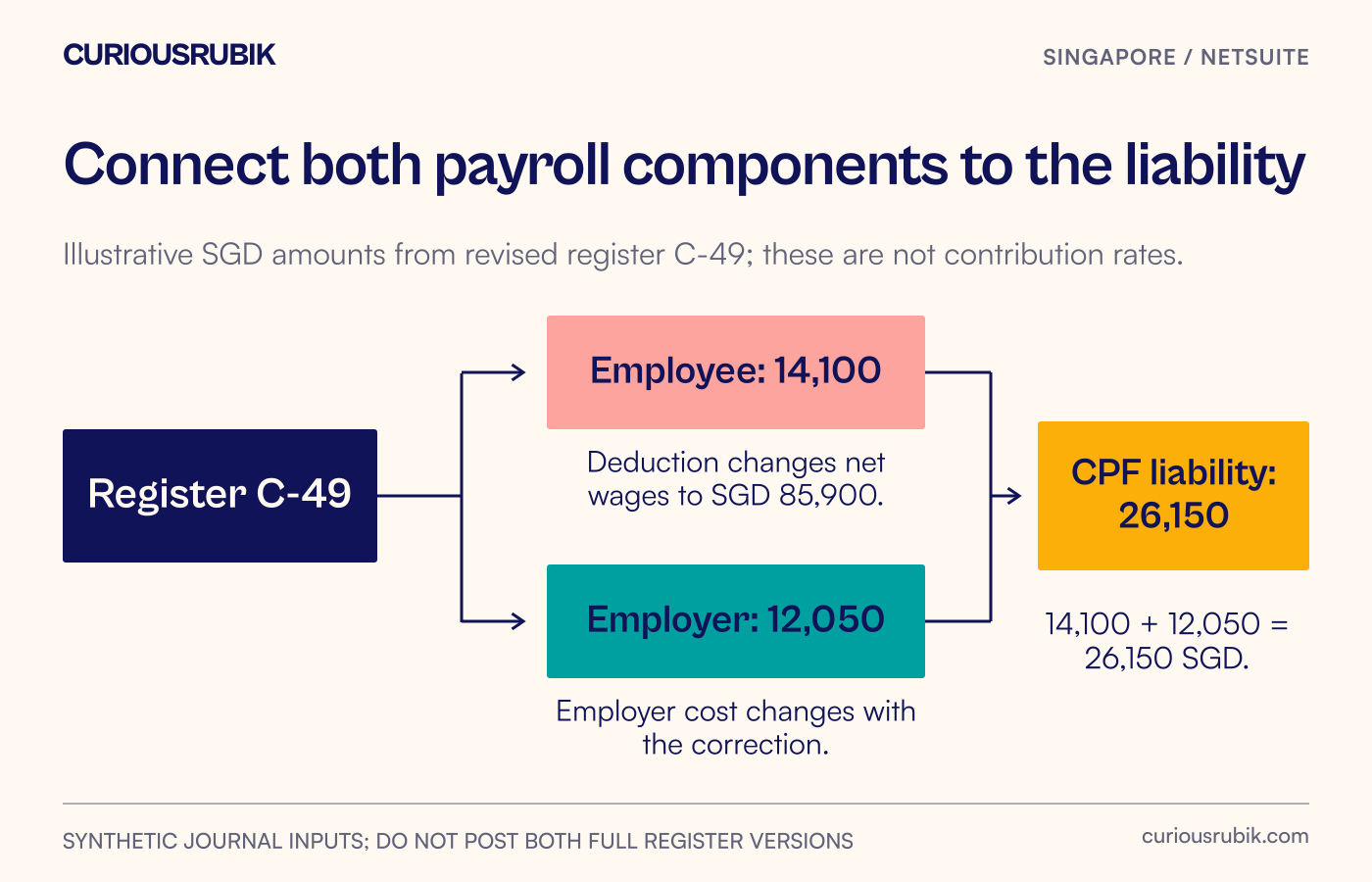
The correction changes both net wages and employer cost, so a liability-only adjustment would be incomplete.
Explain a submission that predates the correction
Suppose the CPF submission evidence still reflects SGD 26,000 because it was prepared before C-49. The difference from the revised liability is SGD 150. The payroll owner must arrange the approved statutory correction process and retain its evidence; the journal preparer must not silently change the register back to match the earlier submission.
The control sheet now has a clear status: approved payroll liability SGD 26,150; current submission evidence SGD 26,000; unresolved correction SGD 150, owned by payroll. The submission version and correction reference explain the difference.
This does not mean an appropriate accrual must wait until a contribution has been paid. The controller determines recognition and posting under the company's accounting policy. The reconciliation should show what is known at posting time and what remains outstanding, rather than confuse missing payment evidence with an instruction to omit the liability.
If the first journal was already posted, a revised full journal may duplicate expense and liabilities. Finance must approve the appropriate correction or reversal method and link it to the original posting. The integration design should preserve that relationship.
Bring opening balances into the payment check
Continue the fictional example with an opening CPF payable balance of SGD 300 from an earlier period. A subsequent bank payment of SGD 26,300 consists of that SGD 300 plus SGD 26,000 relating to the current month's original submission.
The liability roll-forward is SGD 300 opening balance, plus SGD 26,150 current approved liability, less SGD 26,300 paid, leaving SGD 150 outstanding. That remaining amount matches C-49's unresolved correction.
Comparing only SGD 26,300 of cash with SGD 26,150 of current payroll would suggest a SGD 150 overpayment. The opening-balance bridge shows why that conclusion would be wrong in this example. Payment evidence must be attributed to the correct periods and submissions before it is compared with payroll.
Keep the unresolved SGD 150 on the exception list until the approved correction and related settlement evidence clear it. An aging comment such as “timing” needs a specific expected event and owner; it should not roll forward indefinitely without review.
Use the right dates in the operating calendar
CPF Board states that CPF contributions are due on the last day of the calendar month. Its following-month enforcement threshold is a separate rule; the 14th should not be labeled the statutory due date.
Set the internal payroll, review and payment calendar against current official requirements and the business's actual processing arrangements. This article does not calculate late-payment consequences or determine an employer's liability. The practical control is to distinguish the payroll period, submission date, payment date and the dates on which corrections were approved.
A NetSuite posting date is an accounting field. It cannot demonstrate that a statutory submission or payment occurred on time. Retain the relevant external evidence separately and reconcile it to the approved liability.
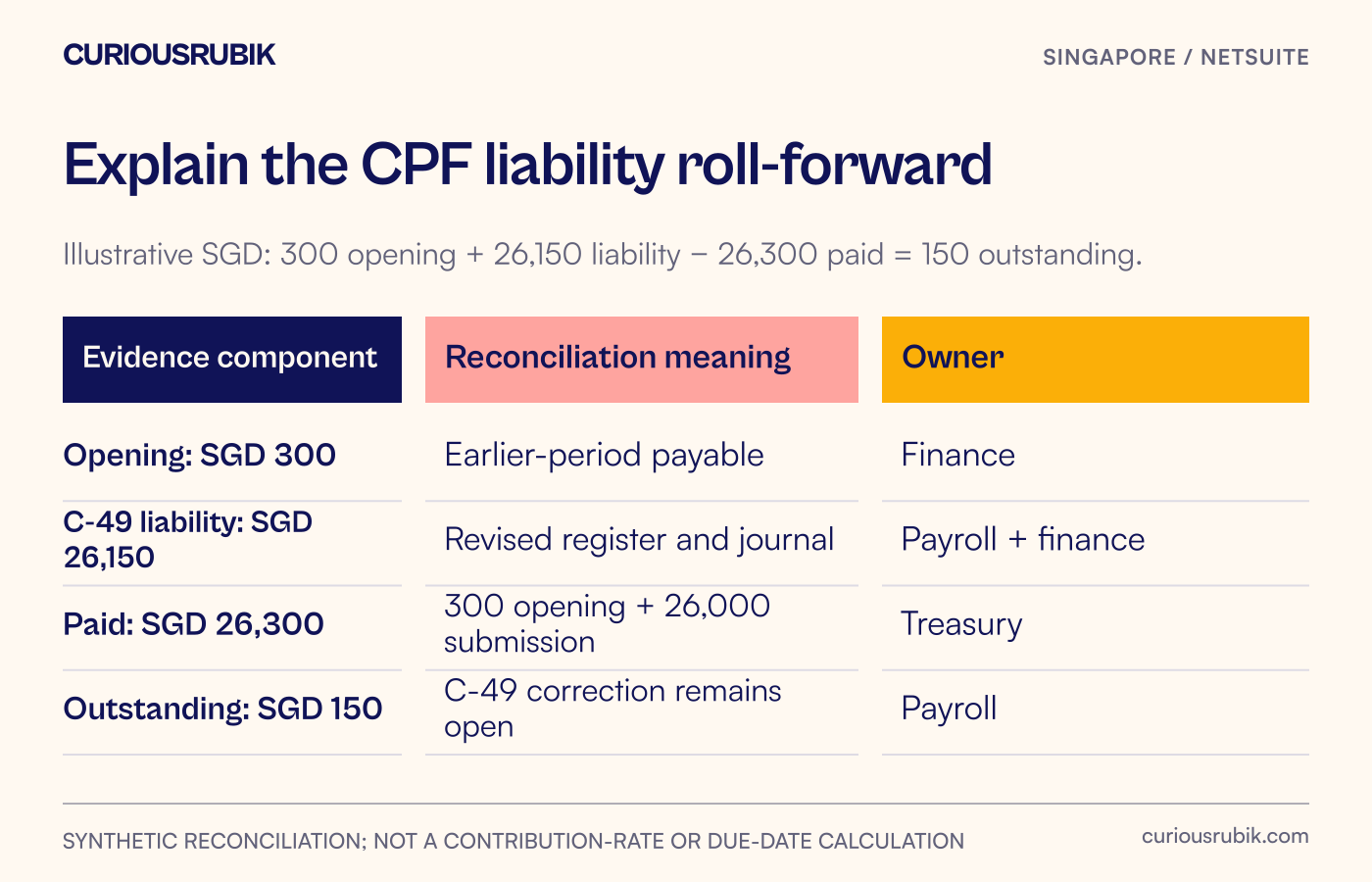
The liability roll-forward explains the remaining amount without forcing unrelated totals to match.
Give the NetSuite interface an acceptance test
For the actual integration or import route, test the original register, revised register, duplicate file and late correction. Require stable pay-run references and a clear rule for whether a new version replaces an unposted draft or requires an approved correction to posted records.
The payroll specialist signs calculations and submission treatment. Finance signs account mapping and recognition. The system owner proves that the configured route carries the approved totals without duplication. Treasury supplies the relevant payment evidence through the authorized process.
Use the fictional bridge as a template for those acceptance cases, then replace its assumptions with the company's approved mapping. A NetSuite integration review can begin with these exact version and reconciliation requirements rather than a broad request to “connect payroll.”