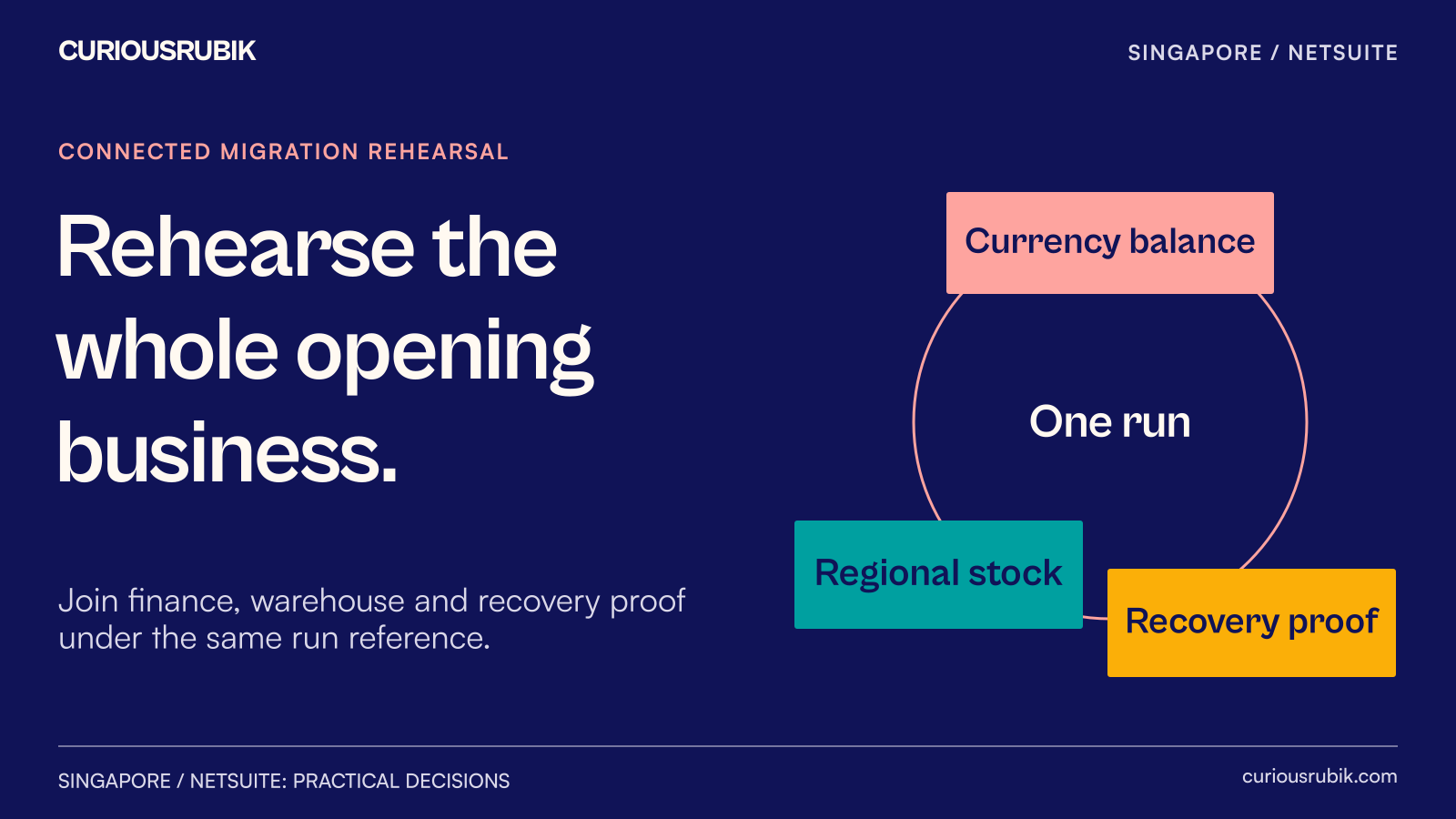
Accept the opening business position as one connected result.
A useful migration rehearsal proves that finance and operations describe the same starting business. For a Singapore distributor, foreign-currency receivables, inventory held in the region and messages still arriving from a warehouse cannot be accepted as unrelated data loads. The rehearsal should connect them through one cutoff, a traceable evidence bundle and a demonstrated recovery route.
Plan the exercise around what the business must do immediately after migration: collect an outstanding invoice, fulfil a remaining order, explain stock in transit and recover an interrupted load without duplicating accepted records. Then decide which source extracts, target records and human approvals would prove each outcome.
The rehearsal population
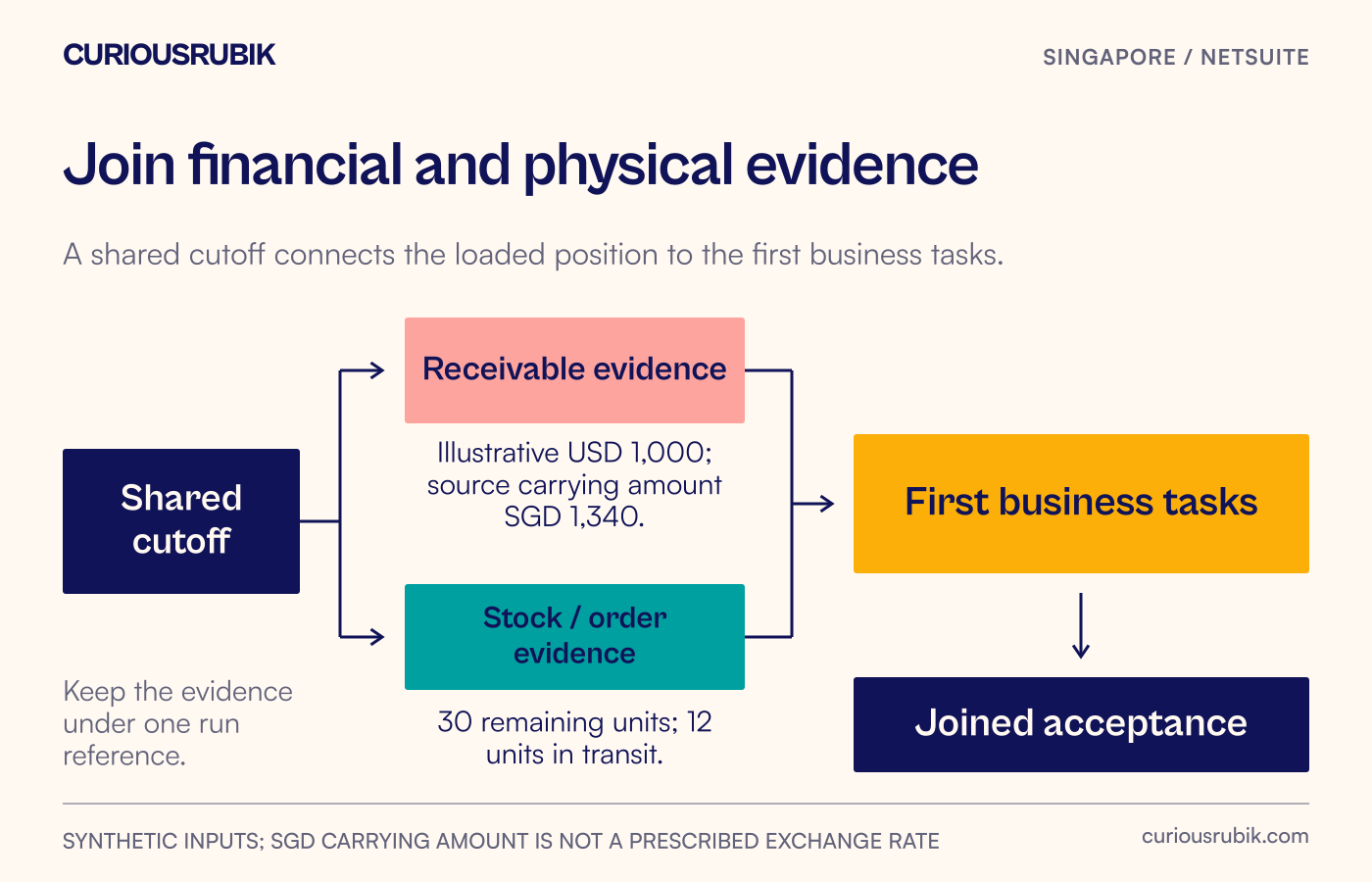
The following is an illustrative exercise, with invented records and amounts. A Singapore trading entity has an SGD base currency. Its selected opening population includes an outstanding USD 1,000 customer invoice with a source carrying amount of SGD 1,340, an order with 30 units still to fulfil and 12 units of stock moving between two approved locations. Finance has approved the intended representation for the exercise; the amounts are not exchange-rate advice or accounting policy.
The warehouse sends an acknowledgement after the first target load. Meanwhile, a receivables import stops before the operator receives a clear completion result. These are deliberate test conditions. They force the team to establish what is already represented, what is missing and which system can authorize the next action.
The scenario should also include a record outside the selected population. For example, choose a settled invoice that must not become an open receivable. This negative case checks the selection boundary rather than testing only records expected to load.
Choose a manageable slice with enough variation to challenge the design. A narrow but connected population can reveal more than a large import of clean masters whose downstream use is never exercised.
Assemble one evidence bundle
Give the rehearsal a unique run reference. Under it, retain the source extract identities, cutoff and timezone, mapping version, target environment and approved configuration baseline. Attach the finance expectations and warehouse-state evidence before the load starts.
The sample bundle has four business exhibits:
- Receivable exhibit: source invoice identity, USD 1,000 outstanding amount, SGD 1,340 source carrying amount, approved target treatment and collection reference. Finance states separately how any valuation or opening adjustment is to be handled.
- Order exhibit: original line reference, 30 remaining units, fulfilment authority and the corresponding warehouse instruction. The order total alone is insufficient if another system can still release the same units.
- Stock exhibit: 12 units in transit, sending and receiving locations, ownership, dispatch evidence and expected receipt treatment. The exact NetSuite record design is confirmed by the implementation lead.
- Exclusion exhibit: the settled invoice and the source evidence explaining why it is outside open receivables. The target check must show that the migration did not reopen it.
Use a common identity bridge across the exhibits where records relate. An order, shipment and invoice can each reconcile within its own spreadsheet while being attached to the wrong customer or entity. The connected test should challenge those relationships explicitly.
Confirm the test environment's actual boundary
NetSuite provides sandbox accounts for testing, and Oracle notes that some features are not fully available there. Establish what this particular environment can demonstrate and record any production-dependent acceptance steps separately.
Inspect external endpoints before running the exercise. A sandbox ERP does not establish that a payment route, email recipient, warehouse endpoint or integration credential is also non-production. Obtain the appropriate authorization and use isolated test destinations for consequential actions. If a provider cannot supply a safe test route, use an agreed simulation for that part and label the remaining evidence gap.
Confirm the import method as well. Record support, permissions and enabled features affect CSV import availability. Do not design the rehearsal around an assumption that a source's complete historical state can be loaded unchanged. Agree the target representation with finance and operations, then test that representation.
For the in-transit example, distinguish a transfer order from a basic inventory transfer. Oracle documents staged movement for transfer orders, which require Multi-Location Inventory. A one-step quantity move would answer a different question. The specialist must validate the applicable record and preferences for the actual ownership and movement involved.
Interrupt the run before declaring it successful
When the receivables load stops, tell the operator only that the outcome is uncertain. Ask them to follow the recovery instructions using the approved identifiers and evidence. They should first establish whether the USD invoice exists and whether its values and relationships match the expected representation.
If the record exists correctly, the next step should preserve it and recover the missing completion evidence. If it does not exist, a bounded retry may be appropriate under the chosen import design. If it exists incorrectly, the correction route needs finance and migration approval. Repeating the whole file is not a universal recovery method.
Next, deliver the late warehouse acknowledgement. The receiving process should relate it to the accepted order and stock state without creating an extra movement. Ask the operator to explain the result using the run evidence, rather than relying on the developer's memory of what happened.
Finally, have users perform the first intended business tasks in the safe test environment. Can collections identify the correct outstanding invoice? Can operations establish which 30 units remain to be fulfilled? Can the receiving team explain the 12 units still in transit? The record load has value only if these questions have usable answers.
Use a joined acceptance decision
The rehearsal board should inspect a small matrix of outcomes rather than separate technical success percentages.
For the foreign-currency receivable, acceptance requires the approved outstanding currency amount and target accounting representation, with differences explained by finance. For the order, acceptance requires remaining demand and one fulfilment authority. For stock, acceptance requires a defensible location and movement position. For recovery, acceptance requires a repeatable procedure that preserves accepted work after an uncertain outcome.
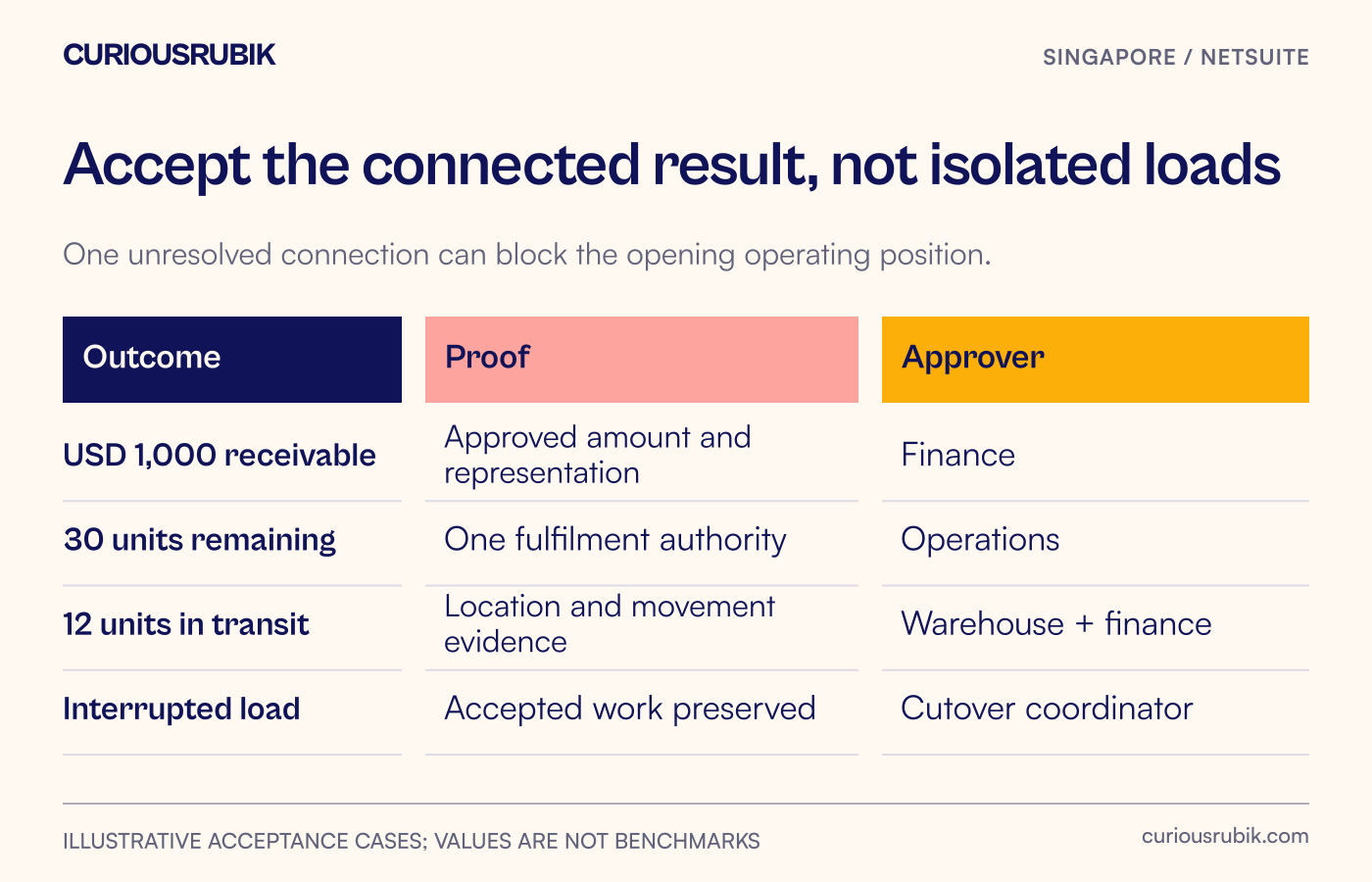
If the invoice is correct but linked to the wrong customer, treat the collection outcome as failed. If stock totals agree but the warehouse can release the order twice, treat operational readiness as failed. If recovery works only because the developer manually identifies a record, improve the runbook and repeat that part with the intended operator.
CuriousRubik's migration defect-triage guide explains how to investigate a failed rule and retest its affected population. Use that discipline inside this connected rehearsal, while keeping the final release decision focused on the business position as a whole.
Carry the evidence into cutover
Update the maintained mappings and runbook with every accepted correction. Preserve the rehearsal version so the team can explain what changed. Before final cutover, compare the intended configuration, source rules and external routes with those actually tested.
The release approver should receive the accepted evidence bundle, unresolved limitations and the demonstrated recovery boundary. A simulation must remain labelled as a simulation. A source balance that finance has not approved must remain an open decision.
The next rehearsal is justified when it answers an unresolved question or proves a changed design. Its purpose is to establish that the Singapore entity can start operating from a coherent position and recover safely when part of the migration behaves differently from the plan.