A renewal team offers a discount because it believes an account is disengaged. The service team knows the customer is waiting for an unresolved implementation issue. Finance has placed a credit note against the same account, while the customer appears under a different identifier in the usage report.
Each team can explain its own actions. Together, those actions may create an unnecessary concession, a delayed renewal, and an avoidable escalation. The commercial problem arises from decisions made with incompatible fragments of customer information.
The cost is easy to exaggerate. It is also easy to overlook because it appears in different places: discounts, rework, delayed billing, disputed invoices, and lost opportunities. A credible business case for connecting customer information should trace those mechanisms separately. Multiplying total revenue by an invented “data leakage rate” produces an impressive number and a weak investment decision.
Fragmentation damages decisions through specific mechanisms
Information can be fragmented even when all data sits in one platform. Separate teams may use different customer definitions, update schedules, or interpretations of status. Conversely, several systems can support a coherent decision if identity, meaning, timing, and ownership are controlled.
There are four useful commercial mechanisms to investigate. Missed opportunities occur when the next relevant action is not recognized. Unnecessary concessions occur when staff lack context about service obligations or previous agreements. Transaction failures occur when billing, fulfillment, or contract details conflict. Response delays occur when employees must reconstruct the customer’s position before acting.
These mechanisms can overlap. A delayed invoice may also require rework and eventually lead to a concession. Record the relationship between them rather than counting every symptom as a separate loss.
Distinguish information failure from policy or capacity failure. A shared view will not solve an understaffed service team or an uncompetitive offer. It may make those problems visible. That visibility is valuable, but it should not be described as revenue recovered until the relevant operational action occurs.
Begin with the decision that went wrong
Choose a bounded commercial process: renewals for one product family, invoice disputes for one region, or quotes requiring cross-team approval. Review recent cases, including successful ones, and reconstruct what each decision maker could see at the time.
For each case, record the customer identity, decision, missing or conflicting information, actual action, subsequent event, and supporting evidence. Preserve uncertainty. A salesperson’s belief that better information would have won a deal is a hypothesis, not a verified financial loss.
Ask a counterfactual question carefully: if the information had been correct and available, what feasible action would have changed? The answer must fit the employee’s authority and the organization’s capacity. Knowing that a customer was dissatisfied does not establish that a service team could have resolved the issue before renewal.
The UK Government Data Quality Framework defines quality in relation to fitness for purpose and encourages targeted improvement across the data lifecycle. Applied commercially, that suggests prioritizing information that changes a consequential decision rather than pursuing a universal cleanliness score. Government Data Quality Framework.
Create an evidence-based loss register
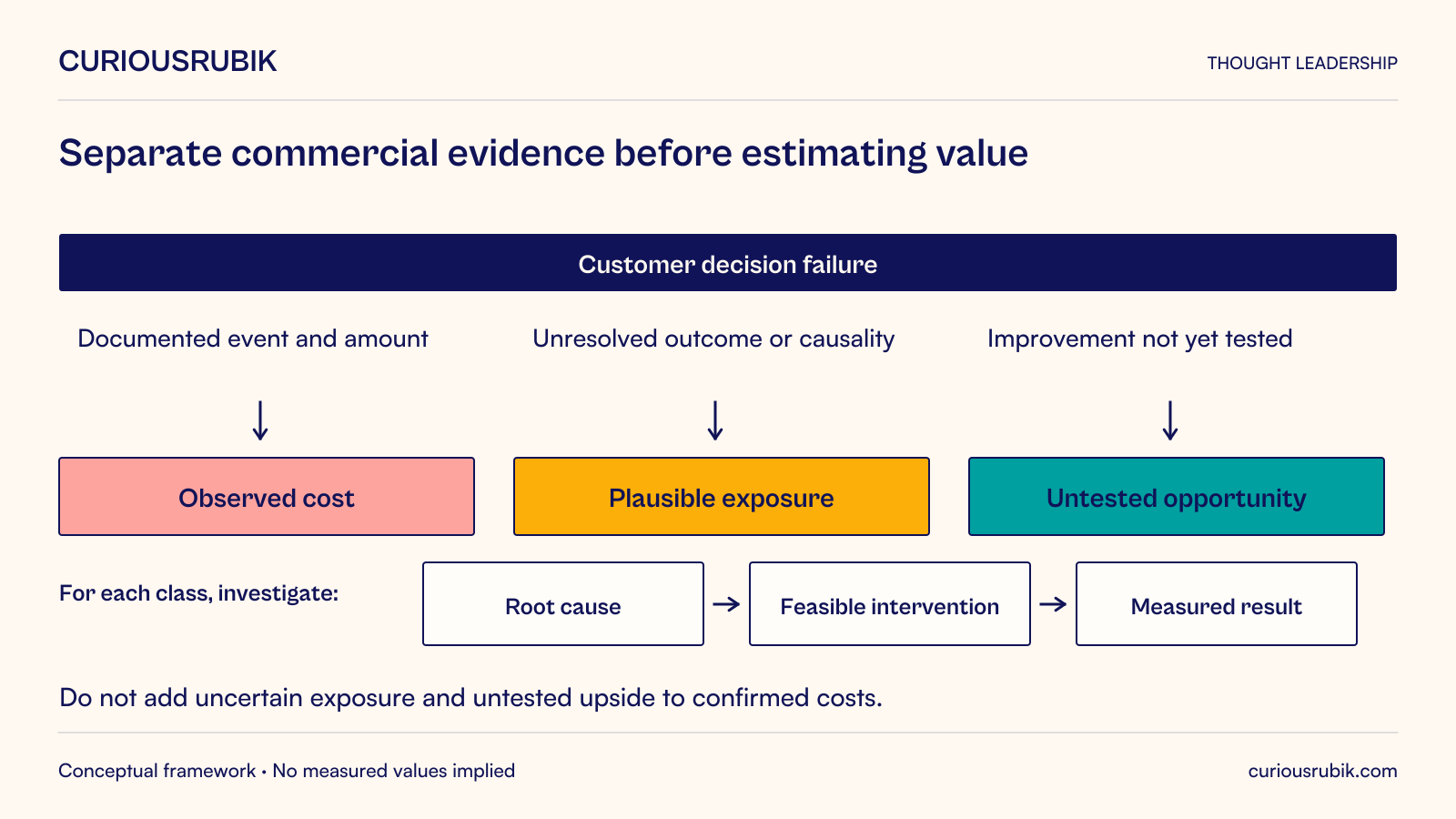
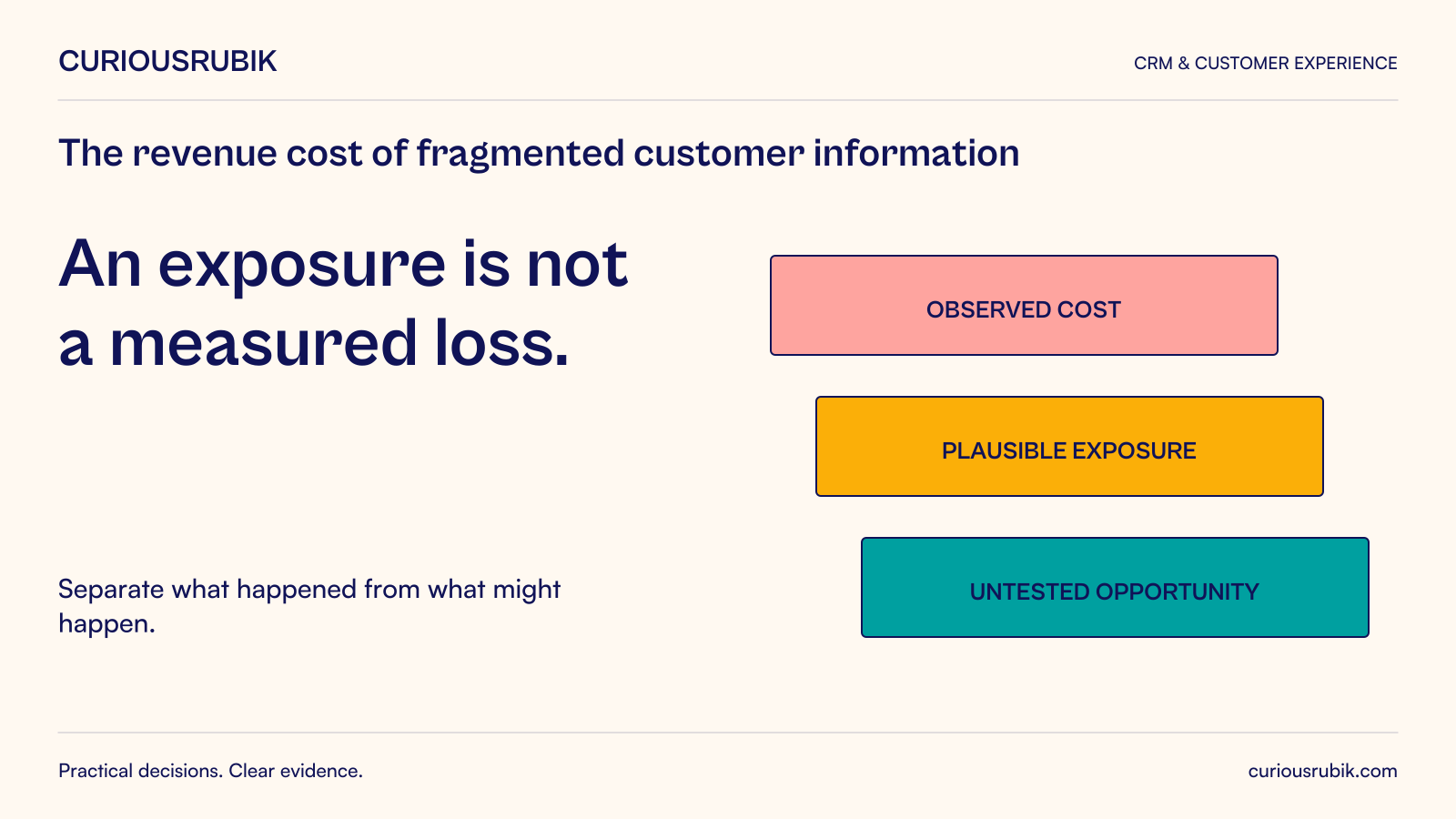
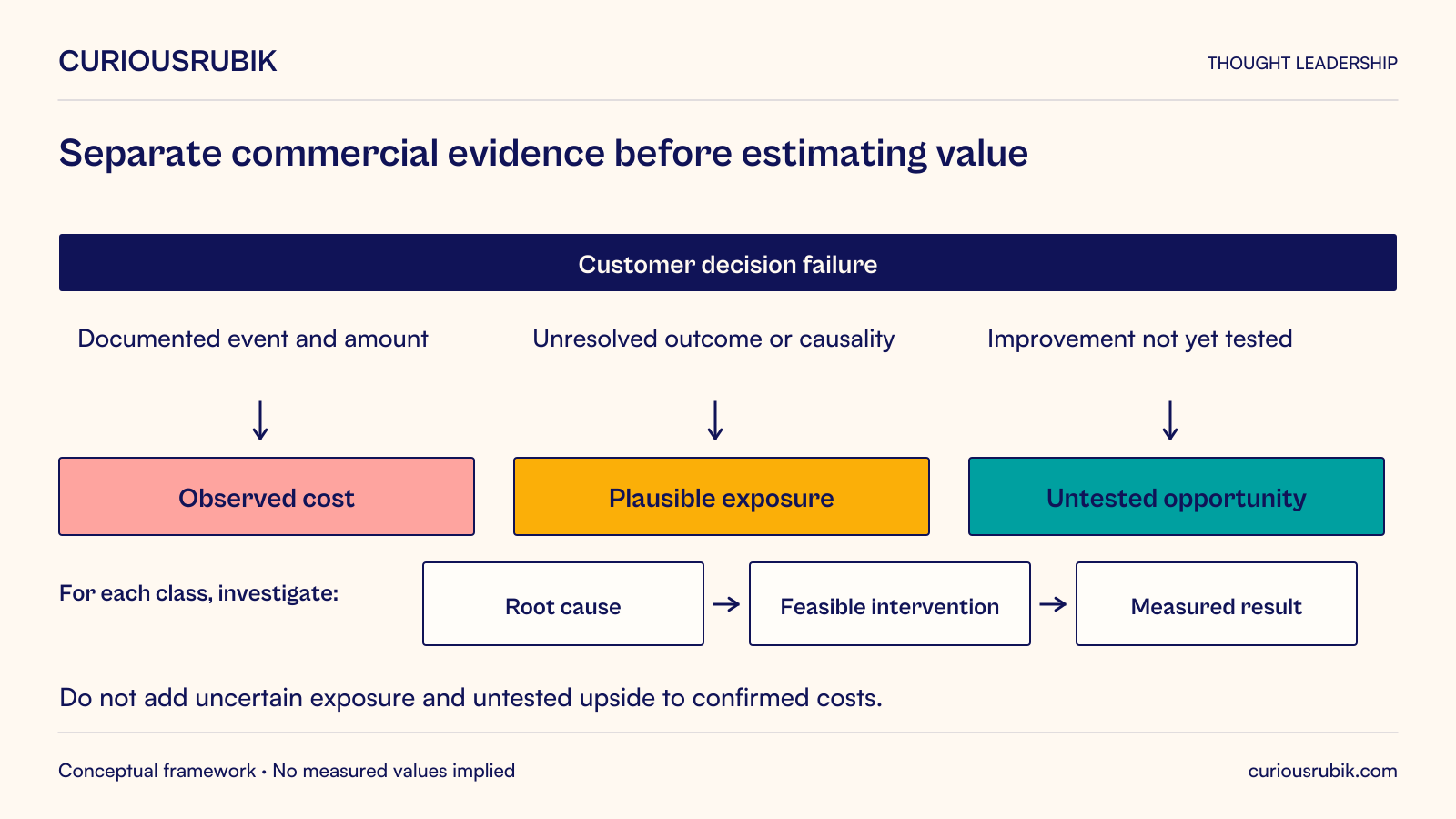
Use a working heuristic with three evidence levels: observed cost, plausible exposure, and untested opportunity. This is a proposed management tool, not an accounting standard.
Observed cost has a documented event and a defensible amount. Examples include an approved duplicate refund or recorded labor spent correcting a misapplied contract price. Even here, distinguish avoidable cost from work that would have occurred under a sound process.
Plausible exposure describes an unresolved commercial risk. An at-risk renewal with missing service context belongs here until the outcome is known. Record the amount exposed and the uncertainty, but do not label the entire contract value a loss.
Untested opportunity describes a possible improvement, such as a better-timed cross-sell. It needs a test of customer relevance and incremental response. Historical correlations are useful for forming the hypothesis but cannot establish the revenue the intervention will generate.
Give each entry a root cause and a candidate remedy. A customer identifier mismatch may require identity resolution; a stale contract term may require ownership and update controls; a slow decision may require changed authority. This prevents the register becoming an undifferentiated argument for a new platform.
A subscription business separates leakage from speculation
Consider a hypothetical business-to-business training platform reviewing a sample of 40 renewals. The sample is illustrative and is not presented as a benchmark. The team finds six cases in which the renewal owner did not see an active service issue before contacting the customer.
In two cases, the customer received a concession already authorized through the service process and then another concession through sales. The register records the actual additional concession, the approval evidence, and whether the second concession was truly unnecessary. It does not count the entire renewal value as lost.
In three cases, the renewal was delayed while staff reconciled the issue. The team records elapsed delay and verified rework. It keeps delayed cash timing separate from permanent revenue loss. Finance decides how any working-capital effect should be evaluated; the project team does not equate a late signature with a lost contract.
The sixth customer did not renew. The record shows the missing information, but the customer also cited a changed training strategy. The team classifies the causal contribution as uncertain. The nonrenewal and foregone contract amount are observed outcomes, while attribution to the information failure remains uncertain. Neither establishes that the amount was recoverable through the proposed intervention.
The proposed intervention is modest: show unresolved service commitments and approved concessions in the renewal workspace, with an owner and timestamp. It also adds an explicit check before a new concession is approved. The pilot compares similar renewal cohorts where feasible and watches for confounding differences in customer size, contract timing, and account-manager support.
A clean dashboard is not the pilot’s success criterion. The relevant outcomes are duplicate concessions prevented, less reconstruction work, appropriate service coordination, and customer outcomes that can reasonably be attributed to the new process. The team also checks whether unnecessary escalation slows straightforward renewals.
Model economics without double counting
Build the investment case from separate components. Rework reduction uses observed task volume, measured handling time, and an appropriate cost basis. Concession reduction uses eligible cases and a defensible estimate of the preventable portion. Incremental sales contribution needs evidence of additional wins and the costs required to deliver them.
Keep revenue, gross contribution, cash timing, and employee capacity distinct. A dollar of additional revenue is not a dollar of profit. Time saved is not automatically a payroll reduction. Earlier invoicing is not necessarily additional revenue. Blending these categories can make a weak project appear attractive.
For a hypothetical arithmetic illustration, suppose a defined monthly process contains 120 reconciliation cases and observation suggests 15 minutes of avoidable work per case. That represents 30 hours of potential capacity before implementation and ongoing administration are considered. The figure is a planning estimate derived from assumptions, not a claim about typical CRM benefits.
Ask whether the capacity can actually be used. If it is scattered across many roles in small fragments, the benefit may be improved responsiveness rather than an avoided hire. State that mechanism explicitly. Test sensitivity to lower case volume, smaller time savings, and a slower adoption rate.
Include continuing costs: identity review, exception handling, interface maintenance, source-system correction, training, and oversight. A connected view that requires a permanent manual cleanup team may still be worthwhile, but that team belongs in the economics.
Improve the information path at its source
Once a high-value mechanism is identified, trace the information from creation to decision. Determine where it becomes incomplete, stale, ambiguous, or inaccessible. The remedy should address that point whenever practical.
For customer identity, establish which identifiers distinguish a contracting organization, a subsidiary, and a service location. For contract terms, identify the authoritative record and the event that updates downstream views. For service commitments, define who confirms status and who resolves a disagreement.
Show quality limitations to the decision maker. A balance last refreshed yesterday should not look identical to a confirmed current position. A probable account match should not silently become an established identity. A missing value should be distinguishable from a negative result.
The W3C Data Quality Vocabulary provides a vocabulary for expressing quality information about datasets, including measurements and annotations. It is a technical Working Group Note, not a CRM quality certification. Its useful principle here is that quality information should accompany data rather than remain invisible to its users. W3C Data Quality Vocabulary.
Choose the smallest integration that changes the decision
An enterprise customer-data platform may be appropriate when many use cases share difficult identity and governance needs. It is not the only response to fragmentation. A reliable contract reference, shared exception queue, or narrowly scoped service-status integration can resolve a specific decision failure sooner.
Compare alternatives using the same commercial mechanism and evidence. One option might consolidate applications; another might preserve authoritative systems and expose a joined view. Consider freshness requirements, access restrictions, recovery behavior, and the team’s ability to maintain the design.
Avoid creating a second unofficial master record merely to simplify a dashboard. If employees can correct a copied contract term without updating the authoritative source, the integration introduces a new inconsistency. Provide a correction path with ownership and confirmation.
A small integration is not automatically cheap. Even one critical interface needs monitoring and recovery. The point is to match scope to a demonstrated decision need, rather than assuming that maximum consolidation produces maximum value.
What to ask before approving the business case
Require the sponsor to show a few traceable cases. What information was missing? What action followed? What cost was observed? What remains uncertain? Which proposed change would alter the action, and who has authority to make it?
Ask the finance owner to separate accounting outcomes from operational estimates. Ask the process owner to confirm that the proposed intervention is usable at the moment of decision. Ask the data owner how the problem will stay corrected when new customers, products, and contracts arrive.
Set a review point after enough relevant transactions have occurred. If the expected benefit does not appear, investigate adoption, source quality, and the original causal assumption before expanding the program. It may be necessary to revise or stop the intervention.
The hidden cost of fragmented customer information becomes manageable when it is made specific. A disciplined loss register, a narrow test, and clear ownership can turn a broad complaint about disconnected data into a defensible commercial decision. That is a stronger foundation for investment than an impressive estimate nobody can reconcile to actual customer work.