The most useful direction for decision intelligence is a system that preserves the link between evidence, the action actually taken, and the outcome later observed. Better predictions are only one component. An organization also needs to know which policy used the prediction, whether the action was feasible and authorized, and whether the resulting evidence justifies changing that policy.
For an operations leader considering a new service-response policy, the immediate decision is how to evaluate and revise it without confusing a favorable metric with proof of improvement. A policy might ask for additional information, route a case to a specialist, or present a suggested response for human review. Its value depends on what happens after those choices, including costs and unintended effects.
Here, decision intelligence means a managed evidence-to-action learning process. This is a working definition for the article, not a claim that one validated standard or product category already provides the complete solution. The future described is a design direction organizations can build toward, not a forecast of autonomous capability.
Preserve the decision that actually happened
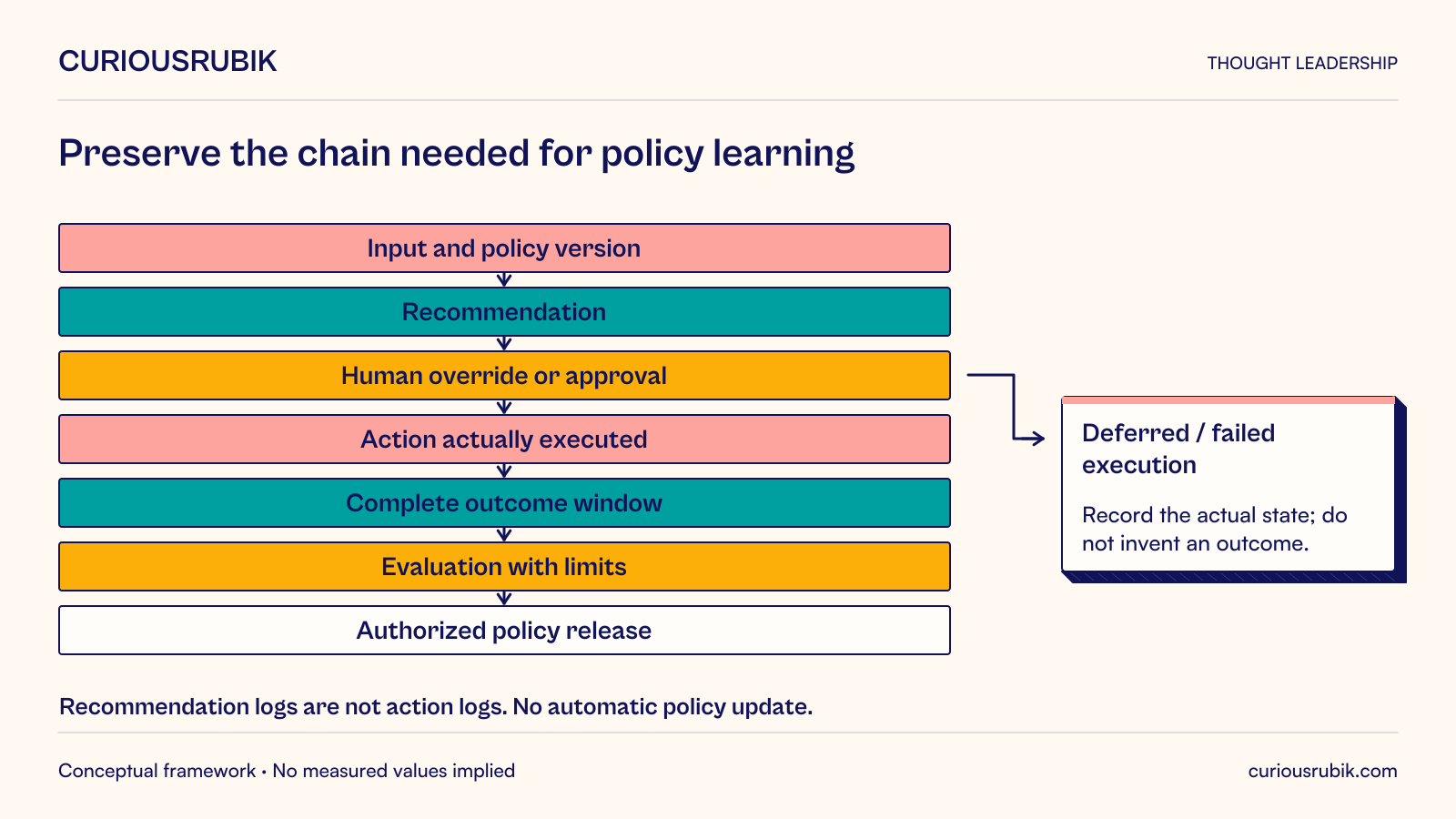
A prediction log does not establish what the business did. A model may recommend one route, a person may override it, and the receiving system may execute something else because capacity or permissions changed. Evaluation needs to distinguish these stages.
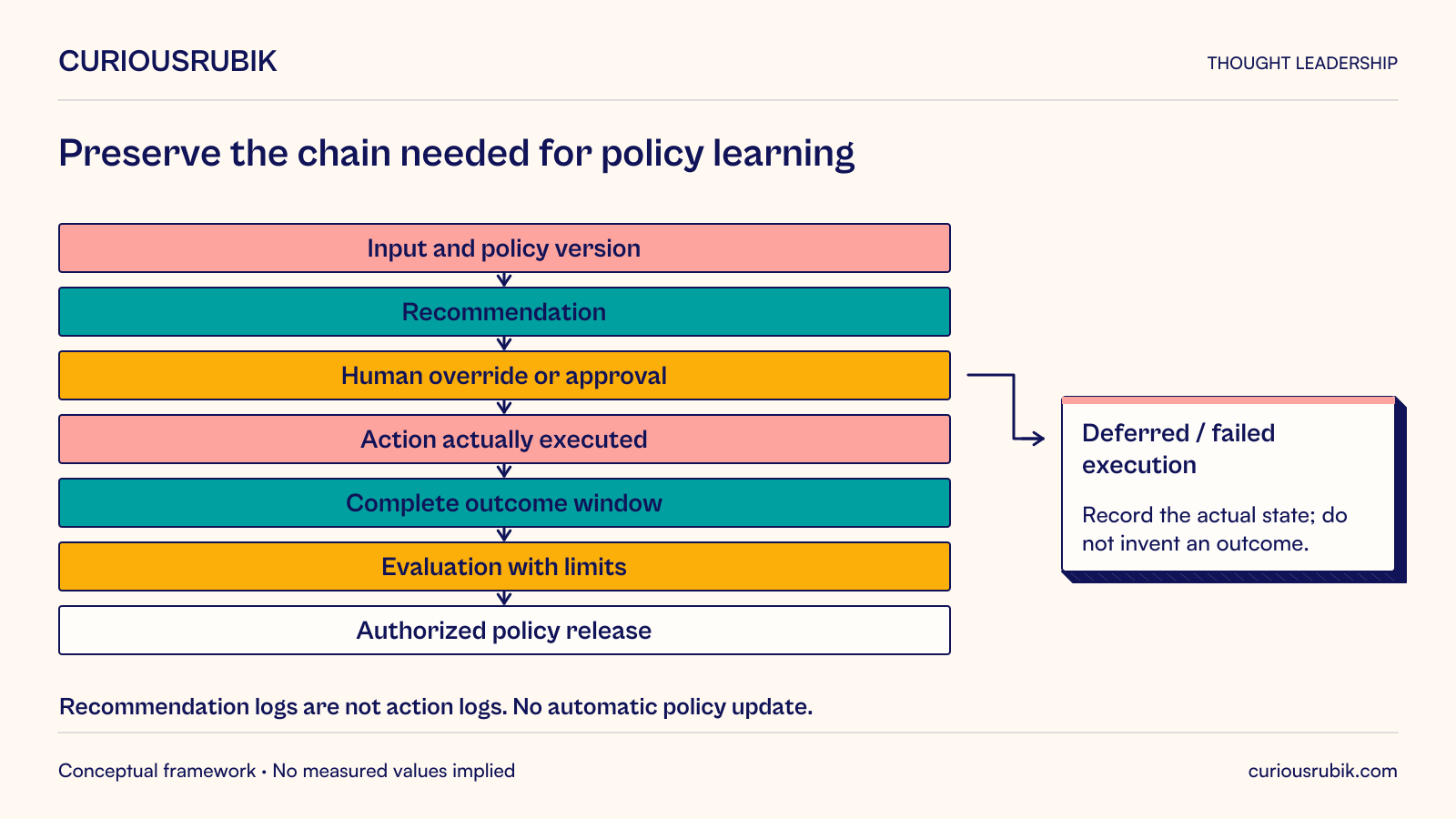
Create a decision record with the relevant input version, policy version, recommendation, responsible actor, authorized action, execution outcome, and review window. Include the reason for consequential overrides where practical. Preserve enough context to reconstruct the choice without collecting unrelated personal information.
Record failed or deferred execution. If a recommendation was never applied, the later customer outcome should not be attributed to that action as if it occurred. Likewise, an action applied after a long delay may have a different effect from the action the policy originally intended.
This record supports operational learning even when no AI is involved. A deterministic rule, a human judgment, and a model-assisted recommendation all benefit from a clear account of what evidence was available and what was done.
Separate prediction evaluation from policy evaluation
Prediction evaluation asks whether an estimate or classification matches its defined target. Policy evaluation asks whether the actions selected using that information improve the intended business outcome under the relevant constraints. A more accurate prediction can still produce an inferior policy if the response is costly, delayed, or poorly chosen.
For a service operation, predicting that a customer will contact support again is different from deciding whether to request clarification or involve a specialist. The intervention itself changes the future that the prediction concerns. Historical relationships may not describe what happens after the policy changes.
Define the outcomes and tradeoffs before testing. A reduction in repeat contacts may be desirable, but not if it comes from discouraging legitimate follow-up or leaving difficult cases unresolved. Include the consequences the organization is unwilling to trade away merely to improve the headline measure.
NIST’s January 2023 AI Risk Management Framework includes measurement, monitoring, and ongoing management of risks across the lifecycle. It supports disciplined reassessment of AI-enabled systems, but it does not establish a particular business policy’s causal benefit. NIST AI RMF 1.0, MEASURE and MANAGE functions
A hypothetical result that needs a fuller decision
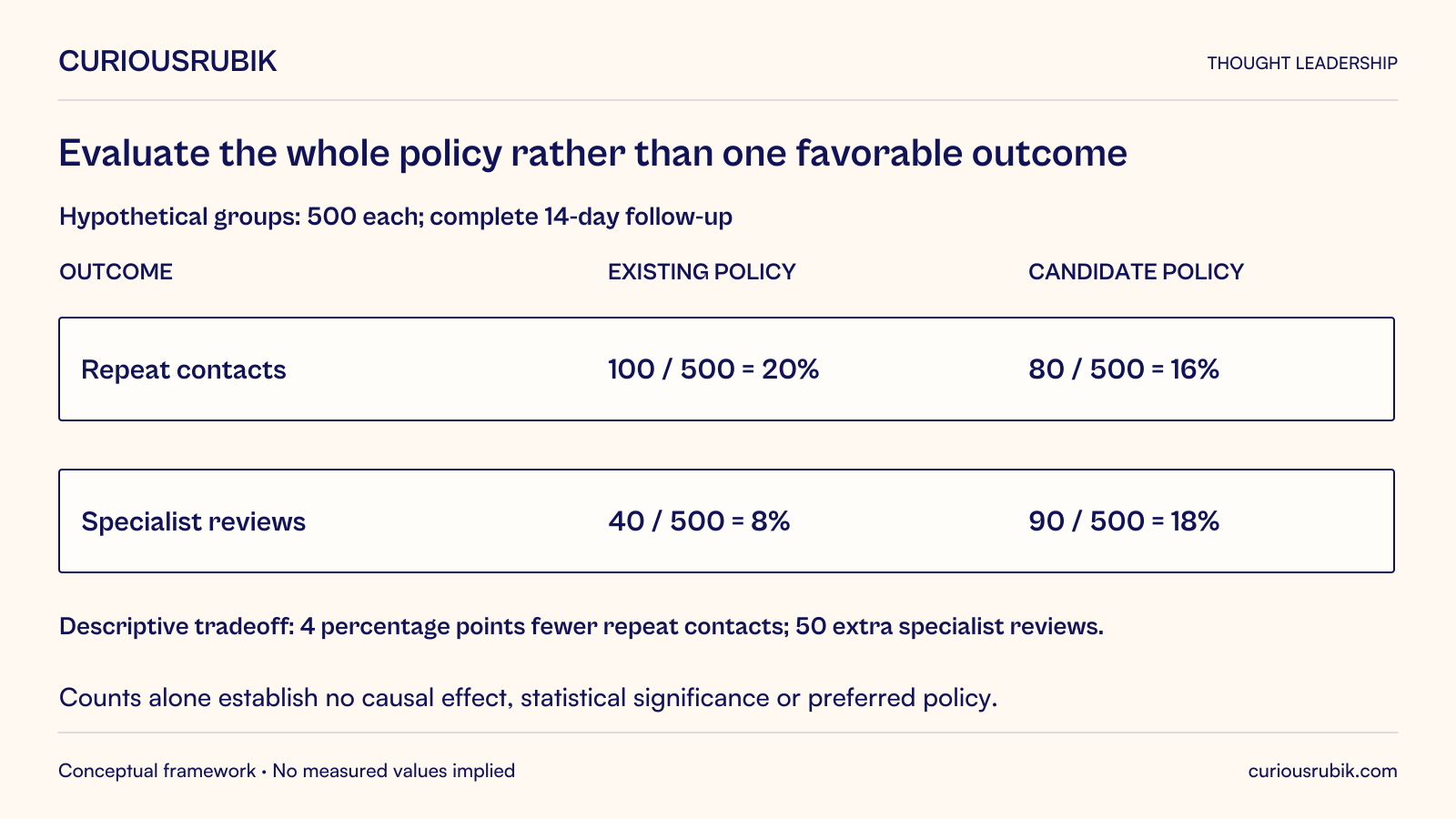
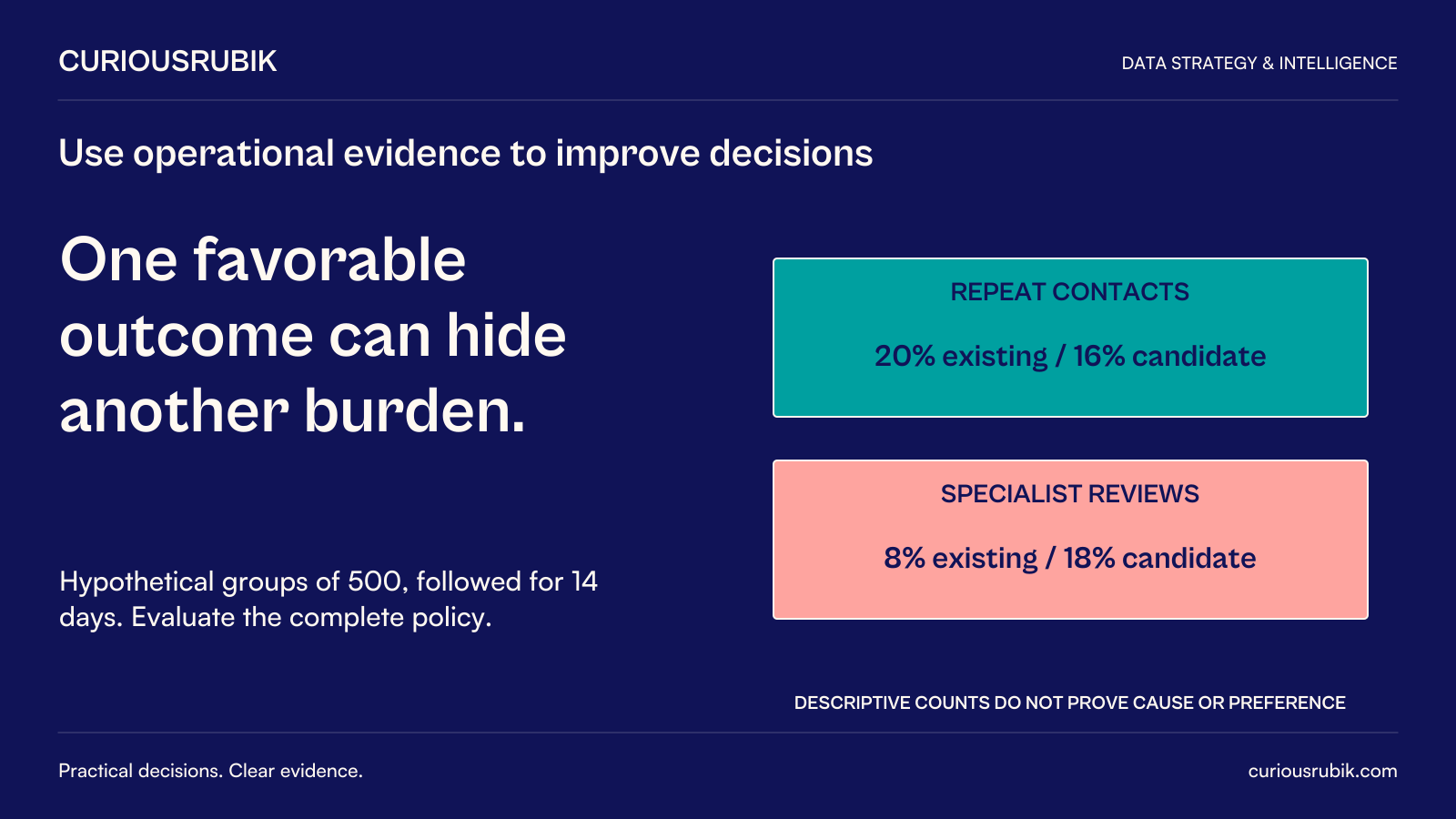
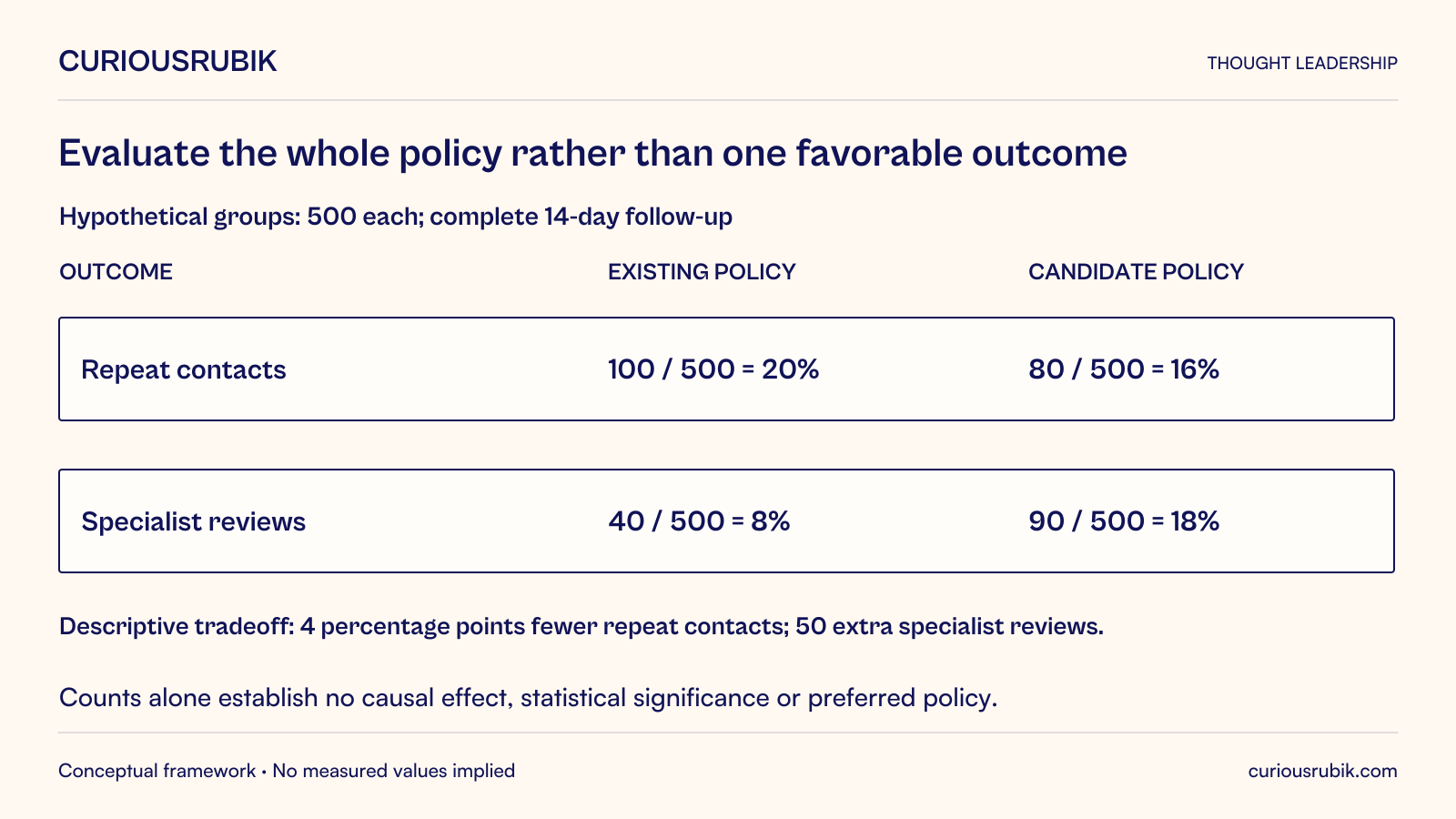
Suppose two hypothetical groups each contain five hundred eligible service requests with complete fourteen-day follow-up. Under the existing policy, one hundred requests produce a repeat contact, or 20 percent. Under a candidate policy, eighty do, or 16 percent. The descriptive difference is four percentage points.
Now suppose the existing-policy group used forty specialist reviews and the candidate group used ninety. Those counts represent 8 and 18 percent of their respective groups. The candidate’s lower repeat-contact share accompanies fifty additional specialist reviews in this invented example.
The arithmetic does not establish which policy is preferable. Management needs the consequence and resource cost of specialist review, the quality of resolved cases, any delayed work elsewhere, and the reliability of the comparison. If the groups were selected differently or observed in different conditions, the repeat-contact difference may not be caused by the policy.
Even a well-designed comparison would need an assessment of uncertainty and important subgroups. A favorable aggregate can hide deterioration for a particular request type. The example supplies no statistical significance claim, generalizable effect estimate, or recommended acceptance threshold.
A decision record should therefore state what is known, what remains uncertain, and what additional evidence would change the choice. The next step might be a better-controlled evaluation, a narrower deployment, a revised intervention, or a decision to retain the existing policy. A dashboard showing only 20 percent versus 16 percent cannot make that choice responsibly.
Choose an evaluation design that matches the process
Where permitted and appropriate, randomized allocation can help compare alternatives. NIST’s engineering-statistics guidance describes random assignment and blocking to address relevant nuisance factors. The experimental unit and design still need to fit the operational setting. NIST/SEMATECH, Completely randomized designs and Randomized block designs
Individual-case randomization is not automatically valid for every workflow. If one policy changes a shared queue or consumes specialist capacity, it can affect cases assigned to the other policy. The team may need a different unit, such as appropriately designed teams or time blocks, with qualified analytical support.
When experimentation is unsuitable, use the strongest feasible comparison and state its limitations. A staged rollout, matched comparison, or interrupted operational history may provide useful evidence, but none should be described as equivalent to an ideal randomized study without justification.
Predefine eligibility, outcome windows, exclusions, and stopping conditions. Avoid changing the success measure after seeing the result. Include safeguards for consequential failures and retain authorized human handling where the proposed policy is not suitable.
Shadow evaluation has a different purpose. A policy can generate recommendations without executing them, allowing the team to inspect feasibility, consistency, and likely conflicts. It cannot directly reveal the outcomes of actions that were never taken. Treat shadow results as evidence about the recommendation process, not proof of business impact.
Watch how the policy changes the data
Once a policy influences which cases are reviewed or which actions are taken, the resulting data reflects that selection. Outcomes observed only for investigated cases cannot automatically describe all cases. A model can become more confident about the population it already favors while learning little about the rest.
Record eligibility and selection as well as execution. The learning process needs to distinguish cases the policy considered, cases excluded by scope, cases assigned to human review, and cases where no action occurred. Missing outcomes should have a reason where one can be established.
Inspect feedback loops. If a routing policy sends more cases to a specialist, specialist findings may become more common simply because more investigations occur. Interpreting that change as proof that the underlying problem increased can reinforce the same routing policy without independent evidence.
Preserve important alternative explanations. Changes in products, intake channels, staffing, definitions, and customer behavior can affect outcomes. Monitoring should help identify these shifts and trigger reassessment rather than automatically treating every change as model deterioration or improvement.
Govern policy changes as releases
Version the policy, its inputs, the model if used, and the rules that translate recommendations into actions. A small threshold change can alter the population receiving an intervention even when the model remains identical. It deserves testing and approval proportionate to its consequence.
Maintain a release record showing the supporting evaluation, known limitations, permitted scope, operating owner, and rollback or suspension conditions. The person approving expansion should see both the intended benefit and the unresolved uncertainty.
Do not make continuous learning synonymous with automatic production change. Updating a model or rule from new data can be useful, but the change needs an appropriate evidence and authorization path. Some decisions justify frequent bounded updates; others require deliberate review before any altered policy affects people or commitments.
Plan suspension around business state. Turning off a recommendation service may be straightforward; undoing actions already taken may not be. The fallback should identify who handles pending work and how existing decisions are reconciled, rather than simply restoring an earlier software version.
Build the capabilities in a useful order
Start with a reliable decision and outcome record, because later evaluation depends on it. Then establish a baseline policy, a suitable comparison method, and a review process that can change the policy when evidence warrants it. Add more sophisticated prediction or optimization only when it addresses a demonstrated limitation.
A simple policy with clear evidence may be preferable to a complex model whose decisions cannot be reconstructed. Conversely, a more sophisticated model may be worthwhile when it improves a well-defined task and the organization can maintain its evaluation and operating responsibilities.
There are costs to decision intelligence: instrumentation, outcome follow-up, expert review, analytical design, and change control. Some low-consequence choices do not justify an elaborate system. Concentrate effort on recurring decisions whose consequences and volume make learning valuable.
The next practical step is to choose one policy already influencing operations. Reconstruct a sample of its recommendations, actual actions, and complete outcome windows. Identify what prevents a trustworthy comparison, and fix that evidence gap before promising smarter decisions. The useful future is an organization that can learn which actions work, for whom, under which conditions, and when its previous conclusions should no longer be trusted.