Enterprise software becomes unreliable when the path from a proposed change to a running service depends on undocumented steps, inconsistent environments and unclear responsibility after release. Faster deployment does not solve that problem if it simply repeats the same uncertainty more often.
The value of DevOps is a more coherent way to build, verify, release and operate software. Development and operations share responsibility for the service outcome, while automation makes routine work repeatable and evidence easier to inspect.
For a business sponsor, the useful question is whether the delivery system reduces uncertainty about what changed, why it is safe to release and what the team will do if the result is wrong. A new toolchain or a renamed team is not sufficient evidence.
Treat the delivery path as part of the product
An application includes more than its source code. Its behavior depends on configuration, data structures, dependencies, permissions and the environment in which it runs. Those elements need controlled change as well.
Map the path from a business requirement to production behavior. Identify manual handoffs, repeated approvals, environment differences and steps that depend on one person’s memory. Distinguish necessary judgment from avoidable coordination and re-entry.
Assign ownership for the complete path. Developers should understand how their changes behave in operation, while operations should participate early enough to influence supportability and recovery. Security and business owners need a clear role in the decisions that concern them.
This does not require every person to perform every task. It requires responsibilities and evidence to connect without losing accountability at departmental boundaries.
Make a release reproducible and identifiable
The team should know exactly what it intends to deploy and how that artifact was produced. Record the source revision, dependency versions, build process and relevant configuration so that the release can be traced and investigated.
Avoid rebuilding an apparently identical version with uncontrolled inputs and assuming the result is the same. Promote a verified artifact through the appropriate stages, with controlled environment-specific configuration and evidence that applies to the actual release.
Google’s Site Reliability Engineering chapter on release engineering emphasizes reproducible, automated builds and repeatable releases. It also describes controls over changes and deployment suited to the service’s risk. These are operating principles, not a requirement to copy Google’s tools or release cadence. Google SRE, Release Engineering.
Keep the release record understandable to the people who will respond to an incident. A version identifier is useful only if it can be connected to the changes, configuration and evidence that produced the running behavior.
A calendar configuration can change the customer promise
Consider a hypothetical business application that calculates a promised completion date for customer work. The software uses an approved operating calendar for the relevant service location.
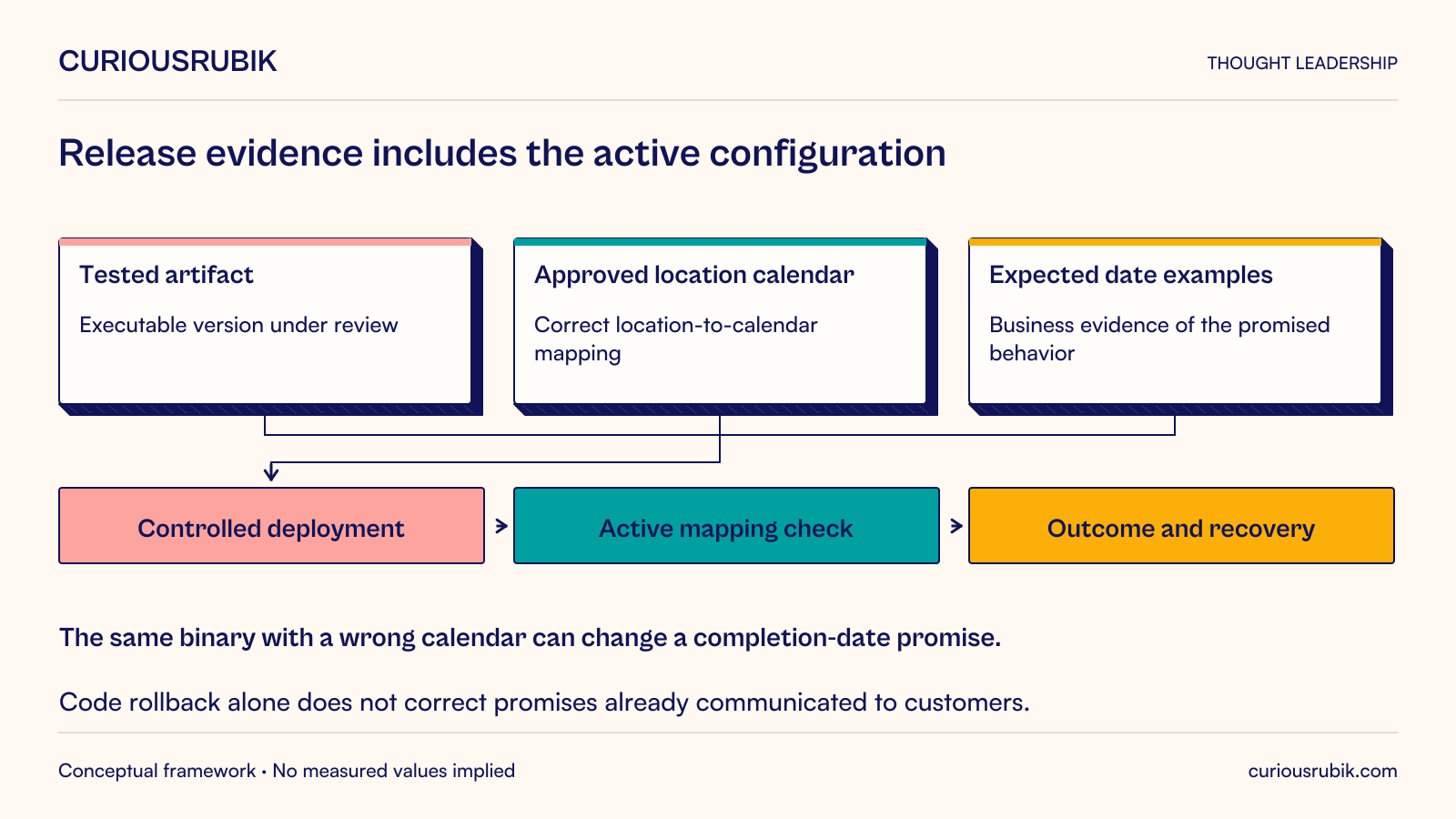
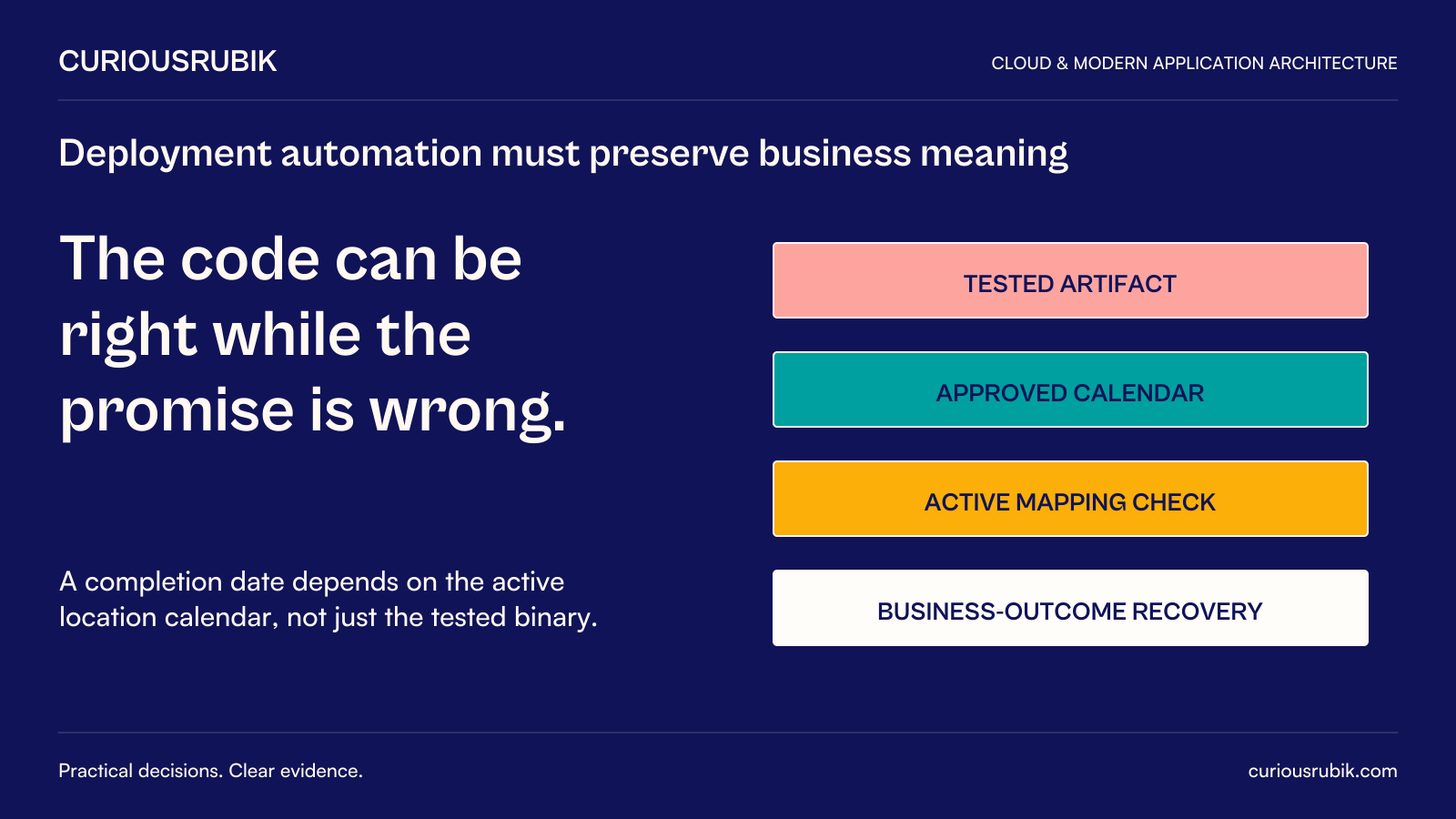
The development team tests a new release against the correct calendar version. In production, an older configuration still points to a different location’s calendar. The same application binary can therefore produce a different promise from the one tested.
A reliable delivery process treats the calendar reference as part of the controlled release context. It verifies the intended mapping, checks representative dates and confirms the active configuration after deployment. A green build alone does not establish that the production service uses the correct business rules.
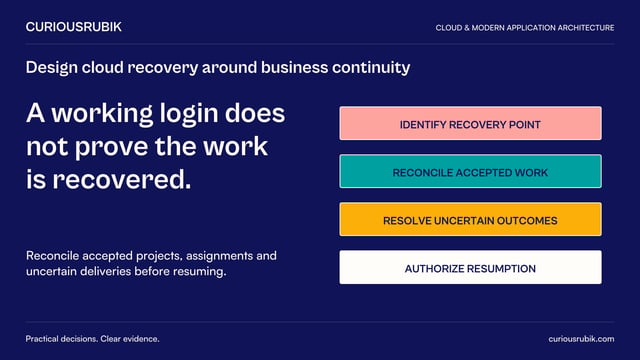
If incorrect dates have already been communicated, deploying the previous binary may not resolve the business effect. The team must identify affected commitments and follow an authorized correction process. Recovery includes the service outcome, not just the running software version.
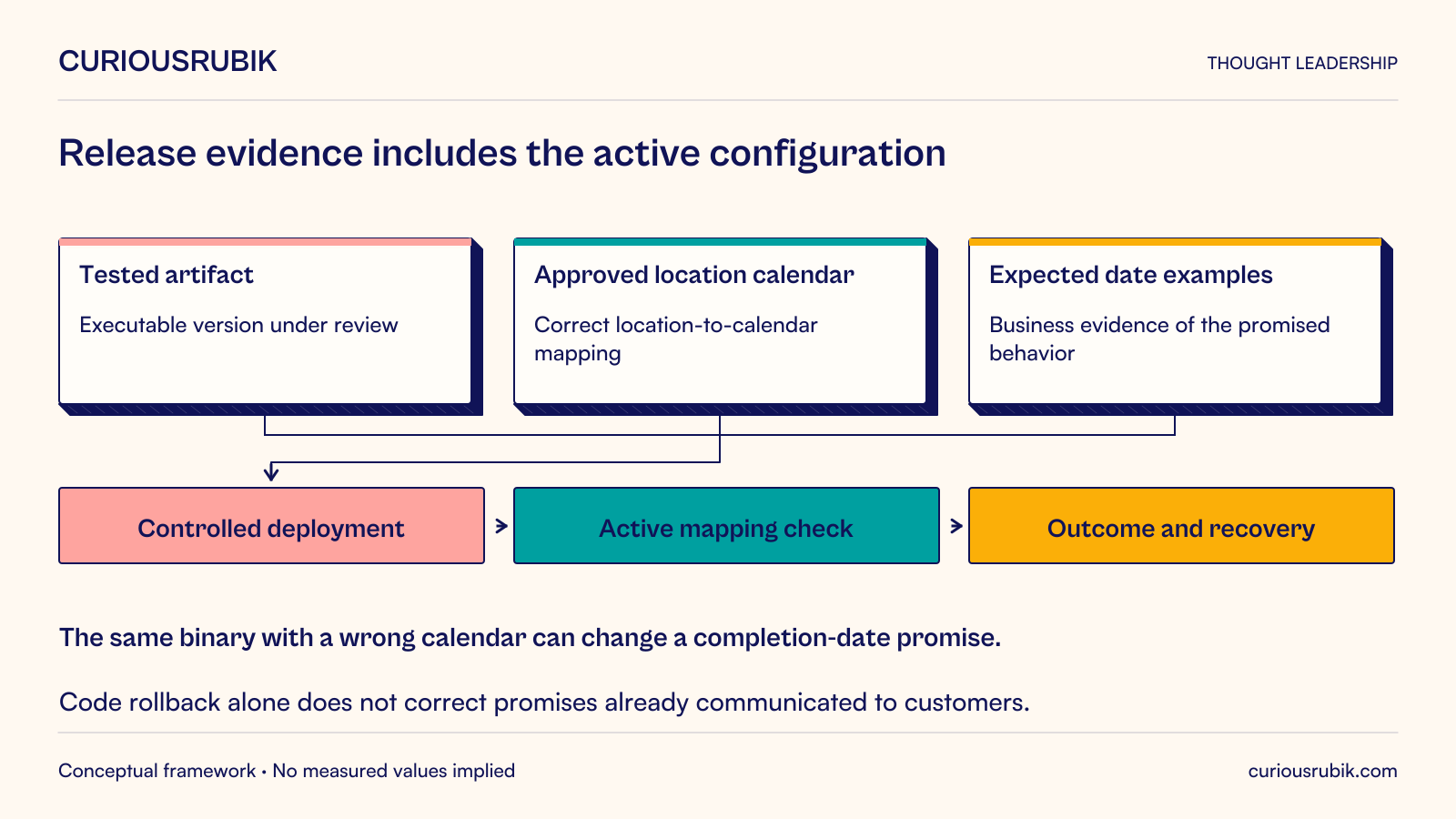
This example shows why reliability depends on connecting engineering evidence with operational meaning. It is not enough for each team to confirm that its own step completed successfully.
Automate checks with a clear purpose
Automation is most useful when it makes a known check repeatable and gives a meaningful result. Unit tests, integration tests, dependency checks and deployment validation address different questions.
Define what each check establishes and what remains outside its scope. Passing a syntax or build check does not prove that the application meets the business requirement. A security scan does not prove the absence of vulnerabilities. A successful deployment command does not prove that users can complete the task.
Use representative expected outcomes approved independently of the implementation where the consequence warrants it. In the calendar example, tests should include relevant location and date boundaries, not simply assert that the function returns any date.
Keep tests trustworthy. Investigate intermittent failures rather than normalizing the habit of rerunning until green. Remove obsolete checks through a controlled process and add coverage when incidents reveal a missing assumption.
The aim is useful evidence at the right stage, not the largest possible test count.
Reduce change size without losing coherence
Smaller changes can be easier to understand, review and investigate, but they must still form a coherent unit of behavior. Splitting work into fragments that leave the service in an invalid intermediate state does not improve reliability.
Plan changes to shared interfaces and data structures so that old and new components can coexist where required. Identify compatibility assumptions and test the sequence, including interrupted deployment.
Separate deployment from enabling a feature when that is useful and safely supported. A feature-control mechanism can limit exposure, but its configuration becomes another change that needs ownership and verification.
Choose rollout stages according to risk and observability. A limited release can reveal problems before broad exposure, but only if the selected population exercises the relevant behavior and the team can detect the failure.
Do not use deployment frequency as the sole performance target. A team can increase the count by making trivial changes while important work remains delayed or unreliable.
Put control where it produces evidence
Approval should be tied to the decision being made. Technical review, business acceptance and production authorization may have different owners and evidence requirements.
Automate routine evidence collection and policy checks where appropriate so that reviewers can focus on meaningful uncertainty. Do not replace a required judgment with a generic green status whose underlying checks are unclear.
Protect the delivery system itself. Control who can change pipeline definitions, dependencies, deployment configuration and production permissions. A well-tested application can still be compromised or misconfigured through an uncontrolled release path.
Maintain a clear record of what was approved and what actually ran. If the artifact or material configuration changes after approval, determine which evidence and decisions must be repeated.
Emergency changes need a supported path too. Urgency can justify a different process under the organization’s policy, but it should not eliminate identity, accountability or follow-up verification.
Design recovery before the release
For each material change, determine the available recovery options. Some changes can be reversed by restoring an earlier artifact or configuration. Others require data repair, compatibility work or a forward correction.
Do not assume that rollback is always safe. A new version may have written data that an old version cannot interpret. An external notification or business commitment cannot be undone merely by changing the application process.
Rehearse the recovery steps in an appropriate environment and identify the evidence required to resume normal operation. Keep responsible people and required access available for the release’s risk window.
Define stopping conditions for a staged rollout. If an important service measure deteriorates or an integrity check fails, the team needs authority to pause rather than continue because the deployment schedule says so.
Recovery planning should influence the design of the change, not be a document written after implementation is complete.
Connect production observation to development decisions
Monitor the user and business outcomes affected by a release. Infrastructure indicators matter, but they may miss incorrect calculations, incomplete work or a broken authorization path.
Use identifiers and release metadata that help connect an observed problem to the relevant artifact and configuration. The operating team should be able to compare behavior before and after the change without relying on recollection.
Agree which signals require investigation and who responds. A dashboard without an owner or decision rule does not create a reliable feedback process.
Feed incident findings into the delivery system. If a configuration mismatch caused a failure, improve the configuration evidence or validation. If a missing business example allowed an incorrect result, add that example to the appropriate acceptance process.
This closes the loop between building and operating the service. The goal is to reduce the chance of repeating the same class of failure, not merely restore service faster each time.
Measure flow and reliability together
Useful measures can include time from an approved change to usable release, time spent waiting, failed changes, recovery effort and repeated manual intervention. Define them consistently and interpret them in the context of the service.
A shorter delivery time is not necessarily an improvement if failures increase or essential work is excluded from the measure. A low failure count may reflect very few changes rather than a strong delivery capability.
Examine bottlenecks with the people doing the work. Some delays arise from missing decisions or conflicting priorities rather than tooling. Automating around an unresolved organizational issue can make the process harder to understand.
Use measurements to guide improvement rather than rank teams with different workloads and risks through a single number. The purpose is a more dependable service and a clearer path for useful change.
Build a delivery capability the organization can sustain
Start with the most consequential uncertainty in the current release path. Make the artifact identifiable, remove an undocumented step, verify configuration or improve the evidence for a critical business behavior.
Develop reusable practices and supported tools without creating a central bottleneck for every change. Teams need enough autonomy to deliver within clear controls and enough shared capability to avoid rebuilding the basics poorly.
DevOps contributes to enterprise reliability when it makes change understandable, repeatable and observable. Its value appears in the organization’s ability to release the intended behavior, recognize when reality differs and recover with evidence rather than improvisation.