Close the overlap with a decision record, not an assumption that files changed hands.
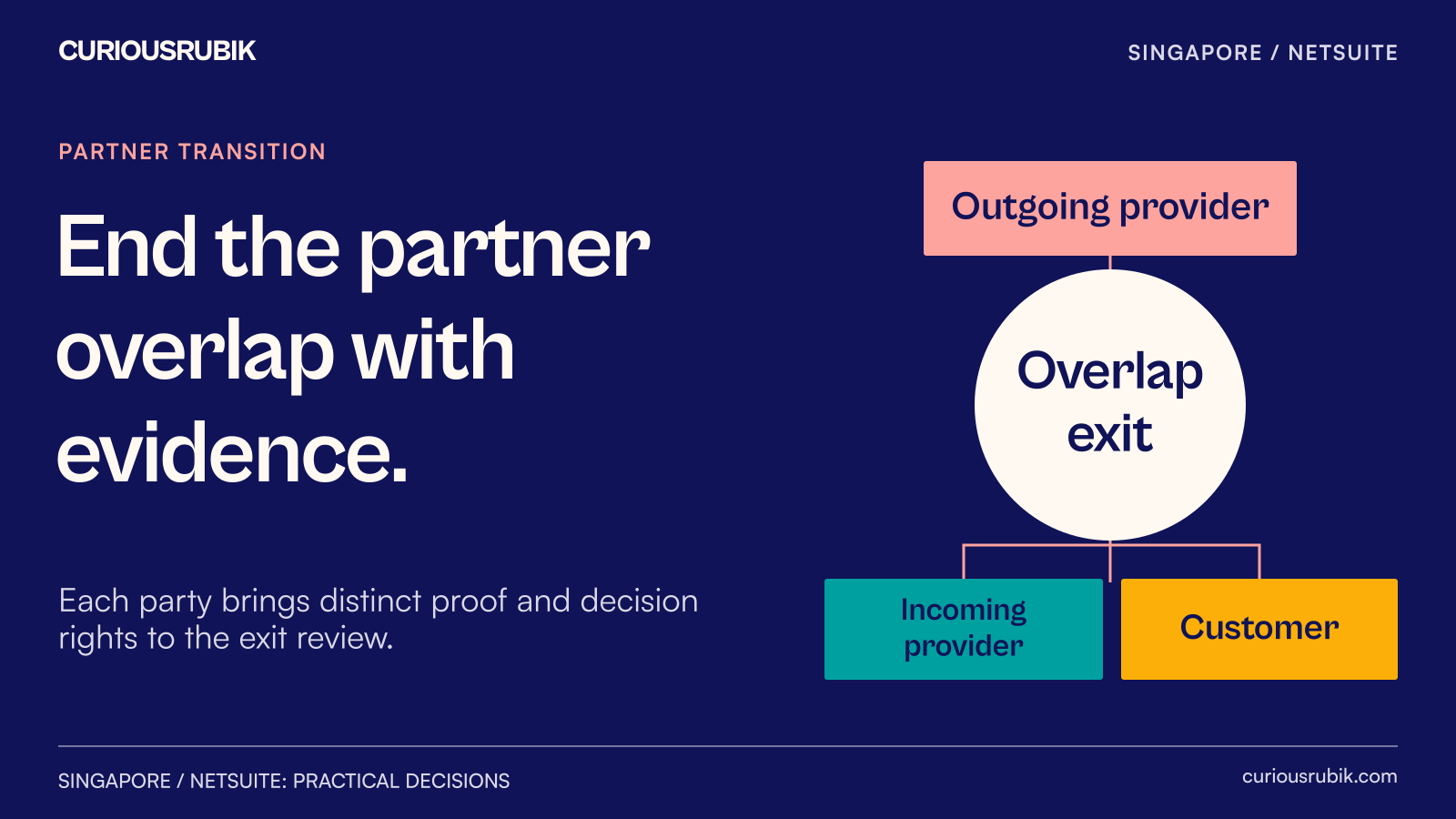
End the overlap between NetSuite support partners when the incoming team can perform the agreed responsibilities, the customer controls the necessary records and access, and remaining obligations have an explicit owner. The last calendar day of the outgoing engagement is a commercial boundary. It is not, by itself, evidence that the support transition is operationally ready.
A Singapore headquarters coordinating regional entities needs to test the handoff across both provider and country boundaries. The incoming team may understand the account but still lack the person who can explain a regional close exception. The transition decision should expose those dependencies before the outgoing team's knowledge becomes harder to obtain.
Separate three forms of acceptance
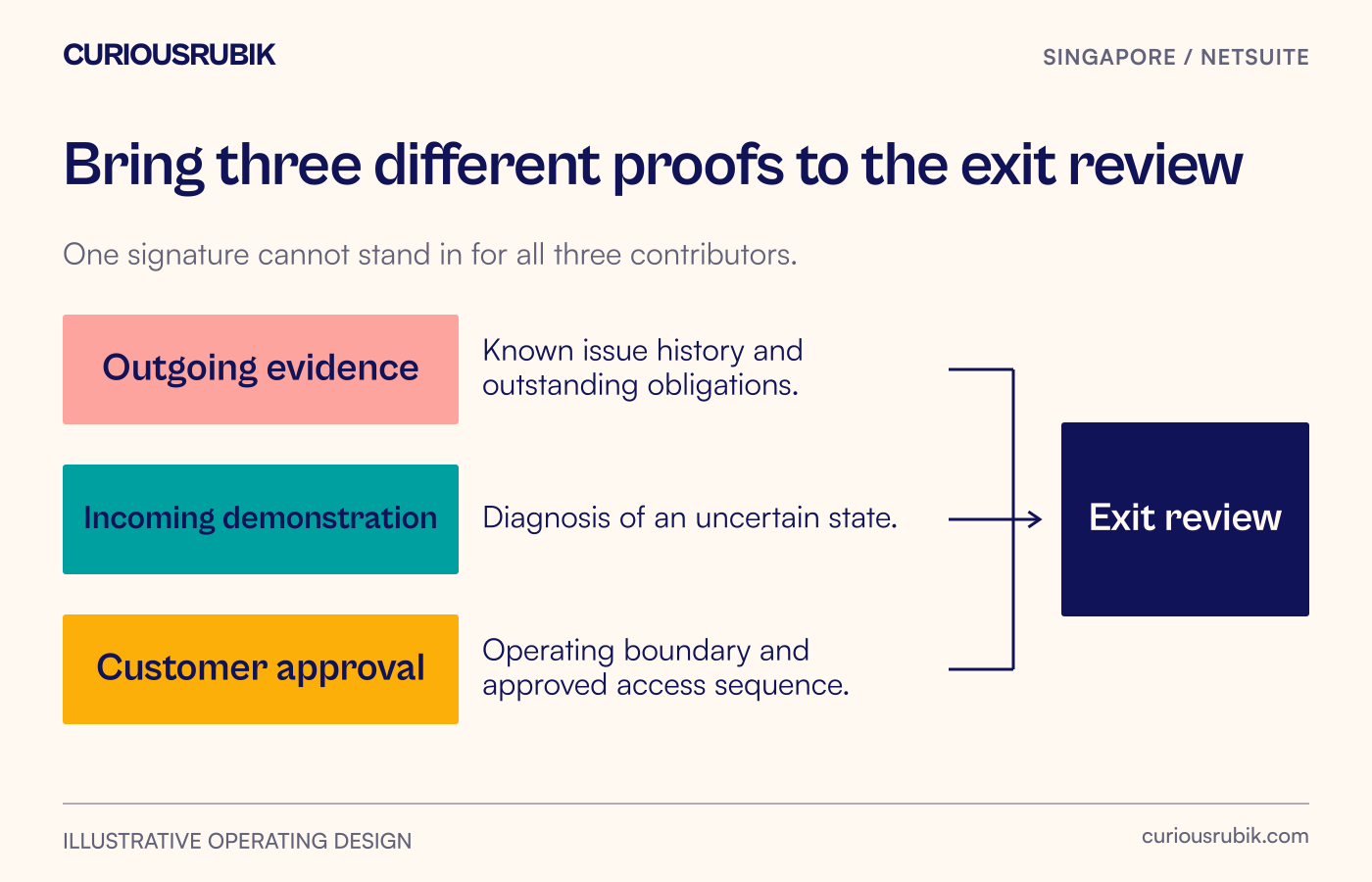
There are three different questions in a partner transition:
- Has the outgoing provider completed its agreed handover obligations? Check the actual agreement and evidence of what was supplied. Commercial disagreements need the appropriate business and legal review.
- Has the incoming provider accepted the defined support responsibilities? It should identify what it can operate now, what it has not tested and what remains outside scope.
- Has the customer accepted the residual operating risk? Business owners need to understand gaps, temporary arrangements and dependencies that neither provider can resolve alone.
Combining these into one “handover complete” status can conceal a material problem. A complete document delivery may coexist with an untested recovery procedure. An incoming team's operational readiness does not resolve an outstanding commercial claim.
Use an overlap-exit record to keep the three decisions separate while showing how they affect the proposed end date.
A fictional transition with one stubborn fault
Consider a Singapore regional group moving from its implementation provider to a new support partner. Headquarters owns the relationship, while a trading subsidiary depends on a warehouse interface. The transition has a planned overlap period, but its duration is not specified here because the appropriate window depends on the actual work and agreements.
The outgoing team has supplied the agreed component references and issue history. The incoming team can locate the finance configuration and diagnose routine user questions. One fault remains open: a warehouse message occasionally reaches an unresolved state, and the incoming team has not yet demonstrated how it would establish whether the business transaction was processed.
These facts and providers are illustrative. The issue is not presented as a known NetSuite defect. Its location could be configuration, integration logic, a provider service or operating procedure; the transition team has not concluded the cause.
The Singapore sponsor wants to end overlap as planned. The country operations owner asks for continued access to the outgoing specialist until the uncertain-state scenario has been exercised. The exit record makes that disagreement testable.
Fill a three-party ownership record
Unclosed warehouse fault. Outgoing provider: supplies the available diagnostic history and explains the known safe investigation path within its agreed obligations. Incoming provider: reproduces or rehearses the diagnostic decision in an approved environment and identifies any limits. Customer: supplies the business references, names the operations approver and accepts any temporary operating boundary.
Support intake. Outgoing provider: confirms which open cases it retains and which are transferred under the agreed arrangement. Incoming provider: confirms the accepted intake route and case ownership from the transition point. Customer: tells authorized users which route to use and prevents two teams from unknowingly changing the same case.
Documentation and source references. Outgoing provider: delivers the agreed materials through the approved location. Incoming provider: confirms that the relevant versions can be found and used. Customer: verifies its access to the records and resolves any ownership or licensing questions under the applicable agreements.
Access transition. Outgoing provider: identifies the access it uses and any remaining approved need. Incoming provider: requests the permissions necessary for its defined tasks. Customer: authorizes the access changes and confirms the effective result. Nobody transfers secret values in a handover spreadsheet.
Test the incoming team's independence safely
The exercise should answer whether the incoming team can make the next safe decision without unexplained help. For the fictional warehouse fault, give it a sanitized event reference and the approved documentation. Ask it to identify the last confirmed state, explain what evidence is missing and choose the authorized escalation route.
A successful exercise does not require deliberately interrupting production. A sandbox or other approved test arrangement may be useful, subject to feature availability and verified external endpoints. Test the exact boundary that matters rather than assuming a non-production ERP account isolates every connected service.
Observe where the outgoing specialist must intervene. An explanation of undocumented logic reveals a knowledge gap. A missing provider entitlement reveals a commercial dependency. A missing customer decision reveals a governance gap. Each needs a different remedy.
NetSuite permissions are role-based, but access readiness requires more than assigning a familiar role name. Verify the intended tasks and restrictions in the actual account. Persistent access changes should follow the customer's security approval process and retain a record of who authorized them.
Make the overlap-exit decision in four rows
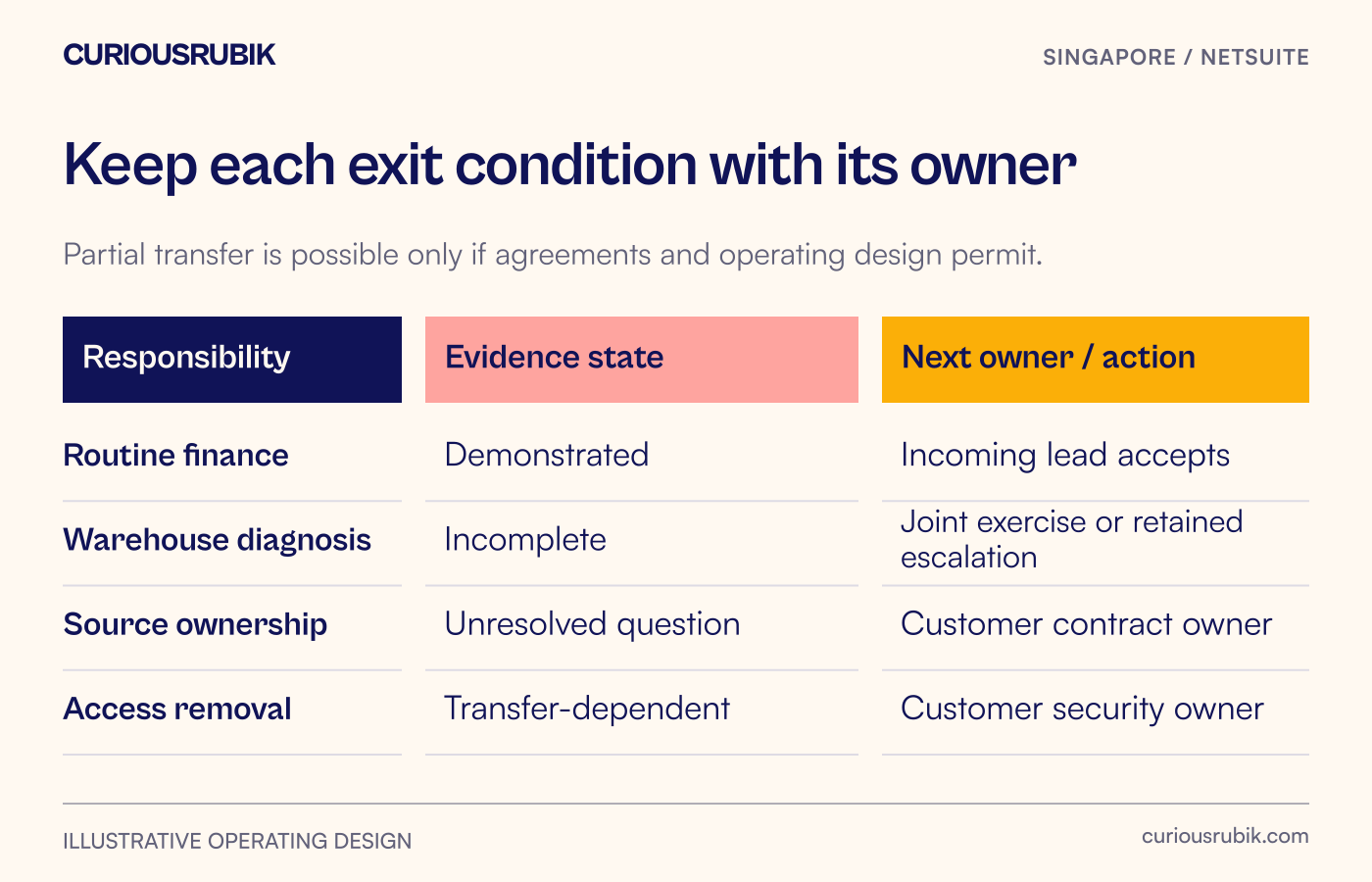
For the example, the decision matrix reads as follows:
- Routine finance support: evidence demonstrated; incoming lead accepts ownership; eligible to leave overlap for this responsibility.
- Warehouse uncertain-state diagnosis: evidence incomplete; incoming and outgoing specialists need a bounded joint exercise; retain a specifically agreed escalation arrangement or defer exit for the affected responsibility.
- Customer control of records: access confirmed, with one source-ownership question unresolved; the business contract owner obtains a determination before relying on that component for future changes.
- Access removal: plan approved in principle, execution dependent on accepted responsibility transfer; the customer security owner controls the sequence and verification.
This may support a partial transition if the contracts and operating design permit it. It does not authorize extending paid services, altering agreements or assuming the outgoing provider will remain available. Confirm the arrangement explicitly with the authorized commercial owners.
Prevent a clean exit from becoming an unowned backlog
Every remaining issue needs a current owner, next action and review condition. Distinguish a known limitation the customer has accepted from a fault somebody has merely stopped investigating. Retain the reason when an issue is deferred.
Also identify the first regional close, release test or provider maintenance event the incoming team will face. The transition exercise should prepare it for those known responsibilities. It should not silently expand the incoming contract to include every future improvement.
Use the existing support handover documentation guide for the contents of the technical pack. The exit record adds a separate decision: whether the evidence and ownership are sufficient to end the overlap now.
For a managed support transition, bring the open-fault list, three-party record and proposed access sequence to the review. A defensible exit leaves the customer able to explain who owns the next incident, including the uncomfortable ones that were still open on the handover date.