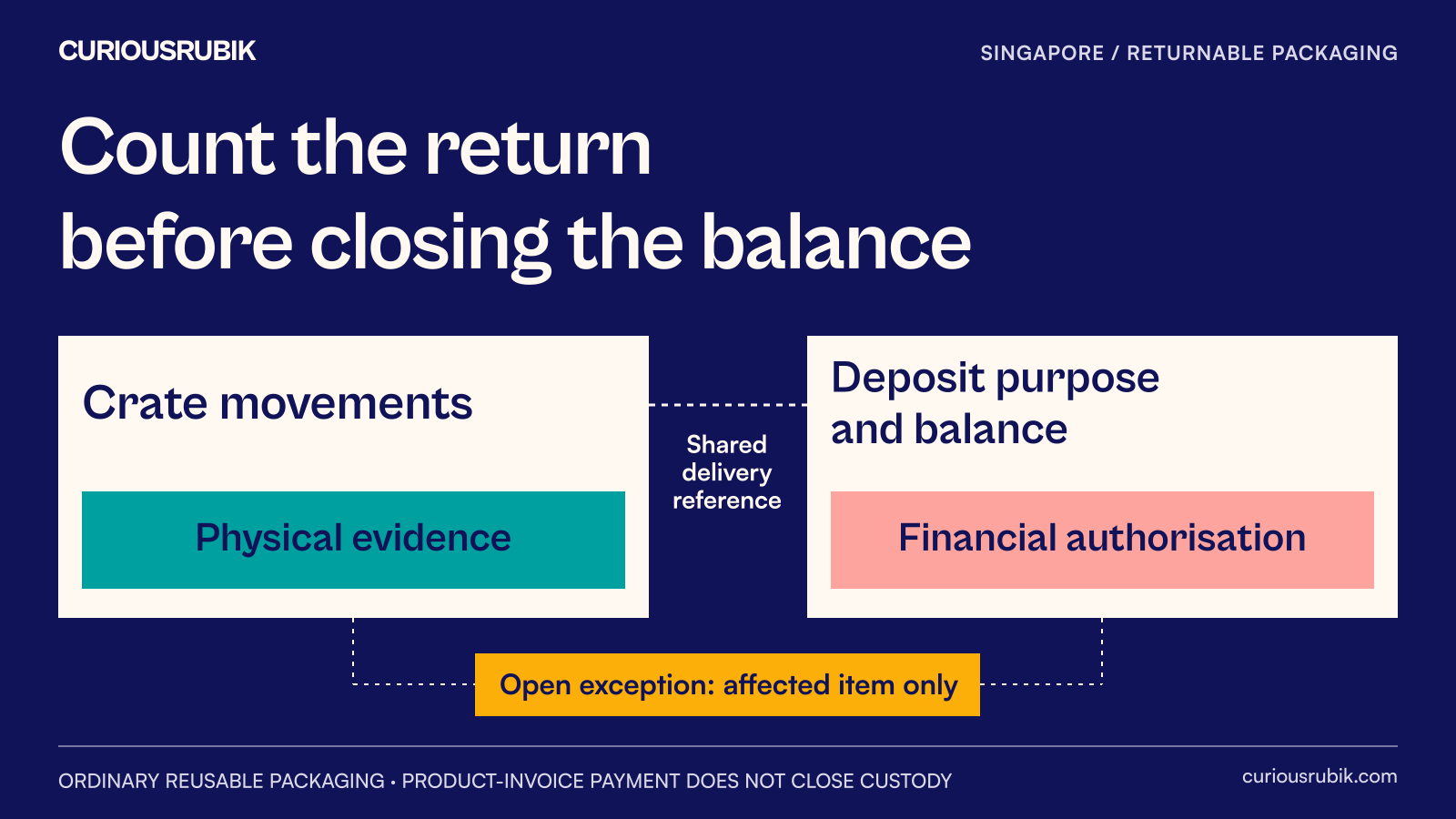
A paid delivery does not tell a distributor whether its crates have returned. A recorded crate return does not tell finance whether a deposit should be refunded, applied or remain under review. Combining those questions into a single “order closed” status makes both harder to answer.
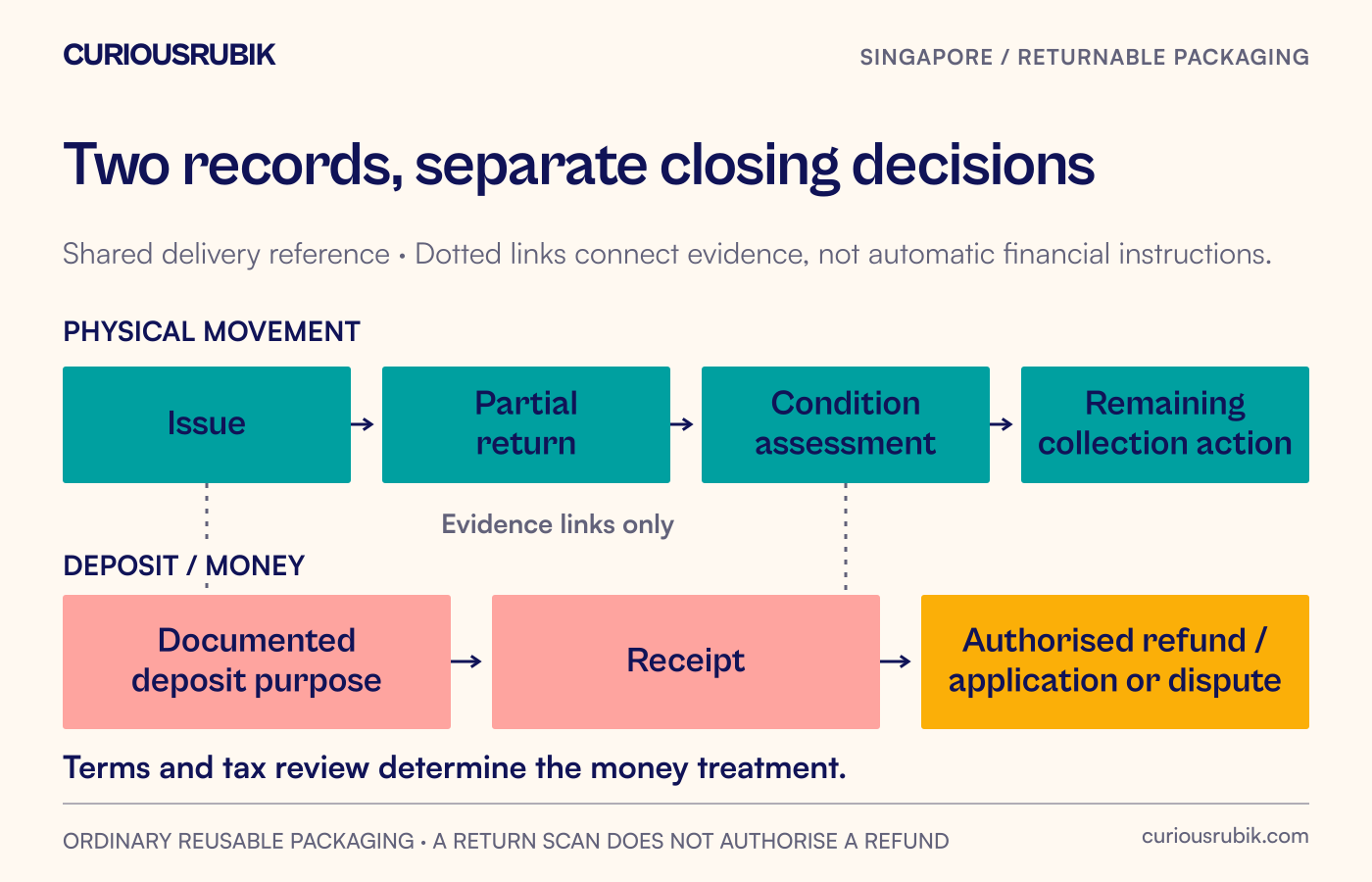
Run two connected records: physical packaging movements and the financial purpose of any related payment. They should share references, while keeping their own evidence and decision owners.
This article concerns ordinary reusable transport packaging. It is not guidance on Singapore's statutory beverage-container return arrangements, and it does not assume that every reusable crate carries a deposit.
Read the delivery record from both sides
Start with a hypothetical delivery of twenty returnable crates to a customer. The goods are delivered and their invoice is paid. From a sales perspective, that part of the transaction may be settled. The packaging record still needs to show twenty crates issued, the receiving location, relevant terms and the expected return arrangement.
If the customer also provides a deposit, finance records what that payment is for. Is it security for return? Does any part form payment for goods or services? What circumstances permit a refund, application or charge? The agreement and actual arrangement answer those questions, rather than the field name chosen by the dispatcher.
For GST-registered businesses, IRAS distinguishes partial-payment deposits from refundable security deposits, including security for the safe return of goods. The GST timing differs according to purpose and subsequent application. A refundable payment can still be a partial payment, so finance needs the underlying terms before deciding treatment.
The distribution coordinator owns the crate position. The account owner resolves customer disagreements. Finance owns the money record and applicable tax review. They need a common delivery reference so that an issue can move between them without being re-created as an unrelated case.
Count what came back before deciding what remains due
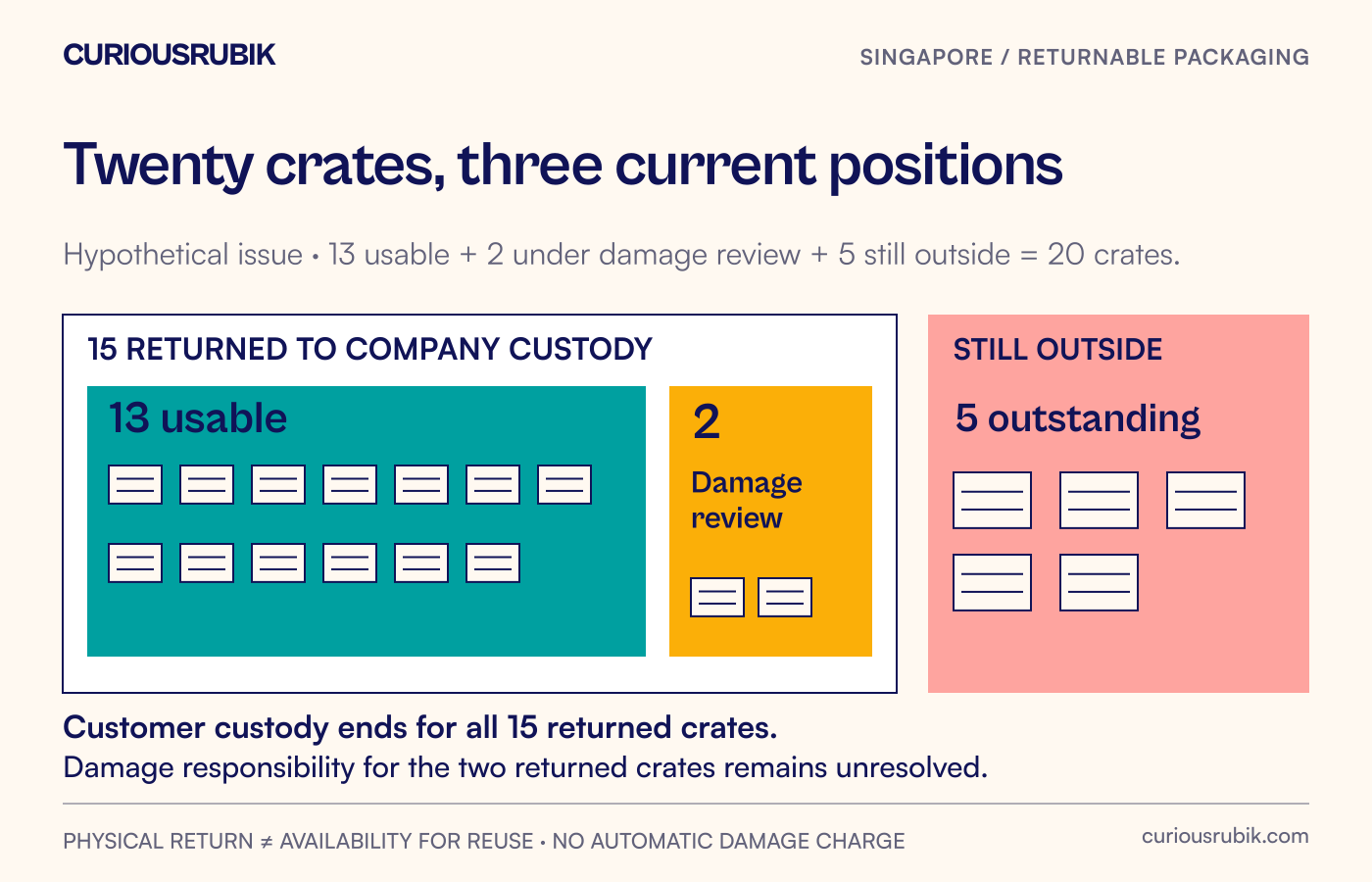
Suppose fifteen of the twenty crates return. Thirteen are reusable; two require a damage assessment. The physical position is five crates still outside the business, thirteen returned and usable, and two returned but not yet cleared for use.
Do not record only thirteen returns because the other two are damaged. That would wrongly leave seven crates in customer custody. Equally, do not add all fifteen to usable stock just because a driver has brought them back. Custody and condition answer different operational questions.
The return event should identify the crate type, quantity, source customer or collection point, date and receiving evidence. If similar packaging is pooled, the process needs a defensible way to allocate the return to the right account. A matching quantity alone may not prove whose balance should reduce.
Ask the receiver to record uncertainty at the time. “Two crates received, damage responsibility unresolved” is more useful than a later disagreement over whether they were returned at all. Preserve the customer's acknowledgement and any relevant condition evidence without turning the delivery paperwork into an unnecessary store of personal data.
Read the diagram text
CURIOUSRUBIK SINGAPORE / RETURNABLE PACKAGING Twenty crates, three current positions Hypothetical issue · 13 usable + 2 under damage review + 5 still outside = 20 crates. 15 RETURNED TO COMPANY CUSTODY 13 usable 2 Damage review STILL OUTSIDE 5 outstanding Customer custody ends for all 15 returned crates. Damage responsibility for the two returned crates remains unresolved. PHYSICAL RETURN ≠ AVAILABILITY FOR REUSE · NO AUTOMATIC DAMAGE CHARGE curiousrubik.com
Annotate the money record without guessing the outcome
The deposit record should reference the movement balance and the terms governing it. It should show the amount received, its documented purpose, amounts refunded or applied, approved charges and the unresolved balance. Include the person authorising each financial action.
The return of fifteen crates does not necessarily mean refunding fifteen-twentieths of a deposit. That result may be appropriate under a particular agreement, but another arrangement may use a pooled deposit, a minimum balance or a different agreed basis. The business must establish the actual terms.
Likewise, the two damaged crates do not automatically justify retaining money. Operations determines the condition and evidence. The account owner establishes the contractual and commercial position. Finance applies the authorised outcome and relevant tax treatment.
If the customer disputes the damage, keep the physical return recorded while the money decision remains open. Do not reverse a genuine return to make the financial balance easier to explain. If a charge is approved, link the charge and any authorised deposit application to the original event.
IRAS's deposit guidance includes specific examples whose treatment depends on their facts. A tenancy-forfeiture example should not be borrowed as a universal rule for lost or damaged packaging. Have the tax reviewer assess the actual crate arrangement and any later application of funds.
Deal with the five crates still outside
The coordinator needs one next action for the outstanding balance: scheduled collection, return with the next delivery, investigation of a disputed issue or an approved alternative. Record who confirmed it and the expected date.
A customer may say that another driver already collected the crates. Investigate the collection record before sending repeated demands or recording a loss. A driver's unallocated return can create a shortage on the customer's account while the crates are already back in the warehouse.
If the customer no longer trades with the distributor, the outstanding packaging needs a specific recovery or commercial decision. Leaving it attached to an inactive account hides the item from ordinary delivery routines. Escalate to the account owner with the issue and return evidence, rather than automatically charging replacement value.
A lost-crate decision should preserve its basis, authority and effect on both records. Closing the physical recovery task does not by itself create an accounting write-off or establish how a deposit may be treated.
Read the diagram text
CURIOUSRUBIK SINGAPORE / RETURNABLE PACKAGING Two records, separate closing decisions Shared delivery reference · Dotted links connect evidence, not automatic financial instructions. PHYSICAL MOVEMENT Issue Partial return Condition assessment Remaining collection action Evidence links only DEPOSIT / MONEY Documented deposit purpose Receipt Authorised refund / application or dispute Terms and tax review determine the money treatment. ORDINARY REUSABLE PACKAGING · A RETURN SCAN DOES NOT AUTHORISE A REFUND curiousrubik.com
Build the reconciliation around movements
For each customer and packaging type, start from the agreed opening balance, add issues and subtract confirmed returns. Show approved adjustments separately with a reason. Then reconcile that result to the customer's position and any stock held by drivers or collection partners.
Preserve transaction dates and cut-off rules. A late-entered collection should be visible as a timing difference rather than an unexplained adjustment. If return evidence arrives in a batch, the coordinator needs to know when custody actually changed as well as when the record was entered.
For the financial side, reconcile the opening deposit balance with receipts, refunds and authorised applications. A difference between the two records is a prompt to investigate, not proof that either side should be forced to match the other numerically.
The practical register can therefore remain compact: customer, packaging type, issue and return references, custody quantity, condition, expected action, deposit purpose, financial status and exception owner. Detailed supporting documents stay linked to the event rather than copied into every row.
Automate exceptions that point to an action
Useful automation can identify an outstanding quantity without a planned collection, a return awaiting allocation or a deposit refund awaiting approval evidence. It can prepare a customer statement for review that distinguishes crates issued, crates returned and disputed items.
Avoid automatic loss charges triggered solely by elapsed time. Do not close a packaging balance because the product invoice has been paid. Do not refund every deposit on any return scan. Those shortcuts confuse evidence from one part of the process with authority for another.
Measure unreconciled balances, repeated collection failures and deposit disputes caused by missing movement evidence. Distinguish physical loss from a record-allocation problem. Reducing a reported shortage by posting an unsupported adjustment improves the report while weakening the control.
Test one customer account from its opening balance through every issue, collection and money decision. If operations and finance can independently explain their figures and connect the open difference to a named action, the design is working. The next delivery should add evidence to that history rather than start another isolated packaging conversation.