A productive meeting can end without a usable next step. The customer says the discussion was helpful. The seller promises to send something. The CRM receives a note that reads “follow up next week.” Seven days later, the seller must reconstruct what the customer was trying to decide, which information was missing and why another message would help.
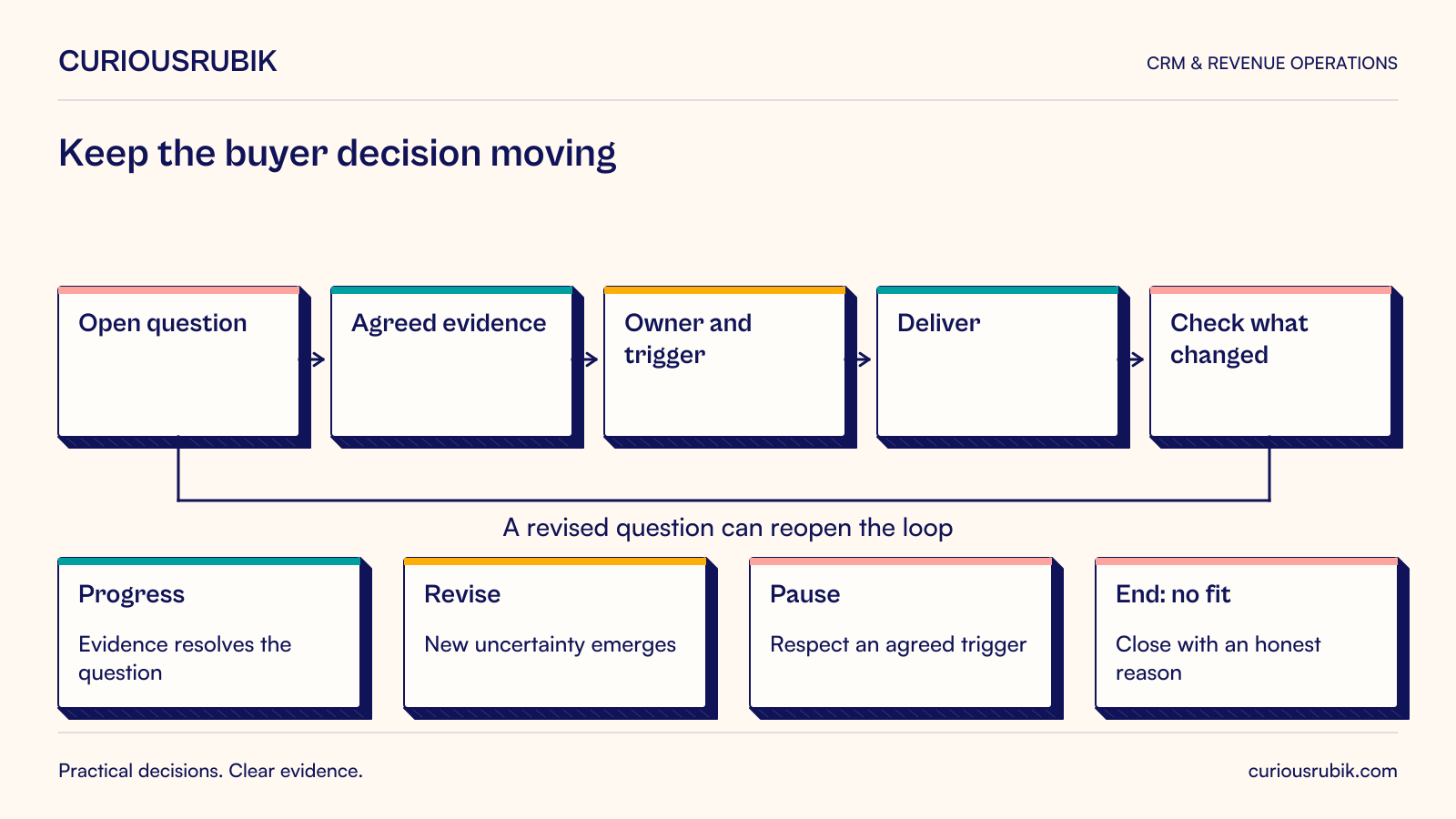
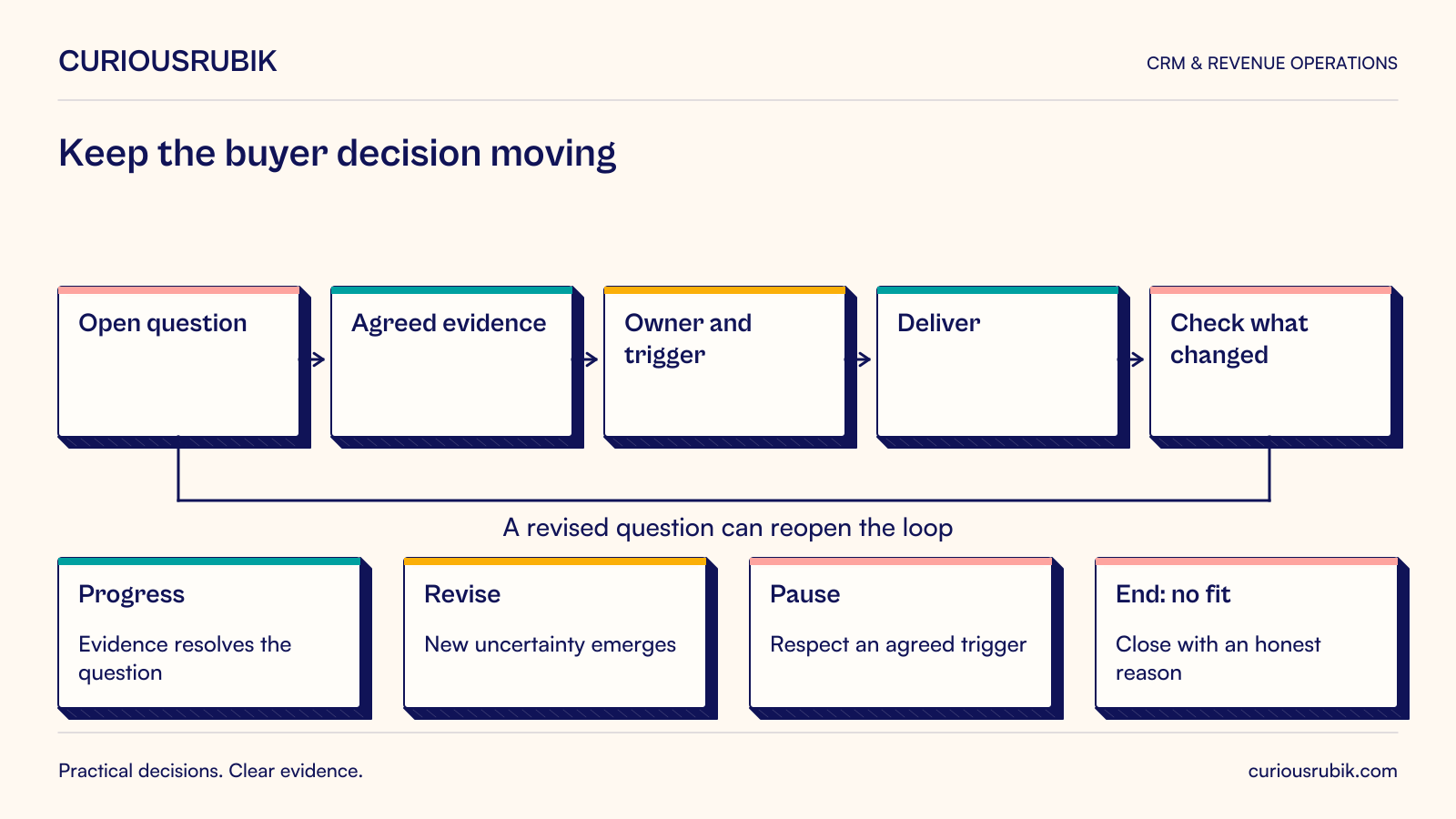
The opportunity has not necessarily been lost to a competitor. It may have lost its next decision. For a sales manager, improving this interval means designing a small commitment loop: capture the buyer’s unresolved question, agree the next useful action, assign responsibility, deliver the promised evidence and review what changed.
This approach does not guarantee progression. Some buyers are exploring, some projects lose funding and some opportunities should close as no decision. The aim is to distinguish those situations from avoidable failures to carry a conversation forward.
Understand what disappears after the meeting
Meeting notes often preserve topics better than commitments. “Discussed integration, pricing and security” says what occurred, but not whether the buyer needs an architecture explanation, a formal quotation or a security review before proceeding. A transcript may contain the answer without making it easy for a colleague to find and use.
The missing element is usually a relationship between four facts: the decision the buyer faces, the evidence needed for that decision, the person who can provide or evaluate it and the relevant timing. A reminder without those facts can generate activity while leaving the decision untouched.
There is a useful distinction in psychological research between intending to achieve a goal and specifying the circumstances and actions that will carry it forward. Peter Gollwitzer’s 1999 paper describes implementation intentions in terms of linking situations to planned responses. That research is not evidence that any particular sales follow-up process improves conversion; it offers a conceptual reason to make an intended action concrete. Implementation intentions.
In sales operations, the practical application is modest: replace “keep in touch” with an action whose purpose and completion can be understood by another person.
Close the meeting around the buyer’s decision
Before ending a substantive conversation, summarize the unresolved question in the buyer’s terms. For example: “You need to determine whether your operations team can reconcile daily stock movements without a second spreadsheet.” This is more useful than “You are interested in integration.”
Then agree the smallest next action that would reduce that uncertainty. It might be a sample reconciliation, a discussion with the actual process owner, a response to a specific contractual question or confirmation that the project is not yet a priority. Another demonstration is appropriate only if it addresses the missing evidence.
Identify who will act and what depends on the other party. A seller cannot honestly promise a completed assessment by Friday if the buyer has not agreed to provide the necessary sample by Wednesday. Record the dependency and propose a revised date when it changes.
Give the customer room to disagree. A next step suggested by the seller is not a customer commitment until the customer accepts it. If the buyer says they need to discuss internally first, capture that reality rather than entering a mutually agreed meeting that does not exist.
Use a compact commitment record
A useful record contains the open question, next deliverable, owner, due date or trigger, dependencies and evidence of completion. Keep the underlying customer context nearby, but do not require an essay after every conversation.
The record should distinguish an internal task from an external commitment. “Ask the solution architect whether a sample is possible” is an internal task. “Send the customer a sample reconciliation by Thursday” is a promise with a recipient and deadline. Conflating them can cause the team to present a tentative plan as an agreed obligation.
Also distinguish sent from useful. Delivering a document proves that an action occurred; it does not prove the buyer’s question was answered. The next conversation should establish whether the evidence resolved the issue, created a new one or showed that the proposed approach does not fit.
This commitment record is a proposed workflow aid, not a validated scoring model. Its minimum fields should be tested with the actual team. If employees must enter the same information into a meeting note, a CRM field and a separate task system, the workflow may be creating its own follow-up problem.
A practical example from equipment sales
Consider a hypothetical supplier of industrial testing equipment. After a demonstration, the buyer’s quality manager is interested but uncertain whether the equipment can handle a particular sample type. The seller’s original note says “Great demo, send brochure and follow up Friday.” A brochure repeats specifications already discussed and does not resolve the uncertainty.
A better record identifies the decision: the quality team must assess suitability for that sample type before requesting purchasing approval. The next evidence is a documented test using an agreed sample and acceptance criteria. The applications specialist owns the test; the buyer owns providing a representative sample and confirming the criteria.
The seller should not invent a promised performance result. The agreed action is to conduct the test and report what happened, including limitations. If the sample arrives late, the delivery date changes transparently. If the test fails, the seller can explore an alternative or stop the opportunity with a useful explanation.
Suppose the test succeeds but the buyer’s facilities team raises an installation constraint. The next action changes accordingly. Sending more reminders about the completed test would be irrelevant. The commitment loop preserves the learning and redirects effort to the current decision.
This is a hypothetical process example, not a claim about achieved conversion or cycle-time improvement. Its value is that every follow-up has a reason the buyer can recognize.
Automate reminders without automating false certainty
Automation is helpful when it remembers an agreed task, alerts the responsible owner to a missed dependency or makes the latest evidence easy to find. It becomes less helpful when it sends messages based only on elapsed time while ignoring what has happened in the relationship.
A reminder should identify the promised action and its current status. If the customer has already replied through another channel, the workflow should allow the owner to stop or update the sequence. If responsibility changes because an employee is absent, the replacement needs the commitment context, not just a list of overdue tasks.
Use human review for messages involving changed scope, unconfirmed capability, unresolved complaints or sensitive commercial terms. A generic “checking in” message may be merely unhelpful; an automated assurance that an unresolved issue has been fixed can create a serious misunderstanding.
Do not infer agreement from silence, an email open or an automated activity signal. Those events can support a workflow observation, but they do not establish the buyer’s intent. Respect communication preferences and applicable requirements, with the relevant team determining the rules for the actual channel and jurisdiction.
Give managers an exception view
Managers do not need to inspect every reminder. They need to see commitments that are overdue, blocked, repeatedly rescheduled or missing a clear purpose. They also need to distinguish an internally delayed promise from a buyer-requested pause.
Review a small selection of records with the seller. Ask whether the next action addresses the buyer’s current question, whether the owner can complete it and what evidence would justify changing the opportunity’s status. This is coaching about reasoning, rather than an exercise in counting touches.
Avoid a universal follow-up deadline detached from context. A customer waiting for a promised clarification tomorrow and a buyer who explicitly requested contact after a quarterly planning meeting need different timing. The process should make those agreements visible, not force both into the same cadence.
When a deal has no genuine next action, decide whether it should remain active. An exploratory relationship may belong in a different workflow from a funded buying process. Keeping both in the same pipeline can obscure priorities and distort the forecast.
Measure whether the loop closes
Track the share of substantive meetings that end with a documented, meaningful next action, but review the quality of those actions rather than treating a populated field as success. An empty promise can satisfy a completeness check while helping nobody.
Pair timeliness with resolution. For example, review whether promised evidence was delivered when agreed and whether the buyer’s question was subsequently resolved, revised or deliberately paused. Count records and use consistent definitions. Do not claim a revenue lift simply because task completion improved.
Look for recurring dependencies across opportunities. If follow-ups repeatedly stall while awaiting the same technical answer, the remedy may be a reusable evidence asset or clearer product guidance. If they stall on approval authority, the remedy may be involving a different stakeholder. More reminders address neither underlying issue.
The next useful change can be small: take the last few substantive customer meetings and ask a colleague to identify the buyer’s open question and agreed next action without asking the seller. Where that cannot be done, improve the record and the meeting close. A sales organization becomes more dependable when useful commitments survive the gap between conversations.