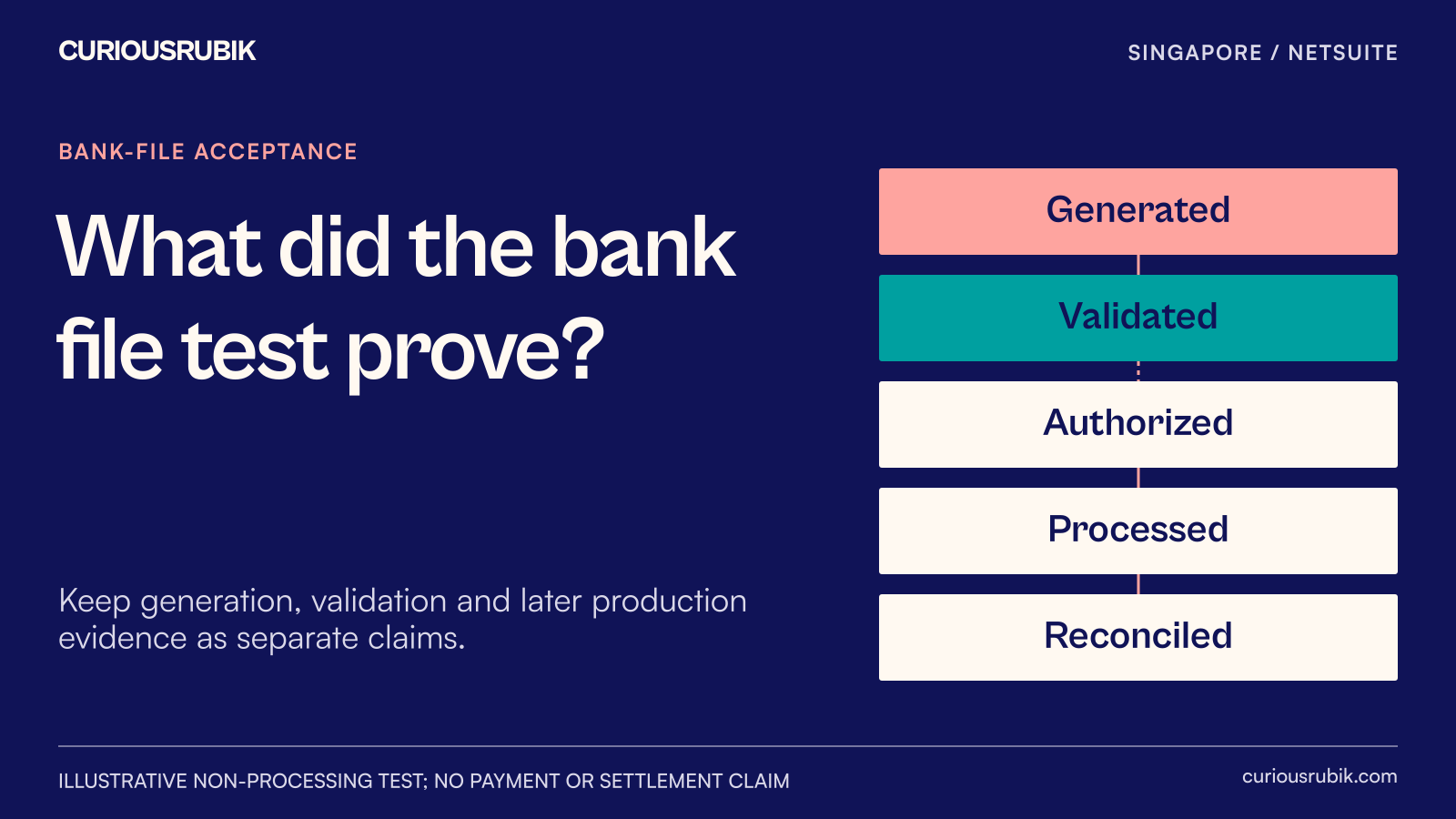
A successful bank-file test proves only the stage covered by that test. Before a NetSuite project calls payments ready, distinguish file generation, non-processing validation, production authorization, bank processing and statement reconciliation. Record the evidence for each stage separately.
This distinction is practical in Singapore because a bank's upload service may provide a test mode that validates a file without sending it for approval or processing. A success label from that mode is useful acceptance evidence, but it cannot establish that money moved or that a live payment route is authorized.
Give each payment-stage claim its own evidence and owner.
Begin with the scope printed beside the result
One Singapore bank's published Universal File Format guidance describes a “Test File” option. The guidance says this mode performs validation without sending the file to approvers or the bank for processing. A successful validation status belongs to that bounded test.
This article uses that documented behavior as a technical example, not an anonymous customer case. Other banks and channels can use different modes and status names. Obtain the selected bank's current specification and confirm the exact test arrangement before interpreting any result.
Write the mode, environment, bank channel, format revision and payment type beside the test outcome. A screenshot cropped to show only “Successful” removes the very information the project needs to interpret it.
An illustrative result that can easily be overstated
Consider a fictional Singapore distributor preparing a three-instruction supplier-payment file in a controlled test environment. The amounts are SGD 1,200, SGD 2,300 and SGD 3,500, totaling SGD 7,000. These are invented test values, and the example describes no live payment or actual bank account.
The team confirms that the file contains three instructions and that their values match the approved test population. It runs the selected bank's non-processing validation mode and receives a successful validation result.
The correct acceptance statement is: “This exact three-instruction file passed the selected channel's non-processing validation under the recorded test conditions.” The pack still has no production-authorization evidence, processing result or bank-statement movement.
Now suppose the project summary says “SGD 7,000 payments completed.” That statement reaches beyond the evidence. The test-mode result should be reclassified before the summary becomes a release decision. No accounting entry or payment rerun should be triggered merely to make the summary true.
A useful test report can be mostly green and still show production operation as unproven. That is an accurate result, not a failure to finish the spreadsheet.
Use an evidence ladder with five distinct stages
At the first stage, the NetSuite owner proves file generation. Retain the approved test population, instruction count, totals, file fingerprint and template version. The file must match the selected instructions and the intended company, currency and format.
At the second stage, treasury retains the bank's test response. Record what was validated and whether the test could process anything. If a field was rejected, preserve the error and the corrected file's new identity; do not attach the old successful response to the new file.
The third stage is production authorization. The evidence belongs to the actual authorized production workflow and approving people. Test access, a generated file and a valid format cannot stand in for it.
At the fourth stage, the operator records the bank's actual processing response under the bank's own terminology. A received file can still have outstanding or rejected instructions. Avoid translating every bank status into a generic “paid” label.
The final stage is statement reconciliation. Finance relates the bank movement to the instruction population and the approved accounting records, with fees, returns and unresolved items explained as applicable.
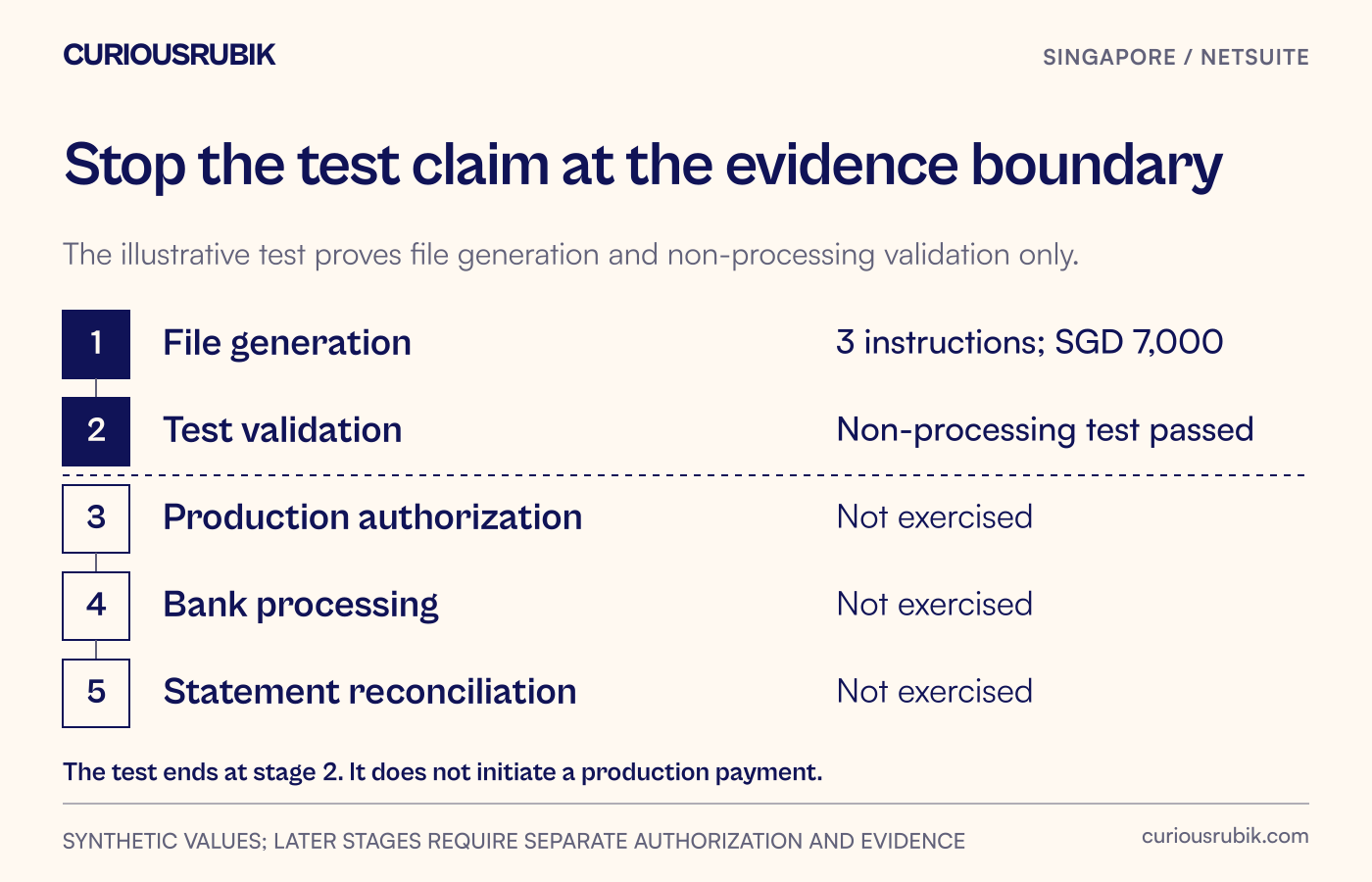
Non-processing validation ends at stage two; later stages require later evidence.
Keep template availability separate from compatibility
Oracle lists Singapore payment formats and their supporting SuiteApps. Those listings help identify candidates to assess. They do not certify that a customer's configured template satisfies the bank's latest revision, every payment type or the customer's account entitlements.
For the proposed route, record the Oracle documentation consulted, installed SuiteApp and template version, licensed capability, current bank specification and any customization. Confirm the specific entity, currency and payment type covered by the evidence.
A public bank help page may describe recent changes without exposing the full technical specification. The customer should obtain that specification through the bank's approved channel. The fictional test pack here cannot establish compatibility with a document it has not inspected.
Also record how a file would reach the bank in normal operation. File generation, manual upload and any separately implemented transmission integration have different owners and controls. A test of one path cannot prove another path's duplicate prevention or acknowledgement handling.
Include a controlled failure, not just the easy sample
Prepare a negative case using bank-approved test arrangements and synthetic data. For example, omit a required field from one of the three instructions. Record whether the channel rejects the file, identifies an instruction-level issue or handles the case in another documented way.
Do not prescribe a universal result. The purpose is to learn and record the selected route's actual behavior. The acceptance requirement is that the team can identify what failed, preserve the file version and know which owner must act next.
Then correct the field and generate a new file version. Verify the count and SGD 7,000 total again before the permitted retest. A corrected address or name should not silently change the amount population.
A timeout case also matters. Record how the operator establishes whether a prior attempt was merely validated, received for production processing or still uncertain. The runbook should prohibit a blind repeat when the state is unknown. Escalation to the authorized treasury owner is safer than treating a missing screen response as proof of failure.
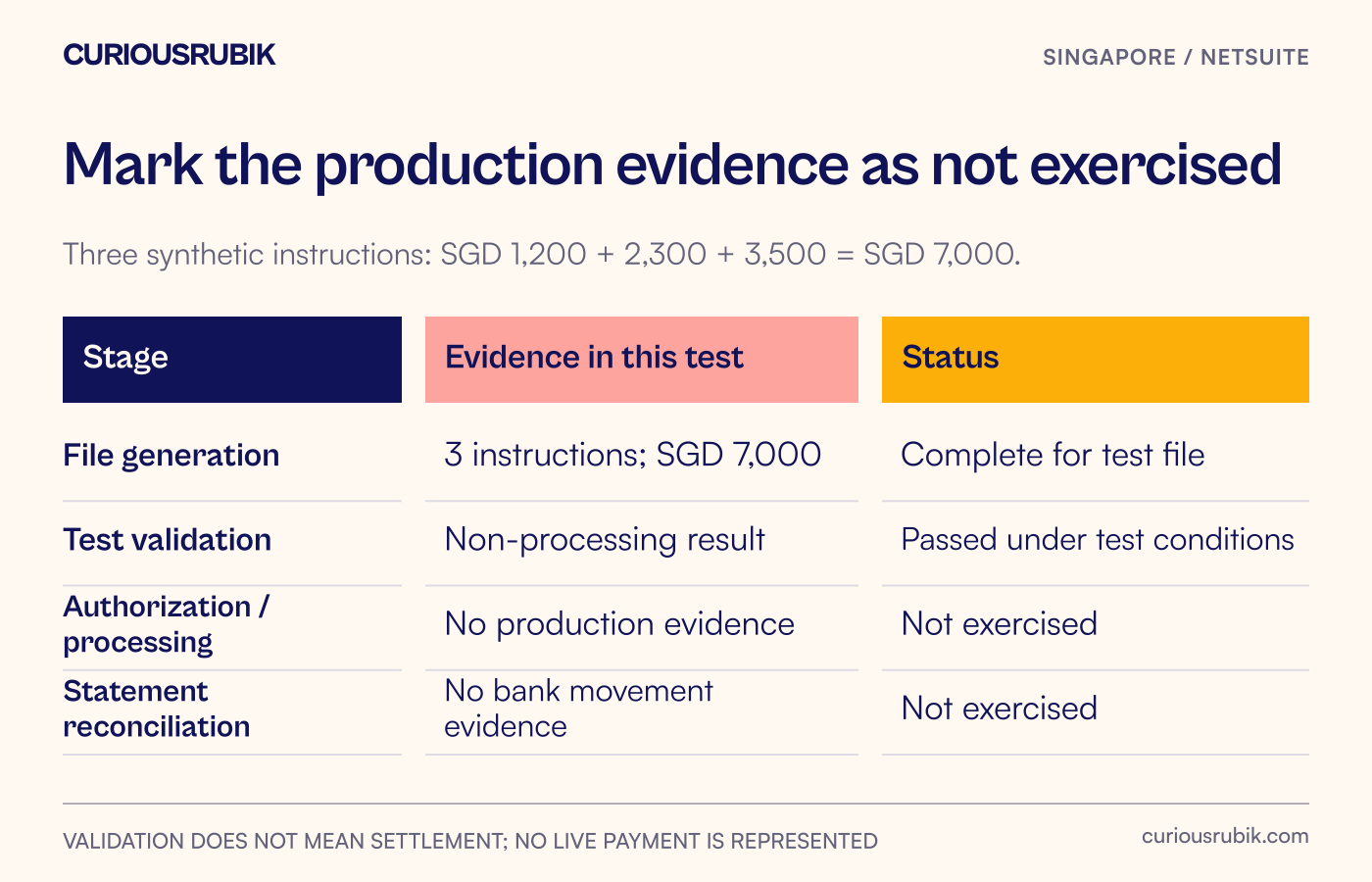
Mark unavailable evidence as pending instead of borrowing a success from another stage.
Make the go-live decision specific
For the fictional SGD 7,000 test, the generation and validation rows can be complete while the remaining rows read “not exercised.” A reviewer signs that limited conclusion and lists what a separately authorized production acceptance process must establish.
The final test pack should name a treasury owner for bank-state interpretation, a NetSuite owner for file generation, and a finance owner for reconciliation. Include escalation contacts and the conditions that require a new format test, such as a template revision or a bank-channel change.
The broader Electronic Bank Payments setup guide covers licensing, records and implementation prerequisites. Use this evidence ladder to tighten its acceptance decision: state exactly what the successful test proved, then obtain the missing evidence through the properly authorized process.