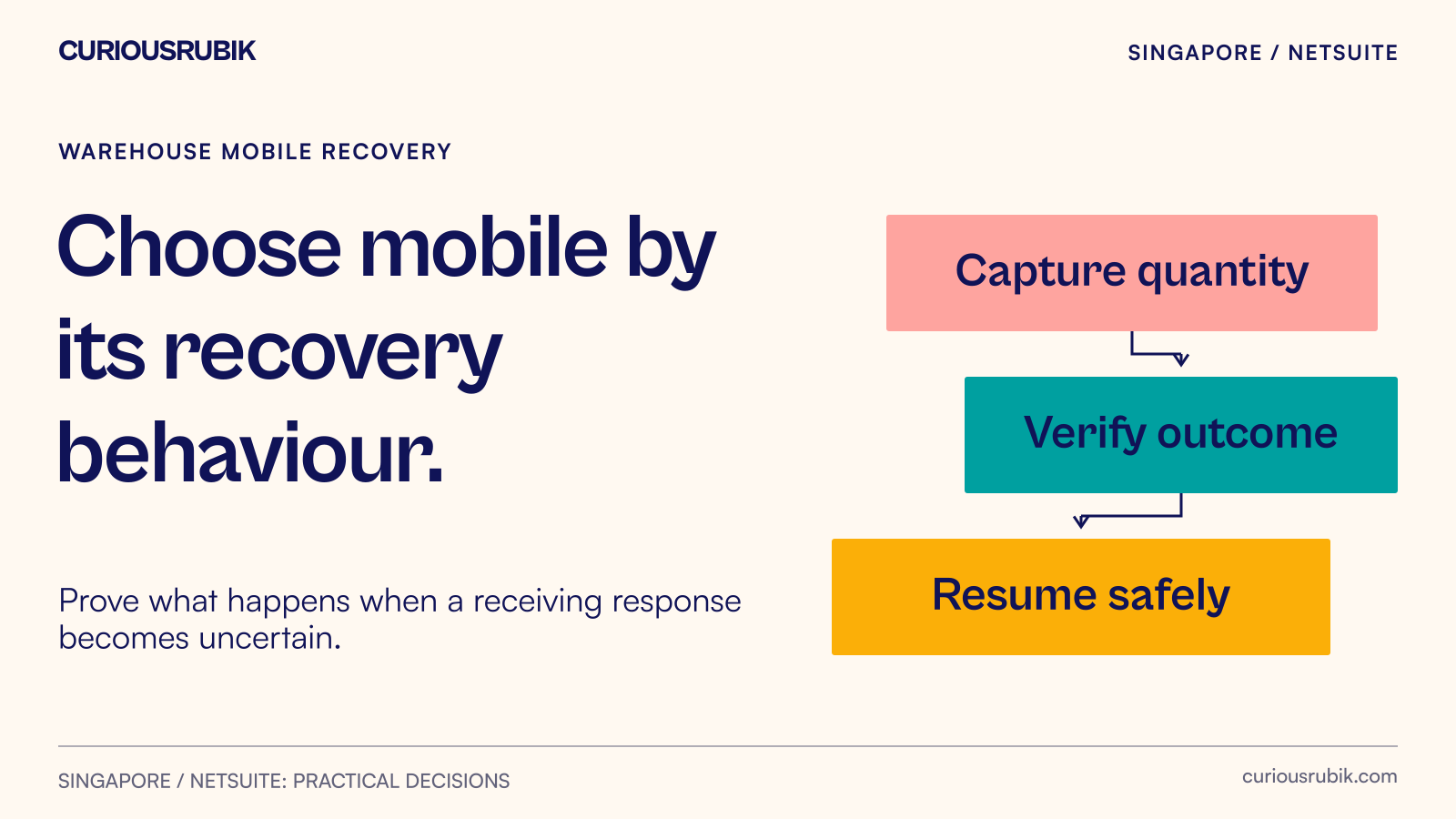
A mobile choice must survive an uncertain receiving response.
Choose a warehouse mobile workflow by testing what happens when a receiving task loses its connection. A clean demonstration proves that the happy path works. The buying decision also depends on whether an operator can recover from a delayed response, a restarted device or an uncertain submission without receiving the same goods twice.
For a Singapore team coordinating regional warehouses, these failures can be hard to diagnose remotely. The person holding a scanner sees a frozen screen. The central support team sees a transaction or a gap in the records. The application must help them establish whether those observations describe the same attempt.
A task, state and network acceptance pack makes that discussion concrete. Use it to compare an employee mobile app, NetSuite WMS and a proposed custom application against the warehouse job each would actually perform.
Begin with the receiving state
Consider an illustrative Singapore distributor whose regional receiving team is testing a new mobile process. An operator counts 24 units against purchase order PO-EX17. The item, quantity and order are synthetic. The label interpretation has already passed a separate test; this exercise is about connection loss and transaction completion.
The operator submits the quantity, but the screen continues waiting. There are at least three possible explanations: the request never reached the service, it reached the service but failed, or it completed and the confirmation never reached the device. These are test possibilities, not a claim about how a particular NetSuite application handles them.
The unsafe instruction is “scan again if it takes too long.” It turns uncertainty into another transaction attempt. The safer procedure first identifies the original attempt and checks the authoritative result through the supported workflow.
Give the attempt a traceable reference where the selected solution supports one. If it does not, define another reliable reconciliation method before deployment. A timestamp and quantity alone may be insufficient when two operators receive identical items from the same order.
Compare three different product routes
NetSuite for Mobile supports employee activities such as expense and time capture, dashboards and record access. Oracle documents offline working for that application. That does not establish offline warehouse receiving in WMS or in a custom application. Ask which exact mobile function the supplier proposes to use for the receiving job.
NetSuite WMS extends warehouse processes through its mobile application. Oracle describes receiving, storage, picking and shipping functions, and identifies Advanced Inventory Management as a prerequisite for Warehouse Management. Its mobile setup also involves supported devices, browsers, role permissions and configured processes. Check the current account entitlements and setup rather than treating “NetSuite mobile” as one interchangeable product.
A custom app may offer a queue designed for unreliable connectivity, but the queue is part of the proposed design and must be demonstrated. Ask what it stores, how it protects local data, how it submits after reconnection and how it distinguishes a repeat attempt from a new receipt. A diagram that says “sync later” leaves the most important behaviour unresolved.
Evaluate each route against the same task. Eliminate a route if the actual receiving function is unsupported. For remaining routes, record demonstrated behaviour and unresolved dependencies instead of awarding credit for unrelated mobile features.
Walk through four connection states
The acceptance pack for PO-EX17 has four cases. Repeat them with the intended receiving role, device, network and configuration. Use controlled test data and an agreed method of introducing interruptions.
- Stable connection. Receive the illustrative 24 units and record the task response, resulting receipt reference and remaining order quantity. This establishes the baseline evidence and confirms what a completed task means.
- Delayed response. Introduce delay after submission. Before any repeat action, determine whether the receipt exists. Record what the operator can see and what the supervisor must check. An ambiguous result remains on hold.
- Device restart. Restart at an agreed point after capture and before confirmed completion. Check which state survives, what must be re-entered and how the original attempt is located. Do not confuse a restored screen with a confirmed transaction.
- Connection recovery. Reconnect after the interruption and observe any queued or repeated submission. Reconcile all related receipts and quantities. The expected business result is one valid 24-unit receipt, or a clearly identified incomplete task awaiting an authorised next step.
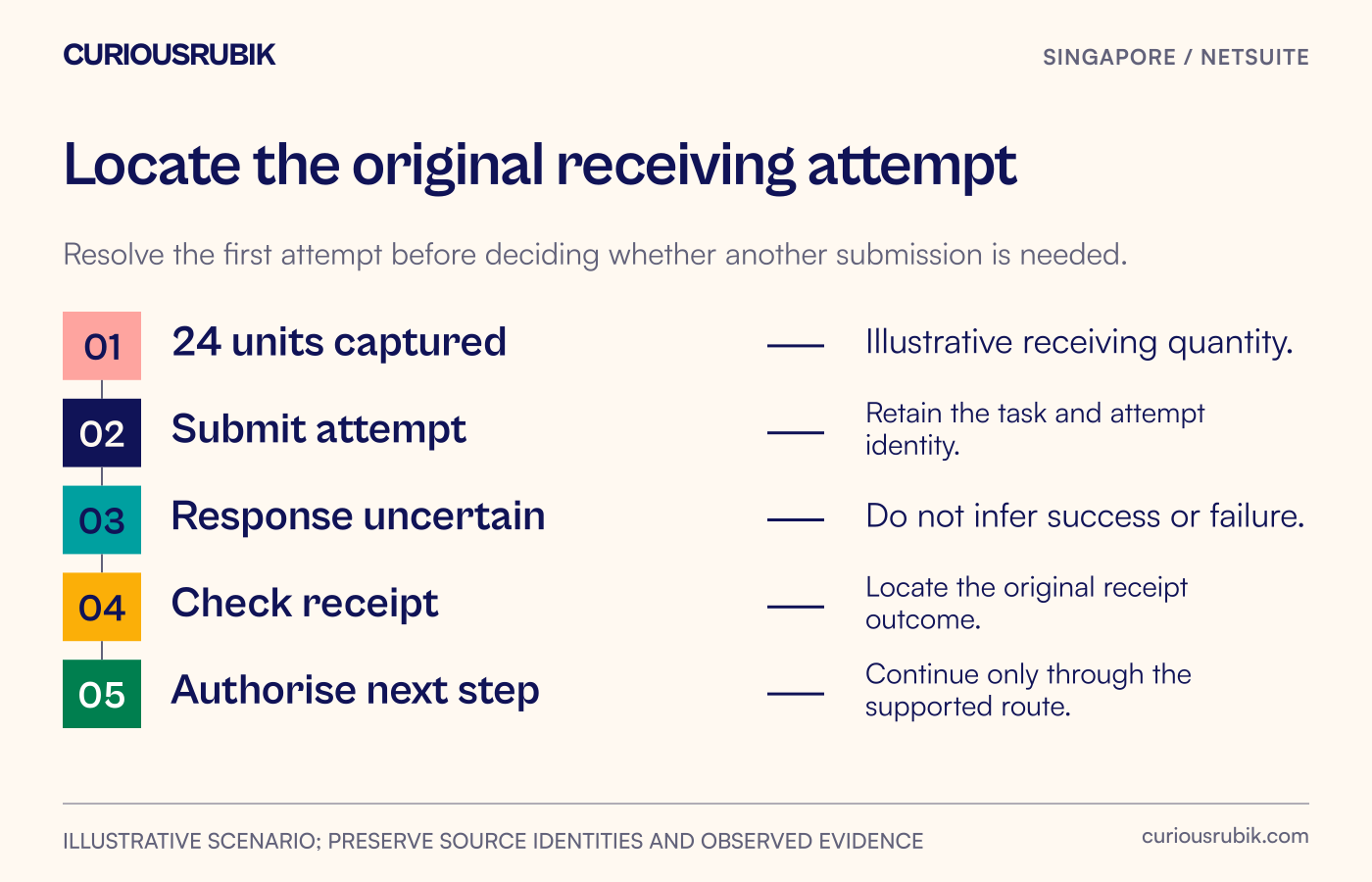
Keep screenshots or logs appropriate to the test, but make the final evidence a transaction reconciliation. A green status on a device cannot settle a disagreement with posted inventory. Equally, an unexplained inventory change should not be dismissed because the device showed an error.
Decide what the operator does while waiting
The workflow needs a usable physical procedure during uncertainty. In the example, the 24 counted units remain in a designated receiving area until the supervisor establishes their recorded state. The operator marks the delivery reference as awaiting verification and does not mix it with the next shipment.
This is an illustrative operating policy, not a built-in NetSuite rule. Adapt it to the warehouse layout, safety requirements and goods involved. Its purpose is to keep the physical stock identifiable while the system question is resolved.
Define who can perform the lookup, who can authorise a retry and who can correct a duplicate receipt through the supported process. The remote Singapore support team may investigate technical evidence; the local warehouse lead still confirms what arrived and what moved. Neither should silently make the other's decision.
If receiving must continue during an outage, specify a controlled fallback with unique references and reconciliation ownership. Decide its capacity and stopping conditions from actual operational constraints. An unrestricted paper backlog can become a second, poorly controlled receiving system.
Use a decision sheet rather than a feature score
For every candidate application, fill three rows with observed evidence:
- Uncertain submission: can the original attempt be located and matched to a receipt? The process owner accepts the recovery instruction only after both completed and incomplete outcomes have been demonstrated.
- Restarted device: can the operator resume or safely abandon the task without losing its identity? The warehouse lead verifies the physical holding procedure and retraining needed.
- Reconnection: can the team reconcile queued, failed and completed work without unexplained duplicates? The application owner documents the result and any custom monitoring required.
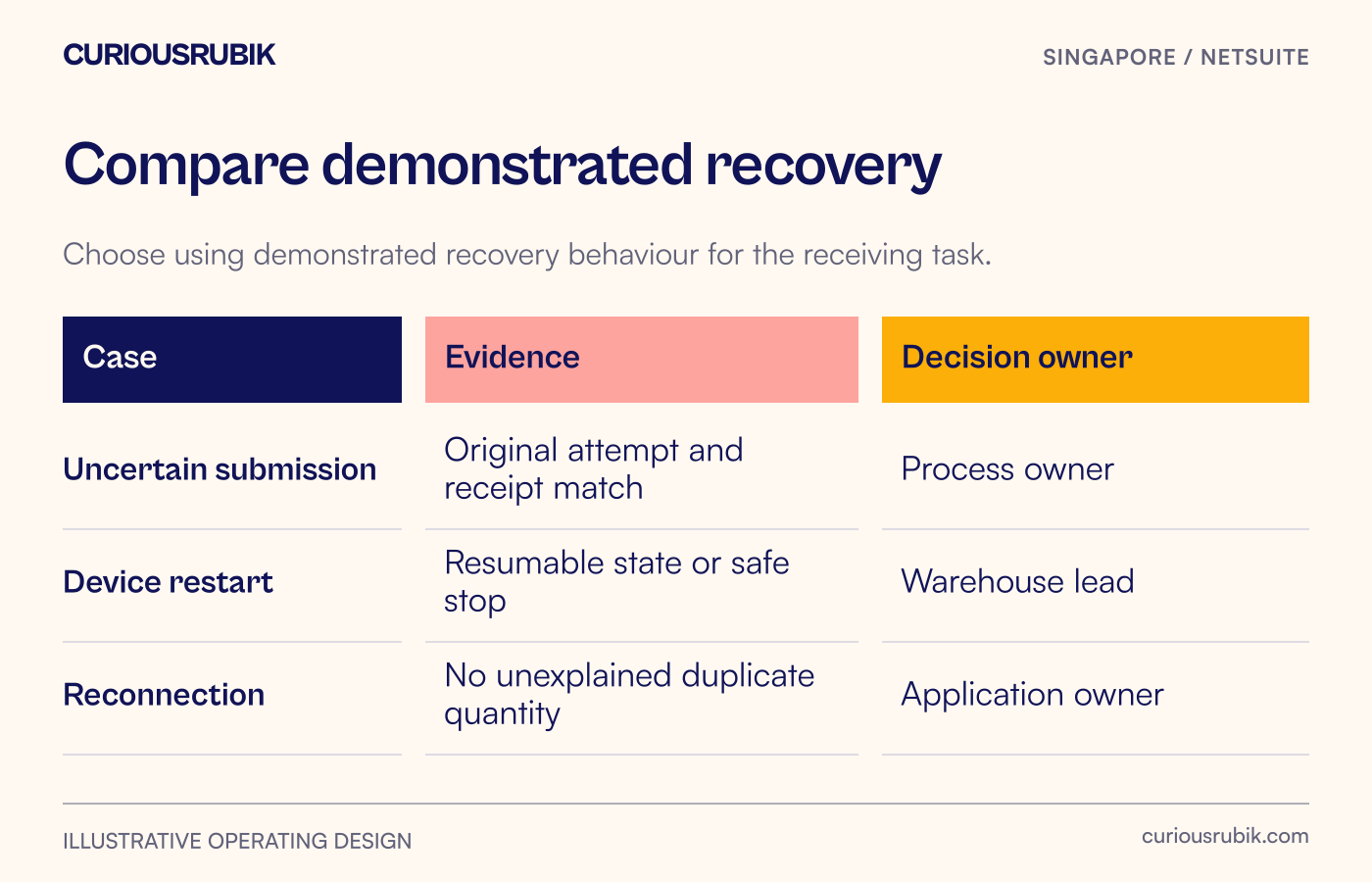
Reject a candidate for this workflow if its unresolved state cannot be investigated safely within the warehouse's operating needs. Another candidate may be acceptable with a supervised fallback. Document that limitation in the purchase and rollout decision so it does not disappear between the demonstration and training.
Take the same pack into rollout
A NetSuite sandbox provides a separate environment for testing, but external integrations and endpoints still require their own isolation checks. Confirm the full route before introducing faults. Do not create connection failures against live receiving simply because the test is described as harmless.
After a pilot, retain the device and application versions, relevant configuration, test references and accepted recovery instructions. Repeat the affected cases when those conditions change. An update that alters session recovery deserves a targeted retest even if barcode parsing is unchanged.
The existing mobile receiving and barcode guide covers a complementary question: whether the scanned label becomes the correct inventory detail. This decision pack asks whether the same task remains understandable when the connection fails. Both must work before a regional receiving team can rely on the chosen mobile route.