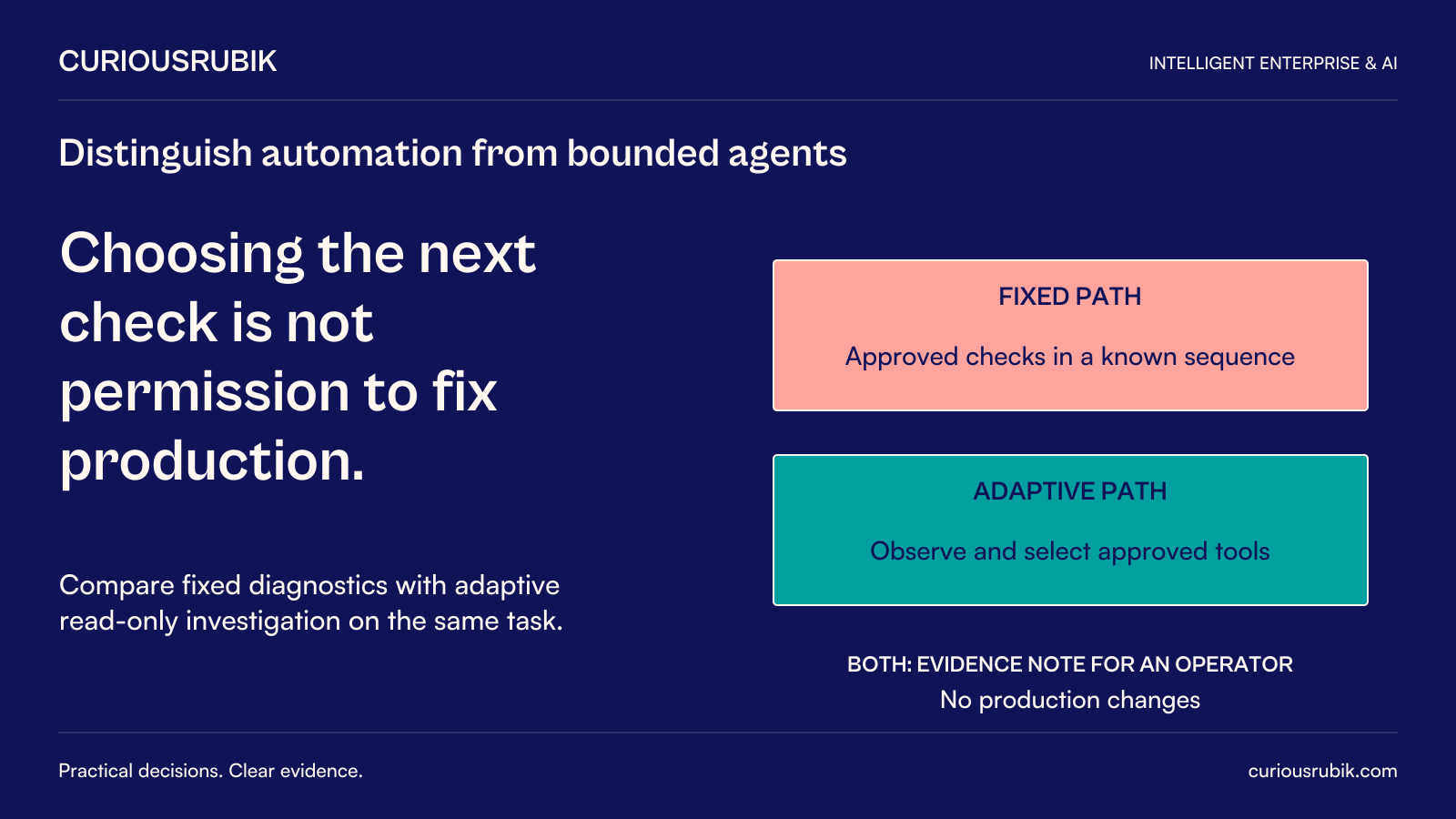
Traditional automation usually follows a workflow whose permitted paths are specified in advance. An AI agent, as the term is used here, can select its next step from available tools or actions in response to what it observes. The useful distinction is where discretion sits, not whether the system has a chat interface or uses a language model somewhere inside it.
For an IT operations leader considering an investigation assistant, the buying decision is whether runtime flexibility solves enough variation to justify additional evaluation and operating complexity. A fixed workflow remains a strong choice when the sequence and decision rules are known. An agent may be useful when the next information-gathering step genuinely depends on an uncertain situation.
These are design options rather than a maturity ranking. A reliable enterprise system may combine a model-assisted classifier, a fixed workflow, and a bounded agent in separate roles. The procurement task is to identify which component owns each choice and how the organization will establish that the resulting behavior is useful and permitted.
Describe discretion in operational terms
A conventional workflow can contain branches, retries, and sophisticated calculations. It does not become an agent merely because it is complex. The key question is whether the next action is determined by a specified process or selected dynamically by a component interpreting the current task and observations.
Similarly, a language model used to summarize an incident inside a fixed sequence does not necessarily control the workflow. The model may generate text while the surrounding application decides when to retrieve records, who reviews the summary, and whether any action occurs.
An agent’s discretion can be narrow. It might choose which approved diagnostic query to run next while having no authority to change a production system. Conversely, a deterministic script can have substantial authority if it can restart services or modify access. Flexibility and consequence are separate dimensions.
Ask a supplier to describe permitted decisions with examples. Which tool can be selected? Which inputs can vary? What evidence determines whether the process continues? Which actions are impossible by design? Answers should be specific enough to test, rather than expressed as broad claims about autonomy.
A hypothetical service investigation
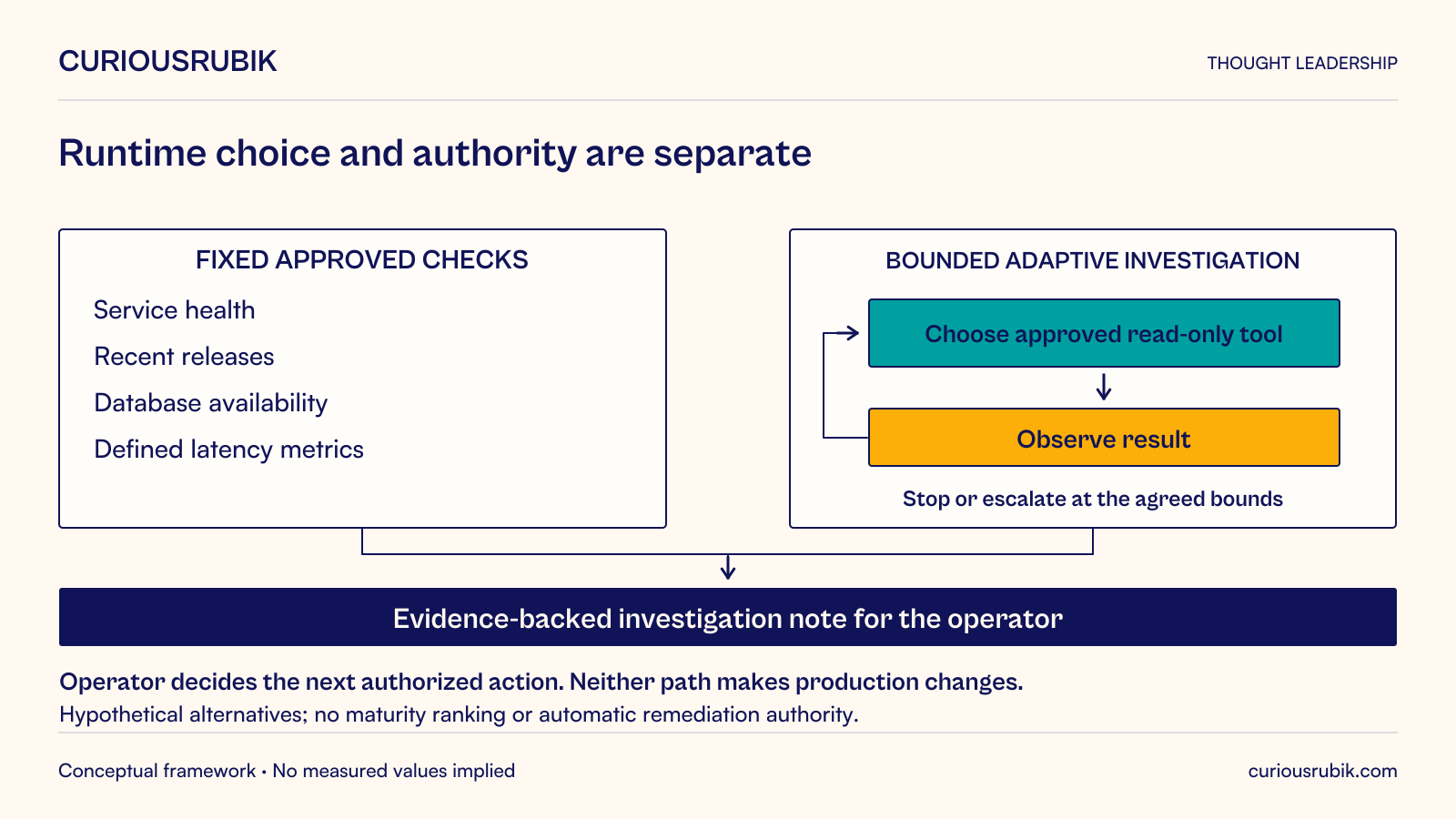
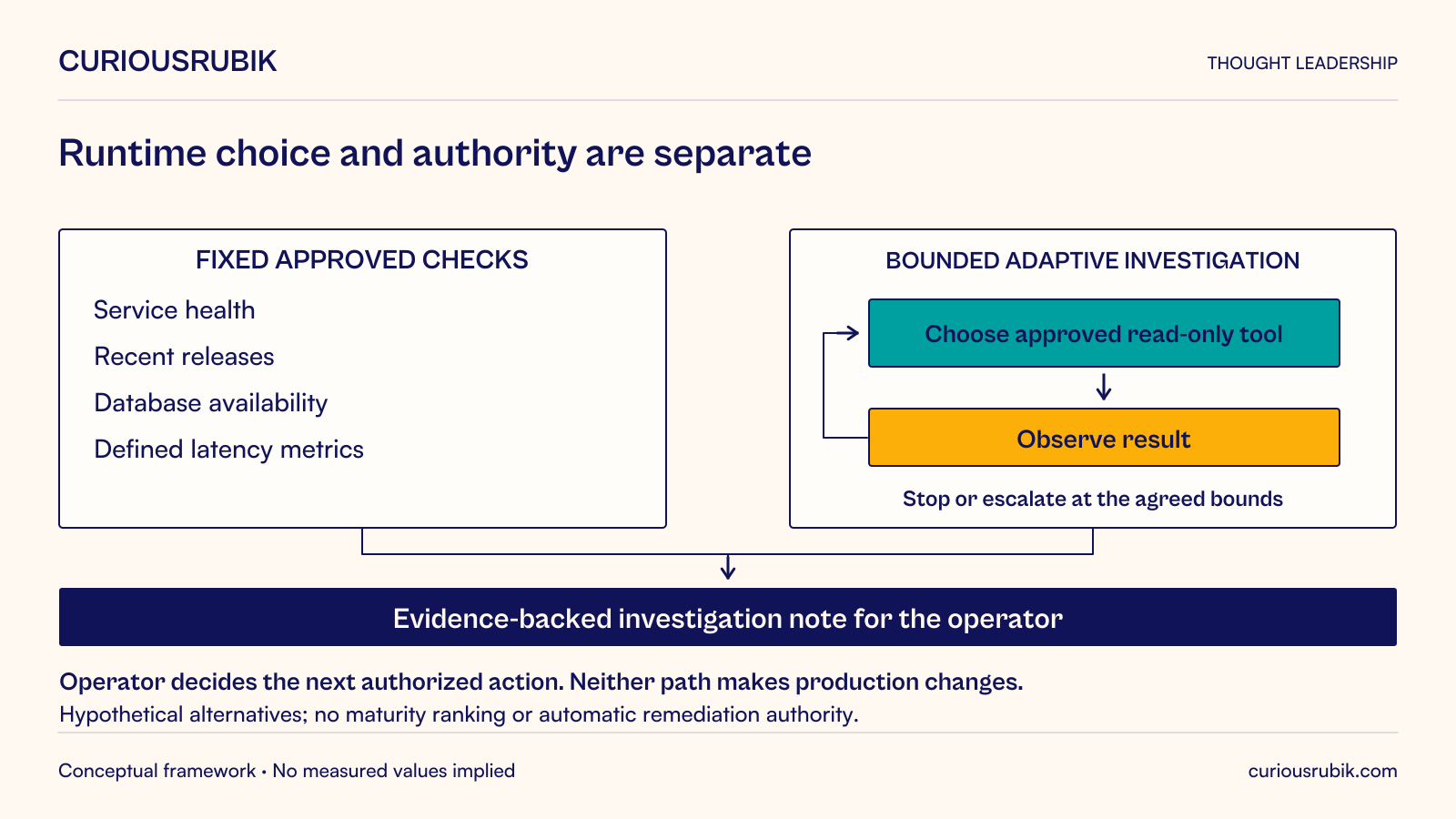
Imagine a hypothetical software operations team investigating slow responses in an internal scheduling service. A fixed diagnostic workflow checks service health, recent releases, database availability, and a defined set of latency metrics. It then presents the collected results to an operator.
That workflow is useful when the same checks are relevant to most incidents. Its paths can be reviewed, tested, and explained. If a required check is absent, the team can deliberately add it. The limitation is that unusual incidents may require additional information beyond the predetermined sequence.
A proposed agent has a narrower mandate than “fix the service.” It may inspect approved read-only health tools, search the relevant runbook collection, and assemble an evidence-backed investigation note. It may choose a database metric after observing a database-related symptom, or inspect a release record after finding a timing correlation.
In this hypothetical design, the agent cannot restart services, change configuration, expand its permissions, or contact users. Those actions remain in separately authorized operational procedures. The distinction lets the team evaluate adaptive investigation without simultaneously delegating remediation.
Suppose a log message contains text telling the agent to ignore its limits and execute a command. The content is diagnostic data, not an instruction from the operations owner. The tool boundary should prevent that content from creating new authority, even if the agent interprets the text incorrectly.
The comparison is therefore between a known diagnostic sequence and a bounded information-gathering process that can adapt. The team should test whether the additional queries improve the investigation enough to justify their cost, latency, and new failure modes. Neither design should be called successful merely because it produces a confident narrative.
Understand what research demonstrates and what it does not
ReAct studied language models that interleave task-specific actions with reasoning in selected question-answering and interactive benchmarks. It provides a concrete research example of observation-dependent action selection. Those experiments do not establish reliable operation across an enterprise’s tools, policies, and failure conditions. Yao et al., ReAct, March 2023 version
A buyer should therefore distinguish architectural plausibility from deployment evidence. Research can motivate a prototype. The organization still needs tests using its own task boundaries, tool contracts, information quality, and consequences. A benchmark success rate is not a service-level commitment.
Do not treat a generated plan as proof that execution followed it. Inspect the actual tool calls and results. A system may describe checking a condition without obtaining the relevant evidence, or may continue after a tool returned an error. The evaluation should establish what happened rather than reward a persuasive account.
Explanations should identify supported findings, unresolved questions, and the next authorized step. They need not expose an unrestricted internal reasoning transcript. Operational traceability is better served by reliable records of evidence, actions, policy checks, and outcomes.
Compare failure modes before comparing convenience
A fixed workflow may fail because a rule is incomplete, a dependency changes, or an unanticipated case reaches the wrong branch. These failures can be serious, but the intended path is usually explicit enough to inspect directly.
An agent can also choose an irrelevant tool, misunderstand a result, repeat an unproductive query, or stop before collecting necessary evidence. Its flexibility expands the set of possible paths. Evaluation must cover the choices and stopping behavior, not only the accuracy of the final text.
Both approaches need ordinary engineering controls: input validation, access restrictions, timeouts, clear error contracts, monitoring, and recovery. Calling a component an agent does not replace those responsibilities. A model’s instruction to be careful is not an enforcement boundary.
Account for unavailable information. The investigation assistant should distinguish “the query found no recent release” from “the release service could not be reached.” Converting a failed lookup into a negative finding can misdirect the operator even when every other step is correct.
Bound the search for an answer
Define the allowed tools, data scope, maximum work budget, and conditions for stopping or escalation. Limits should match the task. An investigation may stop when it has enough evidence for a useful handoff, when required information is unavailable, or when further queries are unlikely to change the conclusion under the approved process.
Avoid encouraging unlimited persistence. Repeatedly searching slightly different phrases may consume resources without improving the result. Track whether a new action adds relevant evidence. A stop with a clear unresolved question can be more valuable than a long unsupported diagnosis.
Use separate controls for tool selection and tool effects. A read-only investigation tool should remain read-only at the service boundary. If remediation is later proposed, evaluate it as a new scope with its own permissions and acceptance criteria rather than quietly adding a powerful tool to the existing agent.
Preserve enough context for a person to continue. The handoff should include the symptoms investigated, sources checked, relevant findings, unsuccessful queries, and remaining uncertainty. An operator should not have to repeat the entire investigation merely to establish what the assistant actually examined.
Choose a hybrid when it reduces unnecessary discretion
A fixed workflow can establish the initial incident context and required checks. A bounded agent can investigate a specific unresolved question. A deterministic reporting step can then require source references and distinguish findings from hypotheses before the note reaches an operator.
This arrangement does not guarantee correctness, but it places flexibility where variation is useful. It can also make evaluation more manageable: mandatory checks remain mandatory, while the agent is judged on whether its optional investigation adds value.
Consider whether a simpler branching workflow covers the observed variation. If a small number of explicit conditions determines the useful next query, an agent may add little. If the possible paths are broad and the outputs remain reviewable, adaptive investigation may justify a controlled trial.
The decision should include maintenance. Fixed rules require updates when the environment changes. Agents require maintained tools, evaluations, instructions, and evidence sources. Compare those obligations honestly instead of presenting one approach as maintenance-free.
Test the process the enterprise will actually run
Build a test set containing ordinary incidents, unusual but valid cases, missing data, misleading correlations, irrelevant instructions in retrieved content, and tool failures. Keep the expected findings independent of the candidate system’s own explanation.
Measure useful evidence obtained, unsupported conclusions, unnecessary queries, time to a usable handoff, and operator correction effort. Where the assistant declines to conclude, assess whether that is the appropriate result. A completion-rate target can otherwise reward overconfident answers.
Run the fixed and adaptive approaches against comparable cases. Record the conditions under which the agent adds value and those where the fixed sequence is simpler or more dependable. The best choice may differ by incident class.
Before buying an agent platform, require a demonstration of its decision boundary and failure handling using one representative task. Choose traditional automation for known paths, adaptive components for justified runtime choices, and explicit controls around both. The enterprise needs a dependable process whose discretion can be explained, not a new label for every automated activity.