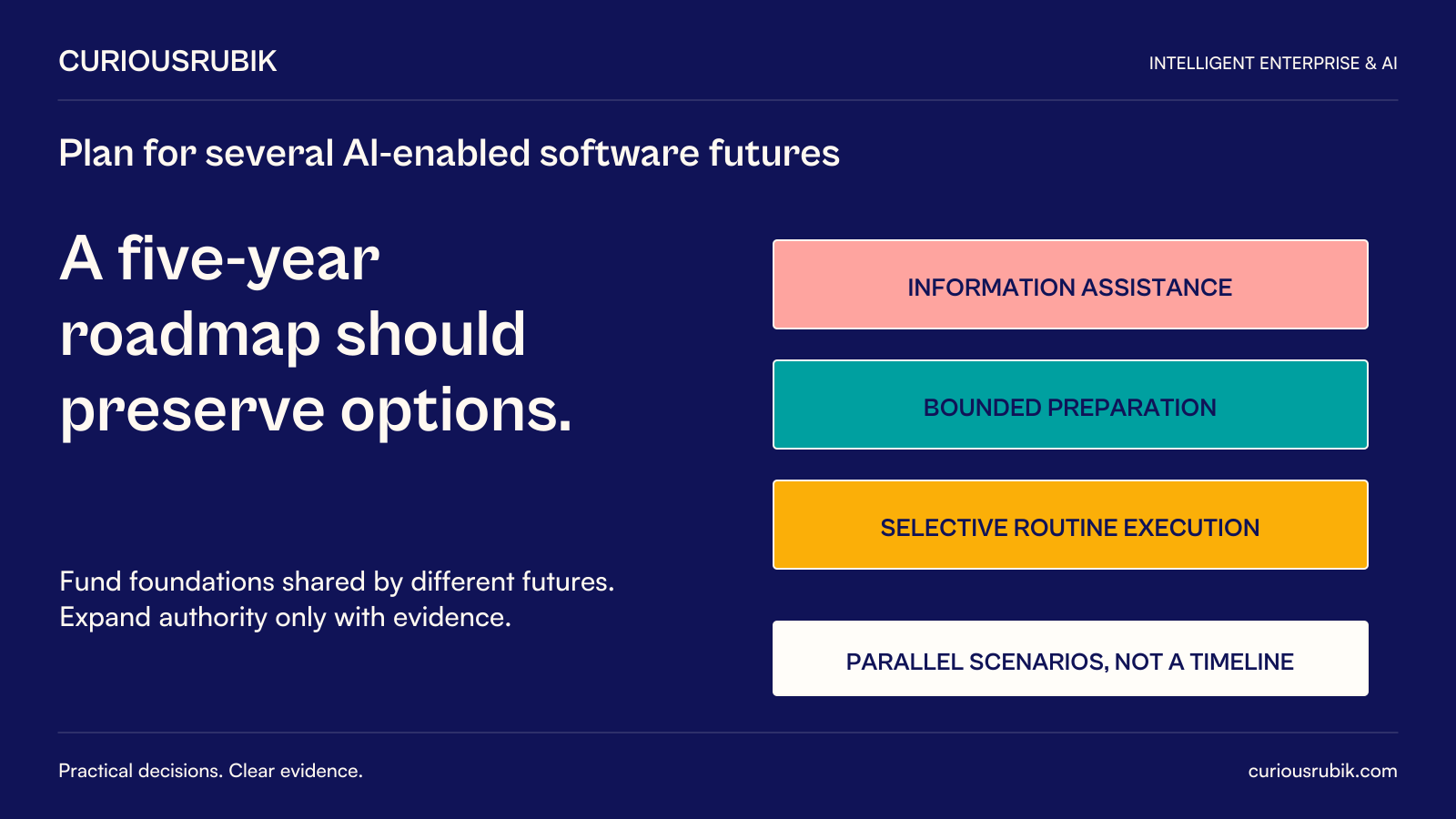
AI is likely to change enterprise software through easier interaction, faster preparation of information, and more adaptive coordination between tasks. The pace and extent of those changes remain uncertain. A useful five-year strategy therefore prepares the enterprise to benefit from improving capabilities without assuming that every application will become autonomous on a predictable date.
For a CIO setting a multiyear investment plan, the decision is which foundations to fund now and which commitments to make conditional on demonstrated capability. Replacing all existing systems in anticipation of a forecast is a different bet from improving their interfaces, data contracts, and controls so several future approaches remain possible.
The strongest roadmap distinguishes durable enterprise needs from uncertain implementation choices. Identity, authoritative records, testable business rules, and recovery will remain important even if the main user interaction changes. This article offers planning scenarios and evidence gates, not a claim that a particular product or capability will arrive within a guaranteed year.
Expect the interaction layer to become more flexible
A plausible direction is for employees to express more tasks in ordinary language, images, or conversation. Software may help translate those requests into searches, draft records, or proposed actions. This could reduce the need to remember which screen contains a particular operation.
That possibility does not remove the need for precise business meaning. “Prepare the quote” may refer to a budget estimate, a reviewed proposal, or a binding offer. The application must still establish which outcome the user intends, which evidence applies, and whether it has authority to proceed.
Conventional screens will continue to have value where people need comparison, dense information, or explicit control. A conversational request can lead to a structured review rather than replace it. Plan for multiple interaction modes instead of assuming that every task becomes a chat exchange.
Evaluate interaction improvements by completed work. A shorter conversation is not automatically better if it hides a missing requirement or requires more correction later. The roadmap should preserve access to the underlying record and a clear way to inspect or amend what the system understood.
Expect preparation to become more abundant
Another plausible direction is lower effort to produce initial summaries, classifications, explanations, and draft artifacts. If that occurs, the bottleneck may move toward checking relevance, correctness, permissions, and readiness for use. The enterprise needs to invest in those receiving activities alongside generation.
More draft output can create queues. A sales engineer may receive more proposed quotations than they can verify. A controller may receive more variance narratives than they can substantiate. A support team may receive longer suggested answers without better source evidence. Track accepted outcomes rather than generated volume.
The organization should distinguish reusable verified information from freshly generated wording. Approved product facts, policy rules, and commercial terms should remain governed records. Generating a new explanation of them does not authorize changing their meaning.
A useful investment is an evaluation and review capability that can compare candidate tools on representative work. Model Cards for Model Reporting proposes documenting intended uses and evaluation conditions. Such documentation can inform comparison, while the enterprise must still test the actual application context. Mitchell et al., Model Cards, 2019 version
Expect coordination to become more adaptive in selected work
Software may increasingly select a next information-gathering or preparatory step based on observed results. This can be useful in tasks with genuine variation, such as investigating an exception or assembling evidence from several sources. It is less compelling when a small, known workflow already handles the task reliably.
Adaptive coordination creates an architectural requirement: tools must expose clear capabilities and consequences. A system cannot safely improvise around interfaces whose operations, permissions, or completion states are ambiguous. Better APIs and operational contracts are useful regardless of which model supplies the planning component.
Keep consequential execution bounded. A future improvement in language understanding does not itself justify authority to change commercial commitments, release products, or alter access. Each broader action needs evidence and a deliberate delegation decision.
The five-year opportunity is therefore uneven. Some functions may become highly assisted while others remain structured and human-led. A portfolio strategy should allow that variation rather than use autonomy as the measure of progress for every application.
A hypothetical machine builder’s roadmap
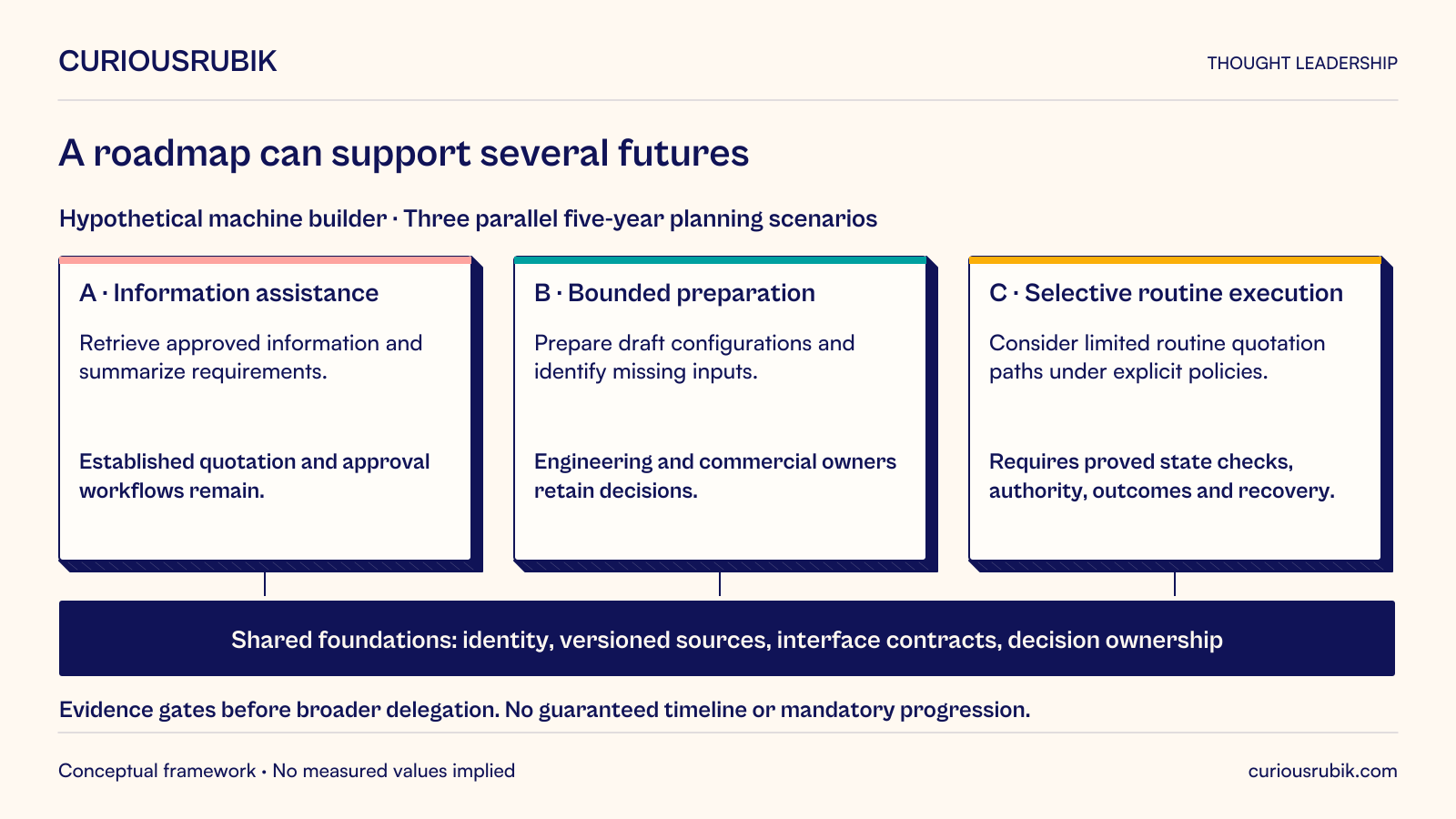
Consider a hypothetical company selling configurable industrial machines. Its quotation process involves customer requirements, approved product configurations, engineering review, delivery assumptions, and commercial approval. The CIO wants to prepare for AI-enabled software without replacing the order platform on the strength of a demonstration.
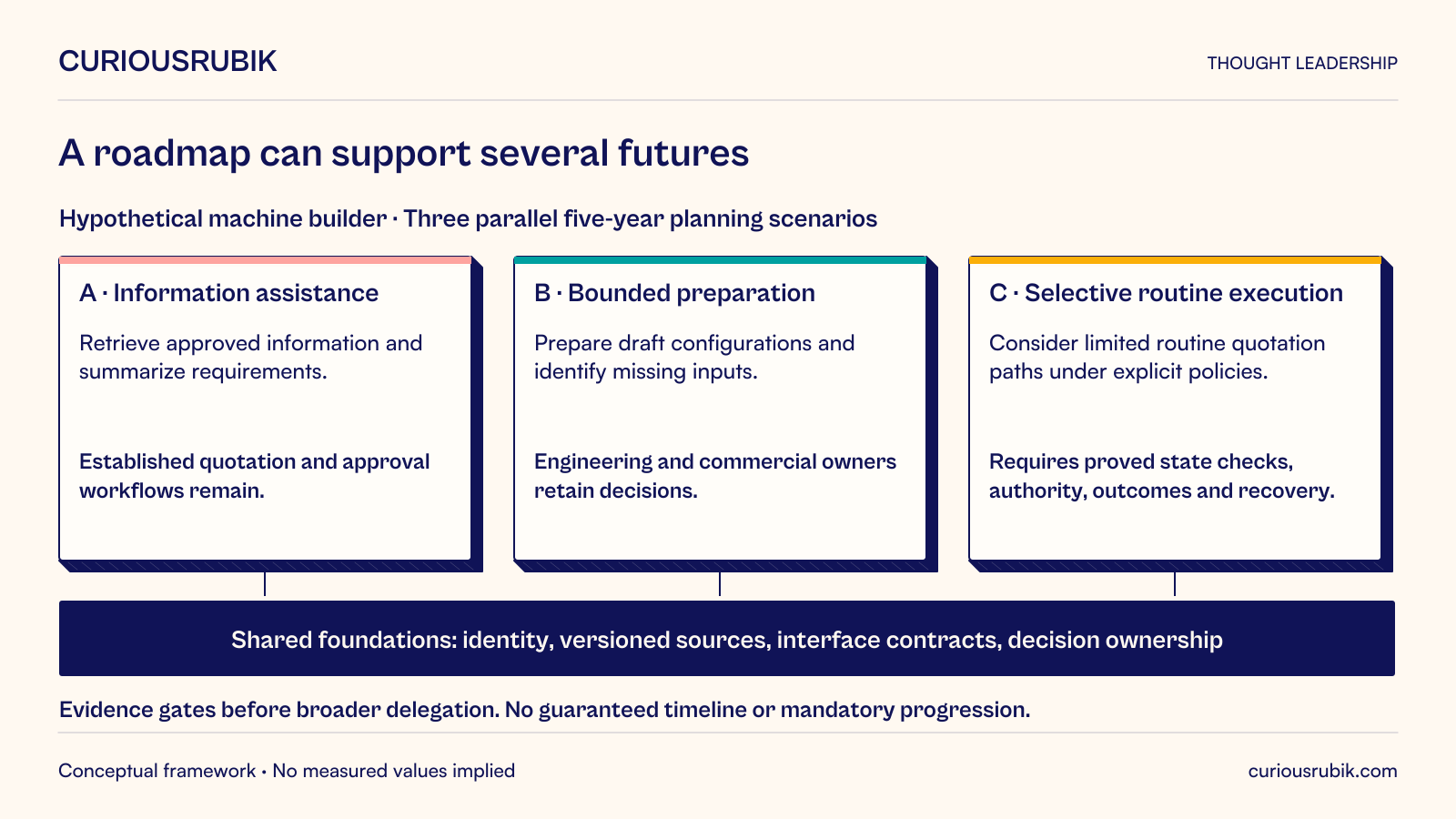
In one planning scenario, AI remains most useful for retrieving approved information and preparing requirement summaries. The company benefits from clearer product data, versioned reference material, and better review tools. It continues to use established quotation and approval workflows.
In a second scenario, bounded assistance reliably prepares more of the draft configuration and identifies missing inputs. The company expands that preparation after testing representative cases, while engineering and commercial owners retain their defined decisions. A prepared configuration remains distinct from an approved offer.
In a third scenario, selected routine quotation paths become dependable enough for limited execution under explicit policies. The company considers that scope only after demonstrating current-state checks, authority enforcement, acceptable outcomes, and recovery. It does not assume the third scenario must follow the second or apply to custom engineering work.
Across all three scenarios, investments in product identity, source versioning, interface contracts, and decision ownership retain value. A long commitment to one proprietary orchestration approach is more sensitive to which scenario develops. That difference should influence procurement and sequencing.
The roadmap uses the five-year horizon to examine dependencies and options. It does not assign a fictional date when engineering approval becomes unnecessary. Management can revisit the scenarios as actual task performance, cost, and operating evidence change.
Separate durable investments from contingent bets
List each proposed investment and ask which scenarios require it. Clean product identifiers, access-aware information retrieval, reliable APIs, and an accepted-record history may support several futures. A specialized agent runtime or a tightly coupled interface may depend on narrower assumptions.
This does not mean avoiding every contingent investment. Experiments create learning. Limit the size of the commitment until uncertainty falls, and specify what the experiment should establish. A small prototype can answer whether a capability is feasible without determining the enterprise’s entire architecture.
Include exit and substitution costs in procurement. The company should understand how to retain its records, evaluations, approved instructions, and integration contracts if a provider changes. Portability is rarely effortless, but explicit boundaries can reduce dependence on one supplier’s implementation.
Sculley and colleagues identify data dependencies, configuration, and environmental change as sources of machine-learning system maintenance debt. That reinforces a practical planning point: operating obligations persist after an initial demonstration, even when model access becomes easier. Hidden Technical Debt in Machine Learning Systems, 2015
Use evidence gates instead of calendar promises
A roadmap milestone should state what the enterprise will be able to establish. Examples include a representative evaluation set, a reviewed data-access boundary, a supported exception process, or a repeatable comparison of candidate models. These are more actionable than a promise to become fully AI-driven in a particular year.
For each proposed expansion, define the required evidence and the owner who decides. Broader preparation might require lower correction effort and preserved source traceability. Broader execution might require additional policy checks, incident containment, and demonstrated recovery. The criteria should reflect the consequences of the task.
Set review points for the assumptions, not just project status. Ask whether the expected workload exists, whether users can review outputs, whether the economics remain favorable, and whether a simpler approach has improved. A roadmap should be able to narrow or cancel a use case without treating that decision as failure.
Avoid allowing a model update to advance the roadmap automatically. A new version may improve one capability and change another. Re-evaluate the deployed task and its dependencies before expanding authority or removing a control.
Prepare the organization for changing work
Map how roles change when preparation becomes easier. Specialists may spend less time assembling information and more time resolving ambiguous cases. That can increase the importance of judgment, source literacy, and the ability to challenge a plausible output.
Protect the capacity needed for those tasks. If the business removes review capacity before demonstrating that it is unnecessary, the resulting bottleneck or control gap can erase the benefit. Workforce decisions need evidence about the complete operating process, not a demonstration’s drafting speed.
Maintain institutional knowledge in forms the organization can inspect. Approved definitions, decision rules, and exception examples should not exist only inside a supplier’s configuration or one employee’s prompts. They are business assets that support both human work and future automation.
The CIO’s next step is to test the portfolio against several plausible futures. Identify the foundations that remain valuable, the bets that depend on uncertain capabilities, and the evidence that would justify expanding each one. Over five years, the enterprise can adapt substantially without pretending to know the exact pace of AI progress. The strategy succeeds when better tools can be adopted without losing control of the work they influence.