When software starts selecting priorities, allocating capacity, or choosing the next business action, the enterprise has delegated a decision. That delegation changes who can affect outcomes, how objectives are interpreted, and what evidence is needed to explain a result. The important management question is which decisions the organization is prepared to delegate under explicit conditions.
For a chief operating officer introducing intelligent scheduling, the immediate choice is who owns the tradeoffs encoded in the system. A model can predict late jobs or propose a sequence. It cannot independently establish whether contractual commitments, customer relationships, utilization, or short-term margin should take precedence. Those are business choices even when they appear as technical weights.
The practical response is to build a decision charter before granting operational authority. Specify the decision, objective, constraints, affected parties, evidence, exception owner, and review process. This article develops that charter through a hypothetical commercial printing operation, concentrating on decision rights rather than a particular AI architecture.
Identify the decision hidden inside the output
Start by asking what changes when someone follows the output. A lateness forecast is information. A ranked work queue directs attention. A schedule published to production commits capacity. These outputs can use similar data while carrying different authority and consequences.
Even a recommendation can influence decisions substantially if people rarely challenge it. Describe the actual operating behavior rather than relying on the label “advisory.” If supervisors routinely accept the first proposed sequence because they lack time to evaluate alternatives, the effective delegation is broader than the interface suggests.
Define the unit of decision. A system that chooses the next print job may look narrow, but repeated choices shape the entire day’s schedule. Assess the sequence over time, including jobs continually deferred, rather than evaluating only whether each individual selection appears reasonable.
Record the counterfactual process: how the decision is made without the software. That provides a comparison and exposes existing weaknesses. Human judgment may already be inconsistent or poorly documented. The objective is an accountable improvement, not an assumption that either people or models are inherently superior.
Separate objectives from constraints
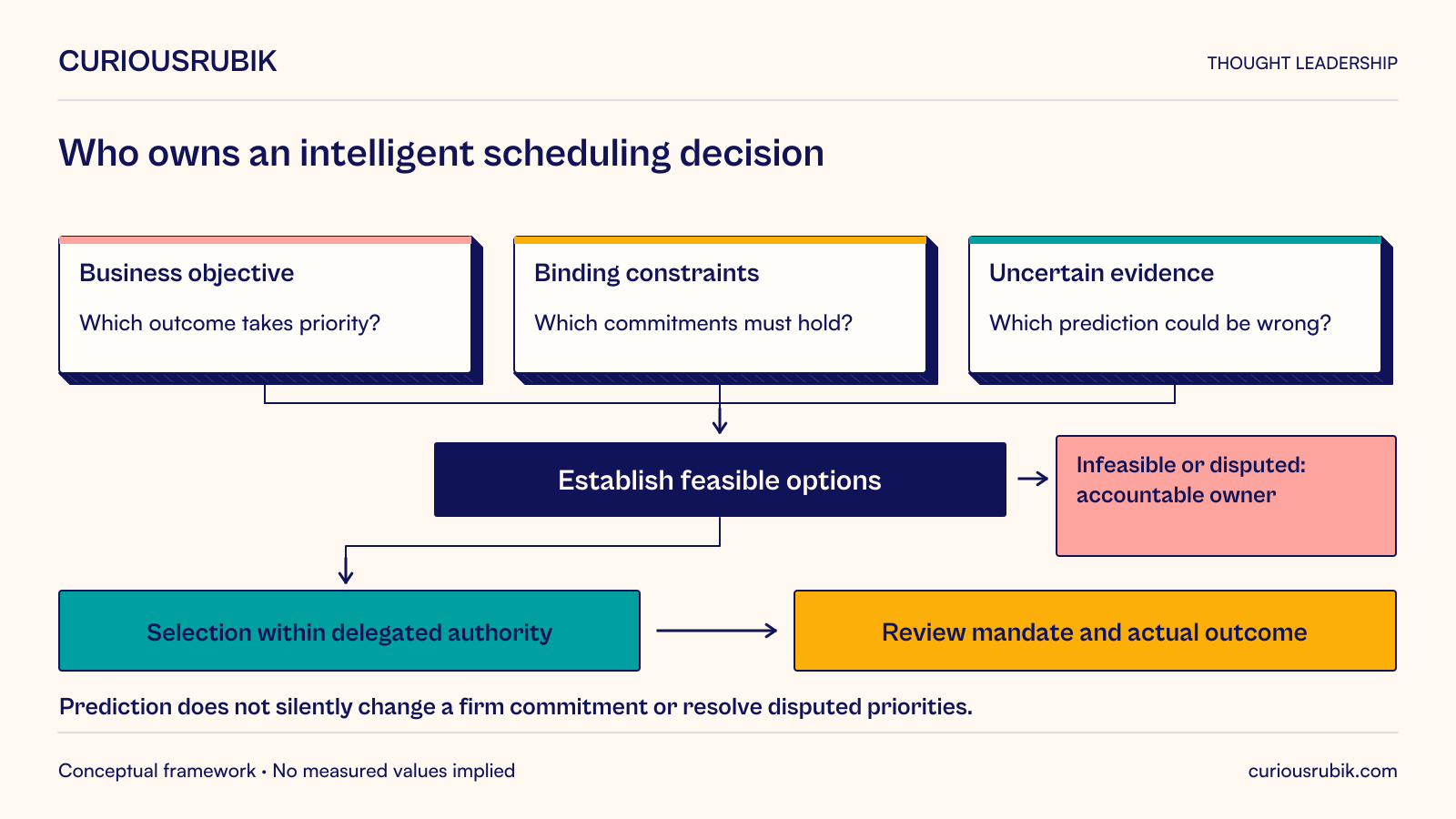
An objective expresses what the business wants to improve. A constraint describes a boundary that must remain satisfied. Minimizing setup time might be an objective; preserving a committed delivery window might be a constraint for certain orders. The distinction should be deliberate.
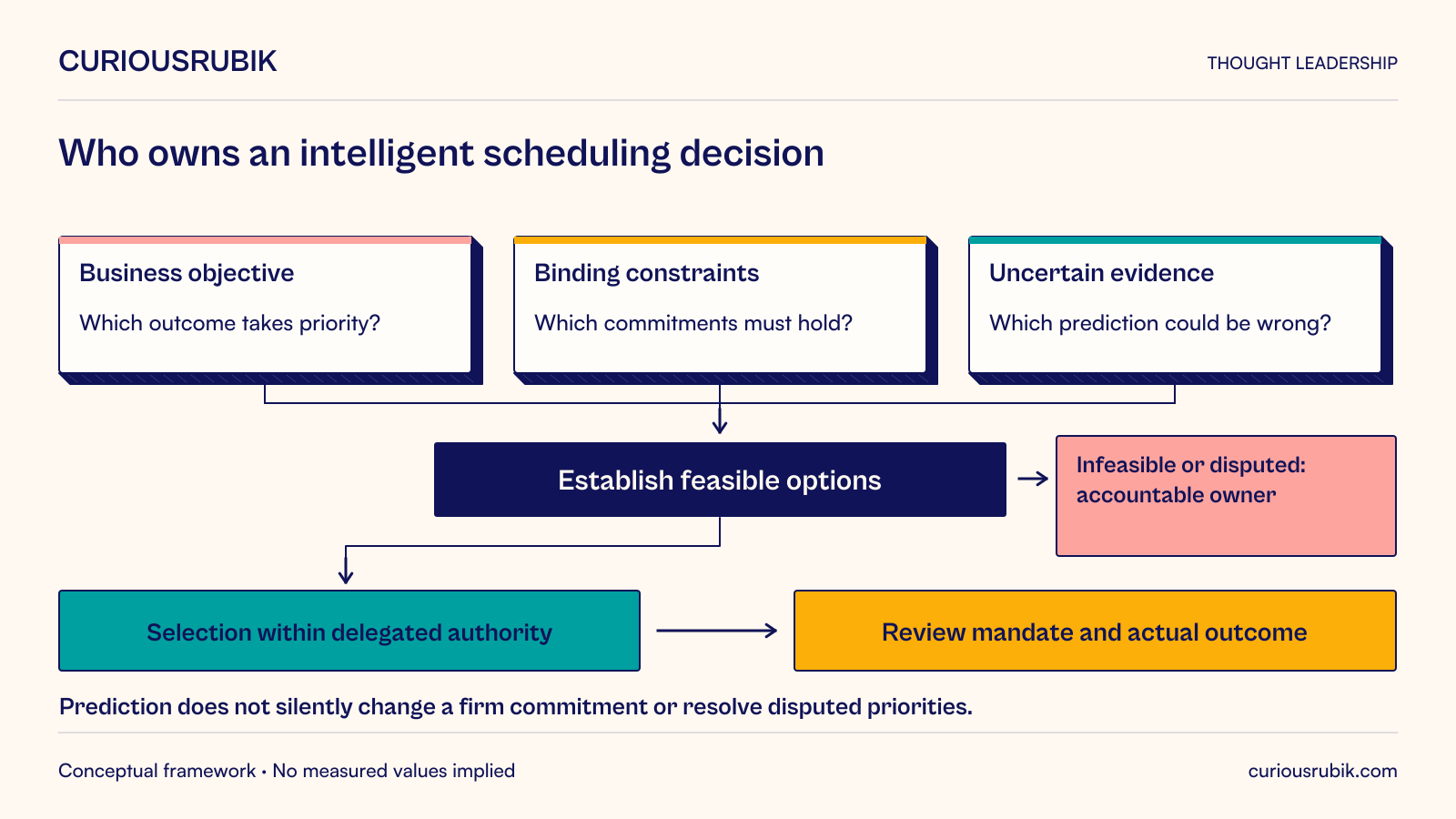
Do not silently turn a firm obligation into a weighted preference. A scheduler may accept a small penalty for breaking a delivery promise if that improves its overall score. If the organization intends the promise to be binding within the scheduling process, the implementation must represent it accordingly or refer the conflict to an authorized person.
Some constraints can conflict. Equipment failure may make every current promise impossible. The system then needs to report infeasibility and present consequences. It should not hide the conflict by inventing capacity, dropping an order from the population, or presenting the least-bad result as fully compliant.
Assign an owner to the objective and each material boundary. Commercial leaders may define commitment priorities; production leaders may define operating feasibility. The executive sponsor must resolve disagreements that cross those responsibilities. Leaving them to a technical team creates policy by implementation.
A hypothetical print-production decision
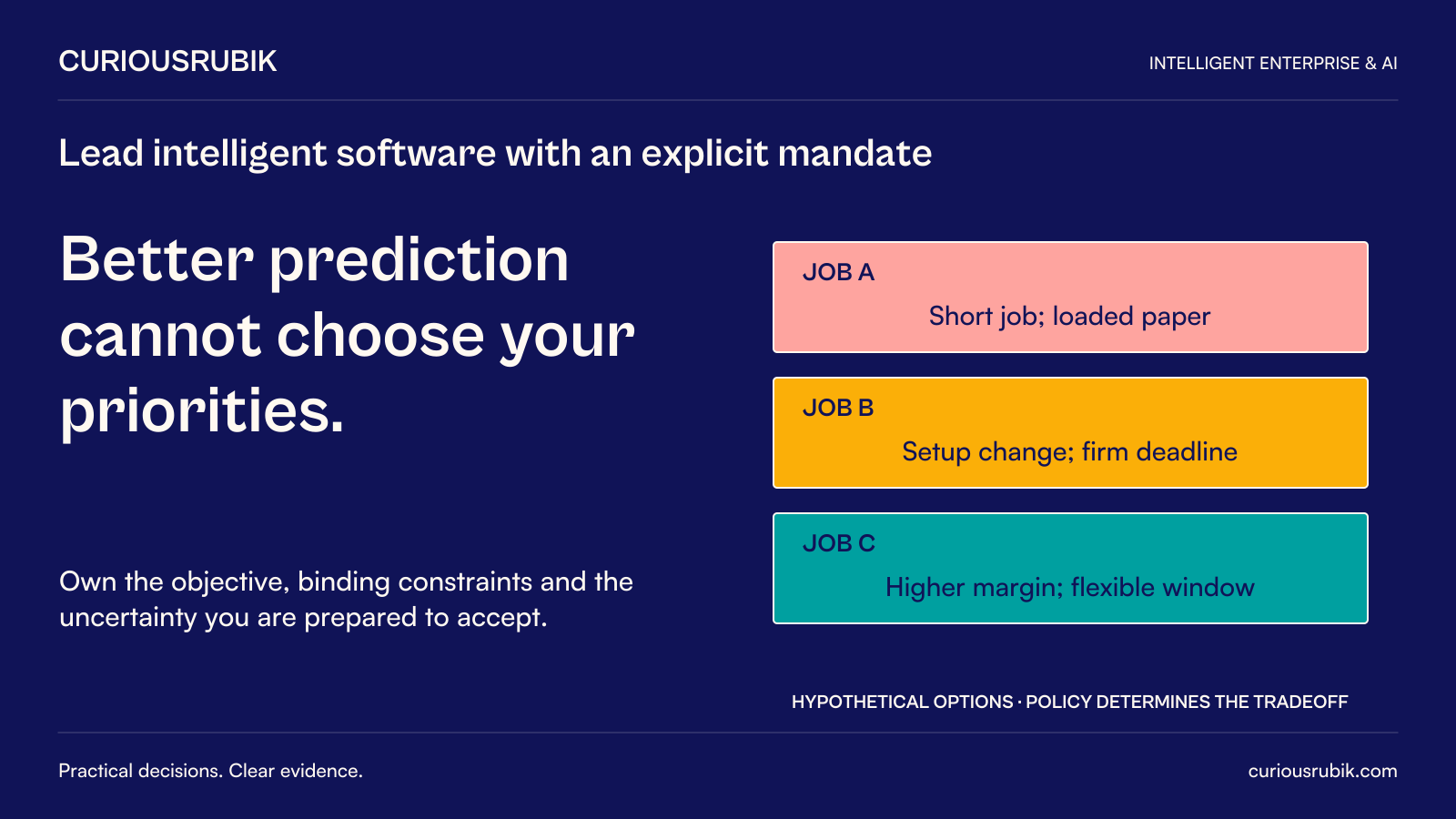
Imagine a hypothetical printing company with three jobs competing for the next production slot. Job A is short and uses the currently loaded paper. Job B requires a setup change but has a firm customer deadline. Job C has a higher contribution margin but a flexible delivery window.
A scheduler focused on minimizing setup changes may choose A. One focused on immediate margin may choose C. A policy that protects the firm commitment may choose B. None of those choices can be judged from the job descriptions alone without knowing the approved objective, constraints, and remaining capacity.
Now suppose the model predicts that B can wait because a later slot is likely to open. That prediction should not automatically alter the customer’s commitment. The decision charter must say whether forecast capacity may support a schedule, what uncertainty is acceptable, and who can approve a risk to a firm deadline.
The production manager sees two feasible proposals. One protects B’s deadline with an extra setup. The other reduces setup work but depends on an uncertain completion estimate for an earlier job. A useful system presents that dependency so the manager can make the tradeoff. A single unexplained “optimal” recommendation would conceal the decision.
After the choice, the company compares the actual result with the information available at the time. If B finishes late because an input was wrong, investigate data quality. If it finishes late because the approved policy tolerated the risk, revisit that policy. If the system ignored the policy, investigate enforcement. These are different failures with different owners.
The example contains no measured performance claim. Its purpose is to show why intelligent software needs an explicit mandate. Better prediction cannot resolve a disagreement about what the enterprise values or which commitments it may change.
Make accountability practical
Name one accountable business owner for the delegated decision. That person does not need to inspect every output, but must own the policy, acceptable risk, escalation capacity, and decision to continue or narrow use. Technical ownership remains necessary and distinct.
Identify who can change the policy. Adjusting a priority weight or a decision threshold may have more operational effect than a large interface release. Treat material changes as business changes with appropriate review, not routine configuration that anyone with administrative access may alter.
The NIST AI Risk Management Framework includes governance responsibilities and context-sensitive risk management. Applying that principle here means recording accountable roles around the decision, rather than assuming a model supplier owns the business consequences. NIST AI RMF 1.0, GOVERN
Create a usable escalation route. The person receiving a disputed schedule needs authority to change priorities and enough information to understand the conflict. A generic support ticket cannot resolve a commercial-versus-production tradeoff unless it reaches someone empowered to decide.
Preserve reasons that can be checked
A decision record should include the relevant input state, policy version, selected action, and material alternatives or constraints where needed. Its purpose is to explain the business decision at an appropriate level, not to store an unrestricted transcript of every internal calculation.
Distinguish a generated explanation from evidence. A fluent narrative saying that a job was prioritized for customer importance is not sufficient if the underlying rule actually favored setup time. Explanations should be checked against the process and information that produced the action.
NIST’s explainable-AI principles distinguish meaningful explanations, explanation accuracy, and knowledge limits. For a scheduling buyer, this supports asking whether the explanation faithfully describes the relevant decision and where the system’s competence ends. NISTIR 8312, Section 2
Keep access proportionate. A supervisor may need to understand a delivery constraint without seeing confidential customer profitability. Design explanations for the person’s decision role and authorized information, rather than exposing every input indiscriminately.
Watch the consequences of repeated decisions
A policy can produce acceptable individual decisions and undesirable aggregate behavior. Repeatedly choosing short jobs may delay long jobs indefinitely. Prioritizing customers with complete records may disadvantage poorly documented accounts for reasons unrelated to the intended commercial policy.
Track outcomes over the population affected by the decisions. Include deferred work, manual overrides, and cases the system declines. A completion metric limited to accepted easy jobs can make the system appear more successful than the operation it is supposed to serve.
Examine feedback loops. A job that is repeatedly deferred may accumulate lateness, which then changes future priority. A customer receiving slower service may create different demand patterns. The resulting data reflects earlier decisions as well as external reality, so simple before-and-after comparisons need careful interpretation.
Review who bears the cost when an objective improves. Higher machine utilization might create more overtime in finishing or less predictable delivery for a particular service class. The executive owner should evaluate the complete operation rather than celebrate one optimized measure.
Choose the appropriate degree of delegation
Use the least authority that achieves a useful outcome. Some decisions can remain recommendations because context is difficult to encode. Others may support bounded execution when rules, evidence, and recovery are well established. Different decisions within the same process can legitimately use different arrangements.
Consider reversibility and timing. Reordering an internal draft queue is easier to correct than changing a published customer commitment. A decision that must happen quickly may need pre-agreed limits rather than a human approval step that cannot be staffed reliably.
Preserve a competent fallback. The business should know how work continues if the system is unavailable, outside scope, or suspended. That requires accessible records and people who understand the decision, not merely a switch that disables the model.
The first executive deliverable should be a one-page charter for one consequential decision. Test it against a normal case, a conflict between objectives, an impossible set of constraints, and an uncertain prediction. Delegate only what the charter explains clearly. An intelligent enterprise gains value when software contributes to decisions the organization can own, examine, and change deliberately.