A portal can display information quickly without displaying information that is current enough for the customer’s decision. It can also display a current answer that becomes obsolete before the customer acts. These are different problems, and neither is solved by adding a real-time label to the interface.
For a business sponsor, the case for faster integration begins with the consequence of delay. Which decisions become materially worse when information is old? How quickly does the relevant fact change? What must be checked again when the customer asks the business to make a commitment?
The right design may combine rapid updates for some information, scheduled refreshes for other information and authoritative checks at the moment of action. The objective is useful, trustworthy service rather than maximum update frequency everywhere.
Define the decision that needs fresher information
Begin with a specific user decision. A customer comparing available production capacity has a different need from a customer downloading last month’s finalized statement. A supplier responding to a changed order needs the relevant revision, not simply a fast-loading page.
For each decision, identify the fact being used, its authoritative source and the consequence if the fact has changed. Distinguish inconvenience, extra handling, missed opportunity and an invalid commitment. These consequences guide the required freshness and fallback behavior.
Ask how the user can act on the information. If nobody can respond to a more frequent update, the additional integration cost may create little value. Conversely, a small delay can matter when the portal invites an action that consumes a scarce resource or changes a commitment.
Record the current failure mechanism. Examples include repeated calls to confirm a stale status, requests submitted against obsolete terms or a customer making plans around availability that no longer exists. A specific mechanism gives the investment a testable purpose.
Separate source time, integration time and display time
A last refreshed label can conceal several clocks. The underlying event occurred at one time, the source system recorded it later, an integration delivered it later still and the portal rendered it after that.
Refreshing the page does not necessarily refresh the business fact. A live API can return information from an internal batch process. An event-driven interface can still be delayed by a backlog or a failed transformation.
Define what the timestamp shown to the user actually means. If it represents the last successful synchronization, do not imply it is the time of the underlying event. If the source has stopped updating, a responsive portal should not conceal that condition.
Measure the delay across the whole path relevant to the decision. Technical delivery latency is useful, but the business cares whether the displayed information reflects the operational state closely enough to support the promised task.
Fresh capacity information is not a reservation
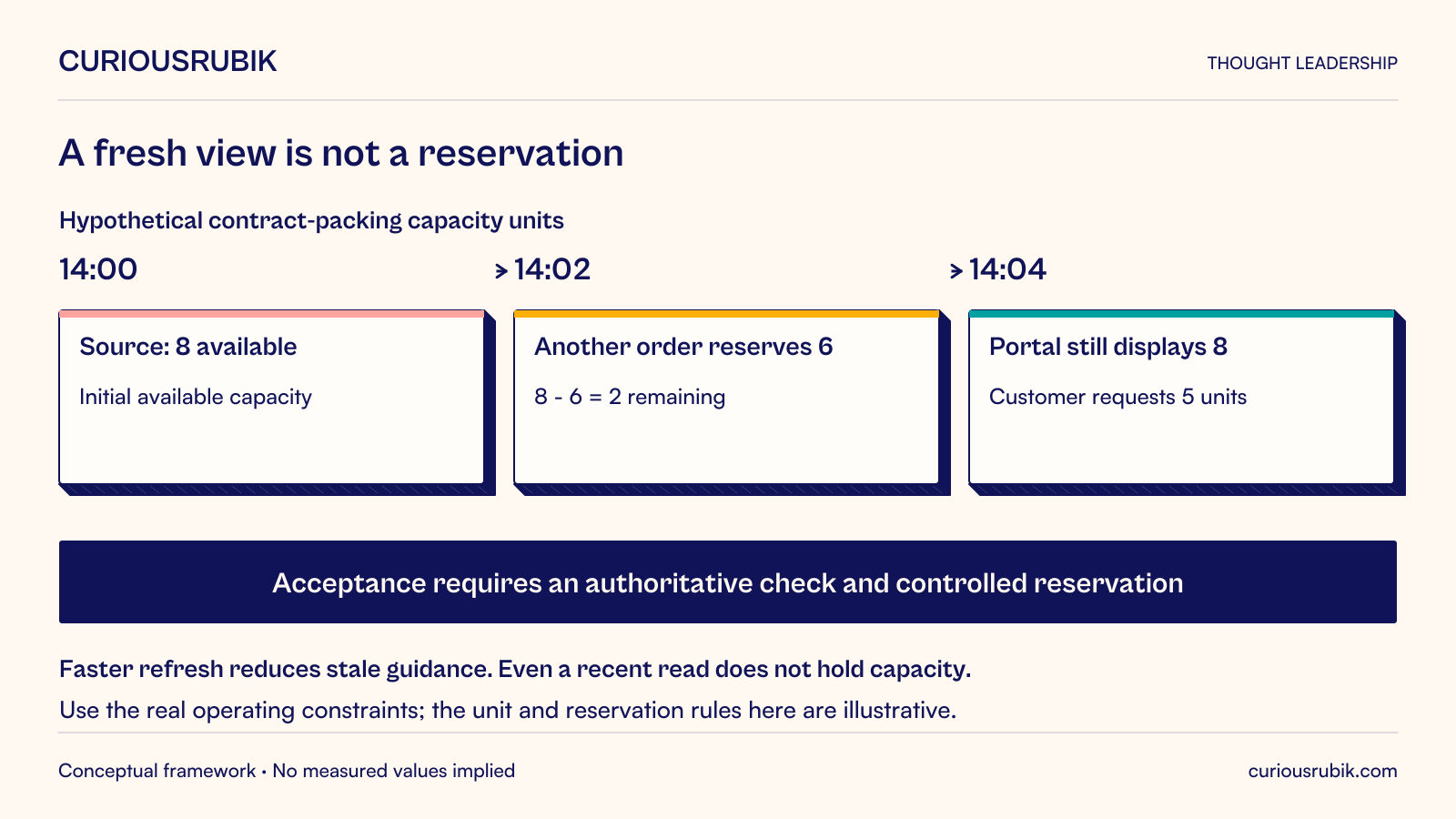
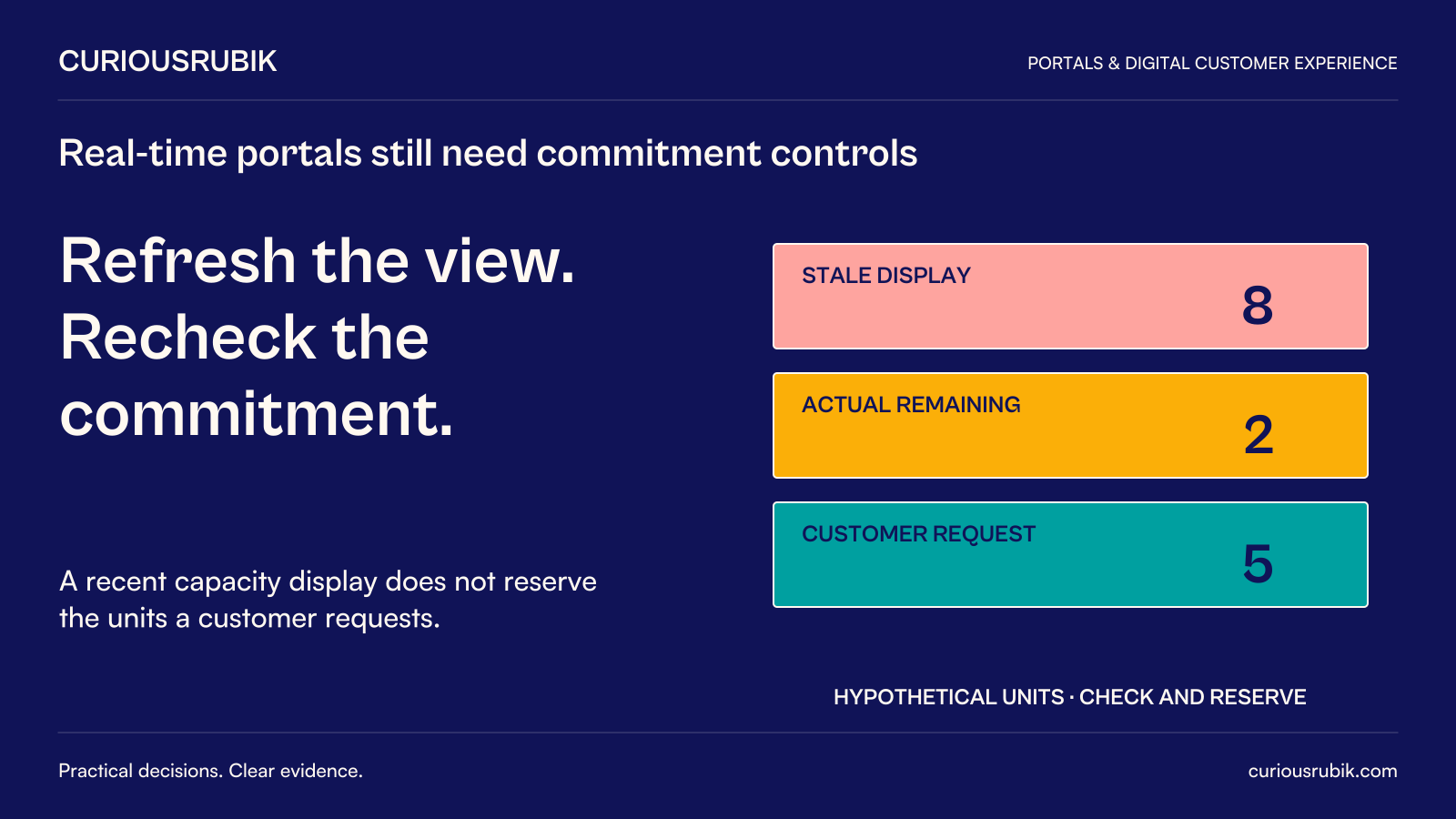
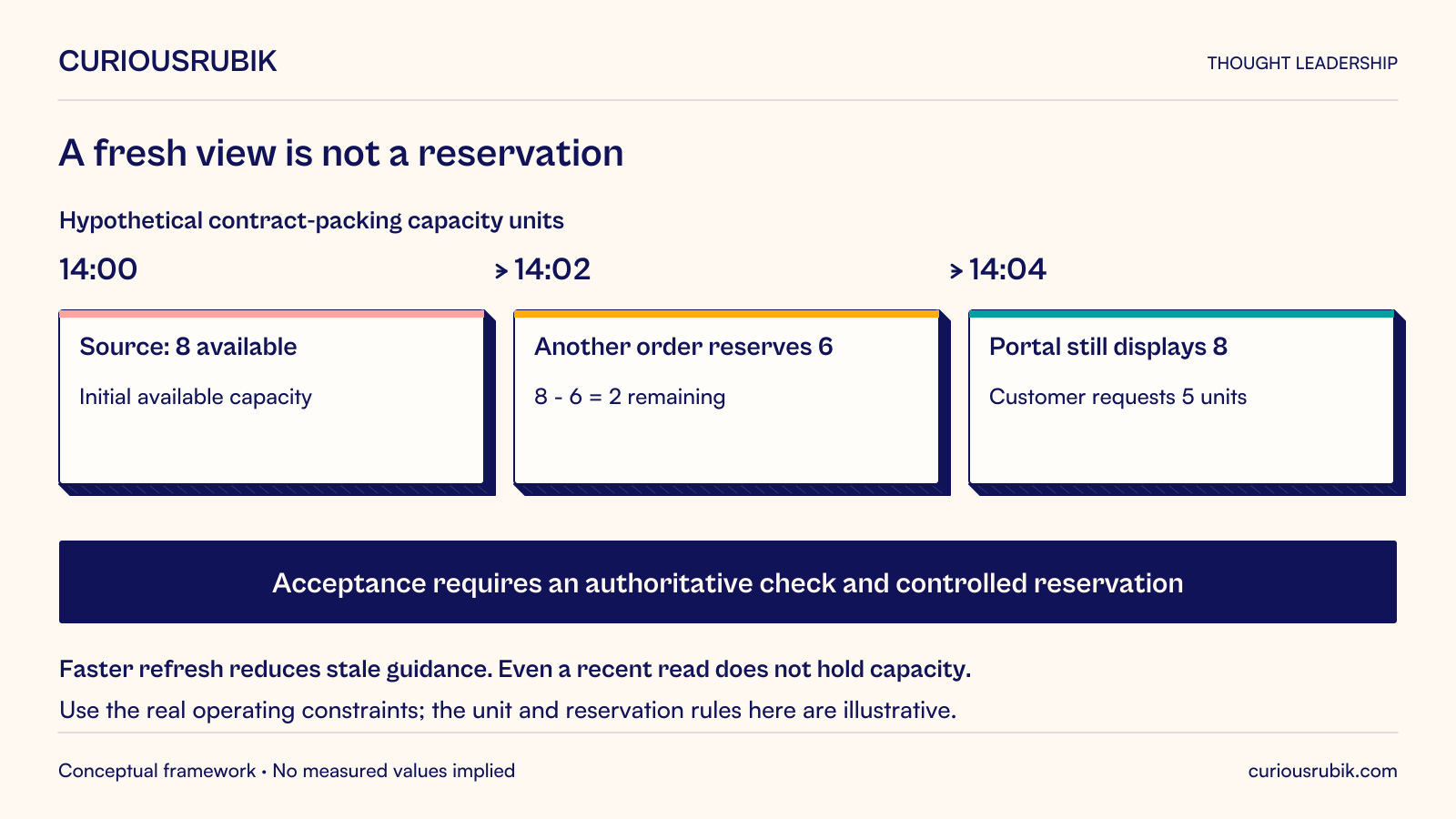
Consider a hypothetical contract-packing provider whose customer portal shows available capacity for a production window. At 14:00, the source records eight available capacity units. At 14:02, another accepted order reserves six, leaving two. At 14:04, a customer sees the old value of eight and requests five units.
A faster integration could reduce the chance of showing the outdated eight-unit value. It cannot by itself guarantee that five units remain available when the customer submits. Another transaction could consume capacity after even a very recent display.
The commitment therefore needs an authoritative check and a controlled reservation process at the point where the business accepts the request. If only two units remain, the service should respond with the actual permitted outcome rather than accepting an unsupported promise based on the earlier screen.
The unit and reservation rules in this example are assumed for illustration. Real capacity planning may depend on product mix, equipment, labor and other constraints. The portal must use the business’s actual rules rather than reduce a complex constraint to a misleading single number.
This distinction keeps the investment case honest. Faster updates can reduce failed attempts and uncertainty, while separate controls protect the validity of accepted work.
Set a decision-specific freshness requirement
A useful working requirement states the maximum tolerated information age under defined conditions, the meaning of the displayed state and what the service does when that condition cannot be met. This is a proposed design aid, not a universal timing standard.
Choose the threshold with the business owner, based on how quickly the fact changes and the consequence of relying on an older value. There is no single real-time interval appropriate for every portal field.
For some information, a dated snapshot is acceptable. For other information, the portal may need to retrieve a current value before enabling a decision. Some actions require revalidation at submission regardless of how recently the screen was updated.
Include exceptions. During a source outage, can the portal show the last known status with a clear age and limitation? Should it disable the affected action? Can it accept a request for later review without implying acceptance of the underlying commitment?
Make the fallback part of the service promise. An undefined response to stale information leaves users and support staff to invent their own assumptions under pressure.
Choose the integration pattern for the need
Scheduled synchronization can be appropriate for information that changes slowly or is explicitly presented as a periodic snapshot. It may be simpler to operate and easier to reconcile than a more frequent feed.
Event-driven updates can reduce the delay between a meaningful source change and the portal view, but they require handling missed, repeated and out-of-order events. A successful event delivery is not enough if the portal applies an older update after a newer one.
A synchronous request can obtain an answer from the source during the user journey, but it also makes the portal depend on that source’s response time and availability. Use it where the business value justifies that dependency and define timeouts and failure states.
Caching can improve responsiveness and reduce source load, but its rules need to fit the information. RFC 9111 defines HTTP cache freshness and validation behavior. Those protocol concepts do not establish that an underlying business fact is current or reserved for the user; the application still needs its own decision and commitment rules. RFC 9111, HTTP Caching, June 2022.
A mixed design is often worth evaluating. It can provide efficient browsing from a maintained view while checking the authoritative conditions when the user requests a consequential action. The actual choice should follow measured requirements, not a preferred technology pattern.
Price the improvement against the actual delay problem
Estimate the cost of the current problem before assigning value to faster updates. How often do stale views cause unsuccessful attempts, repeat contact or corrective work? Which users and transactions are affected? What evidence links the problem to information delay rather than unclear rules or incorrect source data?
Keep categories distinct. Staff handling time, customer waiting, lost opportunity and direct expenditure are not interchangeable. A modeled reduction in repeat calls does not automatically become a payroll saving.
Compare the proposed improvement with alternatives. A clear timestamp, better status explanation or a check before submission may address much of the problem at lower complexity. In other cases, the opportunity to act earlier may justify a faster feed.
Include the operating costs of the new pattern: source capacity, monitoring, recovery, reconciliation, testing and support. A faster integration that requires frequent manual repair can shift rather than remove the burden.
Use scenarios where demand and change rates are uncertain. The business case should show the conditions under which the investment is valuable and the assumptions that deserve validation in a pilot.
Test delayed and conflicting information deliberately
A portal integration should be tested under conditions that challenge its freshness promise. Delay an update, interrupt the source connection, deliver an older event after a newer one and change the business state while the customer is completing the task.
Observe both the system outcome and the user’s understanding. Does the interface show a stale state as current? Does it explain a rejected commitment clearly? Can the customer distinguish a pending request from an accepted transaction?
Test recovery without creating duplicate effects. If a submission’s response is lost, the service should determine what actually happened before encouraging another attempt that could create a second commitment. Keep the request identity and outcome visible to support.
Verify permissions across the integration. Faster updates should not expose a record after the user’s access has changed or include information from another customer context. The freshness of business data and the freshness of authorization are related operating concerns with potentially different consequences.
These tests provide evidence about the promised service, not merely the transport technology.
Monitor whether information remains usable
Track age and completeness as well as technical errors. A feed can be connected while quietly missing one class of updates. A portal can serve pages normally while its source-derived view becomes progressively older.
Define alerts that connect to the affected decision and a responsible owner. The support team should know which users or tasks may have relied on stale information and what corrective action is appropriate.
Use business reconciliation where possible. Compare relevant source and portal states over an agreed scope, investigate discrepancies and retain evidence of correction. The frequency and depth should match the service’s risks and operating needs.
Review the freshness requirement when the business changes. More customers, a different product mix or a tighter commitment window can make a previously acceptable delay unsuitable. Equally, a costly fast feed may become unnecessary if the task changes.
Invest in timeliness where it changes the outcome
Real-time portal integration is valuable when timely information enables a better decision or reduces a demonstrated service failure. It is less compelling when the information is rarely used, the source is unreliable or the customer still cannot complete the task.
A strong proposal connects the delay problem, decision-specific requirement, integration approach, fallback and measurable result. It also preserves the distinction between seeing a current fact and receiving an authorized business commitment.
That combination gives the business something more useful than a fast dashboard: a portal whose information can be understood and acted on within clear, supported limits.