The procedure is current, the employee has signed the training record, and the next job still stalls. A customer-supplied fabric has an unclear pattern orientation, while the production instruction says to confirm the specification before cutting. The document describes the right principle. It does not provide the missing customer decision or the authority to obtain it.
This hypothetical upholstery-workshop case captures the limit of a standard operating procedure. An SOP is an important part of dependable work, but execution also needs competent people, usable information, suitable resources, and a response when the stated conditions do not hold. More pages cannot always supply those missing elements.
An operations leader should judge a procedure by demonstrated use, including exceptions, rather than by its existence in a controlled library. The practical task is to connect the instruction to the operating conditions that make it executable, without trying to document every possible event in advance.
Know what the procedure is meant to control
Define the task, expected outcome, applicable conditions, and boundaries. A procedure should help the assigned person perform the work consistently under its intended circumstances. It should also make clear when the person must stop, seek information, or involve another role.
Distinguish instructions from policy and reference information. Policy establishes the rule or authority; an SOP explains how approved work is performed; reference material supplies details needed for a particular case. Mixing everything into one long document can make each part harder to find and maintain.
State the prerequisites. The employee may need an approved specification, identified material, available equipment, or a qualified reviewer. If a prerequisite is missing, the procedure needs an appropriate route rather than an instruction that assumes the condition exists.
EPA’s guidance treats SOPs as part of a quality system, with preparation, review, approval, revision, and use. The guidance supports disciplined documentation; it does not establish that possessing an approved document proves a person’s competence or an operation’s readiness. EPA QA/G-6, Guidance for Preparing SOPs, April 2007
Test the work at the point of use
Ask an appropriately qualified employee to perform or demonstrate representative tasks using the procedure and actual supporting information. Observe where they need to interpret, search, ask, or improvise. The aim is to assess the operating design, not surprise the employee with an undocumented test.
Include a normal case and a meaningful exception. A clean demonstration can show that the sequence is understandable while missing the condition that causes real failures. Choose exceptions from the work’s actual consequences and known variation.
Check whether the document is accessible when needed. A controlled copy in a distant office is less useful than a clear, current instruction at the work point. The right format may be a concise task guide supported by detailed reference material, rather than one document trying to serve every role.
Observe the surrounding environment. Time pressure, missing tools, unclear identifiers, and conflicting supervisor instructions can defeat a sound procedure. Record those findings separately so the remedy does not become another rewrite of text that was already adequate.
Follow the upholstery exception to its owner
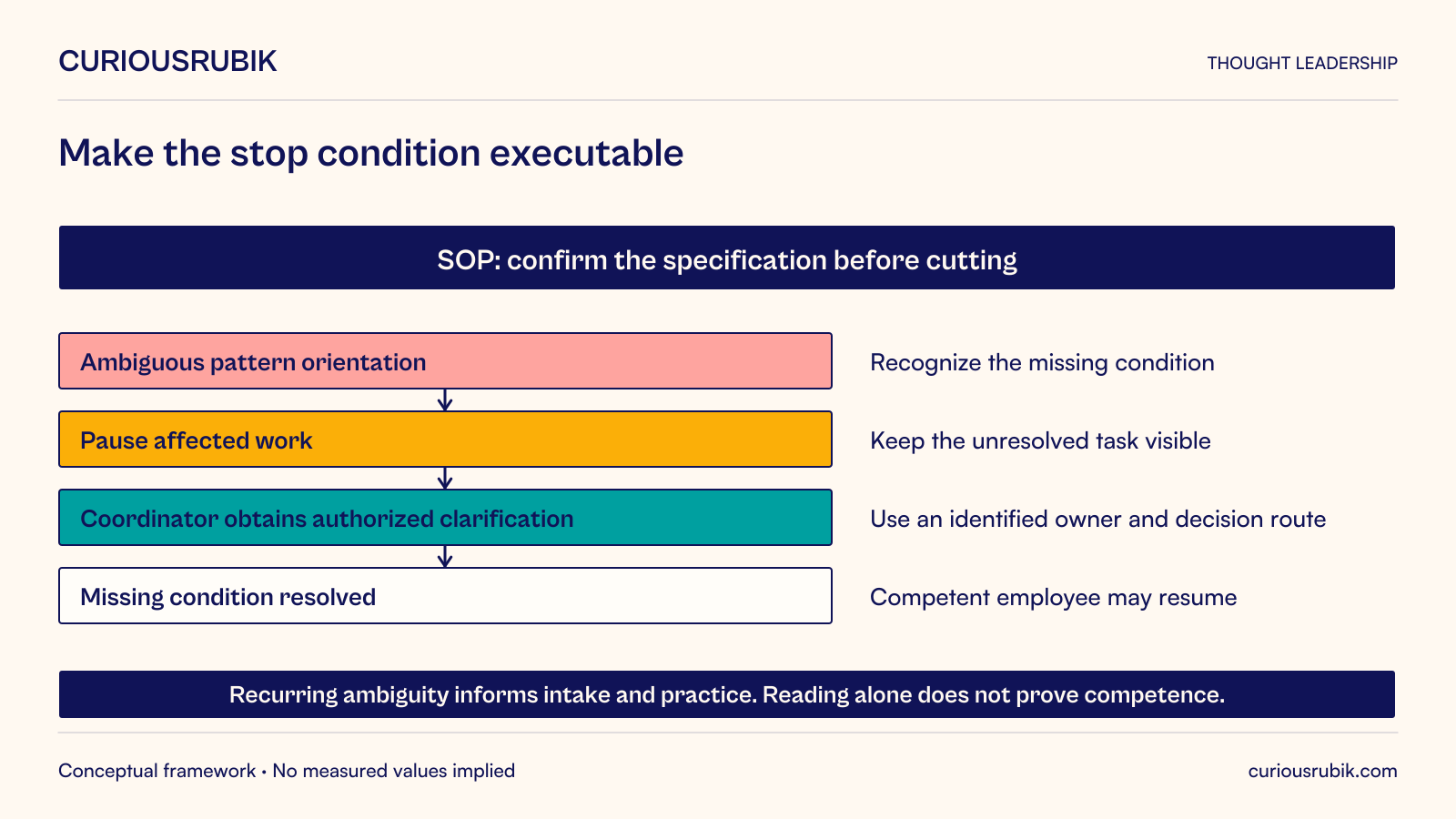
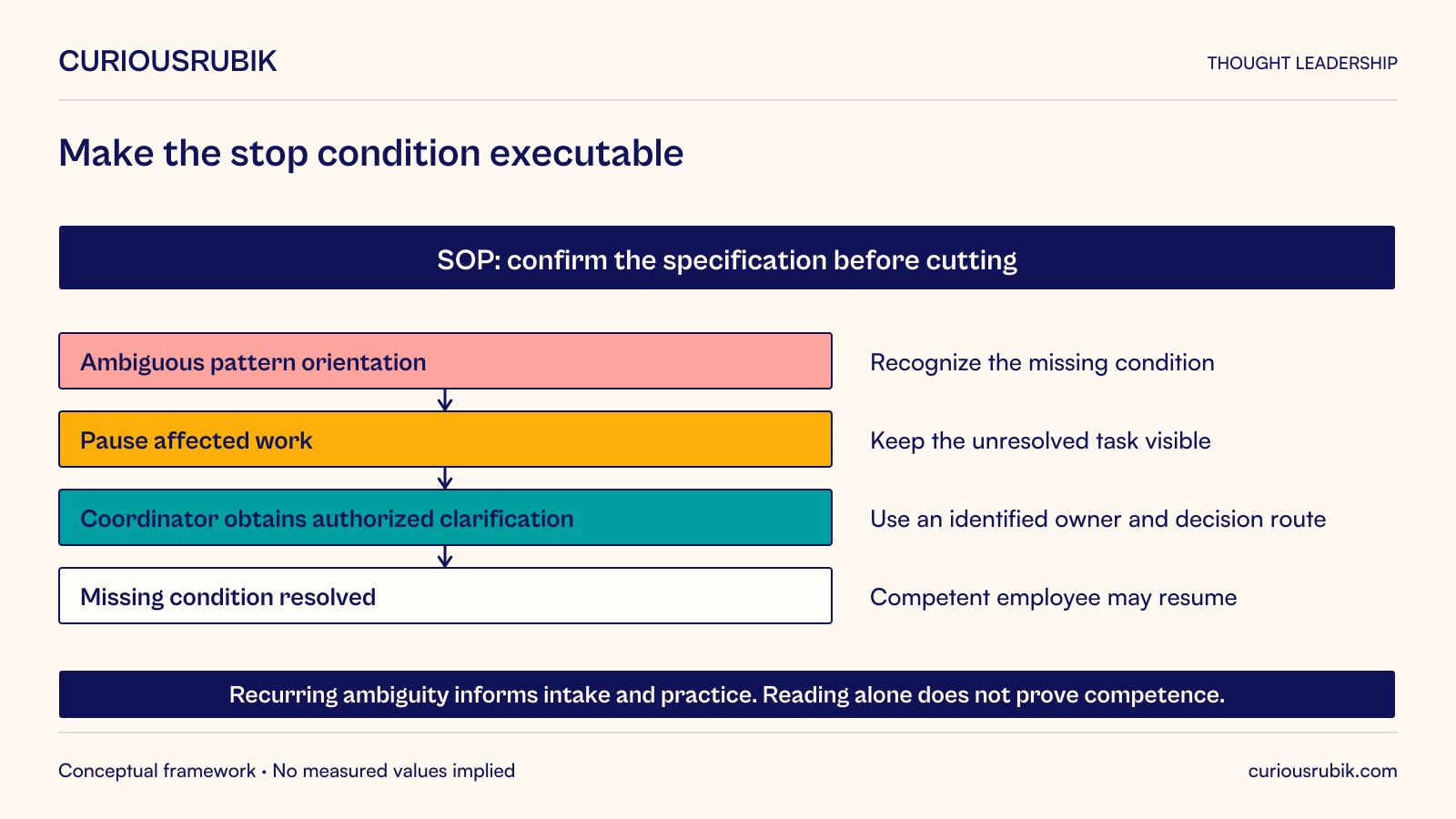
Imagine a hypothetical workshop preparing custom upholstery from customer-supplied fabric. The approved task sequence requires the material and design specification to be confirmed before an irreversible cut. The employee finds that the supplied pattern can be oriented in more than one plausible way, and the customer instruction is incomplete.
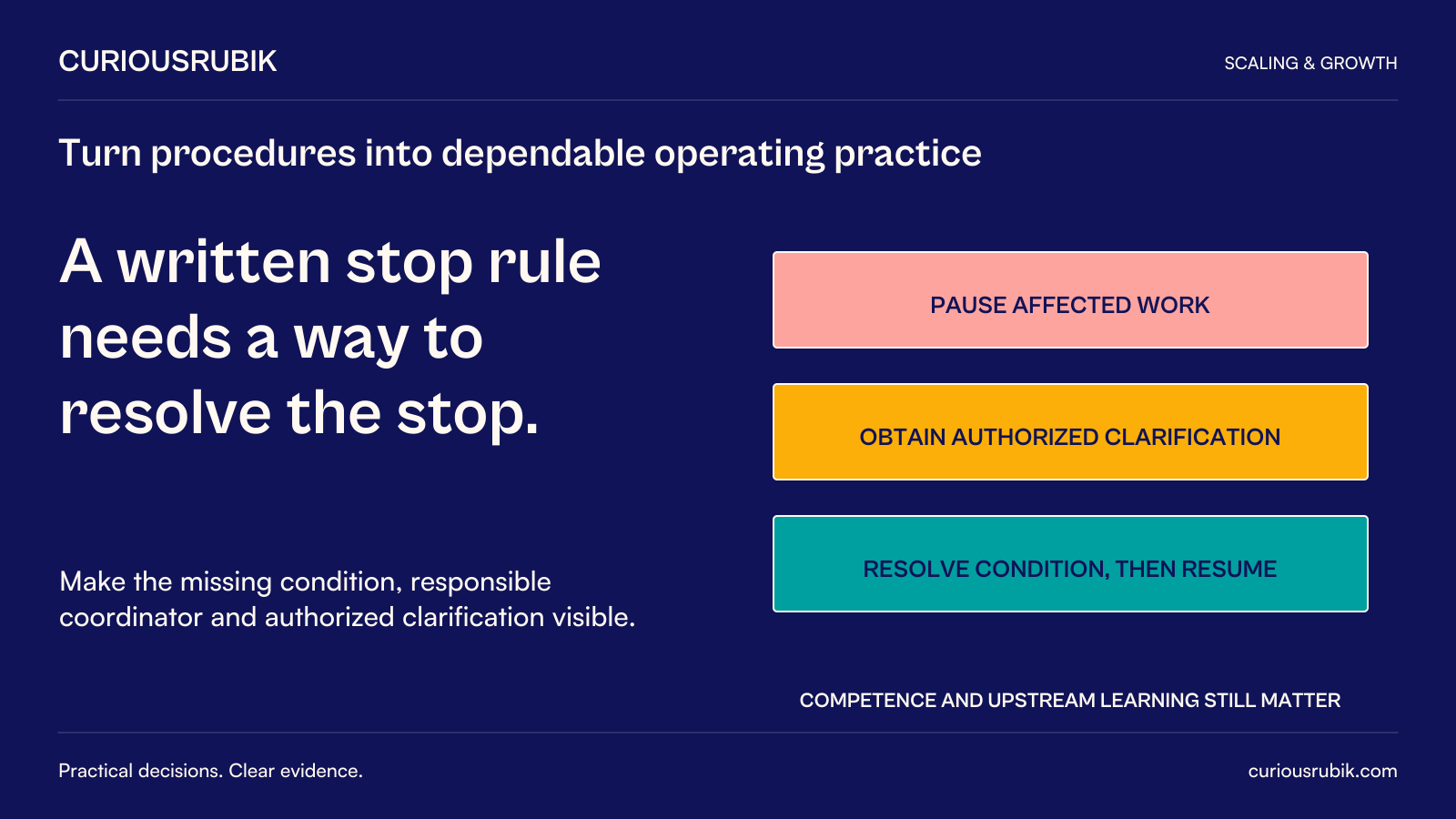
The SOP correctly says to stop and seek clarification. In practice, the employee does not know whether the production supervisor, account coordinator, or designer can obtain and approve the missing decision. Each assumes another role owns the customer conversation.
The first repair is therefore an exception route. A designated coordinator receives the identified job, the ambiguity, and the consequence of waiting. The appropriate design or commercial owner confirms the decision through the approved process. The employee receives a clear instruction tied to that job before work resumes.
The workshop also checks its intake process. If the same ambiguity recurs, a better customer question or an approved example may prevent it. That upstream improvement does not remove the need for a stop route when unusual material arrives.
Training now includes the ambiguous-pattern case. The employee demonstrates that they can recognize the missing condition, pause the affected work, and reach the correct owner without guessing. The assessment concerns the management process; it is not a substitute for the craft skills needed to perform the upholstery itself.
The useful outcome is a complete operating arrangement: a clear standard for routine work, a competent person, the required resources and information, and an owned response to exceptions. A signed acknowledgment alone would establish much less.
Verify competence through the judgment the task needs
Reading and acknowledging a procedure can be useful evidence of communication, but it is not the same as demonstrating skill. Decide what the employee must be able to recognize, perform, check, and escalate for the role.
Use assessment appropriate to the consequence. A simple administrative task may need observed practice. A specialist activity may require formal qualification or other controls under the applicable professional and organizational requirements. Do not substitute a generic training quiz for those obligations.
Give feedback and another opportunity to practice where appropriate. A demonstration that reveals confusion should inform training or design improvement. Avoid treating every difficulty as an individual failing before checking whether the instructions and prerequisites are clear.
Maintain competence when the work changes or is performed infrequently. New materials, equipment, policy, or task scope may require updated instruction and practice. A training record from an earlier operating condition does not automatically establish readiness for the revised one.
Design deviations without normalizing uncontrolled work
A deviation process should identify what is outside the standard, why it matters, who may decide, and how the decision is recorded. It should be usable enough that employees do not need an informal workaround simply to keep legitimate work moving.
Separate a permitted exception from an unauthorized bypass. The former follows an approved decision route with defined limits. The latter skips a necessary condition without the relevant authority. A busy period does not make those actions equivalent.
Review repeated deviations. They may show that the procedure is poorly matched to ordinary work, that inputs are unreliable, or that a specialist service should be designed explicitly. Repeating the same exception indefinitely can be more burdensome than revising the standard.
Preserve the purpose of necessary controls when simplifying. If a check protects against an irreversible error, removing it because it slows the task is incomplete reasoning. Find a better way to obtain the evidence or prevent the defect, with the responsible owner’s approval.
Use the right level of detail
A procedure should be detailed enough for its intended user and task, not equally detailed for everyone. A trained specialist may need critical limits and decision points, while a new employee may need additional examples and supervised practice. State the assumed competence so the document is not used as an unsupported substitute for it.
Separate stable instructions from job-specific facts. The upholstery SOP can require a confirmed pattern choice, while the individual job record supplies that choice. Copying every customer detail into the standard makes it harder to maintain and risks carrying an old decision into unrelated work.
Test whether the format helps the user find the important condition at the moment it matters. Shorter is not always clearer, and longer is not automatically more complete. Observe use rather than judging quality by page count.
Make procedures part of supervision and support
Supervisors should reinforce the approved process and resolve conflicts in priorities. An employee cannot follow a stop condition confidently if a manager informally insists that output must continue regardless. The operating message must match the written one.
Provide a reachable support route. If the procedure requires specialist clarification, establish coverage, escalation, and the behavior permitted while waiting. An instruction to ask someone who is routinely unavailable is not a complete design.
Use observed work to improve the procedure. Capture unclear language, missing examples, and unnecessary effort. The document owner should distinguish changes to wording from changes to policy or technical method that need different approval.
Keep updates connected to practice. When an instruction changes, identify who is affected, what they need to understand, and whether the change alters the demonstration of competence. Uploading a revised file does not by itself establish that work has changed.
Measure adherence and outcomes together
Check whether the procedure is being followed, but also whether it produces the intended result under its stated conditions. High adherence to an inadequate process can still create defects. A good outcome achieved through undocumented rescue may be difficult to repeat safely.
Track exceptions, rework, clarification, and the availability of prerequisites. These measures help identify whether the problem lies in the instruction, information, resources, or execution. Avoid one compliance percentage that conceals all those mechanisms.
Inspect the cases that required a pause. Was the concern valid? Did the right owner respond? Did the resolution reach the work point? This tests the exception design rather than rewarding employees merely for keeping the routine path moving.
The workshop’s next readiness check should therefore put the procedure into use with both ordinary fabric and an ambiguous case. The organization needs to see that work proceeds correctly when conditions are met and stops constructively when they are not. SOPs remain necessary for many operations. Their value is realized through the people, evidence, resources, and decisions that make the written standard executable.