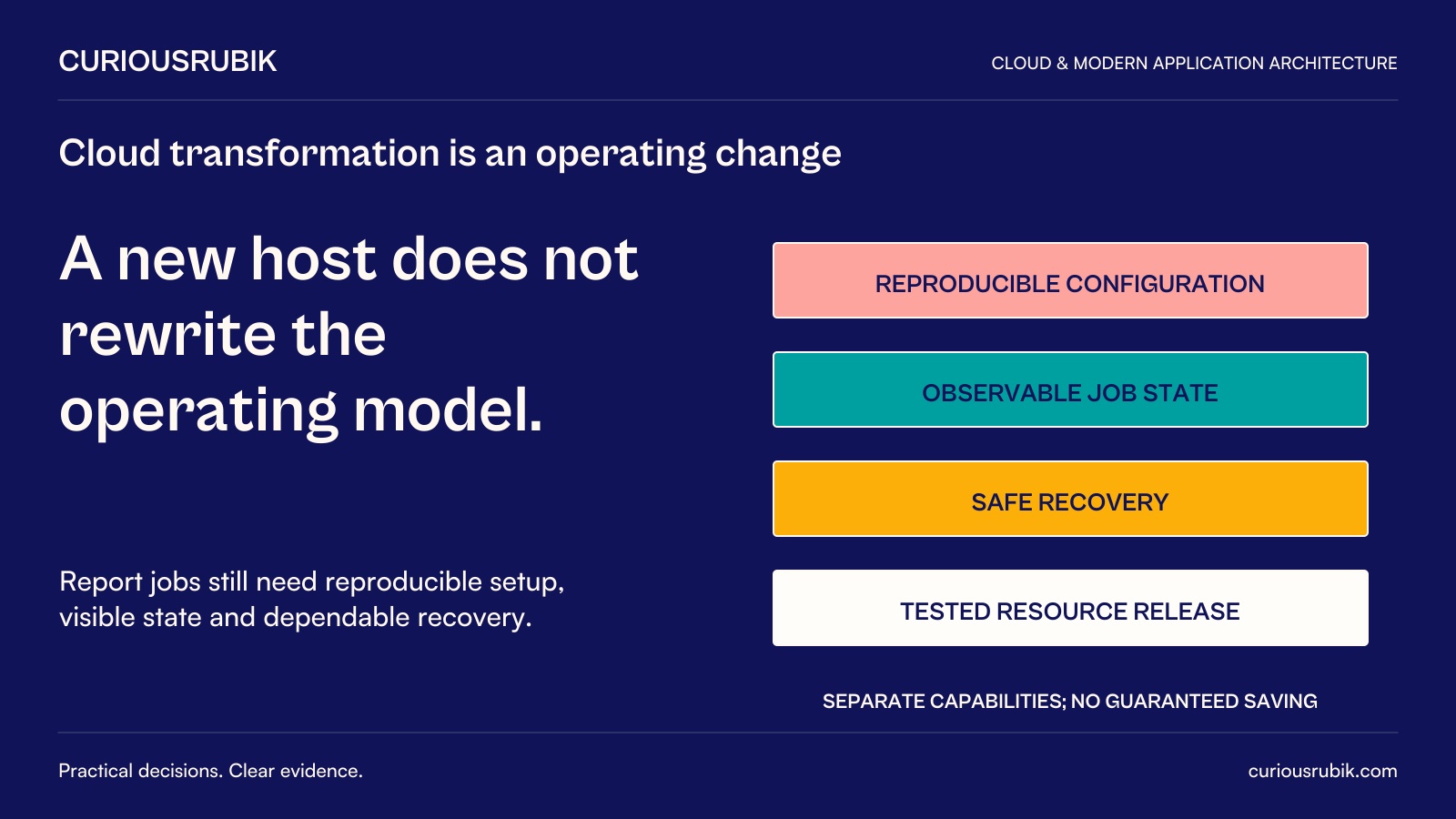
An application can move to cloud infrastructure while the way the business delivers and operates it remains almost unchanged. The same manual release steps, unclear ownership, oversized environments and fragile recovery procedures can follow the workload to its new location.
The migration may still be worthwhile. It can address an expiring hosting arrangement, unsupported hardware or a capacity constraint. The mistake is to attribute broader improvements to the move without changing the mechanisms that would produce them.
For a technology sponsor, the useful distinction is between relocating a workload and improving the capability to deliver, operate and adapt a business service. These objectives can be related, but they require different evidence and sometimes different stages of investment.
State what the move is intended to achieve
Begin with the reason for migration. A data-center exit has a deadline and a relocation outcome. Faster product changes require improvements in delivery and decision-making. Better resilience requires tested recovery and failure handling. Lower cost requires a credible change in resource use or commercial arrangements.
Do not combine these into a vague cloud benefit. Define the outcome, the current constraint and the change expected to remove it. That makes it possible to recognize when migration is a necessary first step rather than the whole solution.
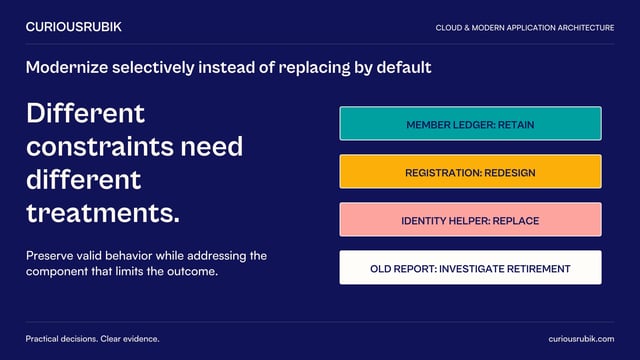
Some workloads may reasonably move with limited modification to reduce transition risk. Others may justify a change in platform or architecture. Some may be better retired or retained temporarily. The choice should follow the workload’s condition and business need rather than a uniform treatment for the entire estate.
Keep the costs and risks of each stage visible. Promising transformation benefits in the migration budget without funding the required operating changes creates an expectation the project cannot fulfill.
Understand the capabilities cloud makes available
NIST’s 2011 definition identifies characteristics including on-demand self-service, resource pooling, rapid elasticity and measured service. Those describe capabilities of the cloud model; they do not establish that every application automatically uses them effectively. NIST, The Definition of Cloud Computing.
An application may still require a manually provisioned environment because its configuration is not reproducible. It may remain unable to scale a particular operation because a shared dependency is the bottleneck. Its consumption may be metered while nobody can connect the bill to a business service or responsible owner.
The investment question is how the organization will use the relevant capabilities. Which tasks become repeatable? Which resources can be released when no longer needed? Which operating decisions become better informed?
Avoid treating service labels as a substitute for design. Moving to a managed service can change responsibilities and constraints, but it does not remove the need to understand those responsibilities or test the resulting service.
A reporting workload can move without becoming easier to operate
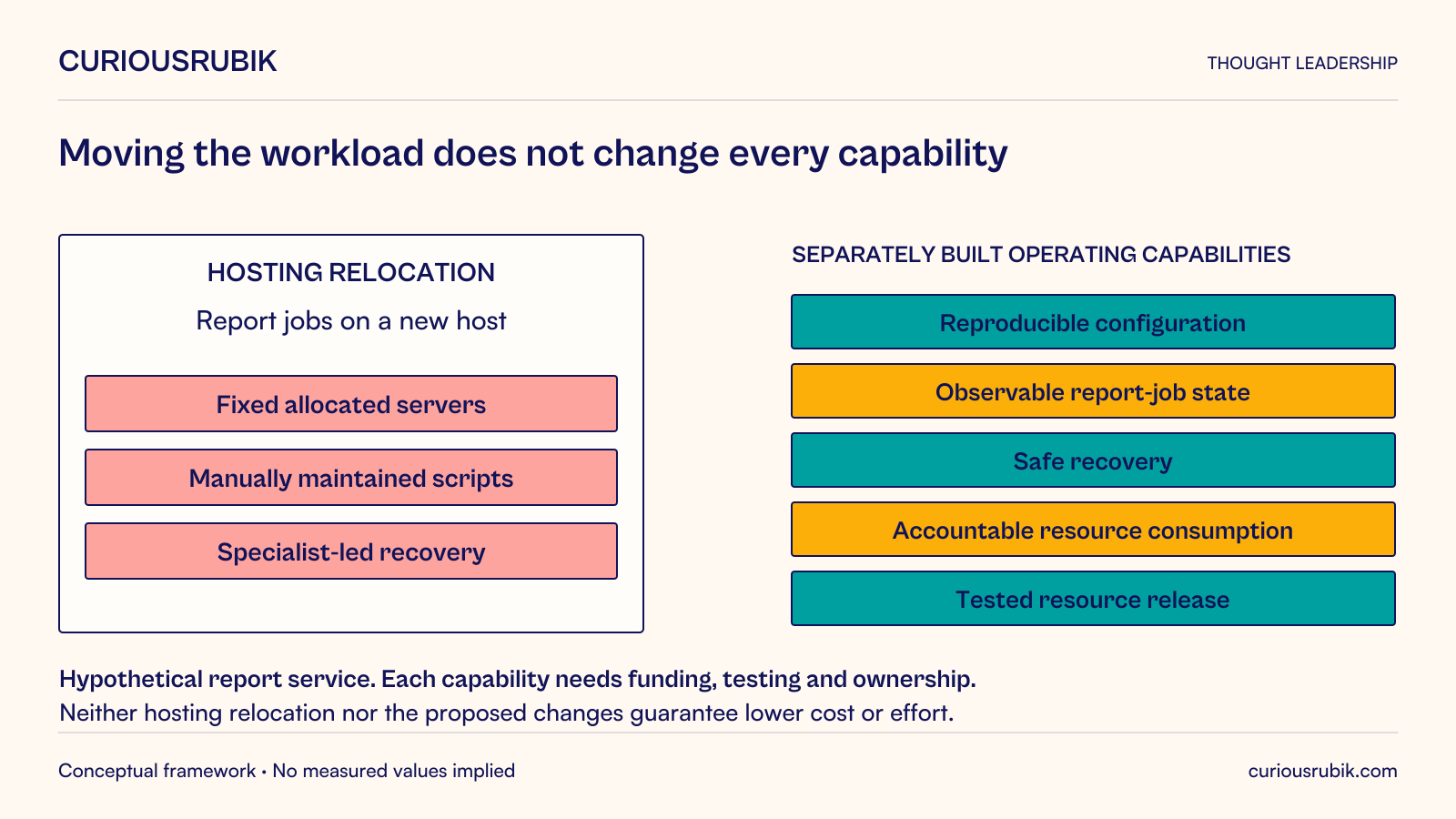
Consider a hypothetical market-research company that produces client reports from scheduled data-processing jobs. Its existing setup uses a fixed group of servers, manually maintained scripts and a shared file area. A specialist restarts failed jobs and checks whether a partially produced report can be used.
A migration copies that setup to cloud virtual machines. The company has changed its hosting location, but the jobs still depend on undocumented configuration. The specialist still diagnoses failures manually, and idle capacity may remain allocated between processing periods.
A separate improvement effort could make job configuration reproducible, define safe restart behavior, isolate client data, track each report’s processing state and measure resource consumption against completed work. Where the workload permits, it could allocate processing capacity when needed and release it afterward.
Those changes are not guaranteed to reduce cost or effort. They require implementation, testing and support, and some jobs may have constraints that limit elasticity. Their value should be demonstrated through the report service’s actual behavior.
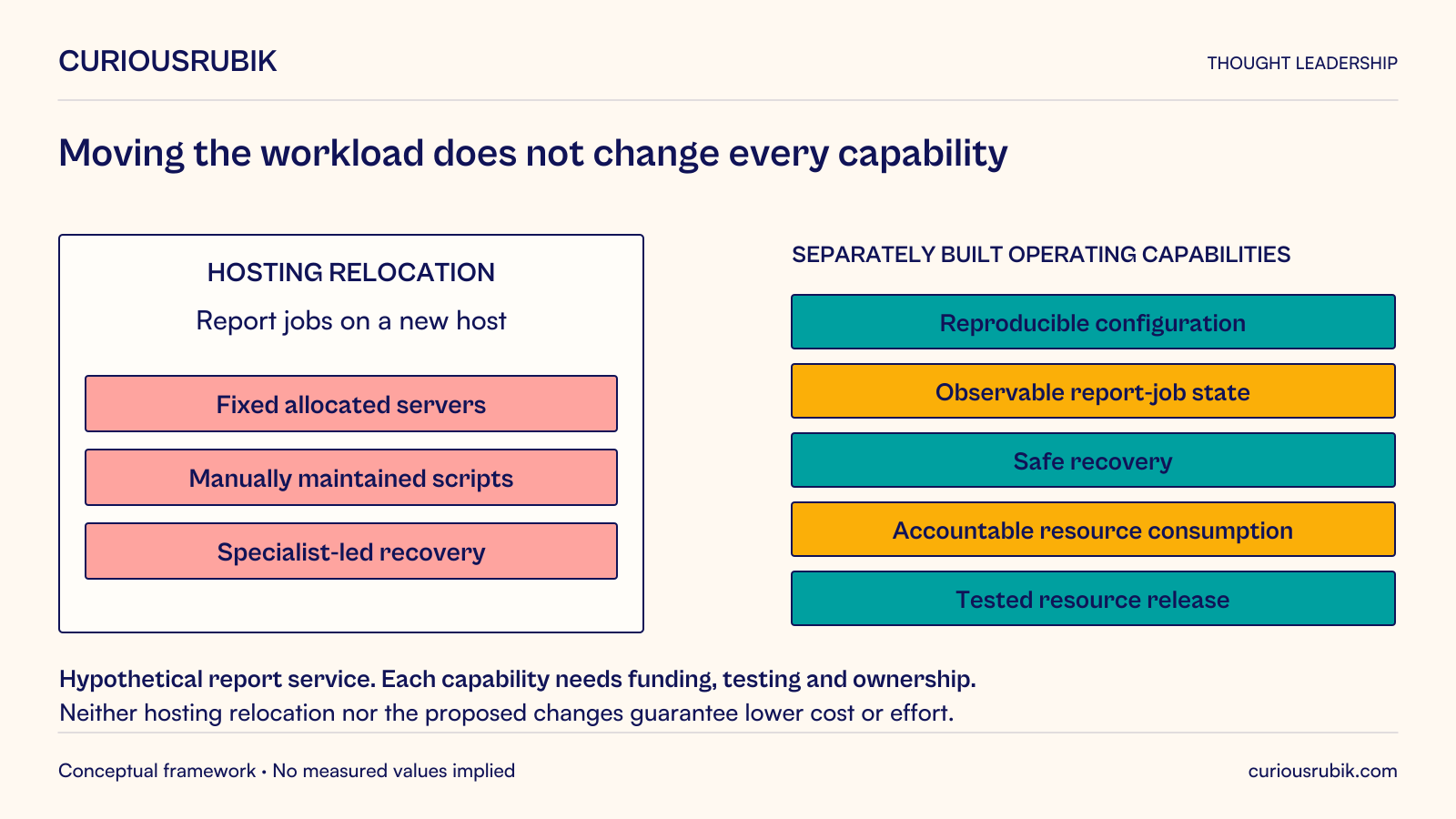
This example makes the distinction observable. The team can test whether another qualified operator can recover a failed job and whether unused resources are actually released, rather than reporting transformation as a percentage of servers moved.
Change delivery practices where they constrain the outcome
Cloud resources can be provisioned quickly, but application delivery may still wait on unclear requirements, manual configuration or a release process that relies on one person. Investigate the actual source of delay.
Make environments and configuration reproducible where appropriate. Record changes, test them and maintain a supported route to restore a known state. A faster manual process may help temporarily, but it remains difficult to repeat and audit reliably.
Improve the path from a proposed change to a verified release. The needed controls depend on the service, but should include evidence that the change meets requirements and does not bypass security or operational obligations.
Do not equate automation with permission to release without judgment. The objective is to make routine evidence and execution more reliable so that people can focus on the decisions that require them.
Measure the relevant result: waiting time, recovery effort, change failure or the ability to reproduce an environment. A new pipeline is an implementation artifact, not the business outcome by itself.
Redesign operating ownership rather than handing it away
A cloud provider performs some responsibilities, while the customer retains others. The exact boundary depends on the service model and agreement. The organization needs to know who handles configuration, identity, data protection, application behavior, incident response and recovery.
Map those responsibilities for the actual service, including suppliers and internal teams. A statement that the provider handles security is too broad to support an operating decision.
Ensure the team can see and diagnose the parts it owns. Logs and monitoring should connect technical symptoms to the affected business process, with permissions and retention appropriate to the information involved.
Review how incidents cross organizational boundaries. Who contacts the provider, who communicates with users and who decides whether a workaround is acceptable? A support agreement does not automatically supply the application’s recovery procedure.
Train the operating team on the new failure modes and tools. The migration is not operationally complete if routine diagnosis still depends on the project team remaining available indefinitely.
Make consumption a managed business responsibility
Metered consumption creates visibility only when the organization can interpret it. Assign resources to services and owners, and explain which activities drive usage.
Distinguish necessary capacity from idle or forgotten resources. Review test environments, temporary processing, retained data and supporting services. Resource release should follow an approved lifecycle, with safeguards against removing something still needed.
Use meaningful units where possible, such as cost per completed report or per active customer service, while stating the included costs. A falling unit cost can coexist with rising total expenditure when demand grows. Neither measure alone tells the whole story.
Avoid presenting every reduction in a cloud bill as a net saving. Include the effort and cost of the change, effects on reliability and any expenditure moved to another service or team.
The reporting example needs an owner who can decide whether a high-cost job should be optimized, scheduled differently or retained because it produces sufficient business value. Cost information without decision authority becomes another dashboard.
Test resilience in the new operating model
Migration can change failure boundaries. An application may become dependent on new identity, network, storage or management services. Understand those dependencies and the effect of their unavailability.
Test recovery of the complete business service, not merely restoration of a server. For the reporting company, the relevant question is whether the team can identify valid inputs, resume or repeat processing safely and produce the correct client output without mixing or duplicating work.
Define acceptable interruption and data-loss conditions with the business owner. Choose and verify recovery arrangements that address those conditions. A backup schedule or provider availability statement does not establish that the required recovery can be completed.
Account for access during an incident. Recovery procedures may need specific privileges and tools, but those should be governed rather than improvised through broad permanent access.
Use rehearsal results to update the plan. A documented design that has never been exercised remains an assumption about resilience.
Separate migration acceptance from benefit acceptance
The migration gate should establish that the workload can operate in the destination with the agreed data, interfaces, controls and support. The benefit gate should establish whether the intended improvements have occurred.
These gates may happen at different times. A service can be successfully relocated while cost optimization, delivery improvements or operating changes remain in progress. Reporting that distinction allows the sponsor to fund and manage the remaining work honestly.
Set owners and review dates for the benefit assumptions. If a promised improvement depends on retiring old infrastructure, removing a duplicate contract or changing team responsibilities, track that action explicitly.
Compare actual outcomes with the baseline and relevant changes in demand. A lower incident count during a quiet period is not enough to prove greater reliability. A higher bill during growth is not enough to prove failure. Interpret the evidence within the service’s operating conditions.
Choose a proportionate transformation path
Not every workload needs a major redesign. A stable, low-change application may justify a limited migration and clear support plan. A strategically important service constrained by manual delivery and recovery may justify deeper changes.
Sequence work so that each stage has a credible purpose and exit condition. Avoid an open-ended transformation program whose completion is defined only by adopting more cloud services.
The distinction between migration and transformation helps the business make better commitments. Moving a workload changes where it runs. Improving the operating capability changes what the organization can reliably deliver, recover and adapt. A strong cloud strategy knows which outcome it is buying at each stage and asks for evidence that the outcome has been achieved.