Product master data becomes operational infrastructure when purchasing, warehousing, selling, and reporting all use it to interpret the same physical goods. The critical decision is how a product or packaging change becomes active across those processes without changing the meaning of existing stock and transactions.
For a supply-chain and data leader, a successful master-data program should make product identity, units, packaging relationships, and location references dependable at the point of use. A clean catalogue is insufficient if a warehouse applies the wrong conversion or an order is interpreted under a different packaging version from the one agreed.
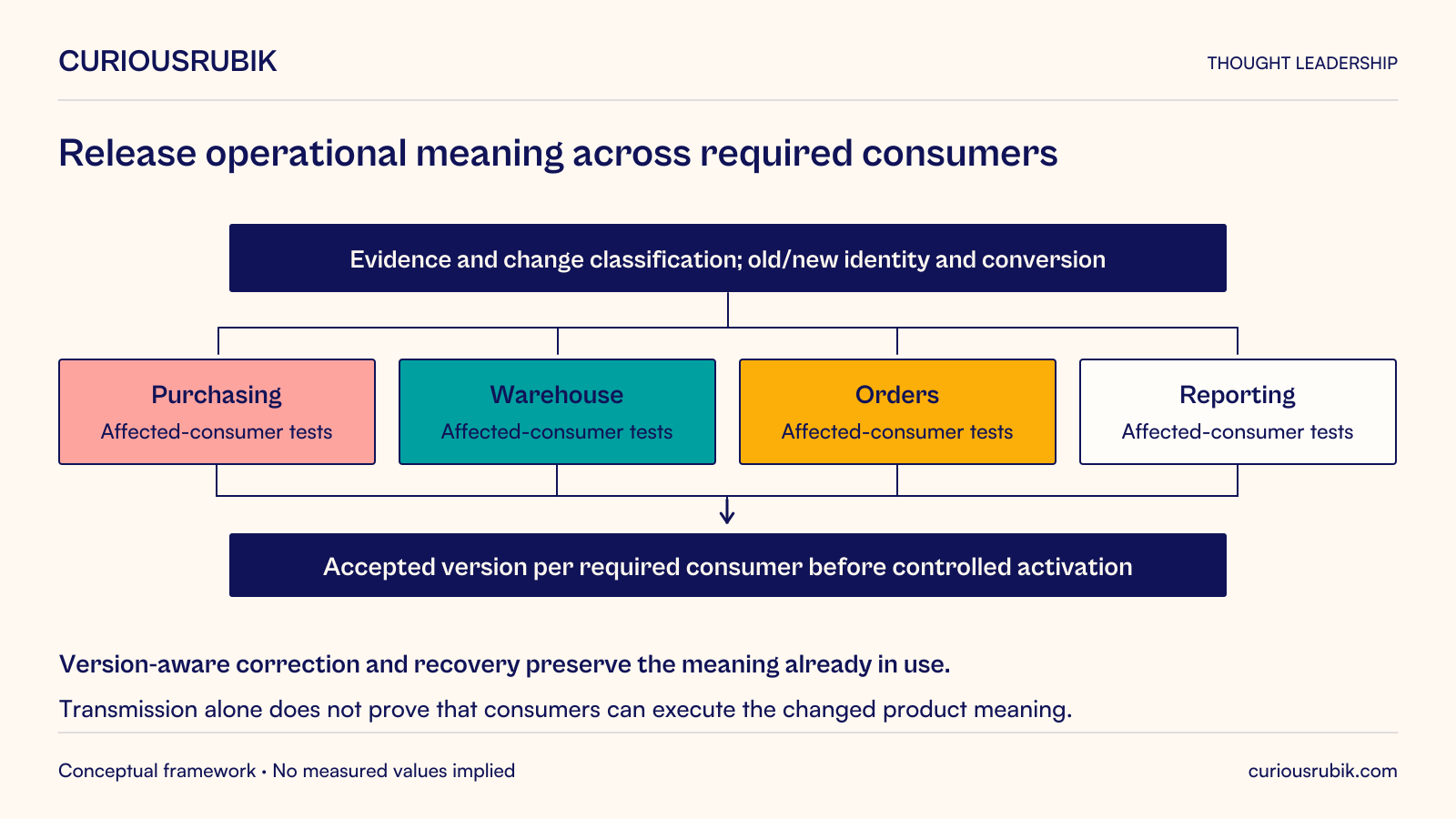
This requires a release process for operational meaning. New or changed master data should have evidence, an effective scope, affected consumers, validation, and a controlled activation. The process can be lightweight for low-consequence attributes and more rigorous where a change alters quantities, handling, or transaction interpretation.
Distinguish the product from its packaging and handling units
A base item, an orderable case, and a logistics container are related objects. They should not be treated as interchangeable simply because users call all of them a “unit.” The product model needs to state what each identifier represents and how quantities relate.
For a fixed-content case, define the contained item, quantity, and applicable packaging identity. A pallet or mixed container may have a different relationship. Do not assume one static conversion can describe every shipment configuration.
Keep purchasing, stocking, selling, and handling units explicit. A supplier may quote by case, a warehouse may count individual items, and a customer may order a different pack. The conversion must be applicable to that item and packaging version, not a generic rule attached only to the word “case.”
GS1’s GTIN Management Standard provides a concrete example of the importance of packaging identity: under its pack/case rule, a change in the number of trade items in a case requires a new GTIN for the relevant packaging level. The rule belongs to the GS1 identification framework; it does not mean every internal descriptive edit requires a new identifier. GS1 GTIN Management Standard, Release 1.0, Section 2.8
A hypothetical packaging change with overlapping stock
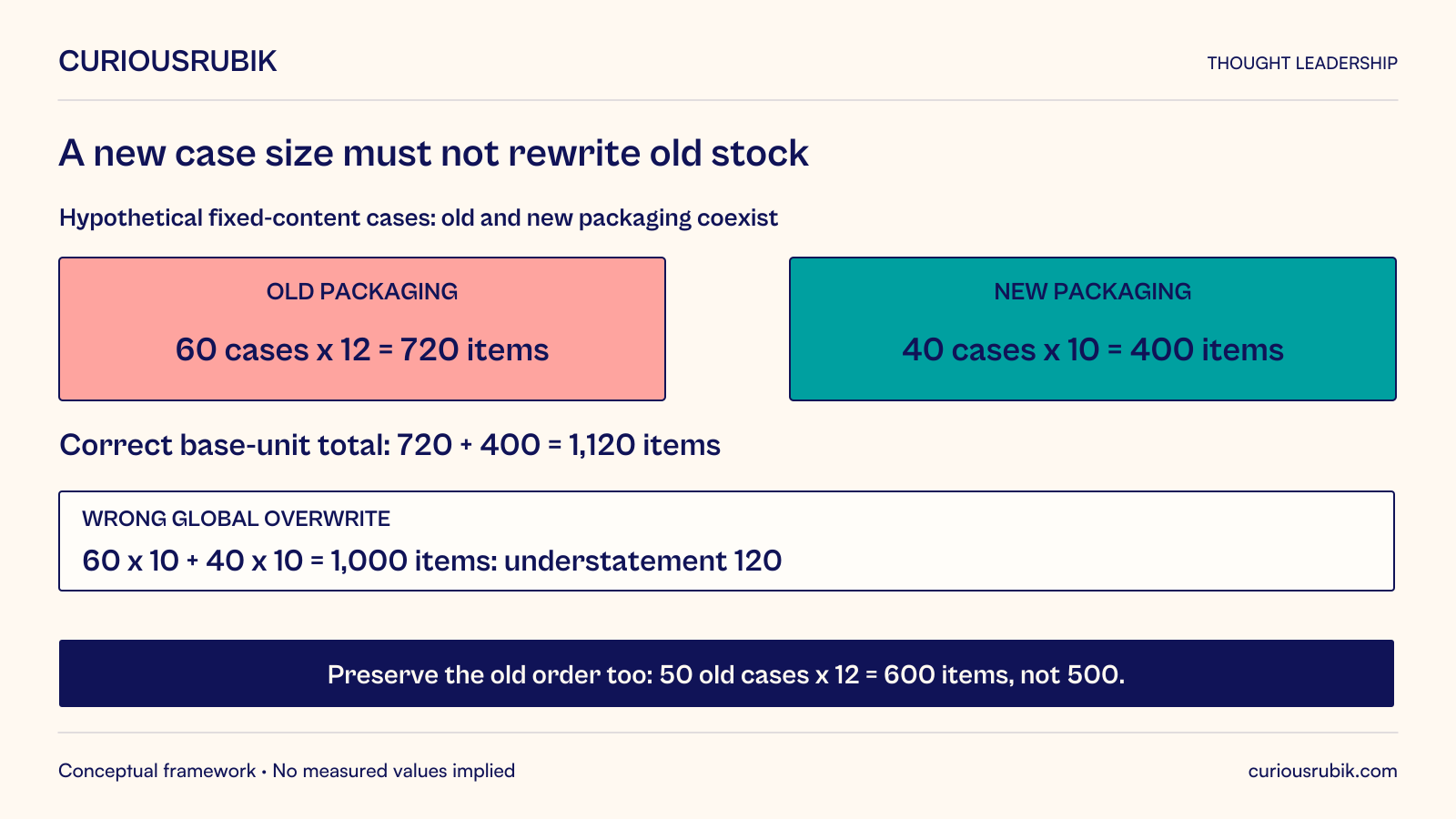
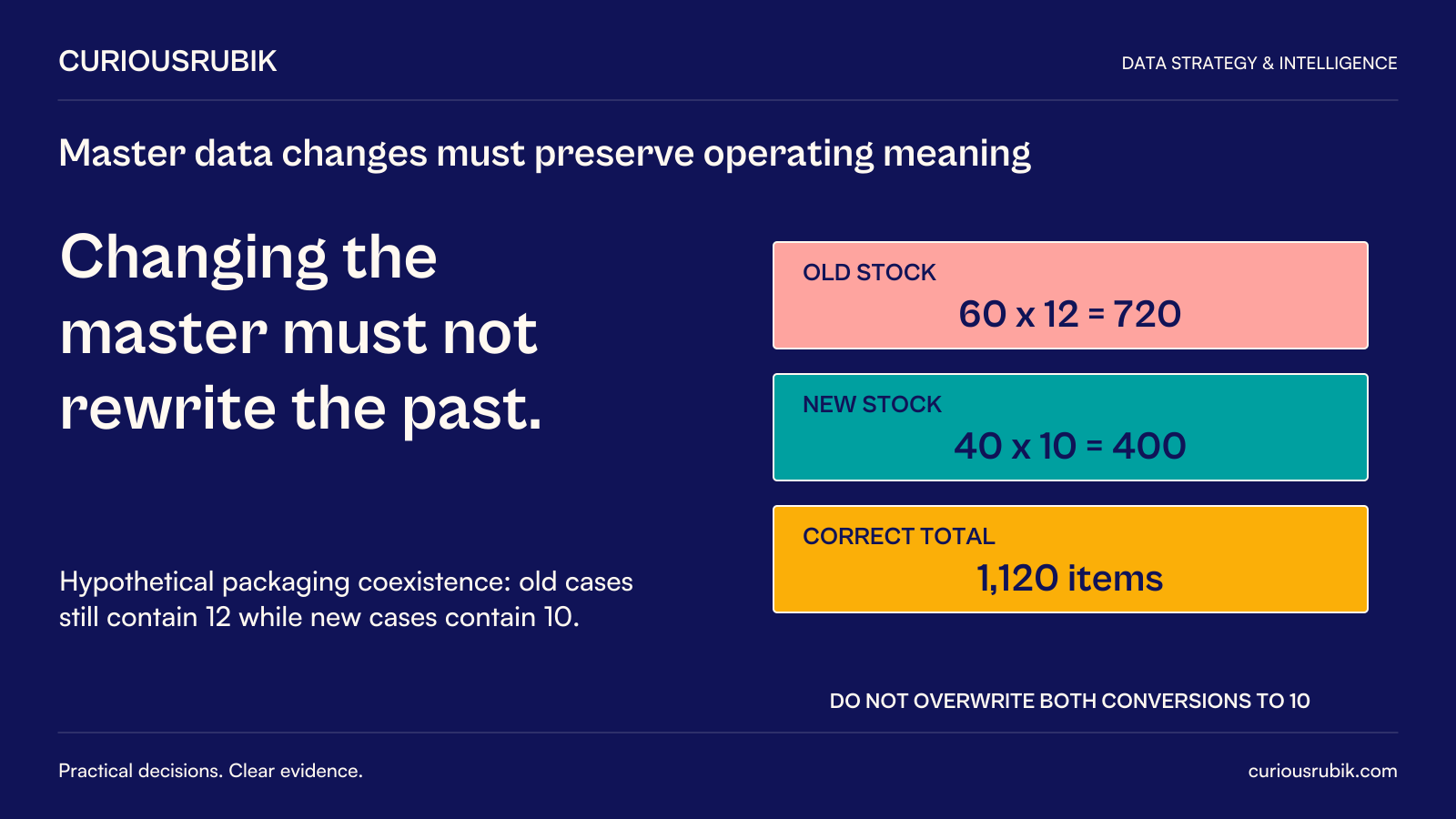
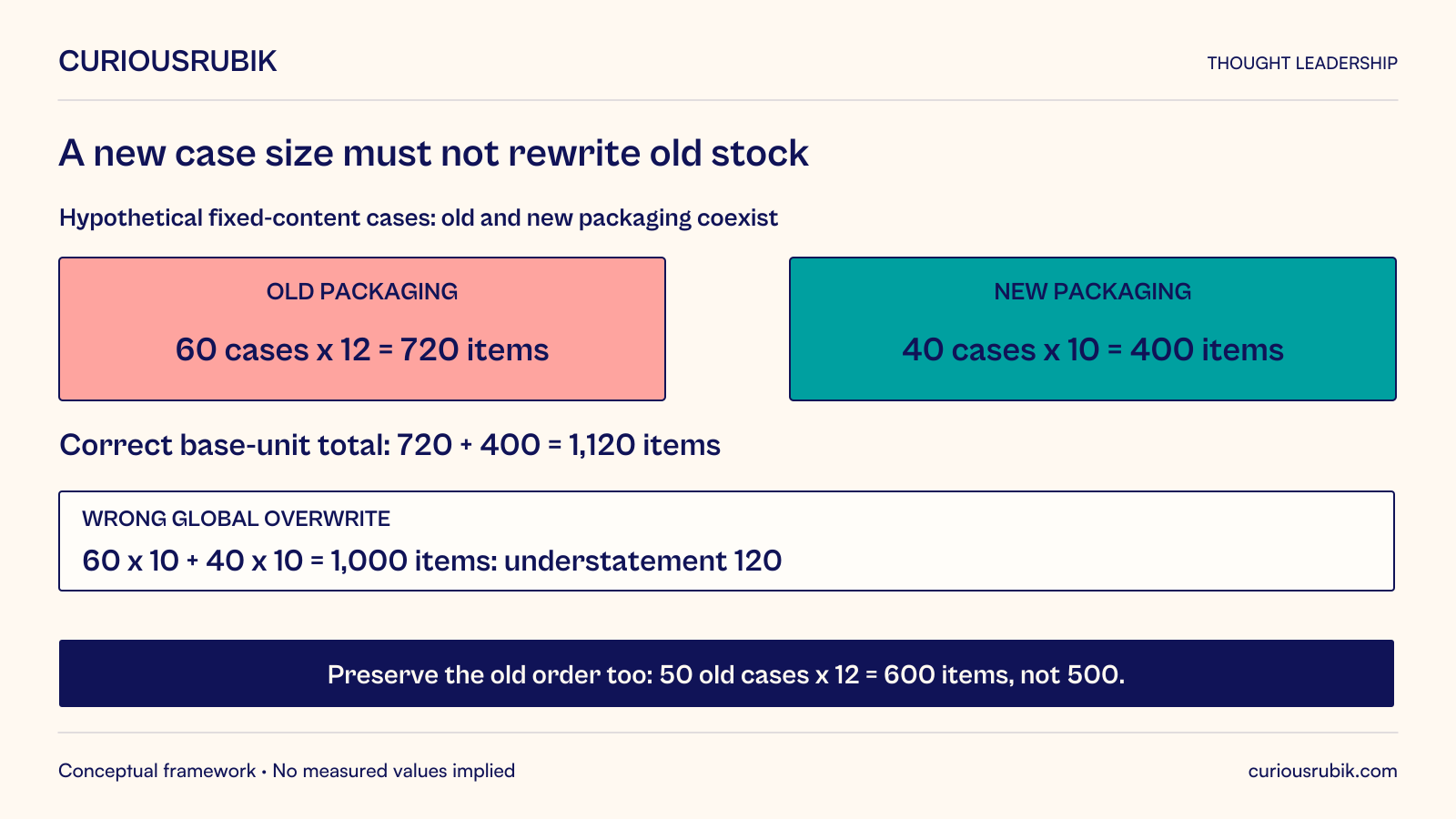
Suppose a hypothetical distributor receives an item in cases of twelve. The supplier introduces a new case containing ten of the same base item. At one warehouse, sixty old cases remain. Another warehouse receives forty new cases.
The old stock represents 720 base items: sixty multiplied by twelve. The new stock represents 400: forty multiplied by ten. Total stock is 1,120 base items, before considering reservations, damage, or other availability rules excluded from this example.
If the organization overwrites a single global “units per case” field from twelve to ten, the sixty old cases are reinterpreted as 600 items. Together with the new stock, the system reports 1,000 rather than 1,120, an understatement of 120 items. No physical movement caused the difference; a master-data change did.
An open purchase order for fifty old-format cases also carries a meaning of 600 base items. Applying the new conversion would reinterpret it as 500. The business must establish which packaging was ordered and what any agreed amendment means. A master-data overwrite should not silently rewrite the transaction.
The correct design distinguishes the old and new packaging identities, links each to the same base item where appropriate, and preserves the applicable conversion on stock and transaction references. Effective dates can help identify when a new format is introduced, but date alone is insufficient when old and new physical stock coexist.
These quantities are hypothetical. The example illustrates a release and identity problem, not a complete inventory-valuation or availability policy. Those additional rules need their own definitions and responsible owners.
Treat location as an operational reference
Location data also needs a clear model. A legal site, warehouse, storage zone, bin, and delivery destination are different concepts. A report grouping stock by region may use a hierarchy that differs from the warehouse’s physical addressing scheme.
Assign stable references at the level required by the process. If a warehouse is renamed or reorganized, existing transactions should remain interpretable. If a bin moves from one zone to another, the change should not automatically rewrite the historical location of every prior movement.
Define which attributes are authoritative locally and which are shared. Warehouse operations may own physical bin structure; a central team may own enterprise site identifiers and reporting relationships. The integration should preserve those responsibilities rather than forcing local detail into one overloaded location field.
Test the relationships the business relies on. A valid location code may still belong to the wrong warehouse or be inactive for the intended operation. Validation should check the relevant hierarchy and state, not merely that the code exists somewhere in the master table.
Create a master-data change package
For a consequential product change, record the requested change, business reason, evidence, affected objects, effective scope, and impacted processes. Identify whether it changes identity, a conversion, a lifecycle state, a classification, or a descriptive attribute.
The evidence should come from an appropriate source. Packaging quantity may require an approved supplier specification or verified physical information. Dimensions may need a defined measurement process. An analyst’s estimate can be useful for investigation but should not silently become an authoritative shipping attribute.
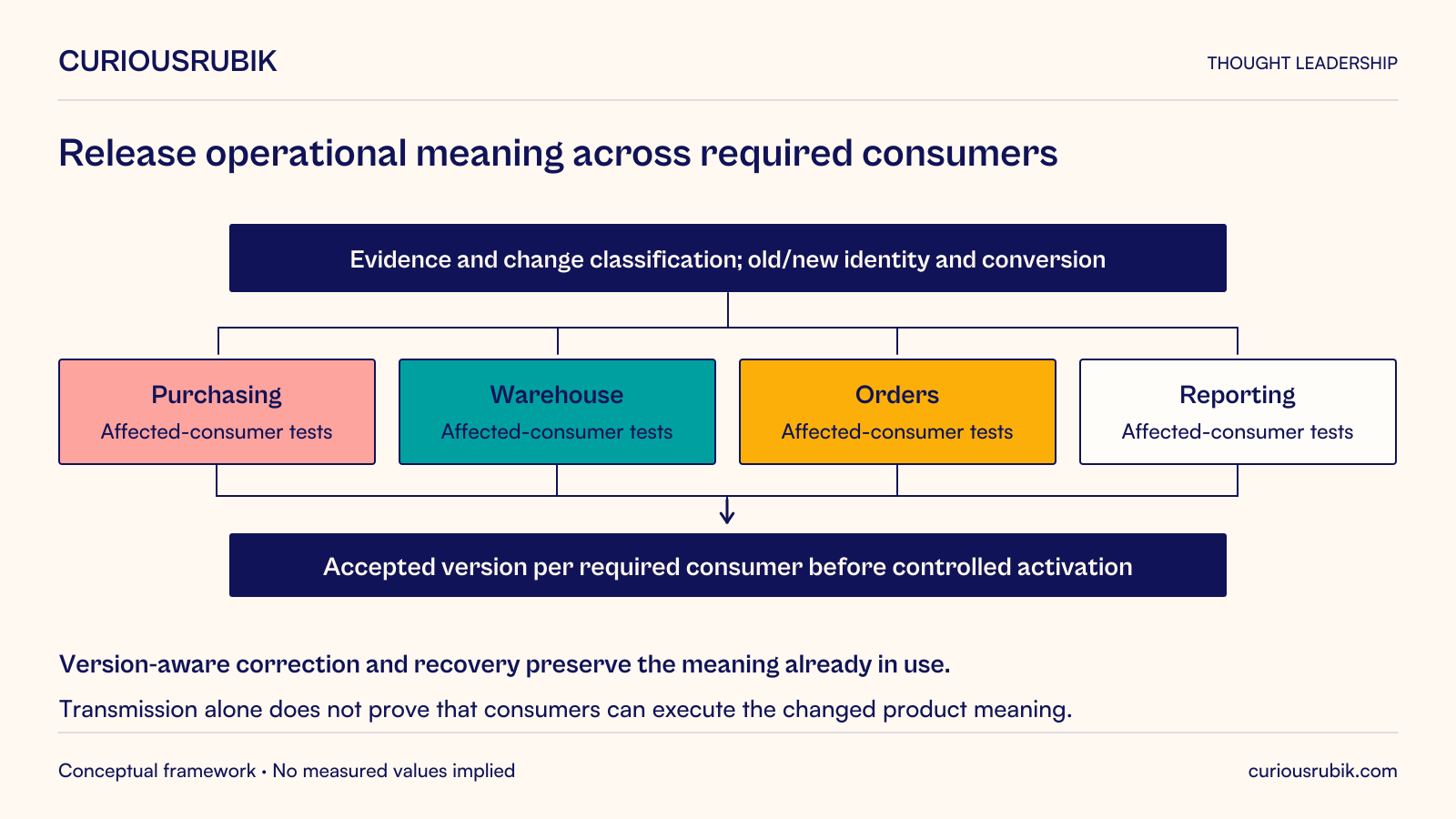
List the consumers that must be ready: purchasing, warehouse execution, order capture, transport planning, customer catalogue, and reporting as applicable. Different consumers may need different fields, but all must preserve the meaning of the changed object.
Include representative test transactions. For the hypothetical case change, test receipt of each packaging version, a mixed-stock count, an old open purchase order, a return, a customer order, and a report in base units. Expected results should be independently specified rather than copied from the current system’s potentially incorrect conversion.
Activate only when the necessary consumers are ready
Publishing a master record and applying it in every required destination are separate events. Track the version each consumer has accepted and whether its relevant validations passed. A successful transport acknowledgment does not establish that the warehouse can scan and interpret the new pack.
Choose an activation policy based on consequence. Some attributes can propagate progressively without disrupting operations. A quantity conversion used by both ordering and picking may require a coordinated activation or a clear way for each transaction to identify its intended version.
Keep a fallback for incomplete propagation. The organization may hold affected transactions, use an authorized manual check, or restrict the new packaging to ready locations. The appropriate choice depends on the business and should be agreed before the first delivery arrives.
Avoid making the central team a bottleneck for every typo. Classify changes by their effect on operations, consumers, and historical meaning. A low-consequence description update can follow a lighter route than a change to pack quantity or location eligibility, while both retain accountable ownership.
Preserve history without preserving avoidable confusion
Retain the relationships needed to explain prior transactions and current stock. Deactivating an old packaging identity for new orders does not necessarily make it invalid for returns or remaining inventory. Lifecycle rules should distinguish new use from legitimate historical reference.
A correction differs from a planned change. If the old conversion was always wrong, the team must identify affected transactions and decide how to correct them through the appropriate operational and accounting processes. If the packaging genuinely changed, historical records may correctly retain the old relationship.
Record the basis for both decisions. W3C’s Data on the Web Best Practices emphasizes provenance and version information for shared data. These principles support traceability here, while the specific product-release and correction policy remains an enterprise design decision. W3C Data on the Web Best Practices, Sections 8.4 and 8.6
Do not assume rollback is a simple field reversal. If transactions have already used the new packaging, restoring an old master snapshot may leave them inconsistent. Recovery should identify which transactions and consumers used each version, reconcile their state, and apply the approved correction rather than erase the evidence.
Measure whether operations can rely on the master
Useful measures include unresolved packaging relationships, transactions held for unknown units, failed scans attributable to master data, propagation delay, and corrections caused by inappropriate version use. Interpret them with the volume and type of changes being introduced.
A high field-completeness score can coexist with incorrect quantities or relationships. Test semantic correctness through representative business operations and source evidence. Likewise, a reduction in duplicate product records is not sufficient if legitimate packaging variants have been merged.
There are tradeoffs. More explicit identities and history increase data-management effort and can make search or selection harder for users. Improve interfaces so people can choose the correct active package without memorizing technical identifiers. Good master-data design includes the workflow that captures and consumes it.
Start with one upcoming packaging or location change. Build its change package, test old and new states together, and establish the activation and recovery rules. Master data becomes a foundation for connected operations when every application can interpret the same object correctly throughout its lifecycle, including the periods when old and new forms coexist.