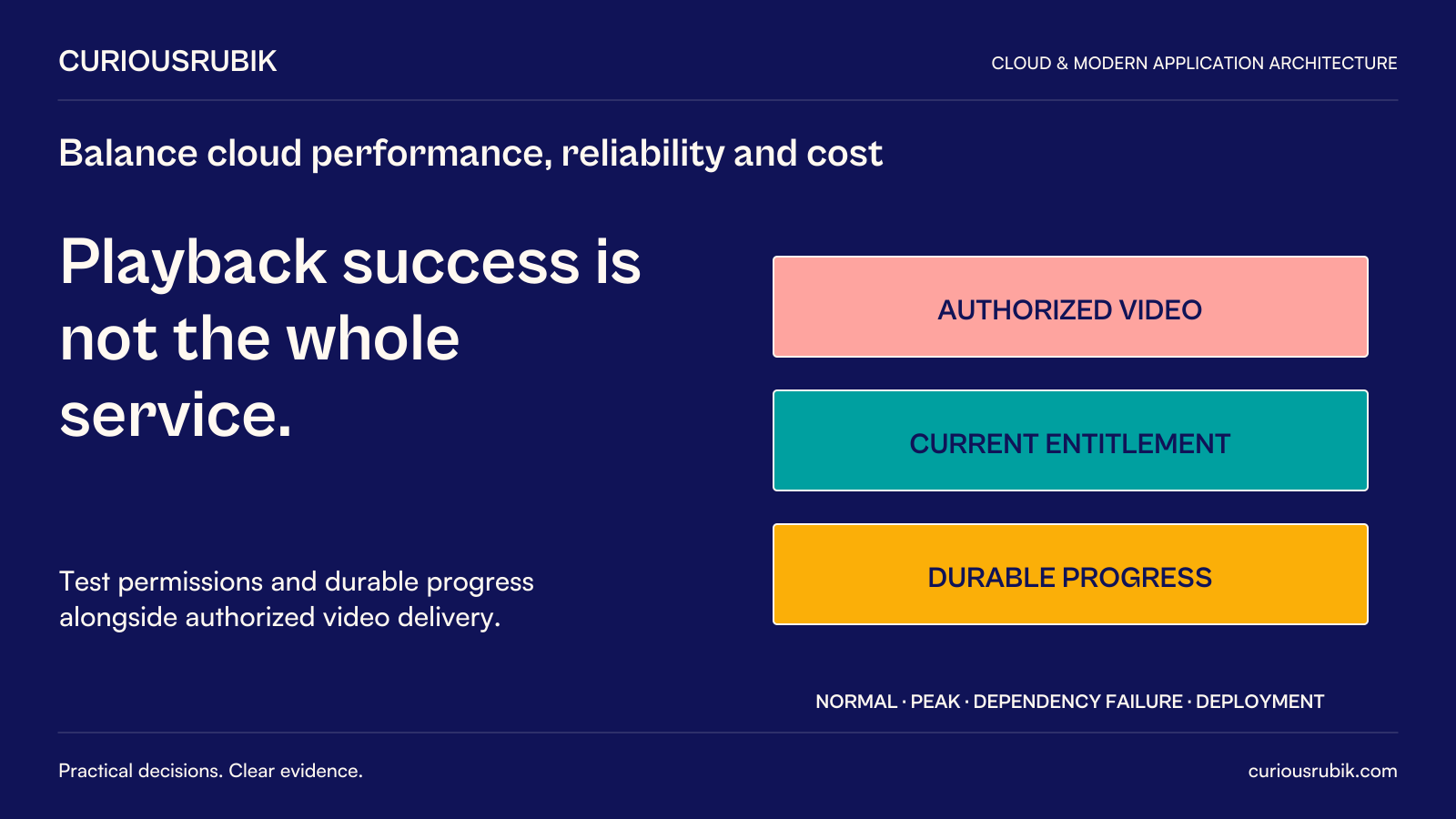
A cloud architecture can look economical under normal demand and become expensive during a peak. It can meet a performance target while every dependency is healthy and fail when one of them slows down. It can include redundant components without giving the operating team a reliable way to recover the business service.
Scalability, reliability and cost therefore need to be evaluated together under specific conditions. They are not three independent boxes that can be checked by selecting more cloud products.
For an architecture sponsor, the goal is a proportionate design that meets the service’s real requirements and makes its tradeoffs visible. That requires understanding the workload, the consequences of failure and the continuing effort needed to operate the design.
Define service outcomes before drawing the architecture
Start with the activities users must complete and the conditions under which they must work. Define relevant response times, completion expectations, data correctness and recovery needs with the business owner.
Avoid treating every action as equally critical. A delayed optional recommendation and a lost transaction have different consequences. A service can remain useful when a secondary feature is unavailable, provided the user understands the limitation and essential controls remain intact.
Specify the workload behind the requirement: concurrent activity, request mix, data volume, background work and expected peaks. A single daily transaction total can conceal a concentrated burst or an expensive minority of requests.
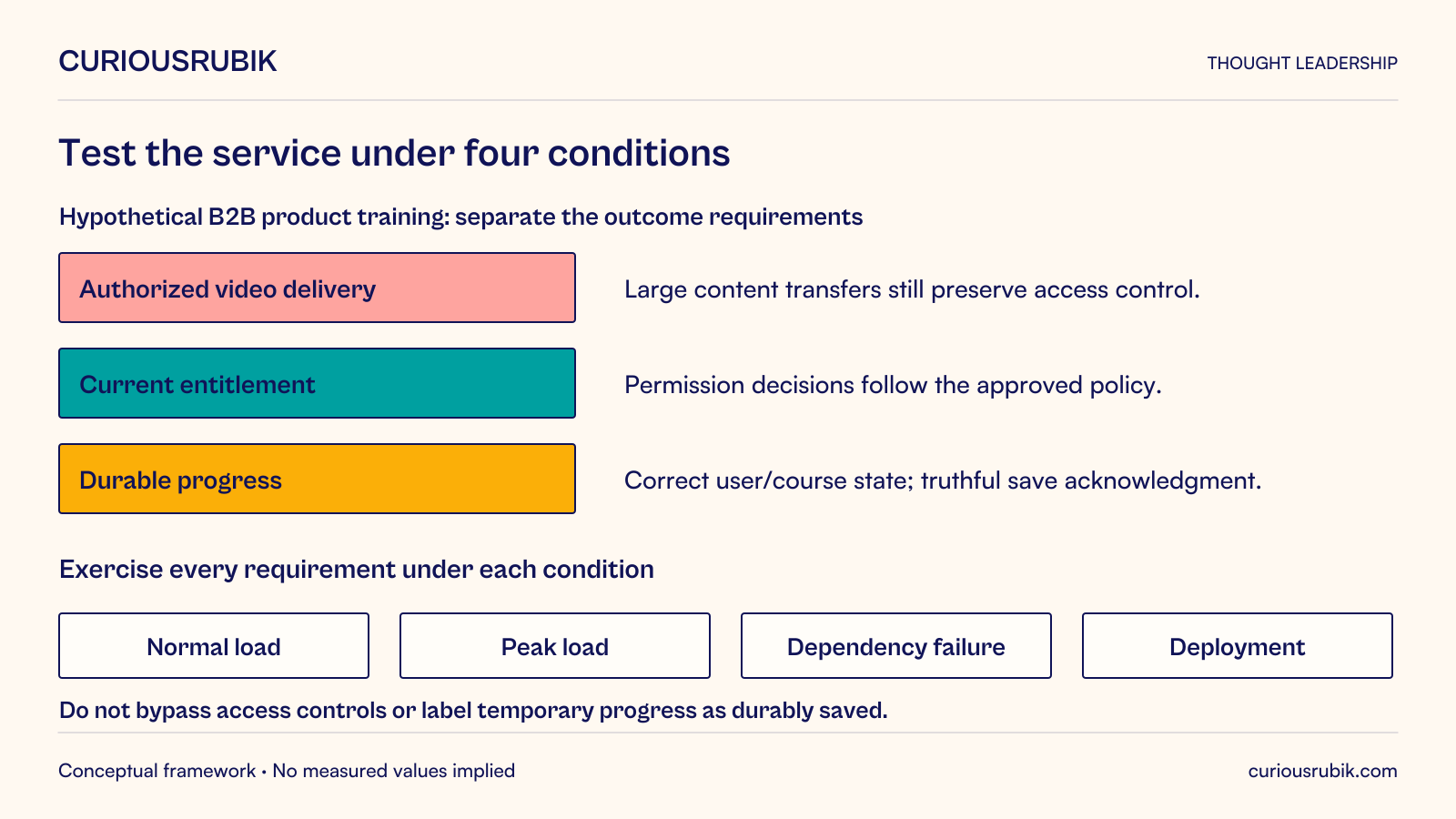
State which conditions the design must support. Normal demand, peak demand, a failed dependency and a deployment are different operating situations. The architecture should be evaluated against the relevant combination, including a peak that occurs while some capacity is unavailable.
Make reliability a business decision
Reliability targets should reflect user needs and consequences rather than a desire to maximize a headline percentage. The cost of additional resilience can include infrastructure, engineering effort and operating complexity.
Google’s Site Reliability Engineering chapter on risk discusses balancing service reliability with other business goals and the cost of achieving it. Its examples come from Google’s operating context; the useful principle is to make the tradeoff explicit for the service being designed. Google SRE, Embracing Risk.
Choose measures that represent the user’s outcome. A server being reachable does not establish that a transaction can complete correctly. Define success and failure at the relevant service boundary and account for partial failures.
Do not use an aggregate availability measure to excuse a serious confidentiality or integrity failure. Different failure types require different responses, and some conditions may justify pausing an action even if that reduces apparent availability.
The target should guide design, testing and operating decisions. It should not become a number selected after observing what the system already happens to achieve.
Separate a training platform’s different needs
Consider a hypothetical company providing on-demand product training to business customers. The service delivers video content, checks whether a user is entitled to access it and records course progress. These activities have different workload and failure characteristics.
Video delivery can involve large data volumes and repeated access to the same authorized content. Entitlement checks depend on current permissions. Progress updates are smaller but need to be associated with the correct user and course state.
A design that routes every video byte through the same application process used for progress writes may create unnecessary contention. Separating content delivery from application processing could improve the workload fit, but the content path still needs appropriate access controls.
The team also needs to decide what happens when a dependency fails. It may be acceptable to delay a nonessential recommendation. It should not falsely tell a user that progress was durably saved when it remains only in temporary state. Whether viewing can continue during an entitlement-service outage depends on the approved authorization policy, not simply on a desire to keep playback available.
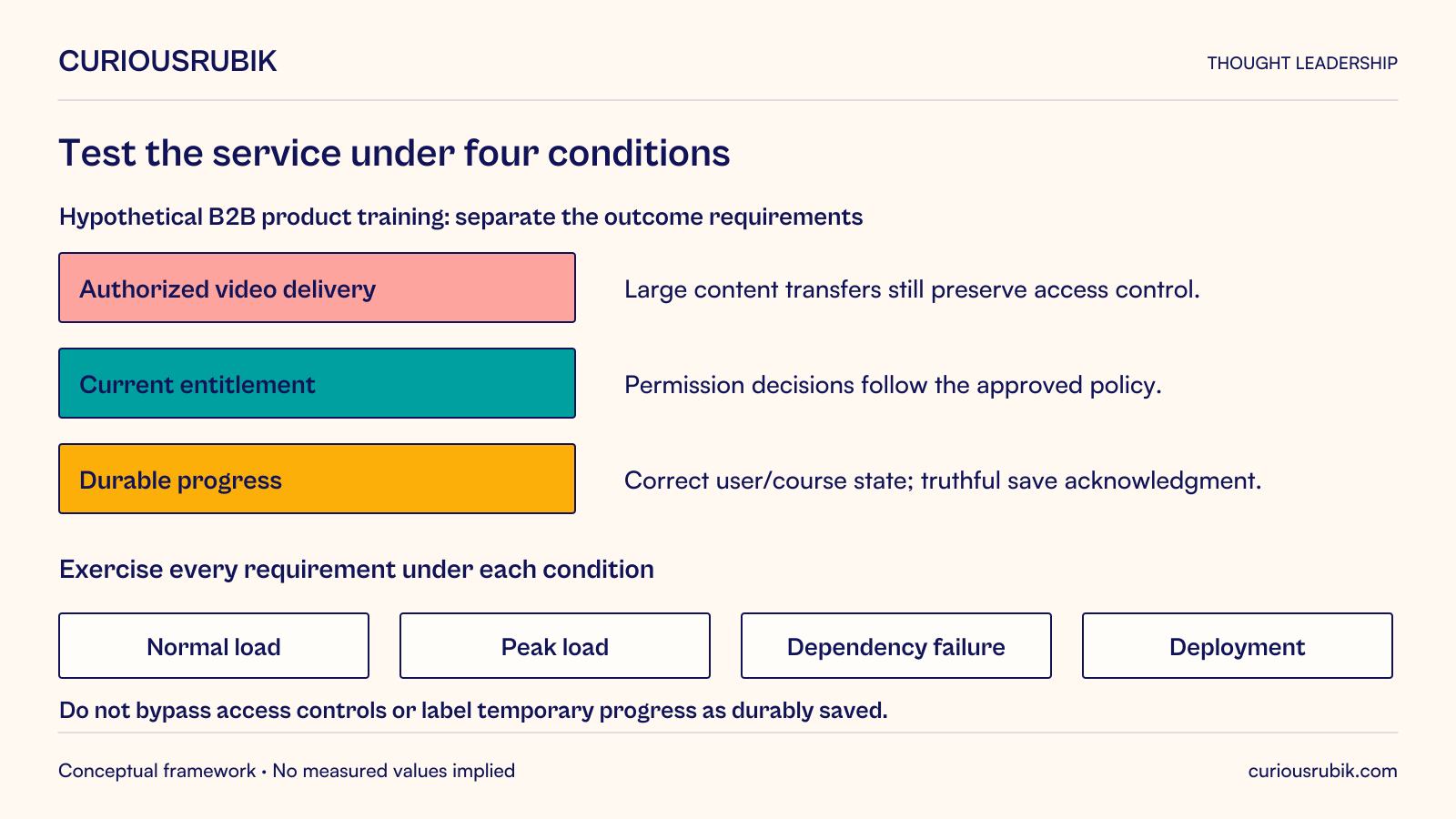
This example is not a recommendation for a particular provider or implementation. It shows why one scaling rule or availability target may be insufficient for the entire service.
Find the constraint before adding capacity
Measure resource use and latency across the important path. The bottleneck might be application processing, database contention, storage throughput, network transfer or an external service limit.
Adding instances helps only when the work can be distributed and the remaining dependencies have capacity. It can make a shared bottleneck worse by increasing concurrent demand.
Test realistic data and request mixes. Large customers, long histories and expensive queries may behave differently from the average case. Include background processing and administrative work that share resources with users.
Understand the time required to add capacity and the signals that trigger it. A short sharp burst may arrive before a scaling mechanism has responded. Some services need a prepared capacity margin, admission control or a queue with a clearly defined delay expectation.
Retest after removing a bottleneck. The next limiting dependency may become visible, and the original capacity model may no longer describe the service accurately.
Design degradation without weakening the essential promise
Decide which functions can be reduced or deferred when resources are constrained. Optional analysis, decorative content or nonurgent background jobs may have different priorities from the core transaction.
Make degraded behavior clear to users and operators. A delayed update should remain visibly pending. An unavailable feature should not be represented as an empty result that implies there is no data.
Preserve security and business correctness. Do not bypass authorization, required validation or transaction safeguards merely to maintain response speed. If those checks cannot be completed safely, the appropriate response may be to decline or pause the affected action.
Bound queues and retries. Accepting unlimited work can create an unrecoverable backlog, while repeated retries can amplify an already overloaded dependency. Define how the service rejects, defers or reconciles work and how users learn the actual outcome.
In the training example, a progress-save failure needs a supported recovery path. It should not create silent loss or duplicate records that later contradict the user’s experience.
Evaluate redundancy as a complete recovery path
Additional instances or locations can address some failures, but only if the service can use them correctly. Shared identity, configuration, data or deployment dependencies may still create common failure paths.
Define the failure conditions the design is intended to tolerate. Test whether traffic can move, required data is available and the operating team can determine that the recovered service is correct.
Distinguish outage recovery from recovery after an erroneous update. A replica can reproduce an unwanted deletion or bad application write. Backups and restoration procedures need to address the relevant data-loss and corruption scenarios separately.
Include capacity during recovery. A standby path that cannot handle the required workload may restore only a limited service. That may be acceptable if explicitly planned, but it should not be discovered during an incident.
Record the manual steps and authority required. A design that depends on an unavailable specialist or an untested privileged procedure has an operating dependency that belongs in the reliability assessment.
Model cost under more than one operating condition
Estimate normal, peak and recovery consumption separately. Include compute, storage, transfer, managed services, monitoring and other relevant charges under the actual pricing arrangement being evaluated.
Do not assume that a lower unit price produces a lower total cost. A design can make more requests, retain more copies or move more data. Conversely, a service with a higher visible price may reduce operating effort or remove infrastructure responsibilities that the organization would otherwise carry.
Add the cost of running the architecture: deployment tooling, support, incident response, testing and skills. Complexity can be an expense even when the cloud bill looks modest.
Use current provider quotations or verified pricing for an actual investment decision. This article does not supply a universal price comparison, because costs depend on configuration, region, usage and commercial terms.
Keep the cost model connected to the workload assumptions. A change in content size, retention or customer usage can alter the economics without any change in the number of application users.
Compare options through explicit tradeoffs
For each candidate design, state the service conditions it meets, the constraints it introduces and the evidence still missing. Avoid reducing essential requirements to a weighted score that lets a low price compensate for an unacceptable control gap.
Identify reversible choices and costly commitments. Some resource settings can be adjusted readily; data movement, integration contracts and operating skills can be harder to change. Preserve useful options where the added cost is justified.
Use a focused experiment to test the most consequential uncertainty. That might be a load test with representative video demand, a failed-dependency rehearsal or a recovery exercise that measures the actual service result.
The experiment should have a decision attached. If the result does not support the proposed design, the team should be prepared to change the architecture or the service commitment rather than simply add more components.
Operate the design as a changing system
After launch, compare actual workload, service performance and cost with the assumptions. Investigate changes in user behavior and data growth before treating a rising bill or slower response as an isolated infrastructure issue.
Assign owners for capacity, reliability and cost decisions, with a way to resolve tradeoffs across them. Separate dashboards do not create coordinated management if nobody can decide whether a particular optimization is acceptable.
Review the design when the business changes its service promise. A new region, larger customer or tighter recovery requirement may justify a different architecture. Equally, a complex capability may no longer be worth operating if its need disappears.
Cloud architecture is effective when the service can scale, recover and remain economically understandable under the conditions that matter. The strongest design makes those conditions explicit, preserves essential correctness under pressure and gives the team evidence for the next decision.