A business outcome becomes useful to an application team only when it changes a design decision. “Improve productivity” does not tell a designer which task to simplify, a developer which state transition to protect or a tester what result matters. Without that translation, the outcome remains an attractive sentence above a conventional feature backlog.
Outcome-led design connects a measurable operating problem to the decisions users must make, the information they need and the behavior the application must support. It also defines the limits: what should not become worse while the team pursues the improvement.
For a product owner, the practical objective is to create a traceable chain from the business result to specific interaction and data decisions. This differs from measuring value after launch. It is a way to shape the application before expensive implementation choices become fixed.
Define an outcome with a population and a consequence
Choose a problem that can be observed in the work. Examples include avoidable rework, incomplete submissions, delayed decisions or unresolved exceptions. Specify the population, relevant period and consequence rather than relying on a broad aspiration.
Define what counts. If the outcome is fewer avoidable event cancellations, distinguish missing organizer prerequisites from a customer-requested cancellation. If the outcome is faster approval, specify when the clock starts and what constitutes a usable decision. Poor definitions can make the application appear successful by changing classification rather than improving work.
Add guardrails. Faster processing should not come from bypassing necessary review, excluding difficult cases or transferring unreasonable work to another team. The design needs to know which constraints must remain true while the primary measure improves.
Keep the initial target provisional when the baseline is weak. Early observation may reveal that the problem differs from the original assumption. The team should improve the problem statement rather than force the evidence to fit an executive slogan.
Understand the task beyond the screen
Observe how users prepare, decide, act and recover. Include the information they obtain from colleagues, documents or other systems. A screen can be easy to use while the complete task remains difficult.
The UK’s Service Standard emphasizes understanding users and their full context, testing assumptions and using prototypes to learn about the actual problem. Its public-service setting differs from an enterprise application, but the design discipline is relevant: start with the need and context rather than assuming the requested solution is correct. Service Standard point 1, 2019 with 2022 update.
Identify the decision moment. What does the user need to know, what authority do they have and what happens if they cannot proceed? A missing piece of information may be more important than the arrangement of controls on the page.
Include downstream users. The person submitting a request and the person acting on it may need different evidence. Designing only for submission speed can create incomplete work that another team must reconstruct.
Translate the outcome into required behavior
For each important decision, define the valid starting conditions, permitted actions, resulting state and exception route. State which facts are authoritative and how the application should respond when those facts are missing or inconsistent.
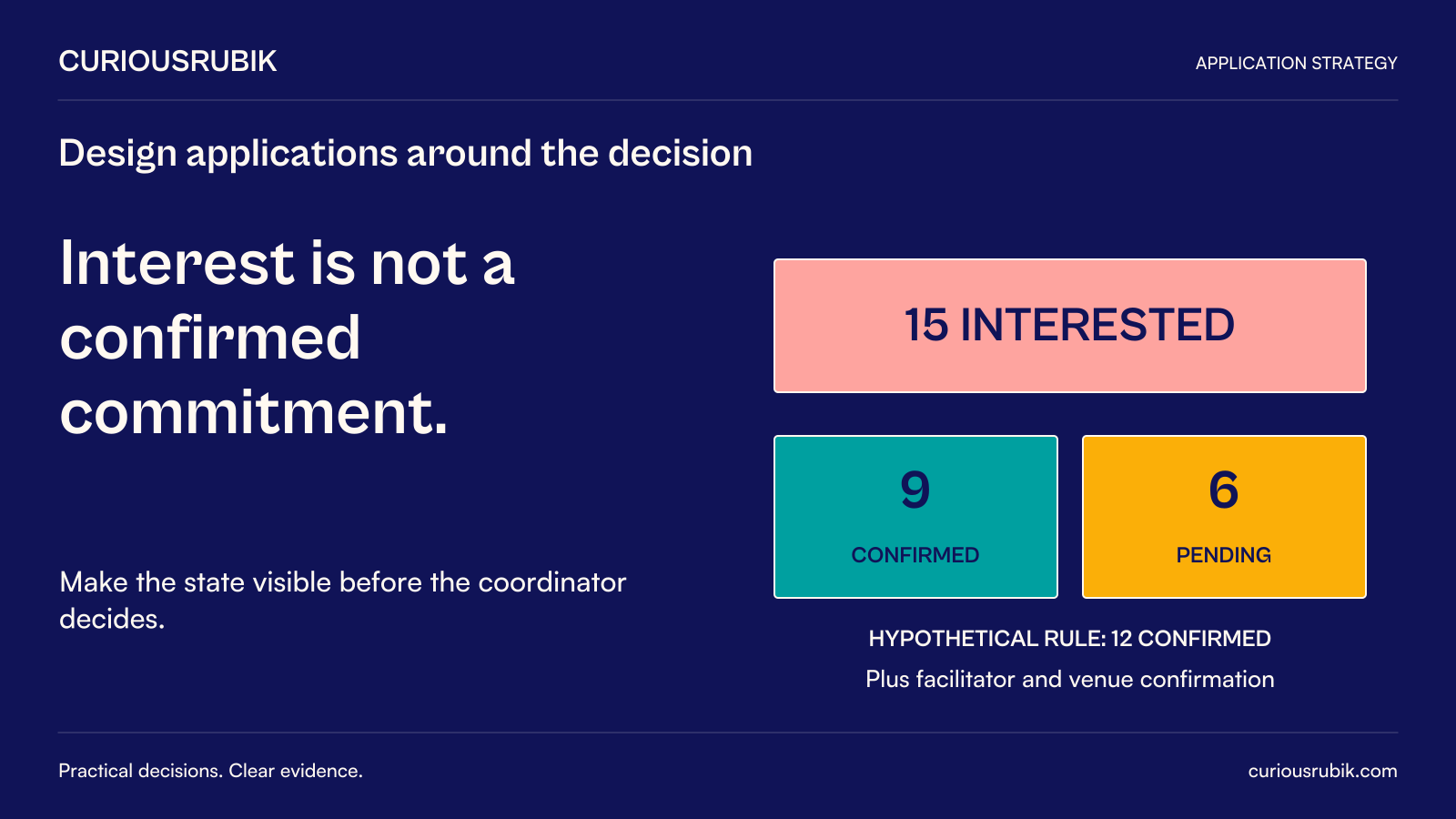
This is where the outcome begins to influence design. If avoidable cancellations come from treating expressions of interest as confirmed attendance, the application needs a reliable distinction between those states and the readiness decision that uses them. A new dashboard showing cancellation counts may help management, but it does not prevent that specific failure.
Keep the requirement at the level of business behavior until implementation choices are justified. The team may use different technical mechanisms to preserve evidence and evaluate readiness, but the required relationship should remain clear.
Document the reason for the behavior. Later developers and operators need to know which outcome it protects. Otherwise, a convenient change can remove a control whose purpose was never visible in the specification.
A training provider makes readiness a design decision
Consider a hypothetical business-training provider building an application to coordinate corporate workshops. The example is illustrative, including its internal planning rule; it is not an educational admission standard or an industry benchmark. The provider wants to reduce avoidable late cancellations caused by incomplete organizing conditions.
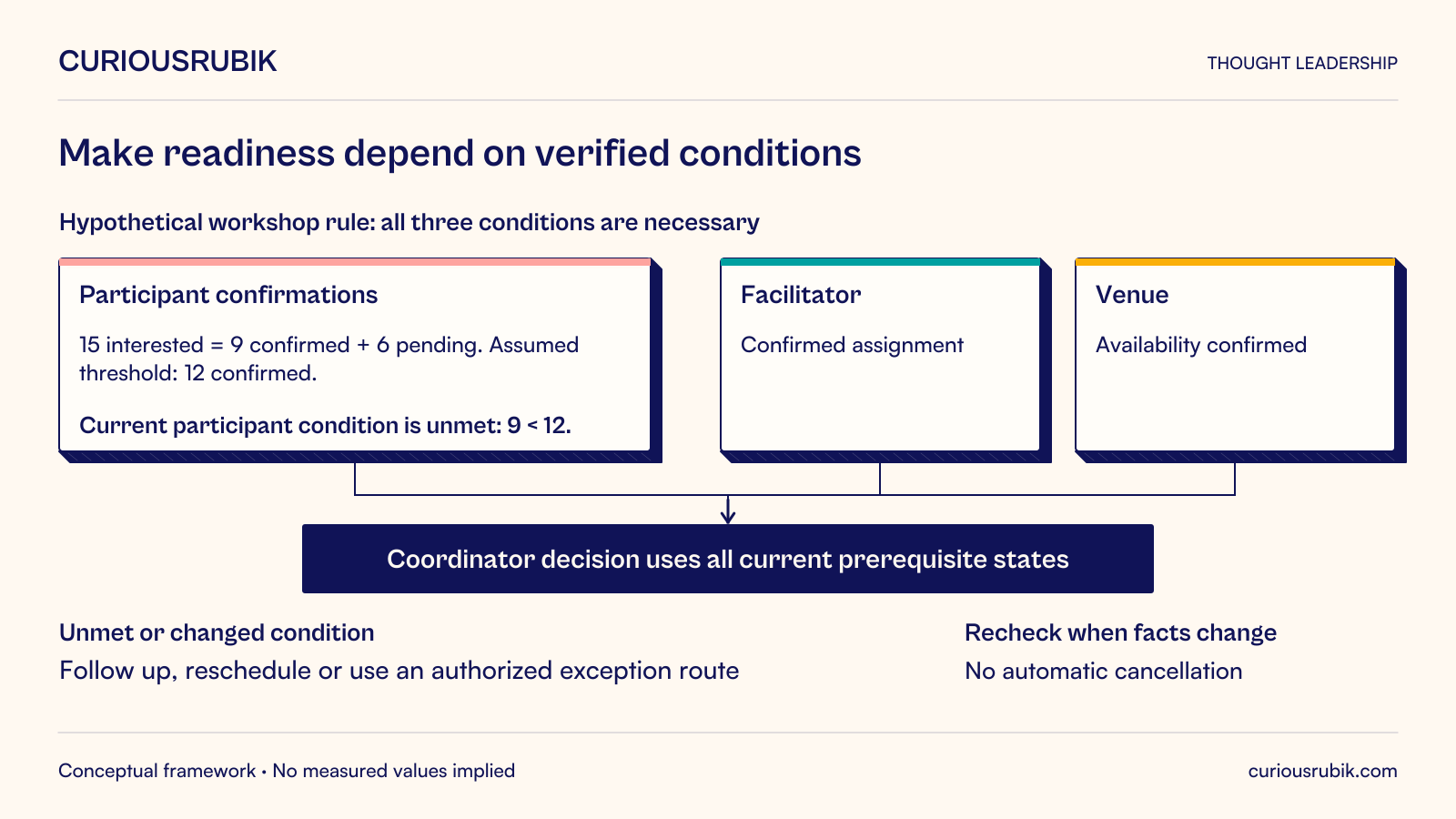
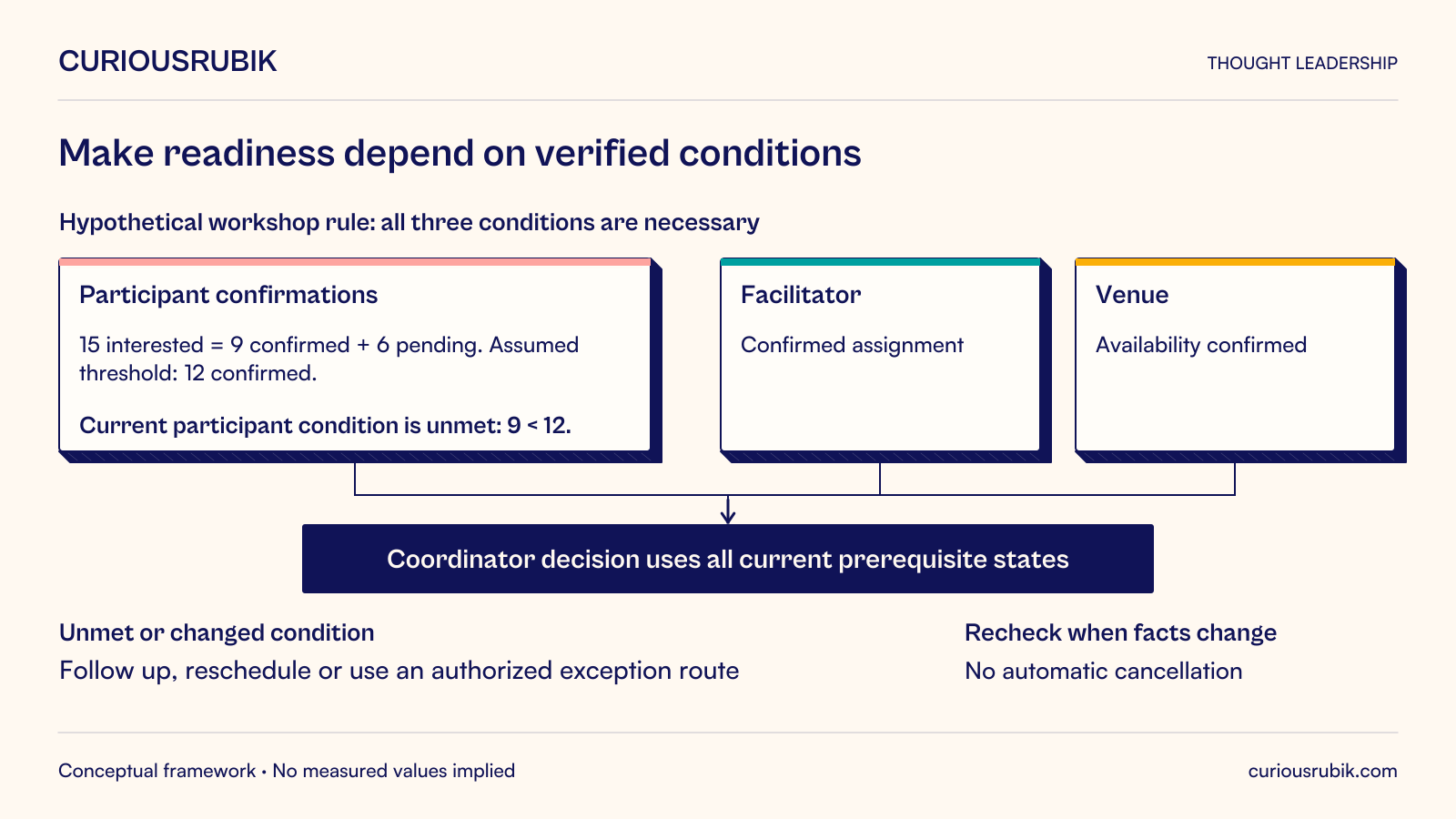
For one workshop, the provider’s assumed policy requires twelve confirmed participants, a confirmed facilitator and an available venue before the coordinator can mark the session ready. Fifteen people have registered interest, but only nine have confirmed attendance and six remain pending. A dashboard that counts all fifteen as committed can show apparent readiness while hiding the unresolved condition.
The product team separates registration, confirmation, facilitator assignment, venue confirmation and the final session decision. It records which evidence establishes each state and who may change it. The readiness view uses confirmed attendance rather than the total inquiry count, while keeping pending participants visible for follow-up.
Reaching twelve confirmations does not automatically settle the other prerequisites. If the facilitator becomes unavailable, the application should show that condition and the responsible owner. The coordinator can pursue a replacement, propose another date or follow an authorized exception route. The software should not invent an agreement or silently cancel the workshop outside the defined authority.
The business owner determines the timing rules and permitted exceptions. A late cancellation or withdrawal can change readiness after an earlier check, so the design records when the conditions were verified and what event requires another decision. The relevant users can see what changed rather than interpreting a stale green label.
This design addresses one source of avoidable cancellation. It does not guarantee attendance or remove every external cause. The outcome measure must retain cancelled sessions in the relevant population and distinguish organizer failures from legitimate customer choices.
Design the interaction around uncertainty
Show users the information needed to make the next decision, including what is unresolved. A generic green status can hide several different conditions: interested, registered, confirmed or ready. Distinct states should have clear meanings and consequences.
In the workshop example, a coordinator needs to see unmet prerequisites and their owners. A facilitator needs a dependable view of the confirmed session and relevant changes. Showing both users the same long activity history may be less useful than presenting the evidence and available actions for each role.
Make error and exception messages actionable. State what condition prevents progress, who can resolve it and what the user can do safely meanwhile. Avoid a message that merely says the transaction failed while leaving the work in an uncertain state.
Do not infer a commitment from passive activity such as opening a page or viewing an invitation. The application needs the evidence required by the business’s actual confirmation process. The exact mechanism should be designed with the relevant owners and constraints.
Prototype the decision before completing the application
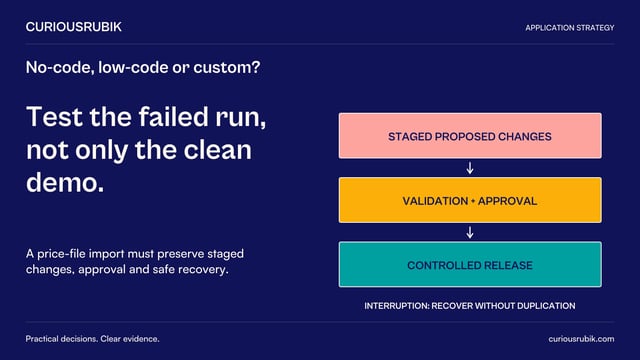
Use a prototype to test whether representative users understand the state and can choose the correct action. Include the difficult case that motivated the design, not just an ordinary successful submission.
For the workshop workflow, ask a coordinator to decide whether the session is ready when registrations exceed the threshold but confirmations do not. Then change the facilitator state and observe whether the user notices which decision must be revisited. Watch where people hesitate, misinterpret labels or seek information outside the interface.
A prototype can answer interaction questions without establishing integration reliability or production performance. Record what it proves and what remains to be tested in the implemented system.
Use the findings to revise the model where necessary. If users cannot distinguish the states because the underlying business policy is unresolved, changing colors or button placement will not be enough. Bring the policy question back to the accountable owner.
Instrument the behavior that should produce the outcome
Capture the events needed to evaluate the design, with appropriate access and retention controls. These may include a pending registration becoming confirmed, a facilitator becoming unavailable, an exception decision and the final session disposition.
Connect those observations to the outcome definition. Review whether cancellations caused by missing organizing prerequisites decline for comparable sessions, while monitoring booking friction and work transferred to coordinators. The application could prevent one error by creating excessive waiting, so the guardrails matter.
Avoid collecting every possible interaction simply because analytics tools make it easy. Data collection should answer a useful product or operating question and respect the organization’s privacy requirements.
Keep interpretation separate from the event record. A blocked readiness decision may represent a useful warning, an incorrect rule or a user misunderstanding. Examine representative cases before assigning a financial benefit to every block.
Prioritize features by the decision they improve
A feature should earn its place by supporting the outcome, a necessary guardrail or an operating requirement. Ask which user decision it changes and what evidence suggests it will help.
Some supporting features are essential even if they do not directly move the headline metric. Access administration, recovery, auditability and maintainability can determine whether the application can be operated responsibly. Their value should be explained rather than excluded from the roadmap because they are less visible.
Sequence work to test the uncertain mechanism early. In the workshop example, proving that readiness reflects verified prerequisites and offers a usable exception route is more informative than completing a broad reporting suite first. Once the mechanism works, the team can expand coverage and refine the surrounding experience.
Outcome-led application design is a discipline of translation. It turns an operating problem into specific relationships, states, actions and evidence. Start with one consequential decision, show how the design helps a user make it correctly and test the complete task. That creates a stronger foundation for business value than a feature list whose connection to the outcome remains assumed.