Moving from a copilot to an autonomous workflow means granting software more authority over a defined task. It should be an evidence-based operating decision, not a default next stage after employees become comfortable with suggestions. Some applications should remain assistive because the remaining judgment, uncertainty, or consequence makes human participation valuable.
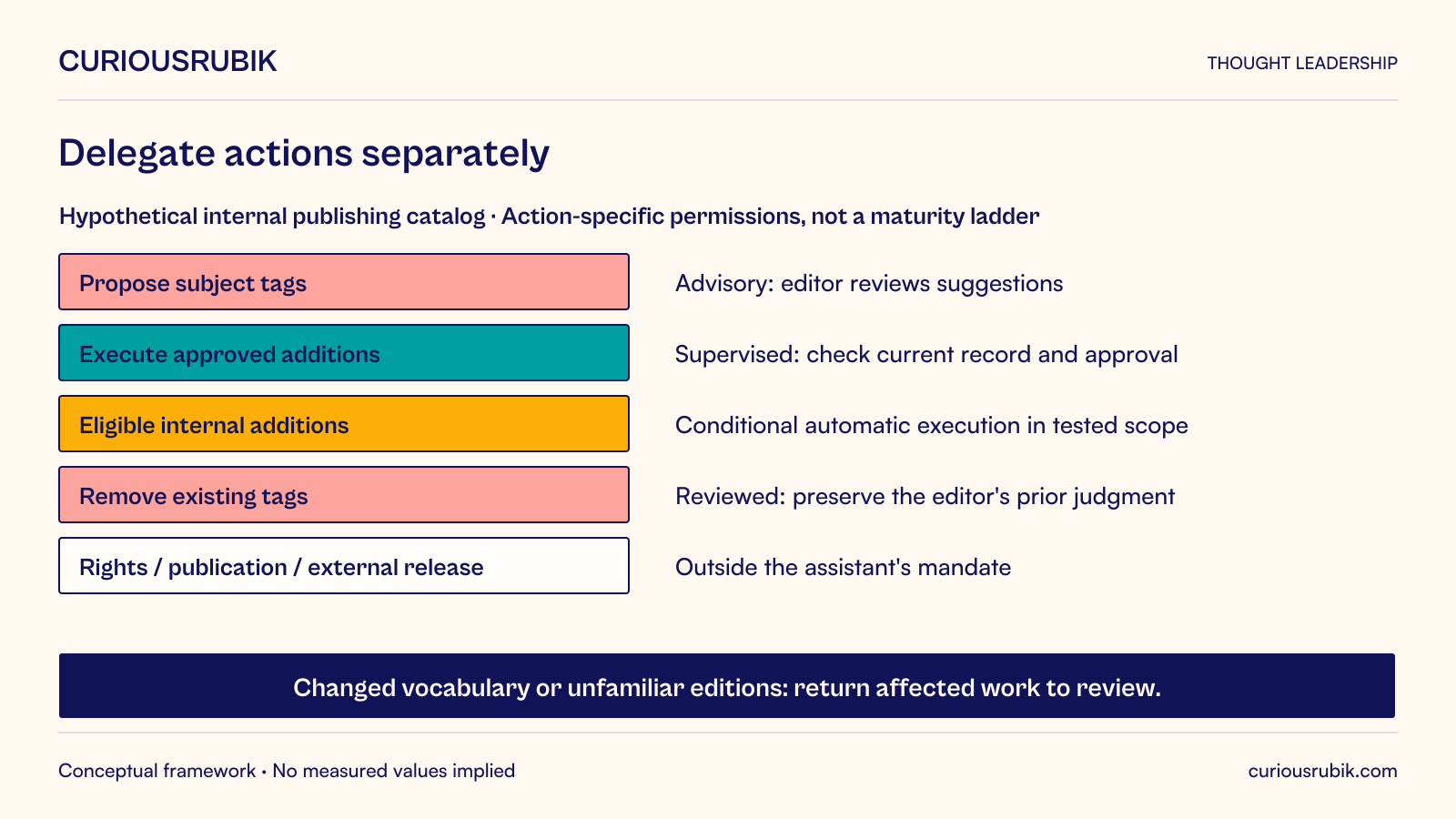
For a digital operations leader managing an AI-assisted publishing catalog, the decision is which specific action can move from proposal to bounded execution. A tool that drafts accurate subject tags has not established that it may change prices, publication status, or rights information. Progress should be recorded by task and permission, not by assigning the entire application a single autonomy level.
The practical approach is to use reversible operating modes, explicit promotion criteria, and the ability to reduce authority when conditions change. The hypothetical catalog example below shows how that journey can remain useful without treating full autonomy as its destination.
Define the work that could change hands
Break the workflow into actions with distinct effects. A catalog assistant may retrieve approved descriptions, propose subject tags, identify incomplete fields, save an internal draft, or publish a changed record. Each action has its own evidence requirements and consequences.
Separate assistance quality from execution reliability. A proposed tag may be sensible while the integration writes it to the wrong edition. A correct record update may still violate policy if the assistant lacked authority to change that field. Promotion requires evidence about both the content and the action path.
Name the business owner for each candidate delegation. That owner should approve the eligible population, permissible changes, exception handling, and expected outcome. The technical team can demonstrate implementation behavior, but it should not infer the business’s willingness to accept a new type of error.
Document the current human process. Identify what reviewers actually contribute and which mistakes they catch. If a proposed automation removes review, the business needs another supported way to address that contribution, or evidence that it is no longer necessary within the narrowed scope.
Use operating modes that answer different questions
In an advisory mode, the system proposes a result and a person decides what to do. This can reveal usefulness and review effort, but acceptance alone does not establish that the proposed result was correct. Review a sample independently.
In a shadow mode, the system produces an output without changing the live record. Compare it with a reference decision and investigate disagreements. Shadow testing avoids some execution risk, but it does not expose every issue that arises when real updates affect later work.
In a supervised execution mode, a person approves a specific change and the system performs it through a controlled action path. This tests object identity, permissions, result acknowledgment, and recovery while preserving the required decision boundary.
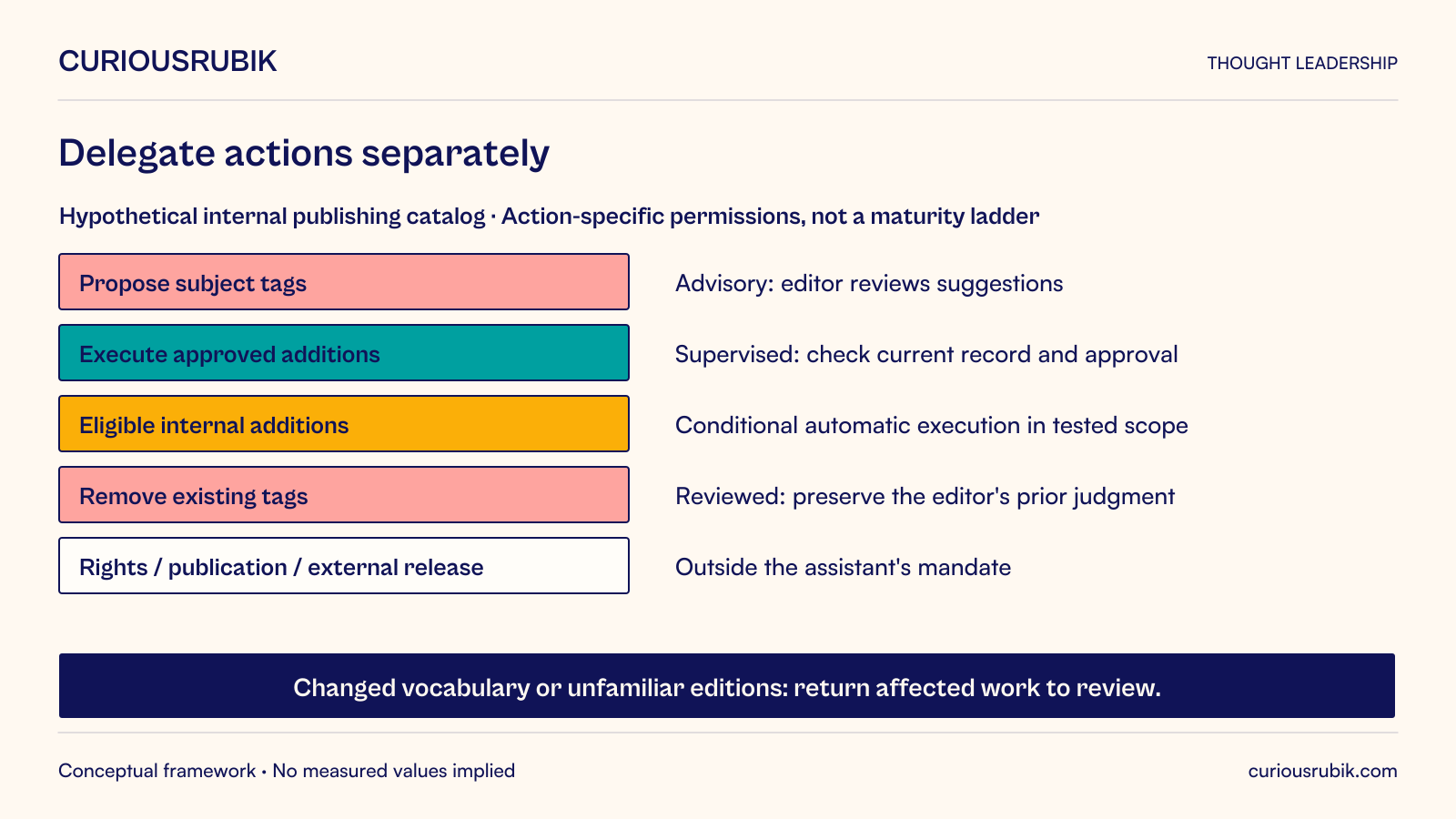
In bounded automatic execution, the system may perform a defined class of changes without individual approval under an explicit policy. These modes are options, not a mandatory ladder. A task can remain advisory, skip an irrelevant mode when justified, or return to greater supervision after a change.
A hypothetical publishing catalog
Imagine a hypothetical publisher maintaining an internal catalog of professional reference books. Editors use an assistant to propose subject tags from a controlled vocabulary based on approved descriptions. The catalog distinguishes title, edition, language, publication status, and rights information.
The first pilot covers only proposed subject tags for a selected group of current editions. Editors review the tags and can reject unsupported categories. The assistant may not infer rights, alter publication status, or publish changes to external channels. Those fields and actions remain outside its mandate.
A shadow evaluation shows that suggestions work well for some established subject areas but are inconsistent for interdisciplinary titles. Rather than declaring the assistant ready for the entire catalog, the owner defines a narrower eligible population and a referral route for ambiguous cases. This is a hypothetical finding used to illustrate a decision, not a reported product result.
The team then tests approved execution. An editor accepts a change for edition E2 while another employee updates the same record. The action path must establish whether the approval still applies to the current version. A good suggestion does not authorize overwriting an intervening change.
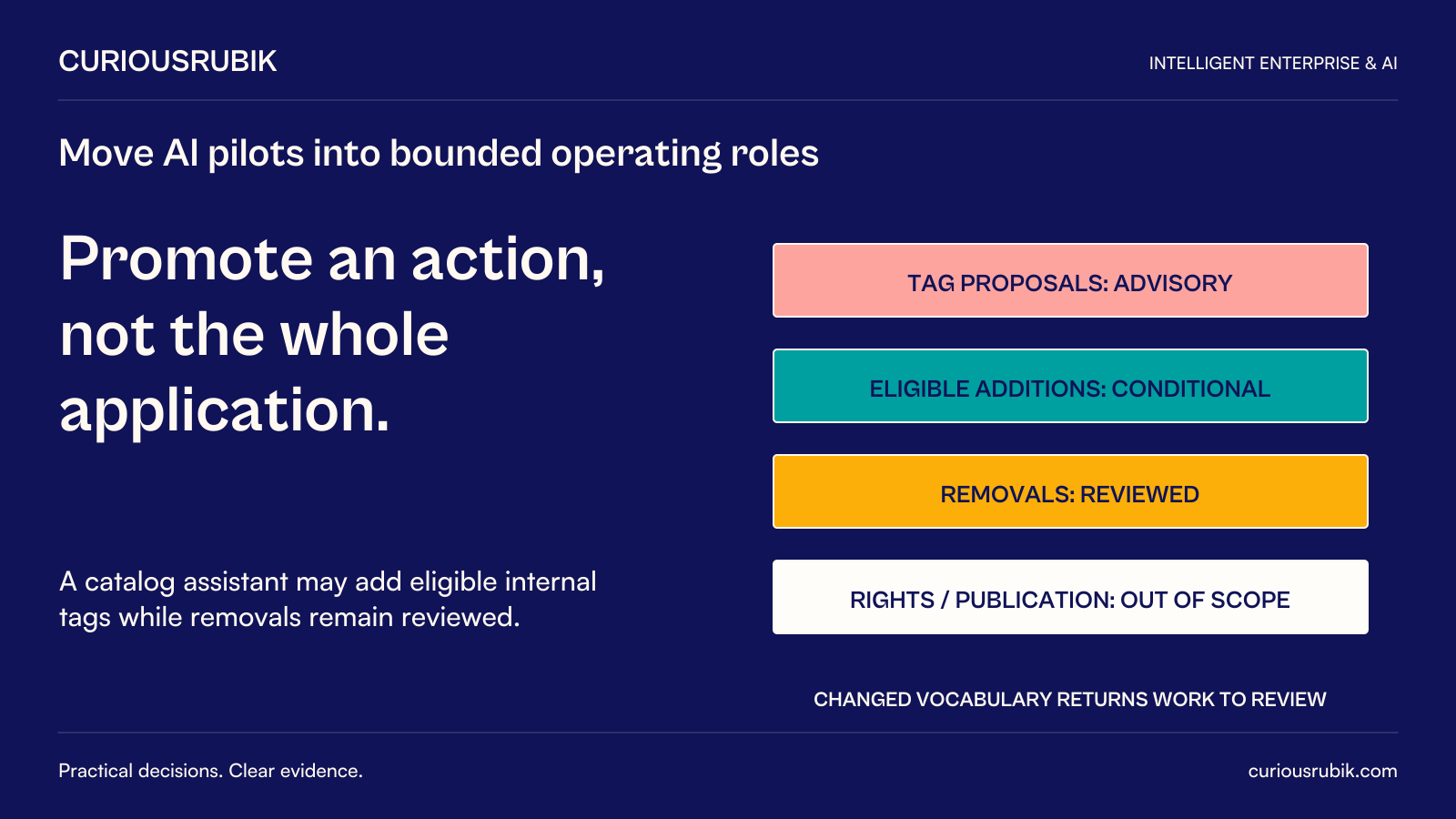
Only after the content and execution tests are satisfactory does the owner consider automatic addition of permitted tags to the internal catalog. Removal of existing tags remains reviewed because it can erase an editor’s earlier judgment. New editions and unfamiliar subject areas remain outside the automatic scope.
If the vocabulary changes, the affected population returns to review until the new mapping and behavior are evaluated. Authority follows the tested conditions. It does not remain permanently expanded merely because an earlier pilot succeeded.
Specify evidence for each promotion
Write the promotion decision before the pilot begins. For content assistance, the evidence may concern accepted quality, unsupported suggestions, reviewer correction, and coverage across the eligible population. For execution, it must also cover correct record targeting, permission enforcement, concurrency, and outcome recovery.
Use representative tests and deliberately difficult cases. A catalog test should include similar titles, multiple editions, missing descriptions, conflicting tags, and records outside the approved subject area. Keep expected outcomes independent of the assistant’s own generated explanation.
Require evidence about cases the system declines. A design may achieve high accuracy by refusing a large or difficult portion of the work. That can be a sensible operating choice, but the residual queue and its cost belong in the promotion decision.
Model Cards for Model Reporting proposes recording intended uses, evaluation conditions, and limitations. That information can support a promotion review, but a model report does not establish that the surrounding catalog workflow is ready for automatic execution. Mitchell et al., Model Cards, 2019 version
Keep permissions smaller than the application
Grant the action component only the capabilities required for the approved task. An assistant adding internal subject tags should not receive broad catalog administration merely because one credential would be convenient. Field, record, and action scope should be enforced outside the model’s discretionary interpretation.
Separate policy changes from ordinary work. The assistant should not expand the controlled vocabulary, reinterpret eligibility, or grant itself access when it encounters an unfamiliar title. It can propose a policy question to an authorized owner without changing the policy itself.
Bind approval to the actual change. If the assistant proposes adding two tags and later produces four, the original approval should not silently cover the expanded update. Preserve the relationship between reviewed content, target record, and executed effect.
Treat external descriptions and uploaded documents as evidence, not instructions that can enlarge authority. A document asking the assistant to publish the record or ignore a restriction does not represent approval from the catalog owner.
Plan what happens after execution starts
Maintain an observable record of attempted and completed changes. Operators need to know which edition was affected, what changed, which policy applied, and whether the result was confirmed. A queue entry marked processed is insufficient if the destination outcome remains unknown.
Define rollback and correction honestly. An internal tag addition may be reversible, while an external publication can already have been consumed by other systems. A technical reversal does not erase every downstream consequence. Keep more consequential effects outside the initial scope unless separately justified.
Prepare a stop mechanism and a resumption process. Stopping new changes is only the first step. The team must identify affected records, distinguish completed from uncertain updates, correct supported errors, and decide which queued work remains valid.
The NIST AI Risk Management Framework treats risk management as a lifecycle activity. In this setting, continued delegation should depend on operating evidence and changed conditions, rather than a one-time pilot approval. NIST AI RMF 1.0, MANAGE
Budget for the work that remains
Automatic handling changes the human workload rather than making it disappear. Editors may spend less time on routine tagging and more on ambiguous categories, vocabulary maintenance, and quality review. Those tasks can require greater expertise than the repetitive work removed.
Estimate exception volume and complexity before expanding scope. A small automatic population with a well-supported residual process can be more sustainable than broad automation that overwhelms specialist review. Do not improve a completion percentage by forcing unsuitable cases through the automatic path.
Preserve practical expertise. Periodic review and ordinary manual capability help the organization identify errors and operate during suspension. If nobody understands the catalog rules without the assistant, the apparent efficiency has created a fragile dependency.
Track accepted business outcomes, correction effort, incidents, and maintenance. A rise in automatically changed records is not sufficient evidence of value. The relevant question is whether the catalog becomes more useful and reliable at an acceptable total operating cost.
Make the next delegation decision explicit
At each review, choose among continuing the current mode, narrowing it, improving the supporting process, or expanding one specific permission. State the evidence and unresolved limits. A decision to remain assistive can be the correct result of a successful pilot.
The operations leader should begin with a permission map for one workflow and select a reversible action whose outcome can be independently verified. Establish promotion and rollback criteria, test the complete action path, and retain the ability to reduce scope. The enterprise AI journey is a sequence of accountable delegations. Its value comes from better work under appropriate control, not from reaching the largest possible autonomous footprint.