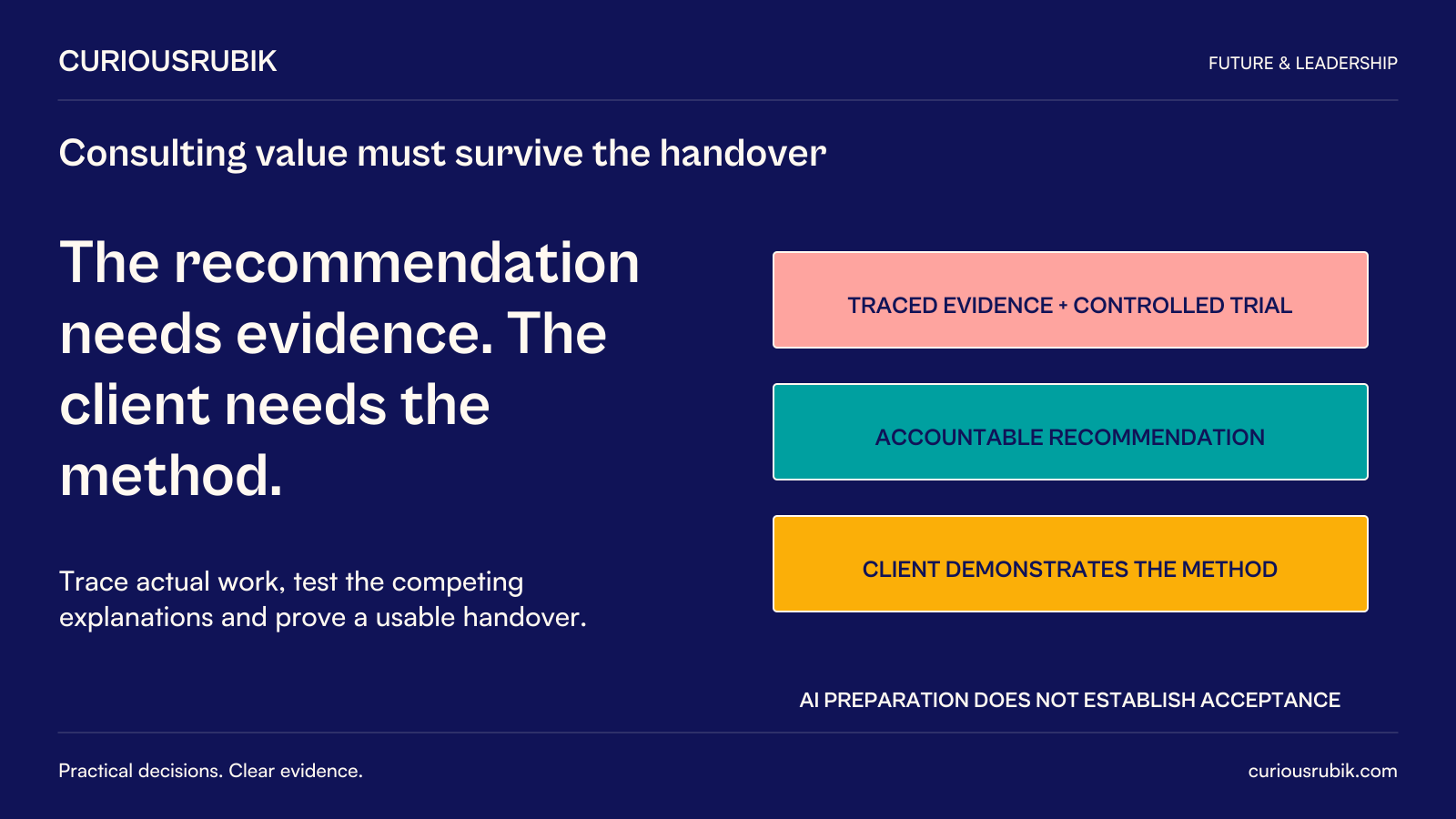
Two consulting reports can look equally polished while offering very different value. One connects its recommendations to observed work, tested assumptions, and explicit tradeoffs. The other restates a plausible generic model. If AI reduces the effort of producing first drafts, buyers will need to become better at distinguishing those deliverables.
The future value of enterprise consulting is likely to depend increasingly on the quality of the inquiry, the judgment applied, and the capability left with the client. That is a conditional direction, not a forecast that a particular consulting role or pricing model will disappear. Producing information, establishing what it means, and helping an organization act remain different kinds of work.
A buyer can prepare by commissioning a decision and its evidence rather than an impressive volume of output. The hypothetical engagement below examines a wholesale floral distributor considering centralized order administration. The focus is how to evaluate consulting value and accountability, not whether centralization is the correct answer.
Specify the decision the engagement must improve
State the business question, the alternatives, and the consequence of getting the decision wrong. “Develop a transformation strategy” may be too broad to guide evidence collection or acceptance. “Determine whether order administration should be centralized for a defined set of branches, and under which conditions” creates a more useful boundary.
Identify what the client already knows and where external help is needed. The gap may be specialist expertise, independent challenge, analytical capacity, or facilitation across functions. Those needs can require different engagement models and different people.
Separate the decision from implementation authority. A consultant can recommend a design and help test it, while the client retains responsibility for approved business choices and commitments. The engagement should make those roles clear rather than allow a recommendation to become policy by default.
Define the evidence expected at acceptance. That may include traced cases, reconciled workload estimates, tested alternatives, unresolved risks, and a supported operating proposal. A slide deck can present the work, but its existence does not establish that the inquiry was completed well.
A hypothetical centralization review
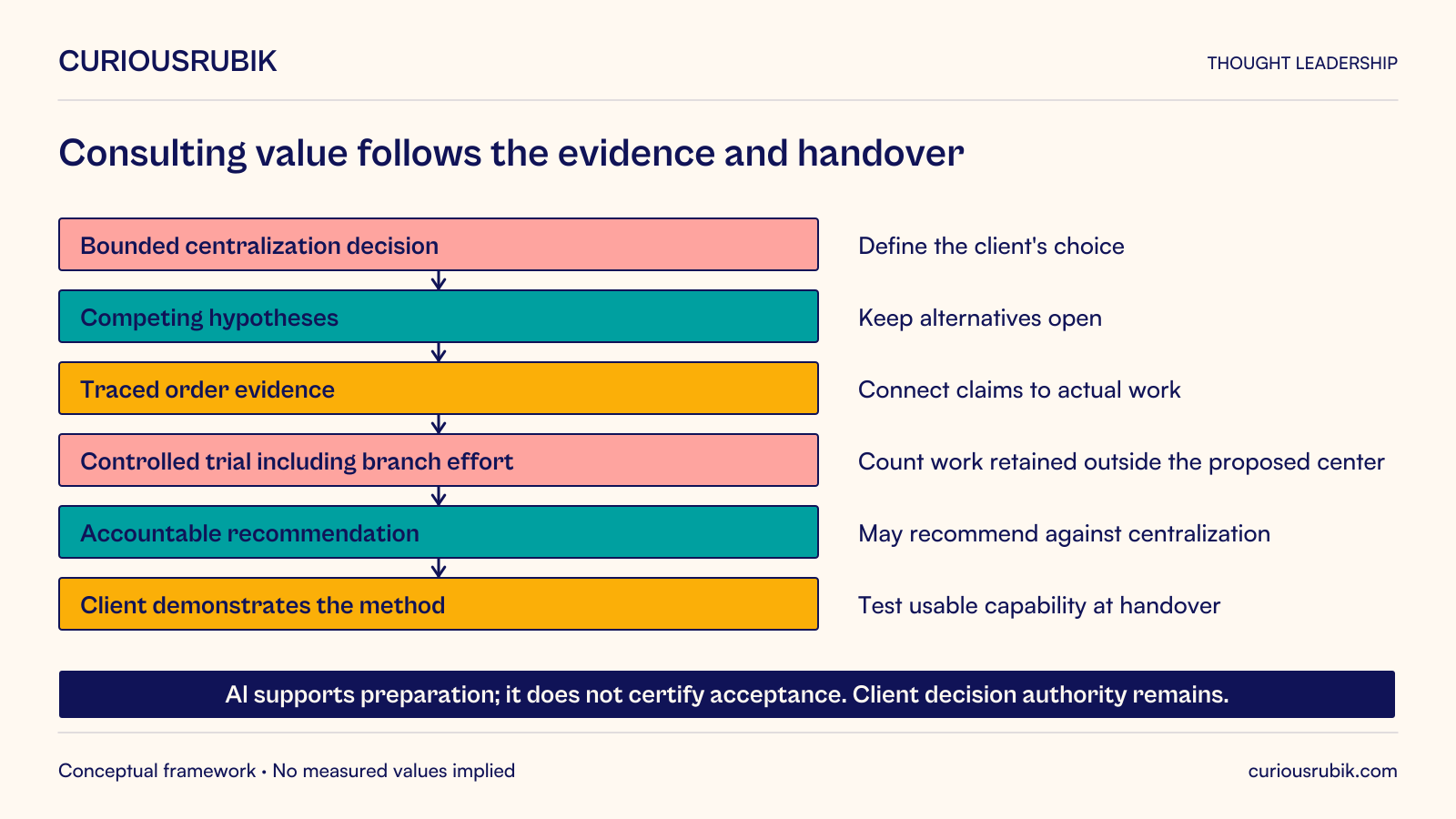
Imagine a wholesale floral distributor whose branches administer customer orders locally. Management believes a shared team might reduce duplicate effort, but branches argue that local knowledge is essential during peaks and last-minute changes. The COO commissions a bounded review.
An AI-assisted first pass can organize documents, summarize interviews, and suggest hypotheses. One hypothesis is that common intake and shared processing would remove repeated work. Another is that moving administration would create more clarification because local staff hold information not captured in the records. Neither should be accepted merely because the generated narrative is convincing.
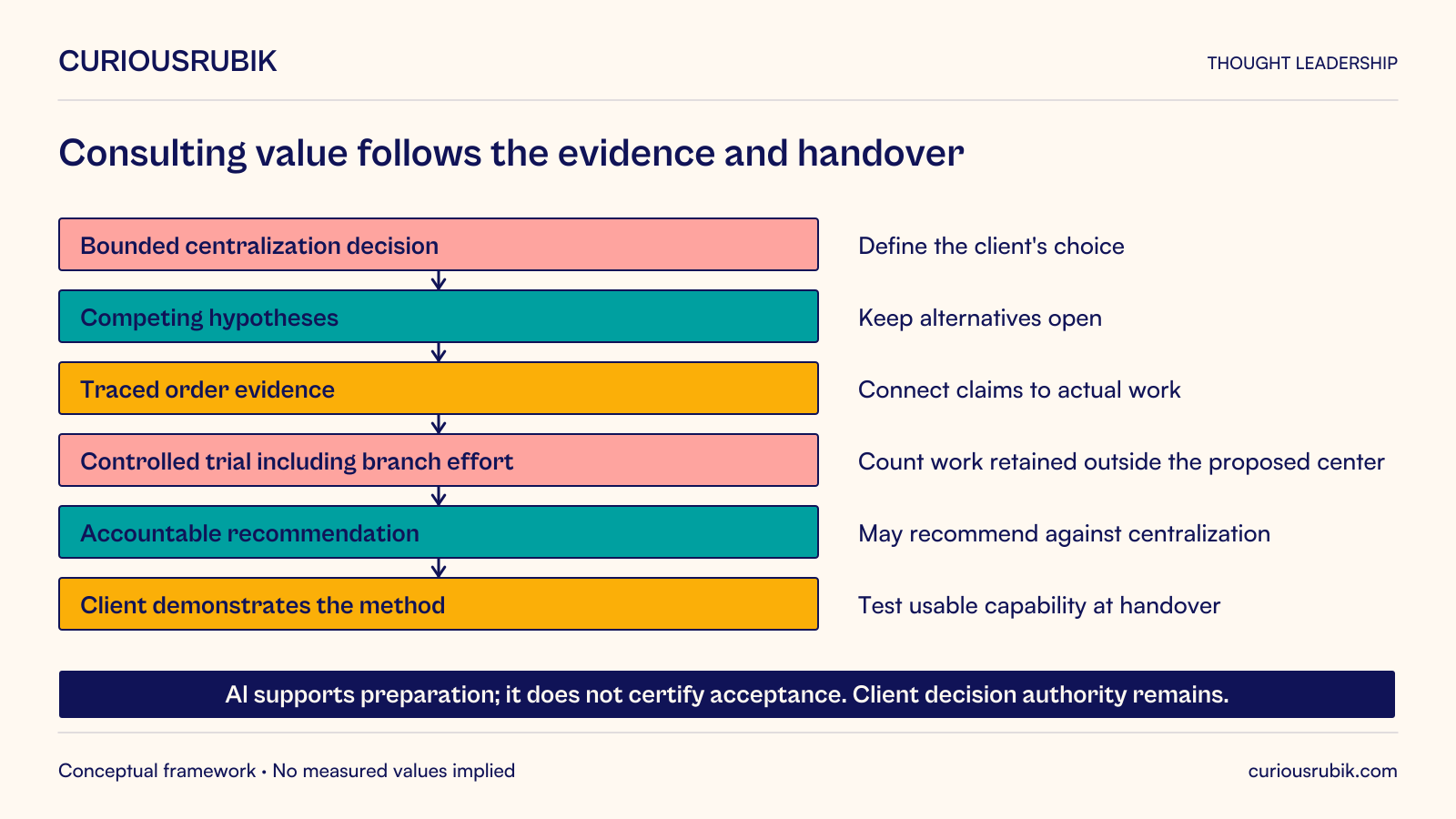
The consulting team traces representative orders from ordinary and peak periods, distinguishes routine work from exceptions, and tests the quality of information available to a central team. It records which observations support each hypothesis and where the sample is limited.
A controlled trial then examines a defined class of repeat orders. The proposed receiving team processes them using the available information and an agreed escalation route. The trial includes the retained work at branches, rather than counting only the apparent efficiency of the central team.
The resulting recommendation may support a shared routine core with local exception responsibility, a narrower pilot, or no centralization under current conditions. The valuable output is a decision that follows the evidence, including findings that contradict the initial business preference.
Before the engagement ends, client managers repeat part of the analysis and explain how they would evaluate a new branch. That demonstration tests whether the organization has gained a capability, rather than merely received a recommendation it cannot maintain. The scenario is fictional and claims no measured saving or client result.
Ask where AI is used and what assurance surrounds it
The buyer should understand which activities may be assisted: research organization, interview synthesis, process mapping, code preparation, or draft recommendations. The purpose is to assess information handling and verification, not to require a ceremonial declaration for every sentence.
Agree what client information may be processed, by which approved services, and under which access and retention conditions. Confidential documents, personal information, and production records should not be exposed simply because an external tool makes analysis convenient. Use the organization’s appropriate security, privacy, and contractual review.
Require material claims to be traceable to evidence. A generated summary can omit a qualification or merge two different views. Review the source basis for consequential findings and distinguish verified facts, stakeholder opinions, hypotheses, and recommendations.
Keep verification independent enough to challenge the original interpretation. Asking the same tool to generate a recommendation and confirm that it is reasonable can reproduce the same mistake. Qualified reviewers and independently established reference cases remain important where the consequences warrant them.
Evaluate judgment through the difficult parts of the work
Ask the proposed team how it will handle incomplete evidence, conflicting stakeholders, and an initial hypothesis that proves wrong. A credible method should permit revision rather than force every engagement toward the supplier’s preferred platform or operating model.
Look for domain understanding expressed through questions and tests. In the distributor example, the team should investigate peak demand, last-minute changes, local knowledge, and retained branch effort. Generic claims about automation or economies of scale do not substitute for that inquiry.
Assess the people who will perform the work, not only the reputation of the firm. Confirm relevant responsibilities, access to expertise, review arrangements, and continuity. An impressive proposal team does not establish that the delivery team has the same capability.
Examine conflicts of interest and commercial dependencies. A consultant may also sell implementation or managed services. That can be legitimate, but the client should understand how alternatives will be evaluated and how advice remains supported when the best option does not lead to a larger follow-on engagement.
Price the work in a way that supports the objective
A reduction in drafting effort should prompt a conversation about the complete engagement, not an automatic assumption that all consulting effort falls by the same proportion. Discovery, specialist review, stakeholder decisions, testing, and transfer may still require substantial work.
Different pricing arrangements can fit different uncertainty. A bounded investigation with unclear findings differs from implementing a well-defined change. Fixed deliverables, time-based work, and outcome-linked elements each create incentives and risks that should be assessed for the actual scope.
Avoid tying fees to an outcome the consultant cannot control without specifying the dependencies. A service result may depend on client staffing, policy decisions, supplier performance, and adoption. Conversely, a contract based only on document delivery can reward output volume rather than useful analysis.
The UK Cabinet Office’s 2022 Consultancy Playbook emphasizes clear outcomes, appropriate engagement design, and knowledge and skills transfer. It is public-sector commissioning guidance, not a universal private-sector contract standard or an AI productivity study. The Consultancy Playbook, Version 1.1, 2022
Make client responsibilities explicit
The client needs to supply appropriate access, knowledgeable participants, timely decisions, and a receiving owner for the work. A consultancy cannot establish a dependable operating model if essential business choices remain unavailable or the necessary evidence cannot be obtained.
Record assumptions about those contributions. If the client cannot provide a representative sample or protected expert time, the engagement should state how that limits the finding or changes the plan. Neither party should quietly preserve the original certainty while removing its basis.
Use joint reviews to resolve material questions and challenge evidence. The client should remain an informed participant rather than wait for a final presentation. Consultants should not be expected to replace every internal responsibility indefinitely.
Protect the distinction between advice, approved change, and external action. Recommendations involving people, commercial commitments, sensitive information, or system access require the appropriate authorized decisions. AI-assisted preparation does not enlarge the consultant’s mandate.
Require knowledge transfer that can be demonstrated
Define what the client should be able to do after the engagement. That may be maintaining a process model, interpreting an evaluation, updating a rule, or assessing the next rollout. A final training session is useful only if it supports that ability.
Transfer the relevant rationale and limitations alongside artifacts. The client needs to understand why an option was chosen, which assumptions remain uncertain, and what would trigger reconsideration. Otherwise, later teams may reuse the output outside the conditions that supported it.
Use an appropriate demonstration of handover. A client owner can walk through a new case, update the analysis with changed input, or explain the escalation route. The test should match the engagement and available capacity, not become unnecessary ceremony.
Agree access to the accepted work products and the permitted use of supporting materials through the actual contract. Clarify any supplier-owned tools or dependencies that affect the client’s ability to maintain the result, with appropriate professional advice where needed.
Buy a stronger decision and a more capable organization
The distributor can now judge the engagement by whether it understands the centralization choice better, has tested its material assumptions, and can maintain the next decision. A longer report or a faster first draft is secondary to those outcomes.
Enterprise consulting can remain valuable in an AI-assisted environment when it combines disciplined evidence, accountable judgment, effective collaboration, and transfer of usable knowledge. Buyers should make those expectations explicit at the start and test them before acceptance. The strongest engagement leaves the client able to act with greater clarity and to recognize when the recommendation’s assumptions no longer hold.