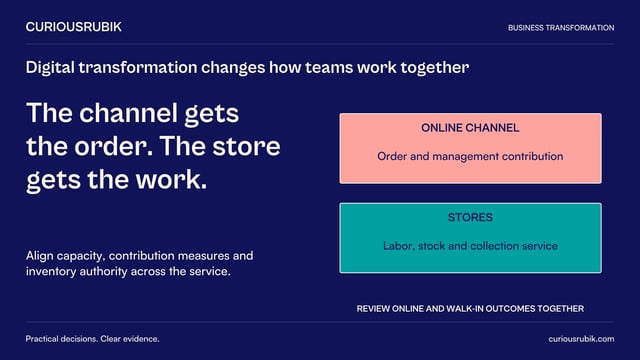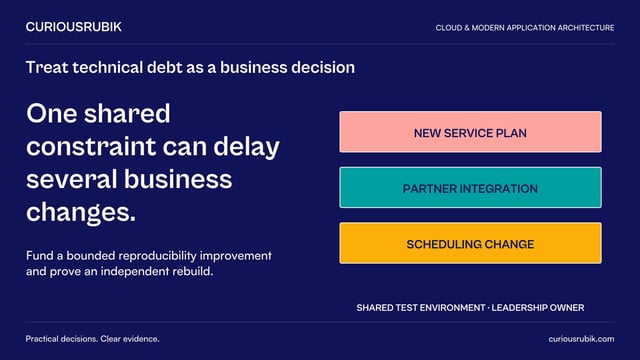
Composable architecture promises that an organization can combine existing capabilities to create or change a business service without rebuilding the whole application estate. The promise is attractive, but connecting components is only the beginning. The combined service must still have coherent meaning, appropriate authority and a reliable way to handle incomplete work.
The strategic opportunity is to make useful business capabilities easier to reuse and replace. It does not require every capability to become a separate microservice, every product to come from a different vendor or every workflow to be assembled without engineering judgment.
For an enterprise leader, the useful question is whether a proposed composition lets the business change a meaningful outcome with less unnecessary coupling, while keeping the resulting service understandable and operable.
Define the capability by the result it provides
A component is useful for composition when its purpose and behavior are clear. A capability such as reserve equipment has a different meaning from return a list of available equipment. The first changes a commitment; the second provides information that may become stale.
Describe inputs, outputs, conditions, permissions and effects in business terms. The interface should make clear what success means and what remains unresolved. A technically valid response is not enough if consumers interpret its business meaning differently.
The OASIS Service Oriented Architecture Reference Model distinguishes service interaction, its real-world effect and the policies and contracts governing use. That 2006 model is not a prediction about future products, but it provides a useful reminder that service composition involves semantics and conditions, not just connectivity. OASIS, SOA Reference Model 1.0.
Choose boundaries around capabilities that can be understood and owned. A collection of low-level technical functions may still require every consumer to reconstruct the same business rules, undermining the intended reuse.
An event package exposes the whole-service responsibility
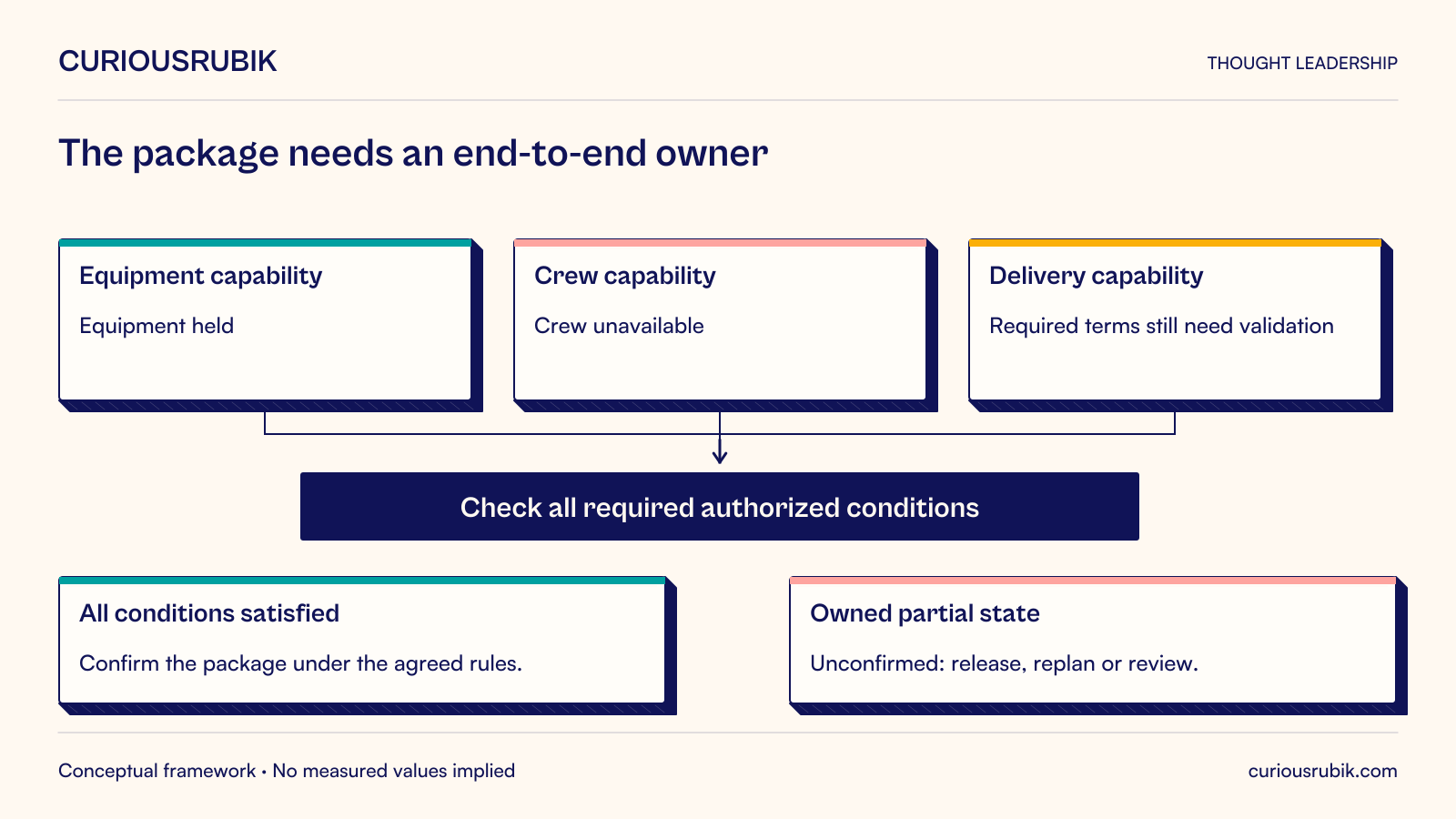
Consider a hypothetical audiovisual provider offering a customer an event package that combines equipment, a qualified crew and delivery arrangements. Separate capabilities can report availability or create holds for each resource.
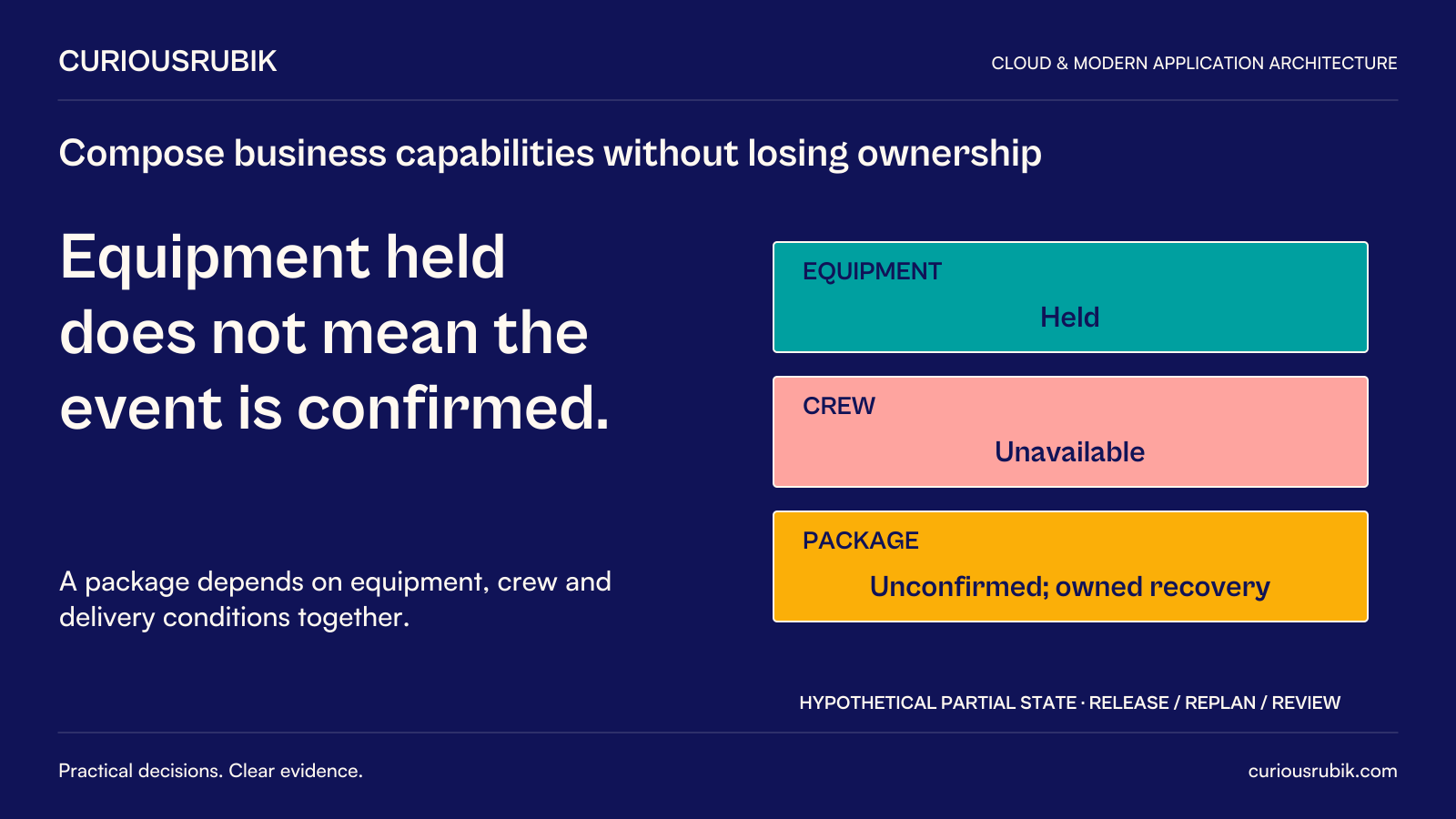
The combined service needs a rule for when the package is actually confirmed. An equipment hold alone is not a confirmed event package if no crew is available. A delivery estimate is not necessarily a delivery commitment.
Suppose the equipment capability creates a temporary hold, but the crew capability cannot satisfy the request. The composition needs an owned response: release the equipment hold where permitted, propose an alternative or send the case for an authorized decision. It should not leave an unexplained reservation consuming capacity indefinitely.
If the event date changes, the combined service must determine which prior conditions remain valid. Reusing the same components does not remove the need to reconsider the package as a whole.
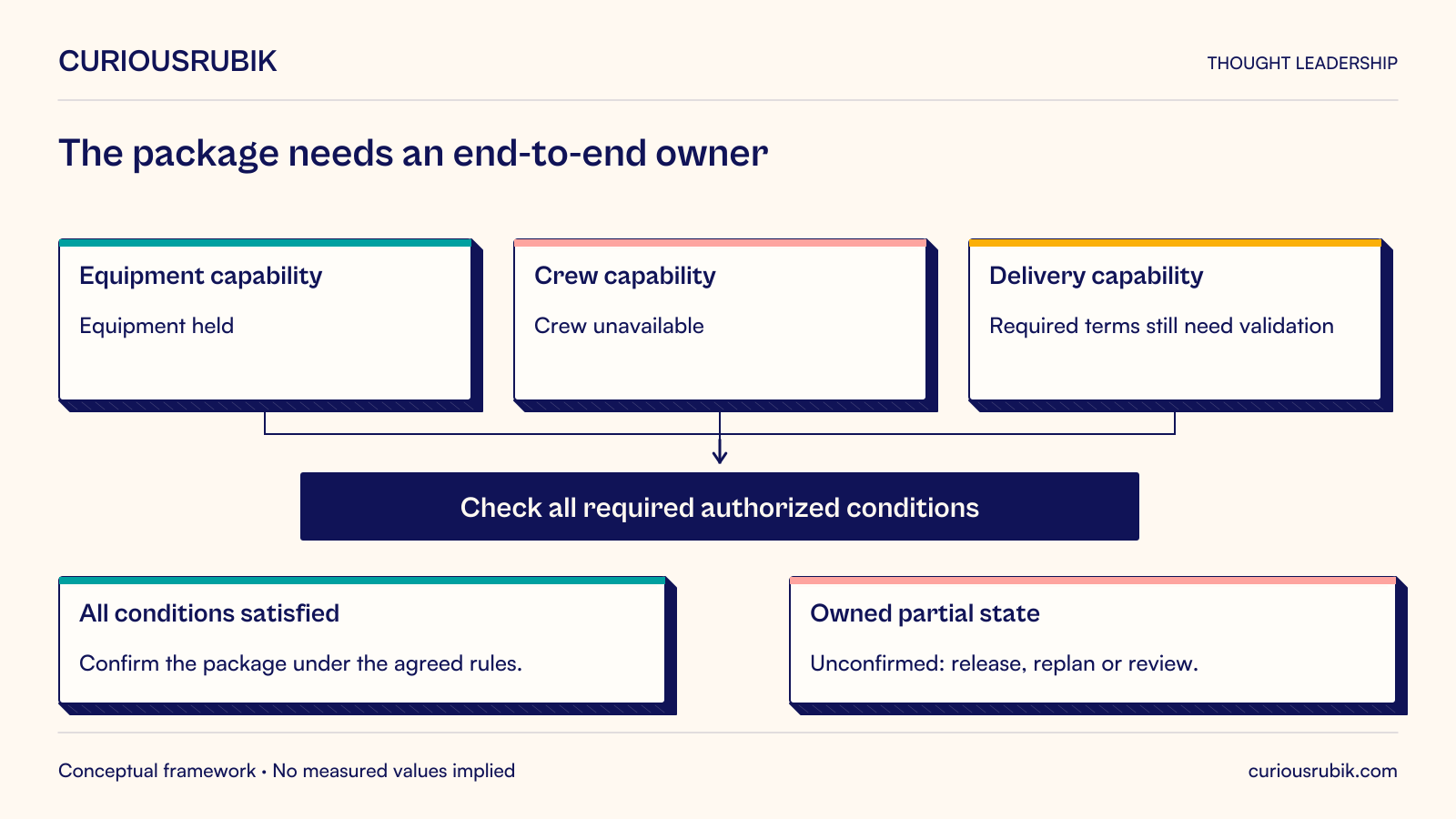
This example illustrates a design obligation rather than a universal booking process. Actual hold, cancellation and commitment rules depend on the business arrangements and must be represented accurately.
Preserve shared meaning across components
Common identifiers and field names help, but they do not guarantee that components mean the same thing. Customer, available, approved and completed can describe different states in different systems.
Establish which capability owns each important fact and how consumers interpret it. Record units, time semantics, versioning and relevant business conditions. A date without an agreed time zone or a quantity without a unit can make a technically successful composition incorrect.
Avoid copying business rules into every orchestration. If each workflow independently decides what counts as an eligible customer or a valid reservation, the organization can recreate the inconsistency that composition was meant to reduce.
At the same time, do not force genuinely different meanings into one universal model. Two business contexts may need related but distinct concepts. Make their translation explicit and assign ownership of that translation.
Useful composability comes from dependable agreements about behavior, not from pretending that every component already shares the same world view.
Design for partial completion and recovery
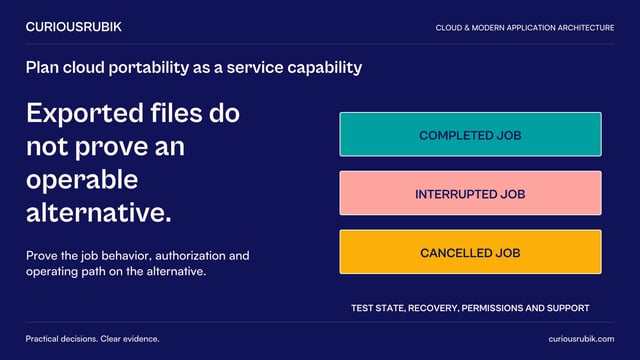
A composed workflow may involve several independently operated capabilities. Some actions can succeed before another fails. The design needs to represent that intermediate state and determine what can safely happen next.
Define whether an action can be cancelled, reversed, retried or only corrected through another business process. Compensation is not always an exact undo, especially when an external commitment or communication has already occurred.
Use stable identities and outcome checks to avoid duplicating effects after an uncertain response. A timeout does not prove that the requested action failed. The composition should determine the actual state before issuing another consequential command.
Bound the time a partial state can remain unresolved and identify its owner. An integration log is not an operating queue unless someone can interpret and act on it.
In the audiovisual example, recovery includes understanding which resource holds exist and which commitments the customer has received. Restarting the workflow from the beginning without that knowledge can make the situation worse.
Keep authority at every boundary
An orchestration engine or AI assistant should not gain unrestricted authority simply because it can call several services. Each action needs the appropriate user, service and business permissions.
Define what context is passed between components and which claims each component trusts. A customer’s request to explore options is not permission to place an order, and permission to reserve one resource does not imply authority to approve the whole package.
Enforce important controls in the trusted services that commit the action, not only in the workflow’s visible interface. This helps prevent another caller or a changed orchestration from bypassing the rule.
Protect information exposed during composition. Search, suggestions and intermediate results can reveal data even when the final action is denied. Scope retrieval and communication to the authorized context.
The goal is reusable capability with bounded authority. Reuse should not become a shortcut around the business’s controls.
Treat reusable capabilities as maintained products
A capability used by several teams needs an owner who understands its consumers, operating requirements and change obligations. Publishing an API without a support and evolution plan does not create dependable reuse.
Document the contract and provide evidence that consumers can test against it. Communicate material changes, define compatibility expectations and give consumers a supported transition path.
Measure whether the capability serves its intended outcomes. A high request count can indicate reuse, but also inefficient calling patterns or repeated failures. Examine successful business effects and the support burden.
Avoid designing for every imagined future consumer. Excessive generality can make a capability hard to understand and expensive to maintain. Begin with real needs, identify common behavior and expand when evidence supports it.
A catalog helps teams discover capabilities only when its descriptions, ownership and operating status remain current. Discovery is a continuing responsibility rather than a one-time documentation exercise.
Make the composed service observable
Operators need to see the progress and outcome of the complete workflow across its components. Use correlated identities and meaningful states so that a failure can be connected to the affected customer task.
Distinguish technical delivery from business acceptance at each stage. The orchestrator may have sent a request successfully while the receiving capability rejected it or placed it under review.
Define service-level measures for the overall outcome. Individual components can meet their own targets while the customer journey remains slow or incomplete because of coordination and queueing between them.
Provide a way to investigate partial states without exposing unnecessary confidential information. Support personnel need enough evidence and authority to resolve the issue, not unrestricted access to every component.
Test the operating view during failures and changes. A diagram that looks clear during design may be difficult to follow when versions differ and several retries are in progress.
Use low-code and AI composition within explicit limits
Tools may make it easier to assemble interfaces, propose workflows or translate a user request into a sequence of actions. Their usefulness depends on the quality of the available capability descriptions and the controls around execution.
Generated orchestration should be reviewed against the same business conditions as hand-written code. Verify permissions, state transitions, failure handling and the meaning of each component’s result.
Do not assume that a tool can infer an organization’s commitment rules from endpoint names. A function called confirm can represent a different effect in each service. The description and tests must make that effect explicit.
Begin with bounded use cases where expected outcomes are observable and consequential actions remain controlled. Expansion should follow evidence of reliable operation, not the appearance of a convincing demonstration.
The future capability of these tools is uncertain. Investing in clear contracts and testable service behavior remains useful regardless of which tool helps assemble the workflow.
Evaluate composability by a real change
Choose a representative change the business wants to make: replace one provider, add a channel, alter a package or reuse a capability in another service. Measure the work and coordination actually required.
Determine whether the change can be made without modifying unrelated consumers or weakening existing controls. Include data migration, testing, deployment and support in the assessment, not just the time to connect an interface.
Compare the result with a simpler alternative. A modular application may meet the need with fewer operating boundaries. Composability is a property to develop where it creates value, not a requirement to distribute everything.
Record the remaining dependencies and costs. A successful small demonstration establishes a useful option within its tested scope; it does not prove that the whole enterprise can be rearranged without effort.
Build adaptability on dependable agreements
The future of composable enterprise architecture depends less on the number of components available than on how reliably they can be understood, governed and changed. Clear semantics, bounded authority, managed partial states and accountable ownership make composition useful.
Organizations can prepare by strengthening those foundations around capabilities that matter to their business. They can then add tools and patterns that reduce assembly effort while preserving control over the resulting service.
The outcome worth pursuing is a business that can change its services without repeatedly rebuilding the same foundations or losing responsibility between components. That requires deliberate architecture and operating discipline, even when the technology makes the connections easy.