Vendor lock-in is not simply the use of a proprietary cloud feature. It is the difficulty and consequence of changing a dependency when the business needs to do so. A proprietary service can provide enough value to justify that dependency. A supposedly portable design can still be difficult to move because of its data, identity, operating procedures or team knowledge.
The useful decision is therefore not whether to eliminate every dependency. It is which dependencies the organization is willing to accept, which switching options matter and what evidence supports those options.
For a technology sponsor, lock-in analysis should make the cost of changing direction visible without forcing the application into a lowest-common-denominator design that gives up useful capability unnecessarily.
Define the change you may need to make
Start with plausible business reasons to change a provider or service. These might include a material price change, an unsupported requirement, a service-quality problem, a changed geographic need or a strategic decision about operating responsibility.
Specify the scope. Replacing one queue service is different from moving an entire application. Exporting records for analysis is different from operating the business on another platform. A recovery option during an outage is different from a permanent supplier exit.
Set the relevant time horizon and acceptable disruption. A migration that is possible over a year may not satisfy a need to restore service in a day. Conversely, maintaining immediate interchangeability can be unnecessarily expensive when the realistic concern is a planned transition.
This prevents a vague portability requirement from driving architecture decisions that do not support an actual business option.
Map dependencies beyond application code
Identify provider-specific interfaces, data models, workflow definitions, identity arrangements, deployment tooling, monitoring and operating procedures. Include commercial and skills dependencies, while keeping them distinct from technical compatibility.
For each, ask what would need to change, who understands it and what evidence would establish an acceptable replacement. A dependency register is useful when it supports those questions; a list of product names alone does not.
Consider the dependencies between dependencies. Moving the application may require a new identity configuration before users can access it. Moving data may require transformation code that itself runs only in the original platform. A monitoring replacement may be necessary to operate the destination safely.
Also examine information that is not part of the obvious data export: permissions, configuration, histories, reference data and job state. Those can determine whether exported records remain useful.
Standard code does not guarantee a portable service
An application written in a common language may still rely on provider-specific behavior. Queue delivery, storage consistency, transaction semantics, identity assertions and managed workflow state can vary.
NIST’s 2012 Cloud Computing Synopsis and Recommendations notes that platform-service interfaces can differ even when standard languages are used. It also identifies a tradeoff: generalized interfaces can reduce some portability risks while adding cost and limiting provider-specific features. NIST SP 800-146, Section 6.4.1.
A container or infrastructure template can package part of a workload without reproducing all of its dependencies. The team still needs to establish whether the destination can provide the required behavior and operating controls.
Avoid treating compatibility with a familiar protocol as complete equivalence. Two services can accept similar requests while handling retries, ordering, failures or access differently. Those differences matter when the business relies on them.
A simulation workflow shows what an export can miss
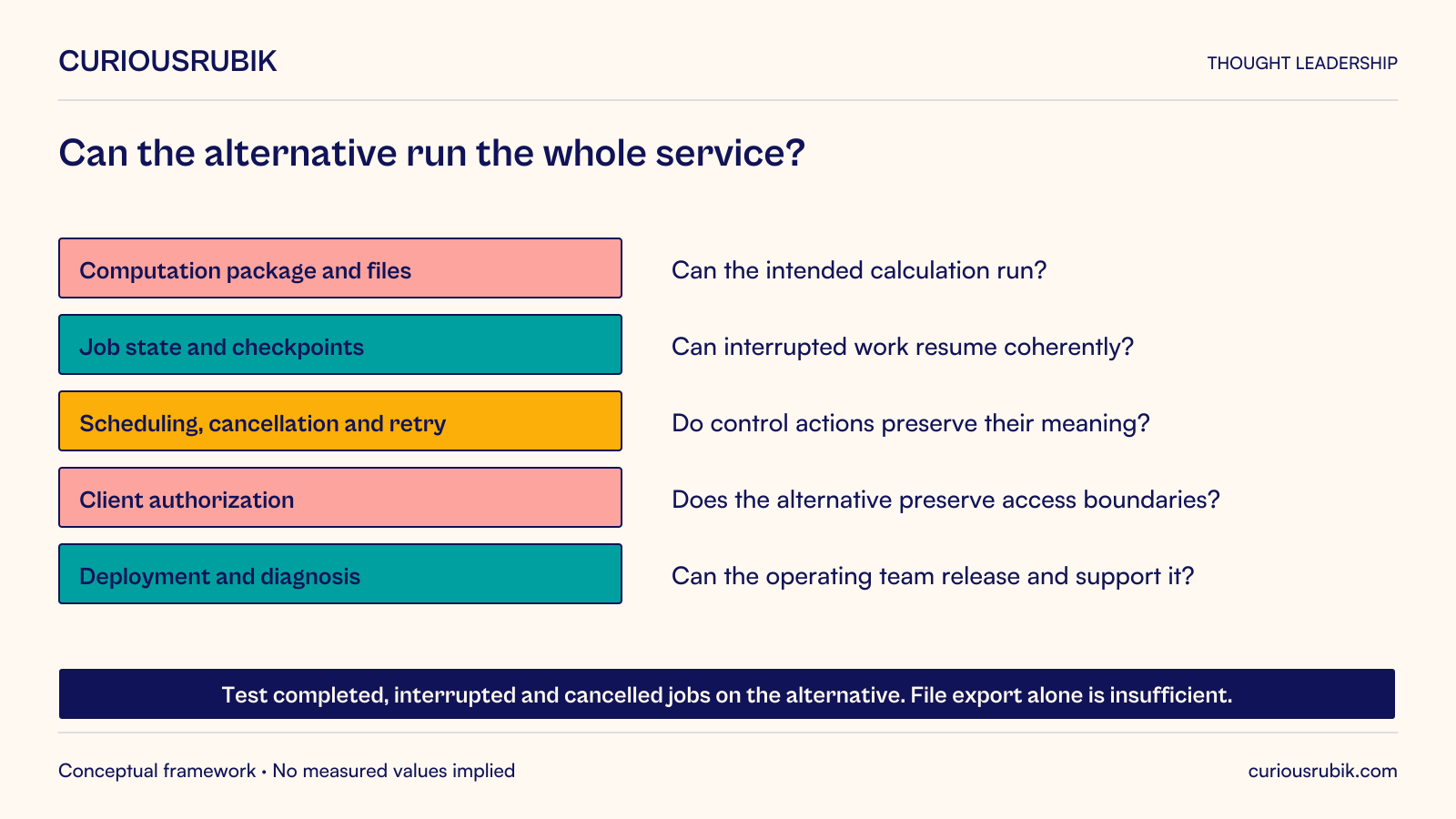
Consider a hypothetical engineering consultancy running simulation jobs through a managed cloud workflow. The application stores input files and results in common formats, and its computation code can run in a portable package.
At first glance, the service appears easy to move. But the workflow also manages job submission, scheduling, cancellation, checkpoints, retry decisions and the relationship between a job and the client authorized to see its results.
Exporting the files does not reproduce those behaviors. A replacement must determine which jobs are complete, which can resume, which should restart and which were cancelled. It must preserve the relationship among inputs, versions and outputs without exposing another client’s information.
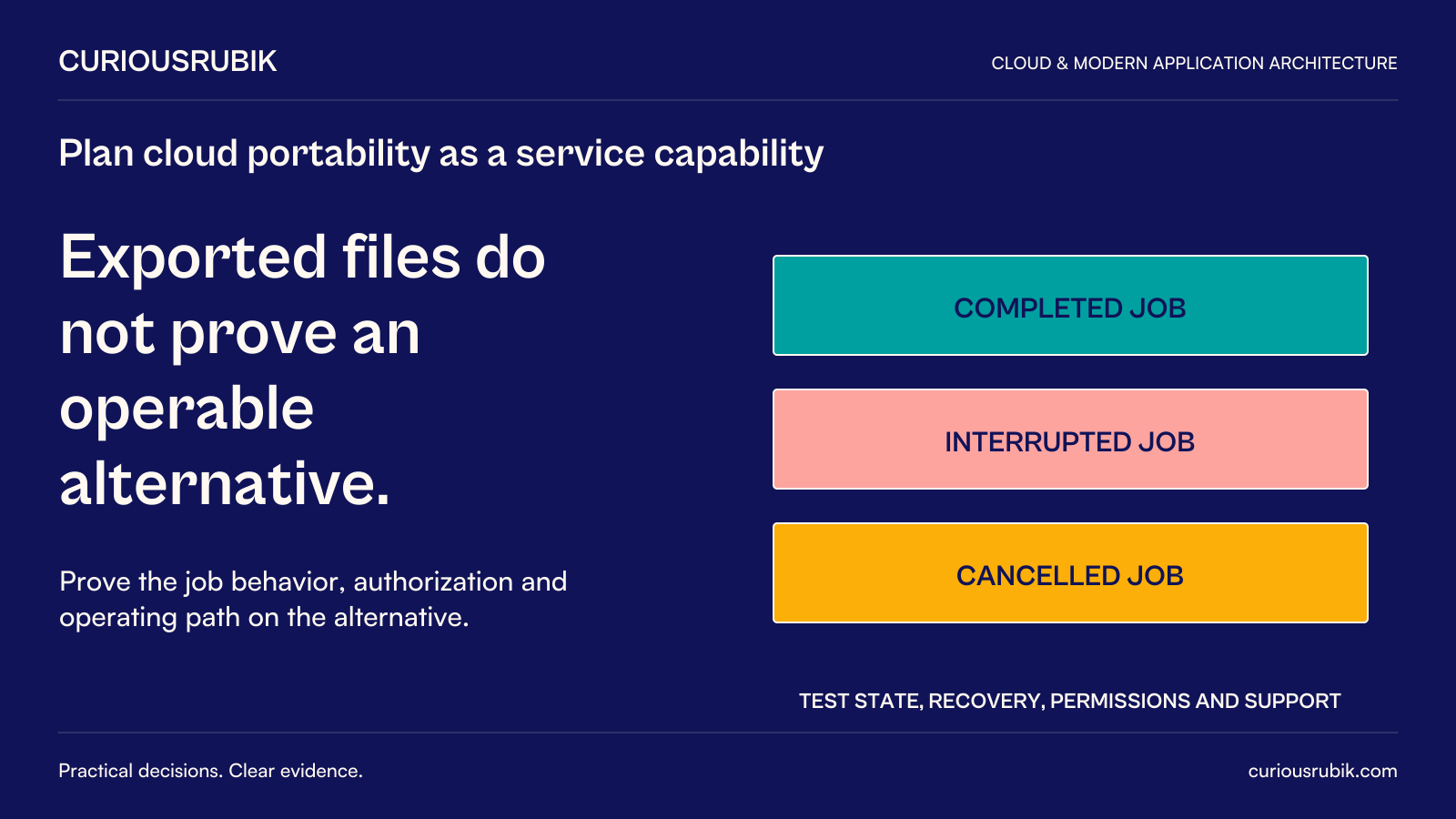
A useful portability test would move a representative set of jobs, including an interrupted and a cancelled job, then demonstrate the intended behavior on the proposed alternative. It would also test how operators diagnose failure and how users retrieve authorized results.
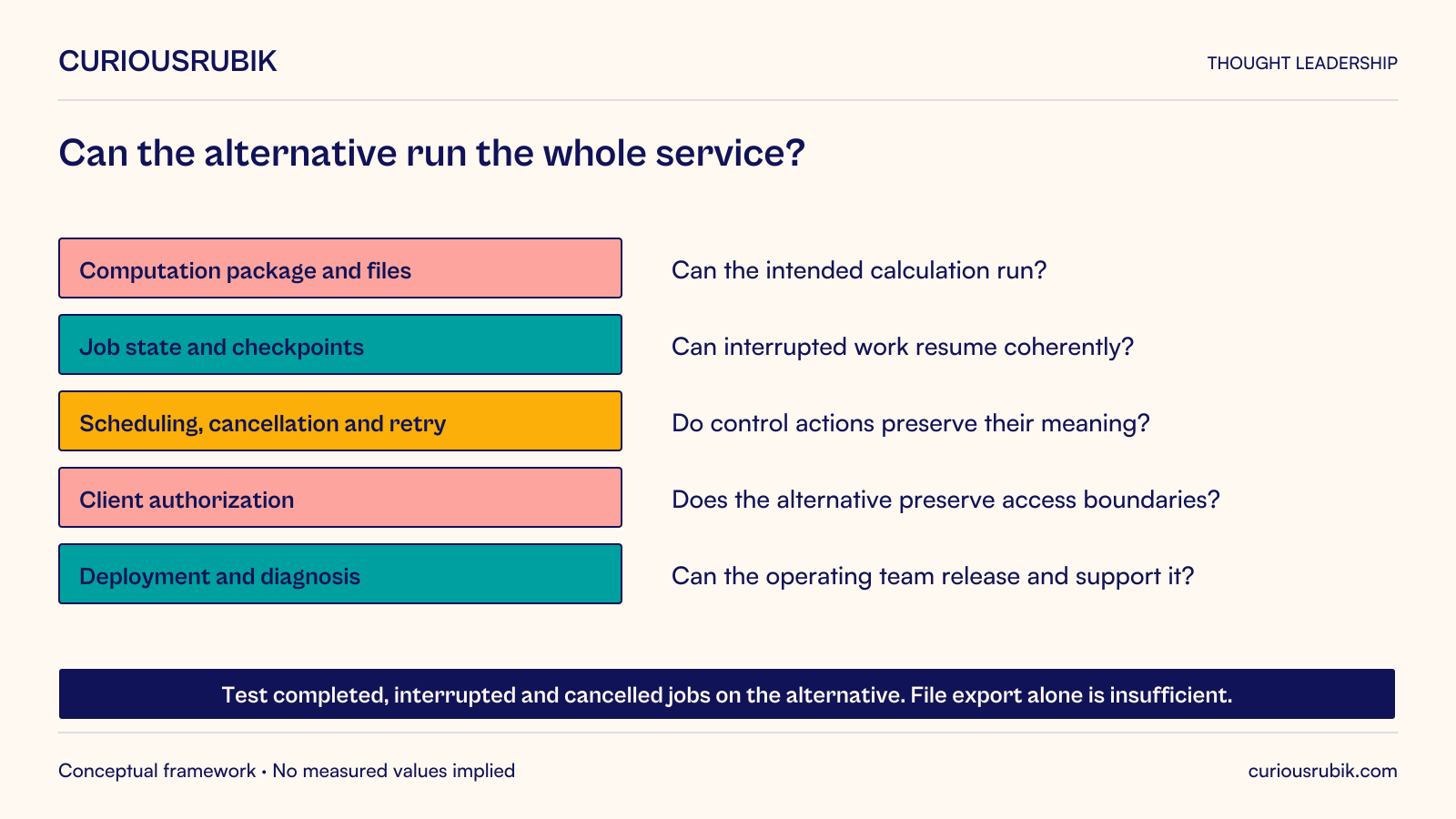
The test may show that most of the service moves easily while one managed workflow dependency requires substantial replacement work. That finding is useful even if the organization decides to keep the existing provider.
Evaluate the value received for the dependency
A managed capability may reduce implementation effort, improve operating support or provide functionality the business could not economically build itself. Include those benefits in the comparison.
Ask what a more portable alternative would cost today: additional engineering, slower delivery, more operational work or reduced functionality. A custom abstraction layer is itself software that must be maintained and tested.
Do not assume that avoiding a proprietary feature eliminates dependence. The organization can become dependent on its own complex platform or on a small group of specialists who understand it.
The decision may reasonably accept a dependency while preserving a narrower exit option. For example, the business might retain its input and result formats, document workflow semantics and periodically test a representative replacement path rather than operate two complete platforms continuously.
Make the accepted tradeoff explicit so that future teams do not mistake it for an accidental omission or an unqualified portability promise.
Choose mitigation at the right boundary
Some dependencies benefit from a stable internal interface that separates business logic from provider-specific implementation. The interface should represent the business need clearly enough that another implementation is plausible.
Avoid wrapping every provider function without a purpose. A thin wrapper that reproduces a proprietary API may provide little practical independence, while a very broad abstraction can conceal useful differences and become difficult to evolve.
Use standard data formats and documented schemas where they fit, but preserve the semantics needed to interpret them. Record units, identifiers, versions and relationships, not just field names.
Keep deployment and configuration knowledge reproducible. If the destination can run the code but nobody can reconstruct the required environment and permissions, portability remains incomplete.
Select mitigations according to the dependency’s consequence and the likelihood of needing the option. The organization does not need the same level of interchangeability for every component.
Distinguish multi-provider operation from an exit option
Running across multiple providers can support particular resilience, geographic or commercial objectives. It also adds integration, security, data movement and operating complexity.
A second provider does not automatically remove lock-in. If the second environment depends on the first provider’s identity, control plane or authoritative data path, the expected independence may not exist.
Likewise, maintaining separate implementations can make ordinary changes more expensive and introduce inconsistent behavior. The team needs evidence that the additional capability serves a defined requirement.
A tested transition option may be more proportionate than continuous multi-provider operation when the business concern is a planned exit. Immediate continuity requires a different design and stronger operating evidence.
State which objective the investment supports. Using one label for portability, resilience and bargaining flexibility can hide important differences in cost and readiness.
Test the option before relying on it
Choose a representative workload and an explicit acceptance condition. Include data transfer, behavior, permissions, performance and operational diagnosis at the level required by the intended option.
Measure the effort and elapsed time, and record what was simulated or excluded. A small proof of concept can establish feasibility without proving that a full production migration will fit the same schedule.
Test the difficult states, not only completed records. In-progress work, historical versions and failed operations often reveal the assumptions embedded in the original service.
Preserve the test artifacts and update them when the application changes materially. A portability test from several years earlier may no longer represent the current dependency graph.
Use the result to revise the risk assessment. If the option is weaker than expected, the organization can strengthen it, narrow its claim or consciously accept the remaining dependence.
Include commercial and operating transition questions
Technical portability does not settle the commercial transition. Procurement and legal specialists should review the applicable agreement, including access to data, assistance, notice requirements and relevant charges or restrictions.
The architecture team should supply concrete requirements for that review: which data and metadata are needed, in what form, at what volume and over what transition period. Avoid assuming that a general export feature satisfies the business’s full operating need.
Plan who will run the destination and support the transition. New skills, parallel operations and reconciliation can dominate effort even when the code change is modest.
Do not assign a universal exit cost or transfer rate. Use current verified terms and measured workload evidence for the actual decision. Keep uncertain assumptions visible rather than converting a rough technical estimate into a contractual promise.
Revisit dependency choices as the business changes
A dependency that was sensible during an early product phase may become harder to justify at a different scale or under a new service requirement. Conversely, a previously important portability option may become less relevant.
Review material dependencies when adopting a major service, changing the architecture or renewing the underlying commercial commitment. Use observed operating value and current switching evidence rather than relying on the original business case indefinitely.
Cloud lock-in becomes manageable when it is a deliberate, bounded tradeoff. The organization can use valuable provider capabilities while retaining clear ownership of its data, behavior and future choices, supported by tests that show which alternatives are genuinely available.