A growth plan rarely arrives as a clean requirement to double application traffic. The business adds larger customers, more complicated orders, longer operating hours and new reporting obligations. Transaction volume may rise modestly while the work required to complete each transaction changes substantially. An application can run out of capacity even when its familiar dashboard still looks reassuring.
For a technology leader and business sponsor, scalability means preserving an acceptable service as the workload and operating model change. More servers are one possible response. They are not a substitute for understanding which resource, dependency or human activity limits the service.
The useful investment question is specific: what growth must this application support, which conditions have been demonstrated, and what will the team do before demand exceeds them?
Translate commercial growth into workload changes
Start with the business plan and trace its operational consequences. A new enterprise customer might bring fewer users than a consumer campaign but much larger imports, more historical records and a concentrated reporting deadline. A new product may require additional checks for every order. Expansion into another region can eliminate the overnight window previously used for maintenance and batch processing.
Describe the changes separately. Relevant dimensions include arrival rate, concurrent activity, transaction complexity, retained data, attachment size, integration calls, geographic distribution and the concentration of work among customers. Include scheduled jobs and administrative tools. They consume resources even when they are absent from the main user journey.
Ask business owners when these conditions might coincide. A quarter-end report, a large customer import and normal order processing may share the same database. Testing each activity alone does not establish that the combined service will work.
This translation produces a workload model rather than a single growth multiplier. It should state assumptions the business can recognize and revise as the commercial plan develops.
The same order rate can create a different workload
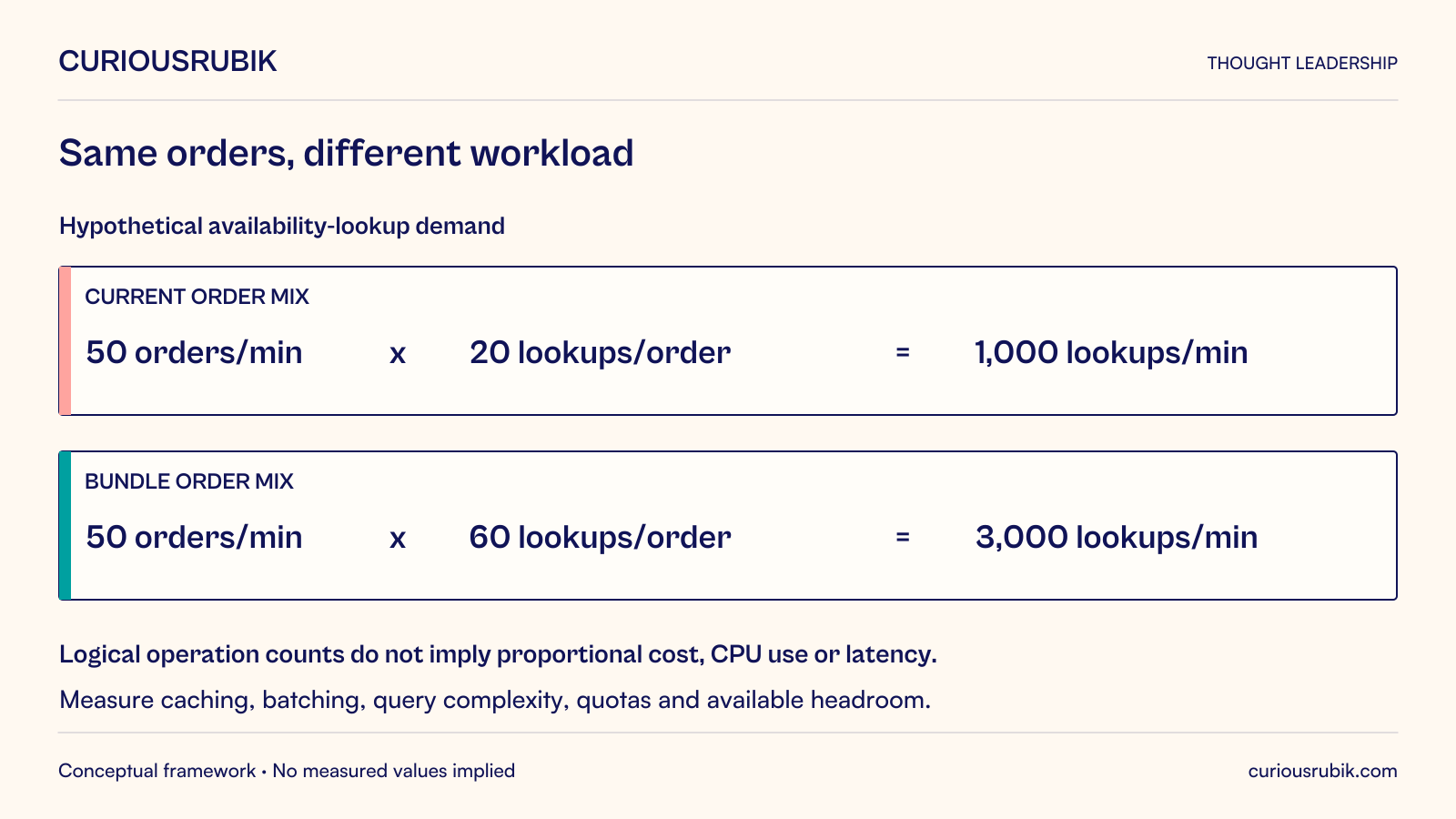
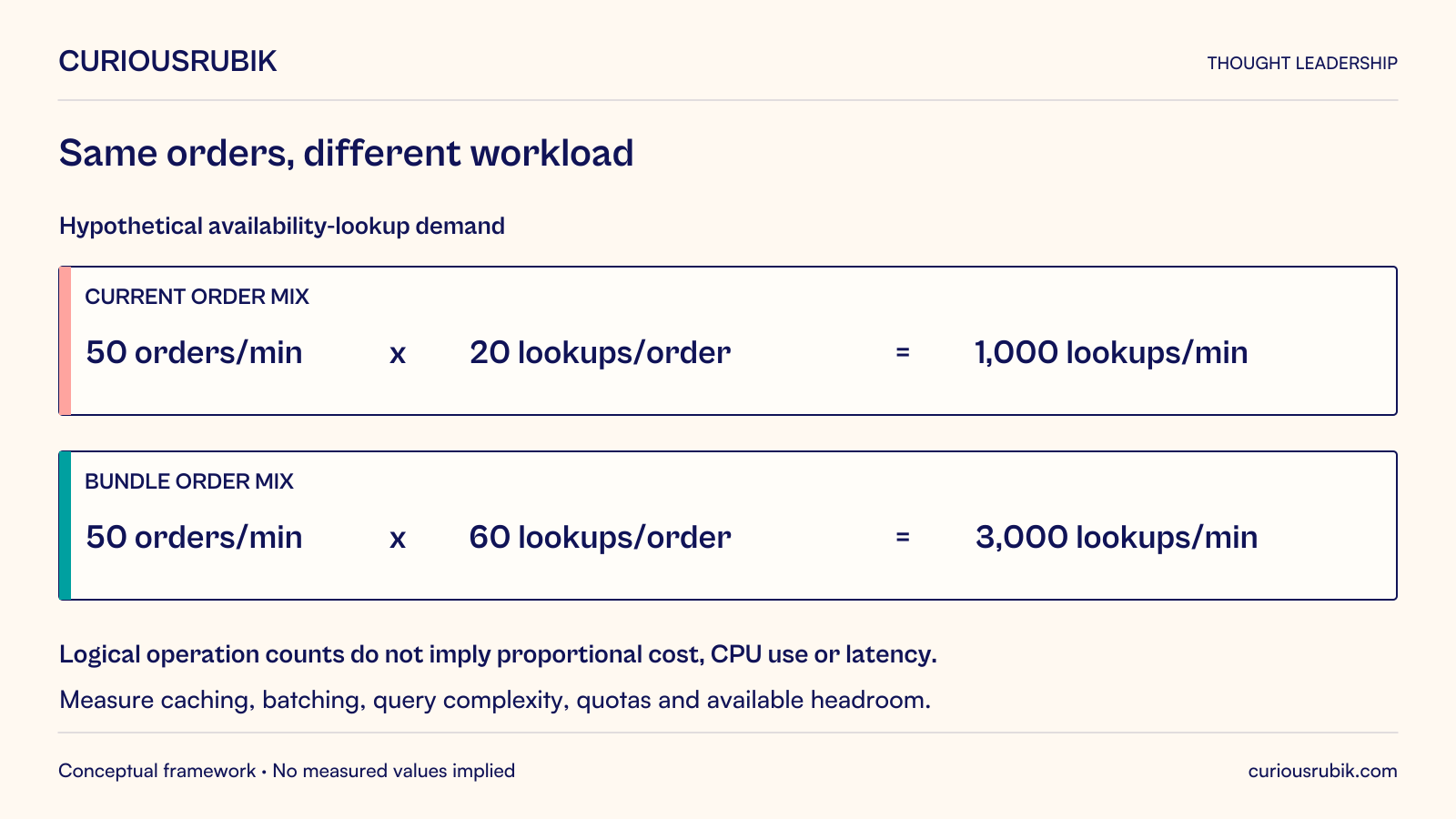
Consider a hypothetical equipment-parts ordering application. At a particular peak, it receives 50 orders per minute. Each order currently triggers 20 logical availability lookups, producing 1,000 lookups per minute under these simplified assumptions.
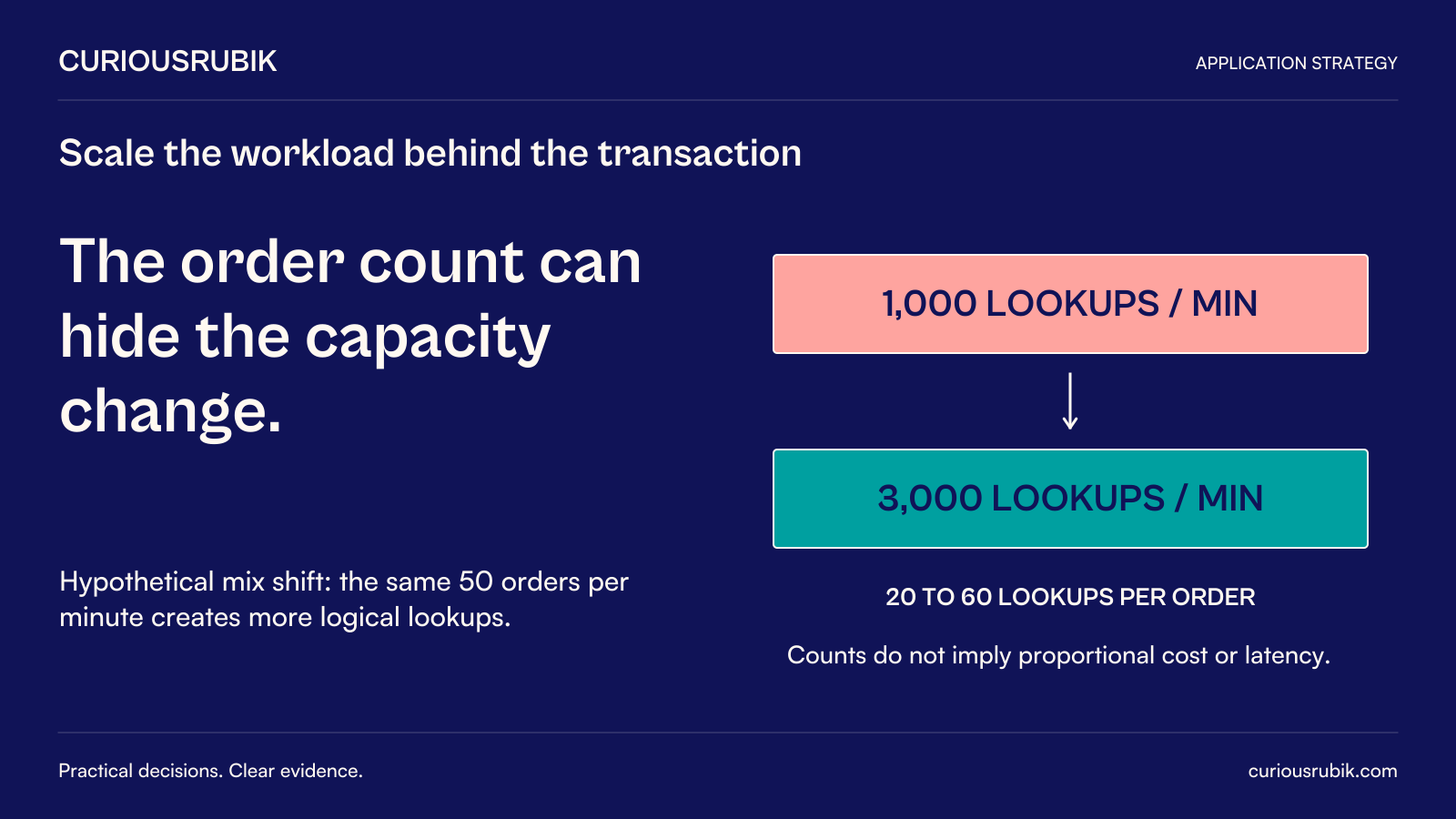
The business introduces configurable bundles. Suppose the new order mix requires 60 lookups per order at the same arrival rate. The modeled demand becomes 50 multiplied by 60, or 3,000 lookups per minute. The order dashboard still shows 50 orders per minute, while this particular downstream operation has tripled.
These figures are an illustration, not a benchmark. They do not establish that infrastructure cost, CPU consumption or response time will triple. Caching, batching, query complexity, connection limits and existing headroom can change the relationship. They identify a dependency that deserves measurement.
The right test reproduces representative bundle structures and data, then measures the actual work across the application and availability service. If the bottleneck is a shared downstream quota, adding application instances may increase contention rather than improve completed orders.
Google’s Site Reliability Engineering guidance makes the broader point that requests can have very different resource requirements, making a request count alone an unreliable capacity proxy. Its operating examples come from Google’s environment; a business application needs measurements of its own constraints. Google SRE, Handling Overload.
Define what acceptable service means
Capacity has little meaning without a service condition. A system may accept a large number of requests while leaving customers waiting, losing work or producing incorrect results. The business needs to define the outcomes that must remain acceptable during the target workload.
For an order journey, distinguish receiving a submission, validating it, obtaining an authoritative availability result and confirming the order. A quick acknowledgement is not proof that the order completed. Measure the stages separately and connect them with a stable transaction identity.
Specify the relevant time distribution rather than relying only on an average. An average can conceal a minority of very slow journeys, including those for the largest customers. Examine slow requests, failures and unfinished work alongside the typical experience.
Google’s monitoring chapter organizes service observation around latency, traffic, errors and saturation. These are useful technical signals; the application still needs a business interpretation of successful completion and unacceptable delay. Google SRE, Monitoring Distributed Systems.
Set targets with the people responsible for the service and its consequences. A background export and an interactive order confirmation can have different timing requirements. Neither should silently trade away data correctness or access controls to meet a speed target.
Test realistic data and combined conditions
A small, clean test database can hide problems that emerge with accumulated history or uneven customer sizes. Use representative record counts, relationships, attachment sizes and data distributions. Include customers with unusually large accounts and queries that return many results.
Test the expected mix of work, not just repeated calls to the fastest endpoint. Include background reconciliation, report generation and imports that share resources. Record the software version, configuration, dependency limits and test data so that the result can be interpreted later.
Increase load deliberately and observe where the service first breaches an agreed condition. Does response time deteriorate before errors appear? Does a connection pool saturate? Does a queue grow without recovering? Does an external service begin rejecting calls? The first visible error may occur downstream from the actual cause.
Also test duration. A short burst may complete successfully while a sustained workload exposes memory growth, connection leaks or accumulating unfinished jobs. The test should cover the operating pattern being promised, including recovery after the peak.
Production testing requires its own safeguards and authorization. A controlled environment may be the appropriate starting point, with differences from production explicitly recorded. A test report should describe those limits rather than imply a guarantee it cannot provide.
Choose a remedy for the measured constraint
Several remedies can address the same symptom, with different obligations. Removing repeated work may help more than increasing capacity. A query improvement, a suitable index, batching or a bounded cache may reduce demand on the constrained dependency. Each needs correctness and maintenance checks.
Caching is particularly sensitive to business meaning. A historical description and a current authorization decision have different freshness requirements. Decide what can be reused, for how long, and how a relevant change invalidates it. Faster stale information can create a more serious failure than a slower explicit response.
Additional application instances can help when work can be distributed and the remaining dependencies have capacity. They may offer little benefit when a shared database lock, external quota or serialized operation is the limit. Confirm the end-to-end effect rather than reporting instance count as evidence of scalability.
Separating heavy reporting from interactive work may protect the user journey, but it introduces data movement and freshness questions. Queuing work can smooth a burst, but it changes when the business receives a completed result. Those are product and operating decisions as well as technical choices.
Compare remedies against the specific constraint, expected benefit, implementation risk, recurring cost and support burden. Retest after the change; improving one bottleneck often makes another visible.
Decide how the application behaves beyond its tested range
Growth forecasts are uncertain. The application needs a controlled response when demand exceeds the conditions it can safely serve.
Define bounded queues, admission limits and clear user states. A queue that accepts work indefinitely can turn an overload into a long, opaque recovery. Show whether a submission was rejected, accepted for later processing or completed. Avoid responses that encourage customers to resubmit an operation whose outcome is merely delayed.
Agree which optional activities can wait. A nonessential analytical refresh may be deferred while order processing continues, provided its consumers understand the stale state. Essential authorization, required validation and transaction integrity should remain enforced. If they cannot be performed safely, the service may need to pause that action.
Retry behavior matters because repeated attempts can add load precisely when a dependency is struggling. Coordinate retry limits, delays and duplicate protection across callers. Recovery should establish the actual outcome of uncertain operations rather than blindly creating another attempt with a new identity.
These controls need an owner and a customer communication path. A technically bounded failure can still create avoidable business disruption if nobody explains what happened or how pending work will be resolved.
Include the operating team in the growth model
An application can scale technically while its support model does not. More customers may produce more permission changes, exception investigations, configuration requests and account-specific imports. Measure that work alongside infrastructure consumption.
Identify tasks that require specialist knowledge or manual database intervention. Understand whether their frequency grows with transactions, customers or product variants. Standardization, better diagnostics and safe self-service may reduce the burden, but their controls and support responsibilities still need design.
Track cost against a meaningful completed business unit, with the accounting boundary stated. Infrastructure cost per successfully completed order is different from total operating cost per customer. Include failed work and retries where relevant so that efficiency does not appear to improve merely because unfinished transactions disappear from the denominator.
Use scenarios rather than a single confident forecast. A high-volume, simple workload and a lower-volume, complex workload can require different investments. Review the assumptions when the business changes its product mix or onboarding commitments.
Keep a capacity decision record
A practical record can be short: target workload, acceptable service conditions, demonstrated result, limiting dependency, remaining uncertainty, planned response and next review trigger. This is a proposed management aid, not a universal capacity standard.
Tie the review trigger to observable change. Examples include a new large-customer import pattern, a material increase in transaction complexity, sustained queue growth or a planned launch that removes a maintenance window. Allow enough time to test and change the system before the commitment takes effect.
Building for growth means developing evidence about the application’s limits and a proportionate way to move them. The strongest plan connects the commercial forecast to real workload, protects correctness under pressure and gives both the technical team and the business a clear decision before capacity becomes an emergency.