An application’s architecture appears in business costs long before anyone proposes a rewrite. A modest rule change requires several teams to coordinate releases. An incident takes hours to locate because responsibility is unclear. A new customer variant creates another copied workflow that must be maintained separately. The development invoice does not show those future obligations clearly.
For a CTO and business sponsor, the useful question is where the structure of the application increases the effort, delay or risk of ordinary work. Architectural quality is not a matter of preferring fashionable patterns. It is whether the design’s dependencies and responsibilities fit the changes and operating conditions the business actually faces.
The first step is to make those costs observable. A diagram labeled complex is not an investment case, and a modern replacement is not automatically an improvement.
Recognize cost that appears outside development
Some architectural costs are direct engineering effort: repeated edits, broad regression testing, fragile deployments or manual recovery. Others appear in coordination, business interruption, support investigation or the inability to make a useful change within the required time.
Keep the categories distinct. Waiting for three teams to align is elapsed delay, not necessarily three teams working continuously. A difficult incident creates exposure and workload, but an imagined worst-case loss should not be reported as an actual cost.
Look for recurring mechanisms. Does a routine change touch unrelated components? Do teams need to understand the entire system to modify one capability? Does one dependency’s failure disable work that could reasonably continue? Does the business repeatedly postpone changes because the consequences are hard to predict?
These observations are starting points for investigation. Staffing, process and unclear requirements can produce similar symptoms. The team needs evidence that an architectural dependency materially contributes before treating redesign as the remedy.
Understand when a shortcut becomes a continuing obligation
The Software Engineering Institute describes technical debt in terms of an expedient design or construction choice that can make later work more costly. Its guidance also recognizes that consciously managed debt can support exploration. The distinction is between an understood tradeoff and an accumulating obligation nobody has made visible. SEI, Managing Technical Debt in Complex Software Systems, 2016.
A temporary duplication may be reasonable while the business learns whether two workflows are genuinely different. It becomes costly if the shared rule changes frequently and every copy must be found, interpreted and corrected. The original decision may have been sensible; the environment that justified it may no longer apply.
Record the assumption and review trigger when taking such a shortcut. For example, a temporary adapter may be acceptable until a source system is replaced, provided its support owner and retirement condition are explicit.
Avoid treating every imperfection as debt that must be removed immediately. Refactoring also consumes capacity and can introduce defects. The business needs to compare the cost of retaining a specific condition with the cost and uncertainty of changing it.
Trace how a change propagates
Select a representative recent change and reconstruct the work it caused. Identify the components, data definitions, tests, teams and releases involved. Distinguish necessary coordination from dependencies created by the current design.
Ask why each part had to change. Several components may legitimately implement different rules. Alternatively, they may contain divergent copies of one business rule because no clear owner or reusable boundary was established.
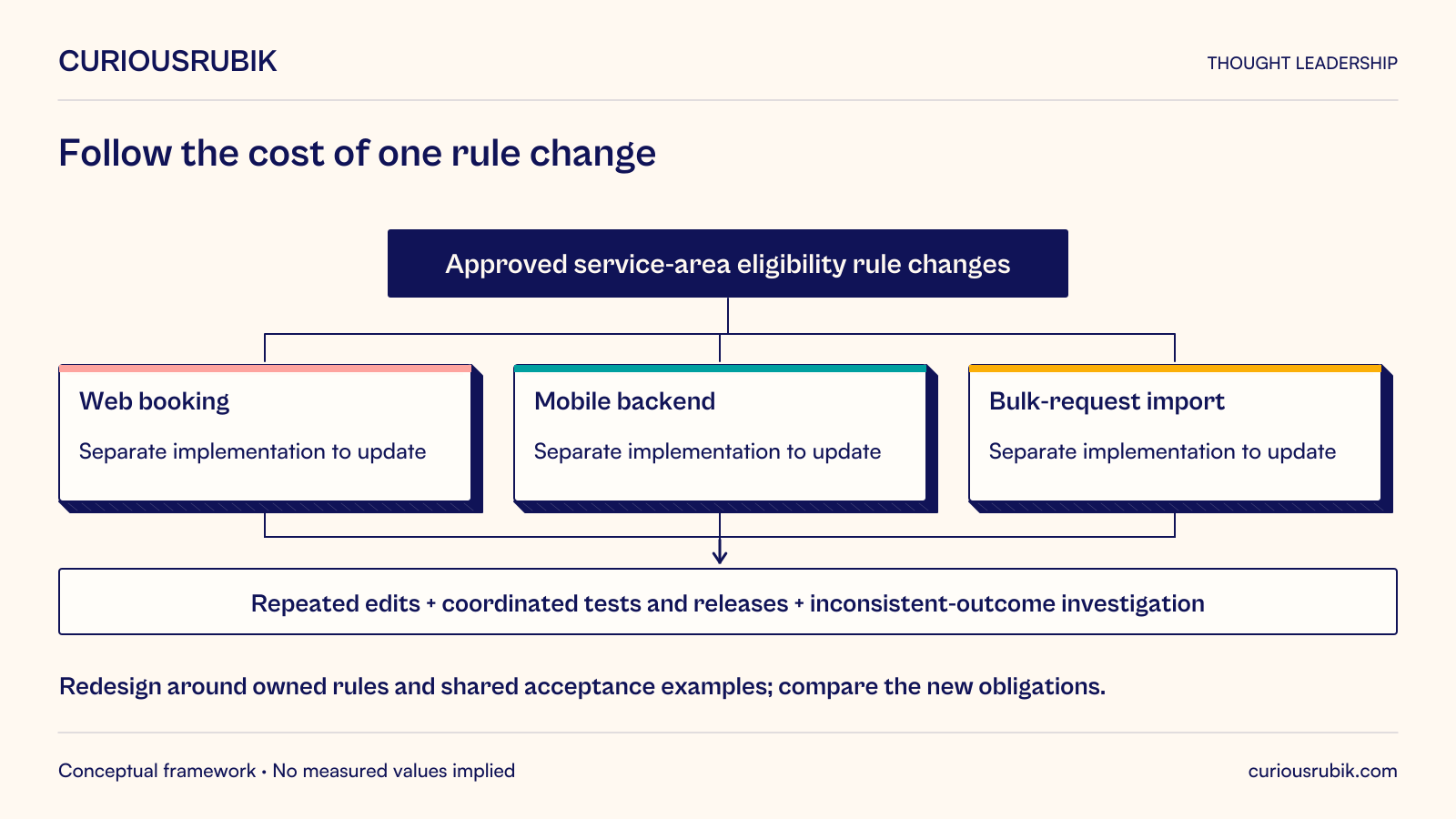
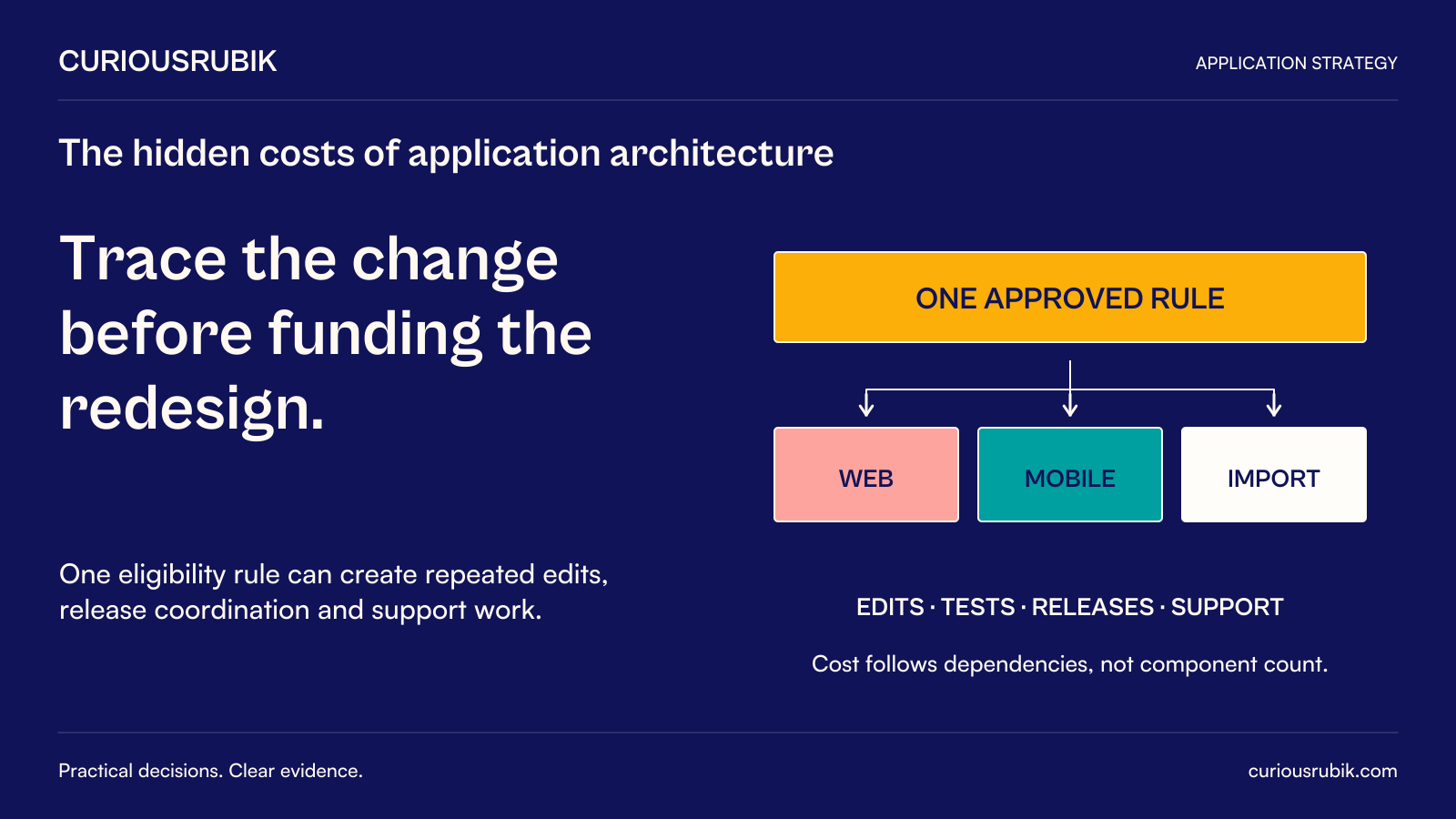
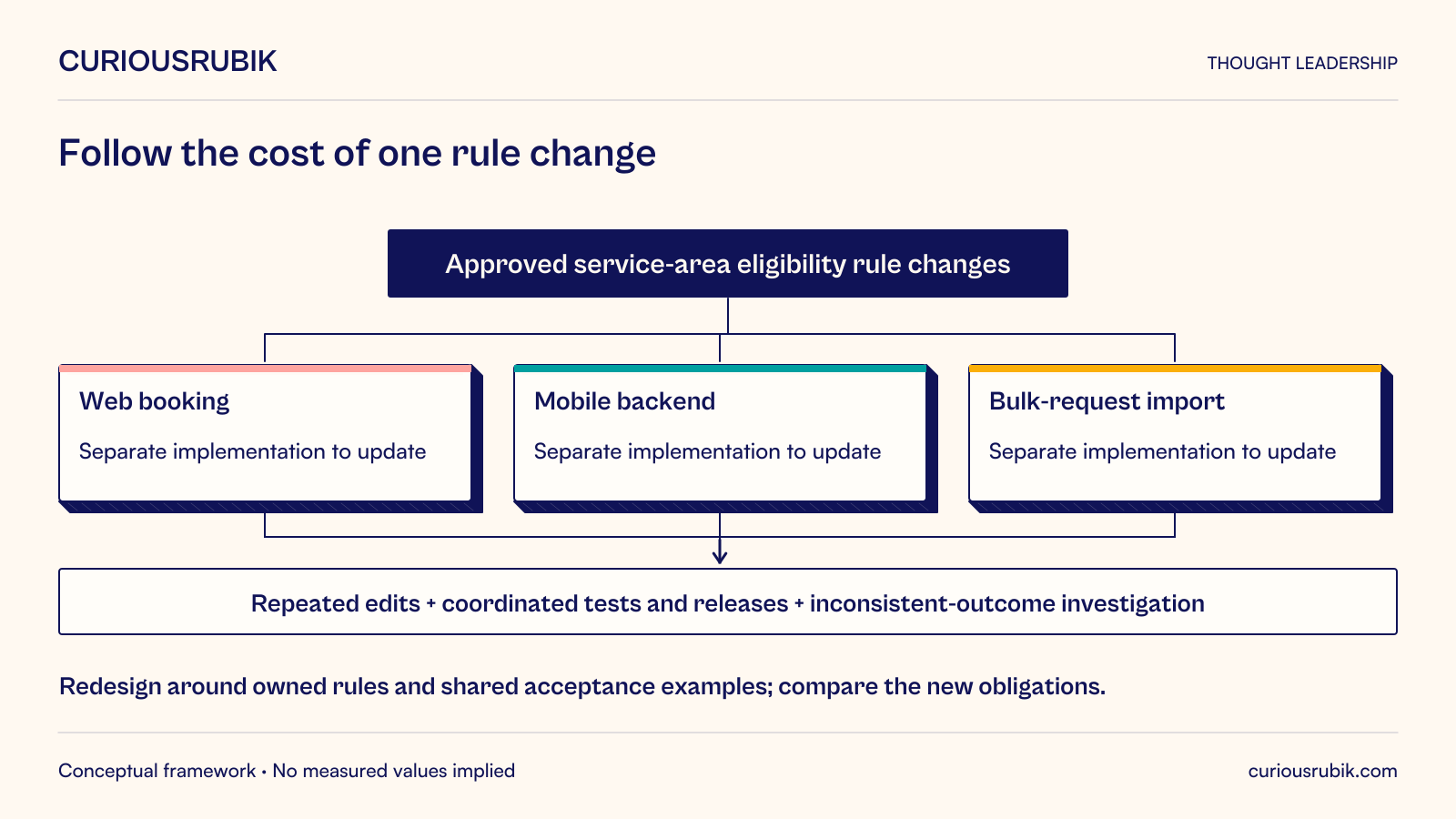
Use the trace to define the problem precisely. “The monolith is too large” is less actionable than “a change to service-area eligibility requires separate edits in the web application, import process and mobile backend, and the implementations disagree.” The latter suggests a boundary and a testable improvement.
Do not measure architecture only by component count. Many small services can still require coordinated changes, while a well-structured application deployed as one unit can preserve clear internal responsibilities. The relevant cost is the dependency behavior, not the label.
A duplicated rule creates three kinds of cost
Consider a hypothetical service company with a web booking application, a mobile application and a bulk-request import process. The example is illustrative. All three need to determine whether a request belongs to a supported service area, using the same approved business rule.
Over time, each channel has acquired its own implementation. When the business changes the rule, the team must update three places and confirm that their behavior remains aligned. One implementation interprets a boundary case differently, creating support inquiries about why a request is accepted in one channel and rejected in another.
The cost includes repeated engineering work, coordinated testing and the operational effort to investigate inconsistent outcomes. The business also faces uncertainty when planning another channel because it does not know which implementation represents the intended rule.
A possible improvement is to establish a clearly owned domain rule and a common set of acceptance examples. The technical implementation could be a shared module within an application, a versioned library or a service, depending on deployment and runtime needs. The architecture decision should compare those options rather than automatically introducing another network dependency.
A shared service can centralize runtime behavior but becomes a dependency that must be available and operated. A library can reduce duplicated logic while still requiring consumers to adopt compatible versions. An internal module can be simpler when the relevant capabilities share a deployment boundary. Each option changes the obligation rather than eliminating all cost.
The team should prove the preferred approach on representative cases, including failures and version changes, then measure whether future changes require less unnecessary coordination. The example does not claim that centralization is always superior; it shows how a specific source of cost can guide the design.
Examine runtime coupling as well as change coupling
A design may be easy to change independently but fragile during operation. A request can depend on several services being available at the same time, or one slow dependency can hold resources needed by other work.
Map the critical runtime path and the consequences of delay or failure. Decide which work can wait, which can proceed with a clearly defined limitation and which must stop. Those decisions belong to the business and technical owners together.
Avoid resilience theater. Adding retries without understanding the operation can create duplicate effects or amplify load. Adding a cache can improve response time while introducing freshness and invalidation responsibilities. Adding a queue can absorb bursts while creating a backlog that needs monitoring and recovery.
The cost question is whether the additional mechanism addresses a demonstrated requirement at an acceptable operating burden. More infrastructure is not automatically better architecture, and a simpler design is not automatically adequate for a consequential workload.
Make operating knowledge part of the assessment
An application can be structurally understandable to its original developers and opaque to everyone else. That creates a continuity risk when support, ownership or personnel change.
Test whether another qualified person can identify the authoritative data, interpret an error, locate the relevant rule and follow the recovery procedure. Observe the work rather than relying only on the existence of documentation.
Improve the highest-consequence gaps. A concise dependency map, a decision record or a reproducible diagnostic can be more useful than a large document that is difficult to keep current. The artifact should answer an operating question.
Do not confuse knowledge transfer with unrestricted access. Support staff need the information and privileges appropriate to their responsibilities, with escalation for actions outside their authority. An architecture that can only be operated through broad emergency privileges has a control problem as well as a support cost.
Build a bounded economic case for improvement
Choose a specific change pattern or incident class and estimate the cost it creates under stated conditions. Use observed effort where available, with enough context to understand variation. Separate internal capacity, external expenditure and business delay.
Estimate the redesign work, migration or transition effort, testing and ongoing obligations of the proposed alternative. Include the period in which old and new approaches coexist. A refactoring proposal that prices only the new code is incomplete.
Test assumptions that could reverse the decision. If the affected rule rarely changes, a large restructuring may not earn its cost. If the business is expanding into new channels, the same dependency may become more consequential. If the application will soon be retired, a containment measure may be more sensible than a broad redesign.
Do not assign a precise monetary value to every hypothetical incident merely to make the case look compelling. Where uncertainty is material, explain the scenario, consequence and evidence needed to narrow it.
Improve the architecture without turning improvement into a rewrite program
A targeted change can establish a better boundary while preserving useful parts of the application. Start with the dependency causing the observed cost, create tests around the current behavior and introduce the alternative in a controlled way.
Define success before the work begins. Will a future rule change affect fewer unrelated components? Can a failure be diagnosed more quickly? Can a capability be released independently without weakening controls? Measure the intended improvement and watch for new operating costs.
Keep a route to stop or revise the intervention if the evidence does not support expansion. Architectural work should produce a clearer and more economical operating model, not simply a larger collection of technologies.
The hidden cost of architecture becomes manageable when it is connected to specific work and decisions. Trace one recurring change or incident, identify the dependency that creates unnecessary burden and compare a bounded remedy with retaining the current design. That gives the business a defensible reason to invest in architecture beyond aesthetic preference or technical fashion.