The most misleading cloud estimate is often not the one with an incorrect unit price. It is the one that omits a category of usage or assumes that resources disappear when the business no longer needs them.
A design can create extra copies, repeated transfers, verbose logs, idle environments and recovery capacity that do not appear in the headline application estimate. The invoice may report those charges accurately while the organization struggles to explain which business activity created them.
For a technology and finance team, the practical objective is to connect architecture, consumption and ownership before committing to the design. Hidden cost becomes manageable when the team can identify the quantity being consumed, the rule that determines its price and the person able to change it.
Start with the resource path, not the headline server
Trace a representative business operation through the infrastructure it uses. Include processing, storage, databases, messaging, network movement, monitoring and external services. A user request can trigger work in several places even when it appears as one transaction in the application.
Record where information is copied, transformed or retained. Identify temporary outputs, failed jobs, retries and test environments. These can remain active outside the normal completion path.
Map each resource to a service owner and business purpose. An unallocated charge is not necessarily waste, but it is difficult to govern because nobody can explain the tradeoff behind it.
The first result should be a consumption map, not a savings target. Reducing a resource without understanding its role can damage reliability, investigation capability or recovery.
Metering does not create accountability by itself
NIST’s cloud definition includes measured service, in which resource usage can be monitored, controlled and reported. That visibility is a capability of the model; the organization still needs to interpret usage and connect it to its decisions. NIST, The Definition of Cloud Computing.
A detailed bill can show what was charged without showing why the resource exists or whether the business still needs it. Resource names, ownership metadata and deployment records help bridge that gap.
Decide how shared costs will be represented. A platform service may support several applications, and forcing all of its expense onto one visible team can distort the comparison. The allocation method should be understandable and consistent enough for the decisions it supports.
Keep total cost and unit cost together. Growth can increase total expenditure while reducing cost per completed business unit. A low total bill can also conceal poor service if work is failing or users are abandoning the application.
Data movement can be larger than the incoming dataset
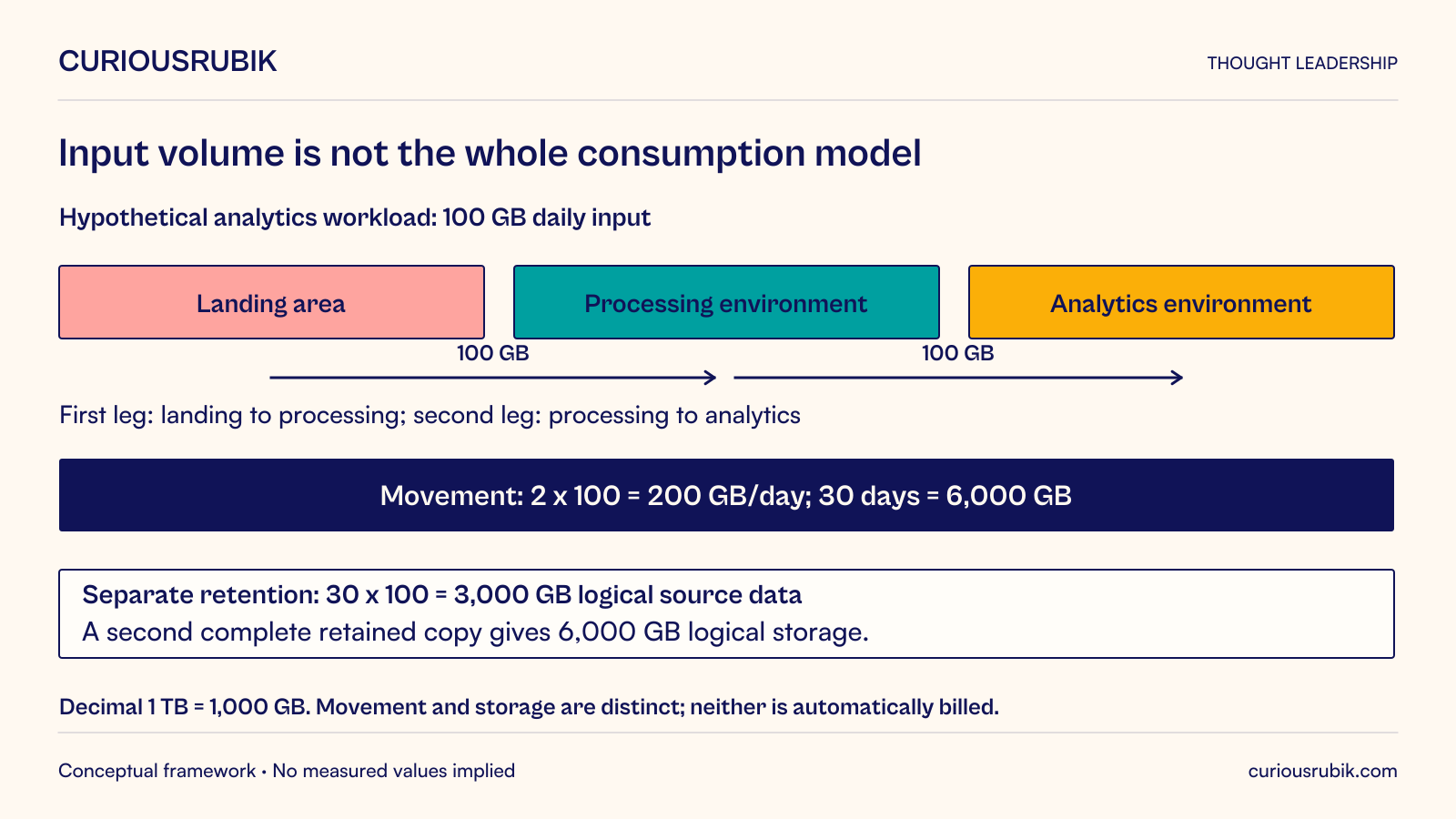
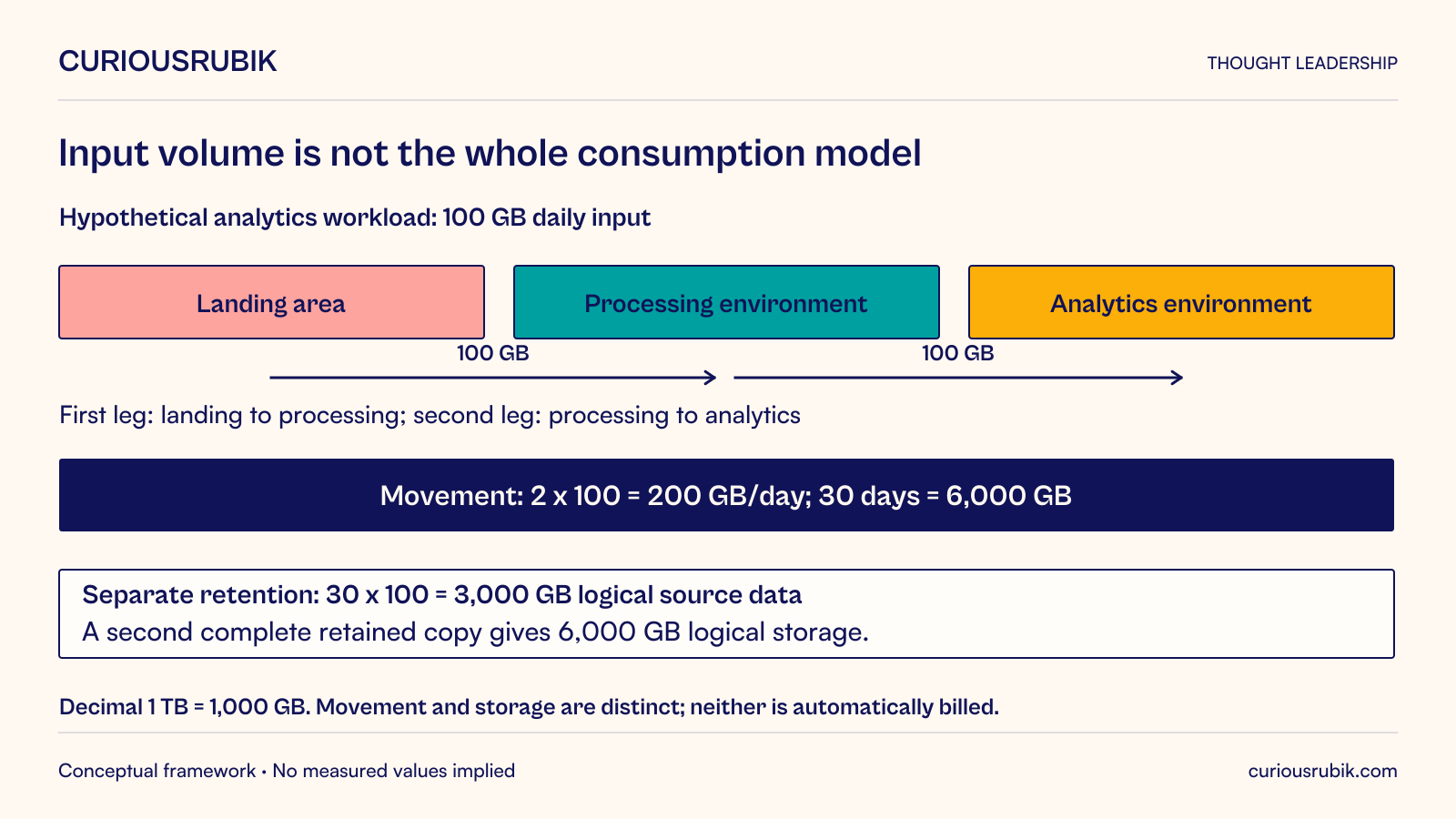
Consider a hypothetical analytics workflow that receives 100 GB of new data per day. It moves the data from a landing area to a processing environment and then moves an equally sized result to an analytics environment.
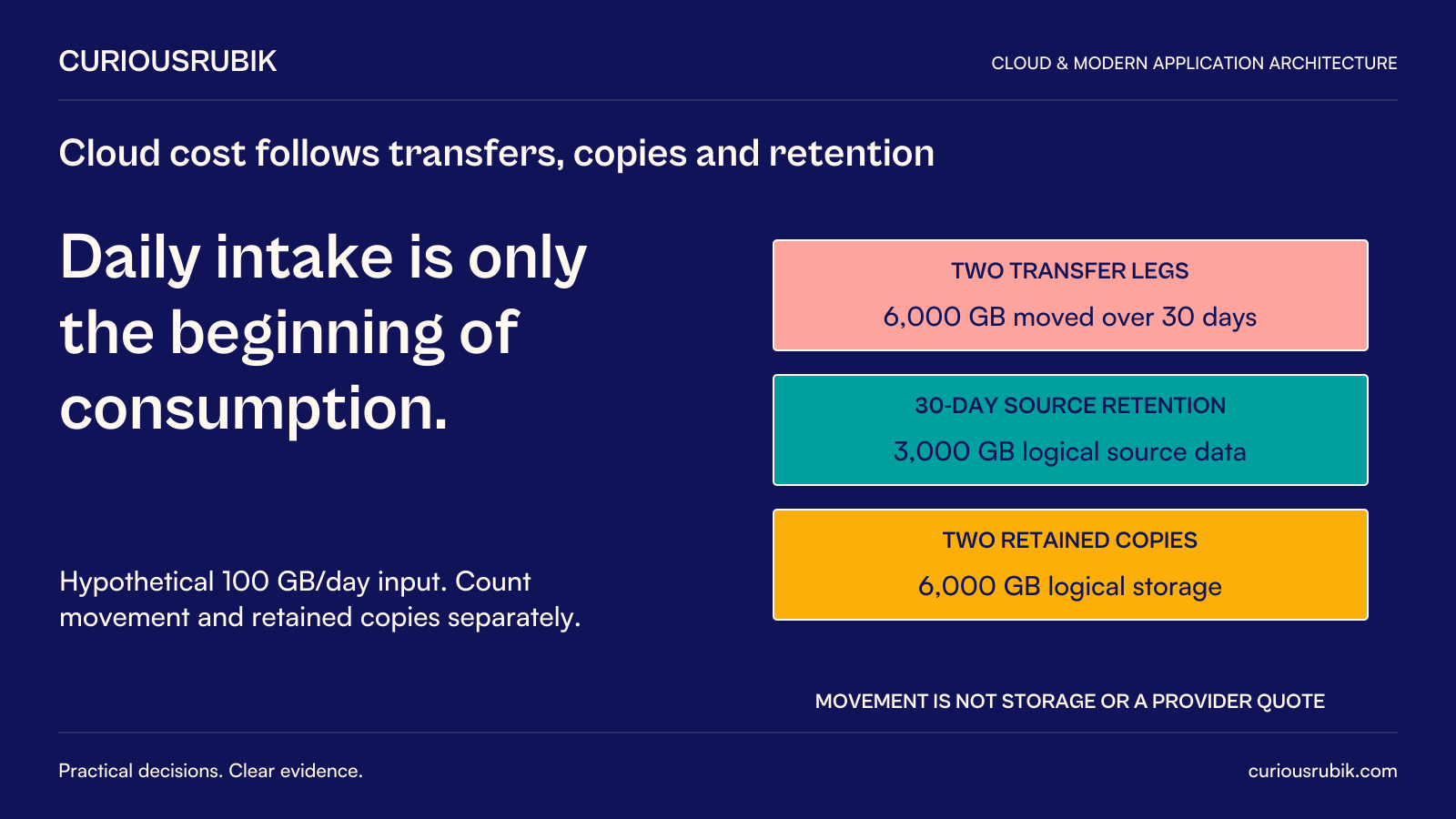
Under the simplifying assumption that each leg carries 100 GB, the workflow moves 200 GB per day across those two legs, or 6,000 GB over a 30-day period. That is movement volume, not a statement that every gigabyte is billable. Actual charges depend on the provider, direction, location, service and commercial terms.
If the design retains 30 days of incoming data, it holds 3,000 GB of logical source data at steady state under the same assumptions. A second complete retained copy raises the logical total to 6,000 GB before compression, metadata, redundancy, deduplication or other implementation effects. Those effects can change the billed storage quantity.
The example shows why estimating from only the 100 GB daily intake is incomplete. The team needs to trace transfers, copies and retention separately, then apply the relevant verified pricing rules.
A redesign might reduce transfers or copies, but only after confirming why they exist. A retained copy may support recovery or a necessary consumer, and removing it can shift cost or risk elsewhere.
Examine the lifecycle of temporary resources
Development, test and analysis environments are easy to create and easy to forget. A resource intended for a short experiment can become a continuing expense when there is no owner, expiry condition or supported shutdown process.
Define the expected lifetime when provisioning temporary resources. Record who can extend it and what must be preserved before removal. Automated cleanup needs safeguards against deleting work or information still required by the business.
Review resources after projects finish, tests fail or staff responsibilities change. A deployment pipeline may create infrastructure successfully while its cleanup step never runs. A cancelled project can leave its environments untouched.
Look at utilization in context. Low average use may indicate waste, but it may also reflect required standby capacity or a short critical peak. The decision should follow the resource’s service obligation, not a single utilization threshold.
Include observability and investigation needs
Logs, traces and metrics can create substantial data volumes, particularly when every request produces detailed records or when labels generate many distinct time series. Their cost depends on collection, processing, retention and retrieval arrangements.
Determine which evidence is needed for operations, security and business support. More data is not automatically more useful if the team cannot search it or connect it to a transaction.
Review duplication across tools and environments. The same event may be collected several times for legitimate reasons, but the organization should understand those reasons and their costs.
Retention should follow approved requirements and investigative needs. Do not reduce it solely to lower the bill without considering the consequences. Conversely, indefinite retention should not be the default when nobody has established a need.
Test whether the chosen level of detail is sufficient to diagnose representative failures. Cost control is more credible when it preserves the evidence the operating team actually requires.
Price resilience and recovery explicitly
Redundant capacity, replicated data, backup storage and recovery testing are part of the service’s cost. They should not arrive as surprises after the architecture is described as complete.
Define the recovery conditions the business requires and identify which resources support them. A second location can introduce additional storage, transfer, configuration and operating work. It may be justified, but its value should be tied to a tested failure scenario.
Distinguish backup creation from recoverability. Retaining many copies does not prove that the application can be restored within the required conditions. Include rehearsal effort and the temporary resources used during recovery tests.
Do not optimize away spare capacity without revisiting the service promise. A lower bill achieved by removing the ability to operate during a failure is a changed risk decision, not a free efficiency gain.
Watch the cost of failed and repeated work
A workload estimate based only on successful transactions can omit retries, abandoned jobs and reprocessing after errors. Those activities consume resources even when they produce no usable business output.
Track attempts and completed outcomes separately. A rise in cost per completed job may reflect a failure problem rather than a more expensive provider. The remedy could be improved validation, a corrected dependency or safer retry behavior.
Bound automated retries and understand whether an operation may already have taken effect. Repeating uncertain work can create both additional consumption and inconsistent business results.
Include human correction and support effort in the broader operating analysis. A technically inexpensive service can be costly if specialists must repeatedly investigate incomplete work or reconcile outputs.
The objective is not to suppress necessary recovery. It is to make avoidable repeated work visible and address its cause.
Compare commercial commitments with usage uncertainty
Pricing arrangements can reward predictable consumption, but a commitment also changes the organization’s options. Evaluate the workload evidence, term, scope and consequences of changing or ending the service before treating a discount as a saving.
Compare like-for-like service conditions. A lower quoted rate may exclude support, recovery, data movement or capabilities included in another option. The relevant decision is the total incremental cost of meeting the requirement.
Use verified current prices and contract terms for an actual estimate. Cloud pricing can vary by service, configuration, location, currency and agreement. This article provides no provider-specific price recommendation.
Separate utilization optimization from contractual optimization. Buying a discounted commitment for resources that should have been retired can lock in an unnecessary obligation. Improve the demand model before assuming that a lower rate is the main opportunity.
Build an estimate that can be updated
Record the workload assumptions, resource quantities, pricing basis and exclusions. Show which inputs come from measured usage and which remain forecasts. Include plausible peak, growth and recovery scenarios.
GAO’s 2020 cost-estimating guidance emphasizes scope, assumptions, sensitivity analysis and updating estimates with actual costs. Applied here, those disciplines make it possible to explain why a cloud estimate changed rather than simply replace the old number. GAO, Cost Estimating and Assessment Guide.
Prioritize the assumptions that materially affect the decision. If transfer direction or retention dominates cost, verify those details before spending time refining a minor compute estimate.
After launch, reconcile actual consumption with the model. Determine whether differences come from demand, architecture, pricing or incomplete resource cleanup. Assign corrective actions to owners who can influence the cause.
Turn visibility into proportionate decisions
A useful cost review identifies a specific resource, its purpose, the available alternatives and the effect of changing it. It should include the effort required to implement the change and any impact on service quality.
Do not pursue a lower invoice as the only objective. Some spending supports valuable growth or required resilience. Other spending persists because a temporary decision was never revisited. The team needs to distinguish those cases.
The hidden costs of cloud infrastructure are often hidden only from the business model, not from the meter. Connecting consumption to service outcomes, lifecycle rules and accountable owners gives the organization a more reliable way to control expenditure without weakening the work the infrastructure is meant to support.