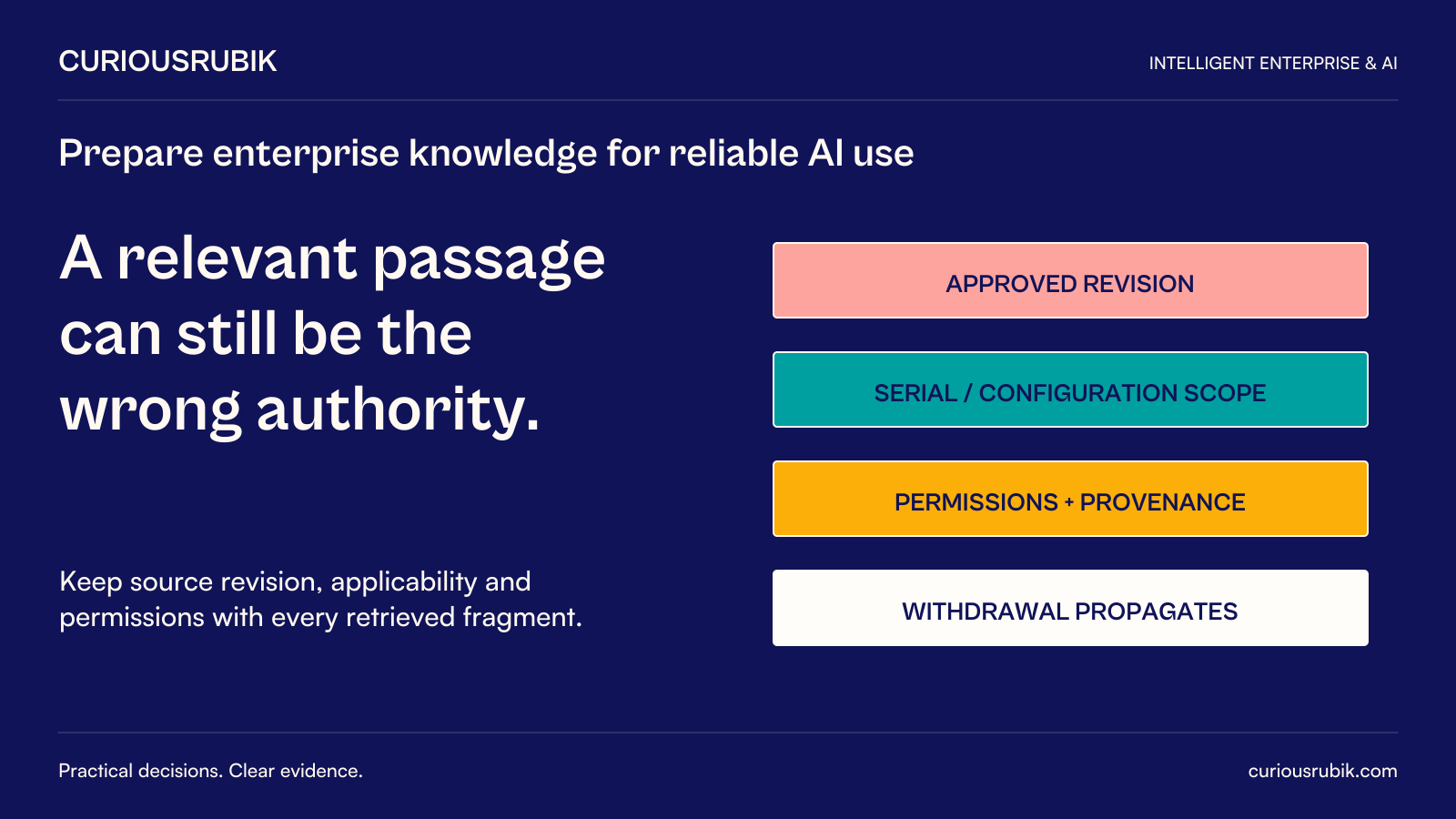
Enterprise data should be prepared for the decision an AI application must support. For a document-grounded assistant, that means supplying the right source version, relevant context, and permitted information at the moment of use. Converting a folder of documents into a searchable index is only one technical step; it does not establish that the resulting answers are current, authorized, or supported.
For a knowledge-platform leader building an assistant over industrial equipment manuals, the immediate decision is how to govern the corpus from authoritative source through retrieval and answer. The critical preparation work includes document identity, applicability, chunk boundaries, permissions, and change propagation. This is a different problem from assembling training labels for a predictive model.
The practical goal is a maintainable retrieval corpus with an explicit source contract. The hypothetical manual example below concerns identifying and citing applicable documentation, not prescribing maintenance procedures. Technical work must still follow the organization’s approved instructions and qualified oversight.
Begin with the questions the assistant may answer
Define the intended information task. Finding the applicable manual, locating a supported specification, and recommending a maintenance action carry different requirements and consequences. A project should not expand from document search into operational advice merely because the same model can produce both kinds of text.
Write representative questions and the evidence needed to answer them. A question about a particular asset may require model, revision, serial range, installed option, and effective date. If that context is unavailable, the correct response may be a request for clarification rather than a best guess.
Specify what counts as support. A relevant passage must actually establish the answer under the applicable conditions. A citation to a document that mentions the equipment is not enough if the passage concerns a different configuration or an obsolete revision.
Retrieval-augmented generation research combines generation with retrieved information on defined language tasks. It motivates a useful architecture, but does not guarantee enterprise answer correctness or access control. Those properties require additional design and testing. Lewis et al., Retrieval-Augmented Generation, 2021 version
Establish authoritative document identity
Assign stable identities to documents and their versions. A filename such as manual-final-new.pdf is not a reliable authority rule. Record the issuing owner, approval status, version, effective dates, applicable products or assets, and the location of the authoritative original.
Distinguish an approved revision from a convenient copy. A downloaded document, annotated working file, and supplier-issued original may contain similar text while carrying different authority. Preserve that distinction in the corpus rather than deduplicating solely on apparent content similarity.
Define how supersession works. A newer document may replace an older one for all assets, only for a serial range, or only after a modification. Do not assume that the most recently uploaded file is universally applicable. The responsible engineering or product owner must supply the rule.
Keep unresolved authority out of confident answers. A document with unclear ownership or applicability can be held for review or made available only with appropriate limitations. The index should not make an unapproved source look authoritative simply because it retrieves well.
A hypothetical manual corpus
Imagine a hypothetical manufacturer supporting two versions of a packaging machine. Manual M7 revision B applies to one defined serial range. Revision C applies to a later configuration with a different optional module. These identifiers and applicability rules are invented for the example.
An employee asks which manual governs asset A. The asset record identifies the earlier serial range, but the repository’s newest upload is revision C. A retrieval system that favors recent text without checking applicability may return the wrong reference even though it finds the product name correctly.
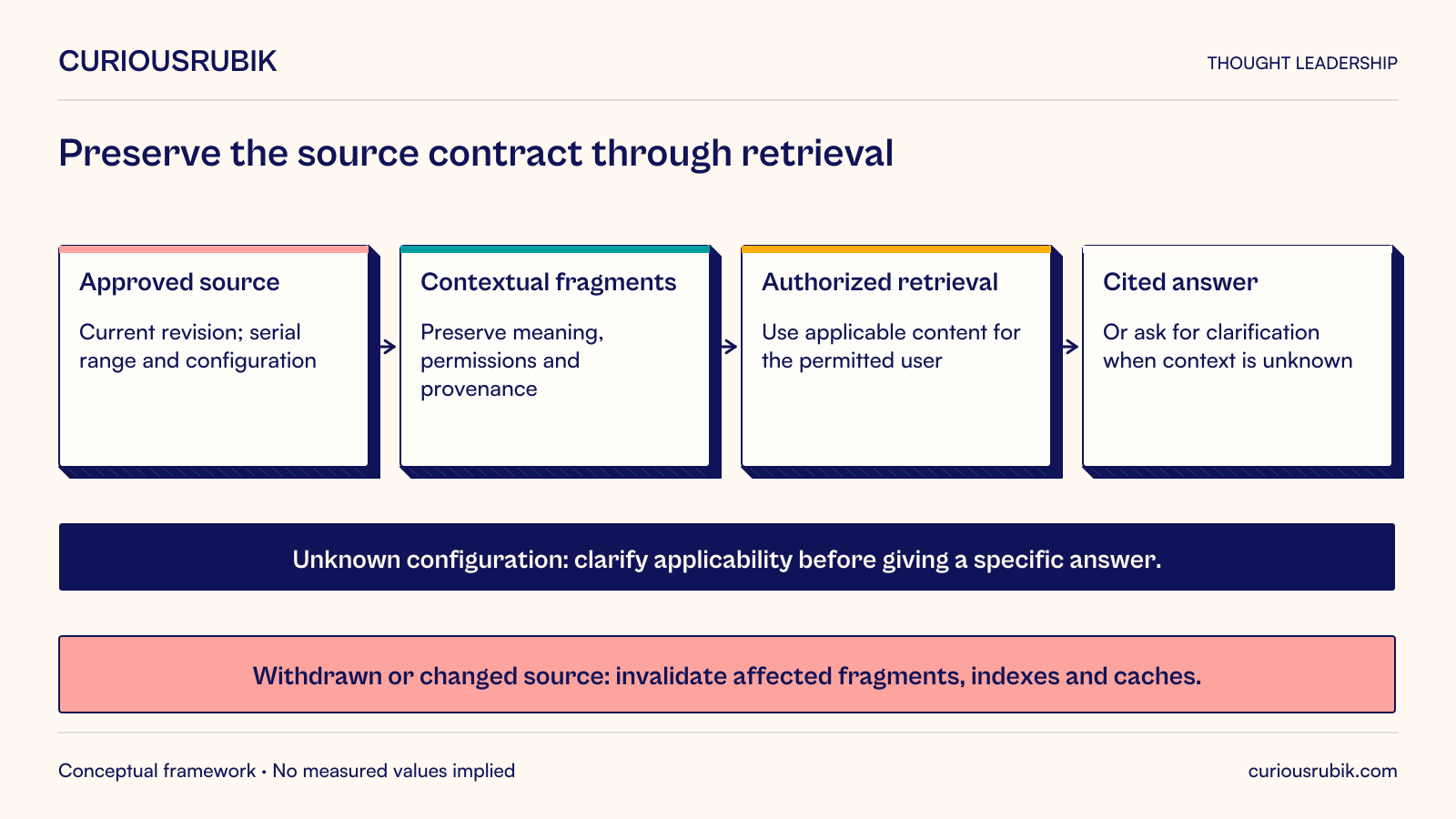
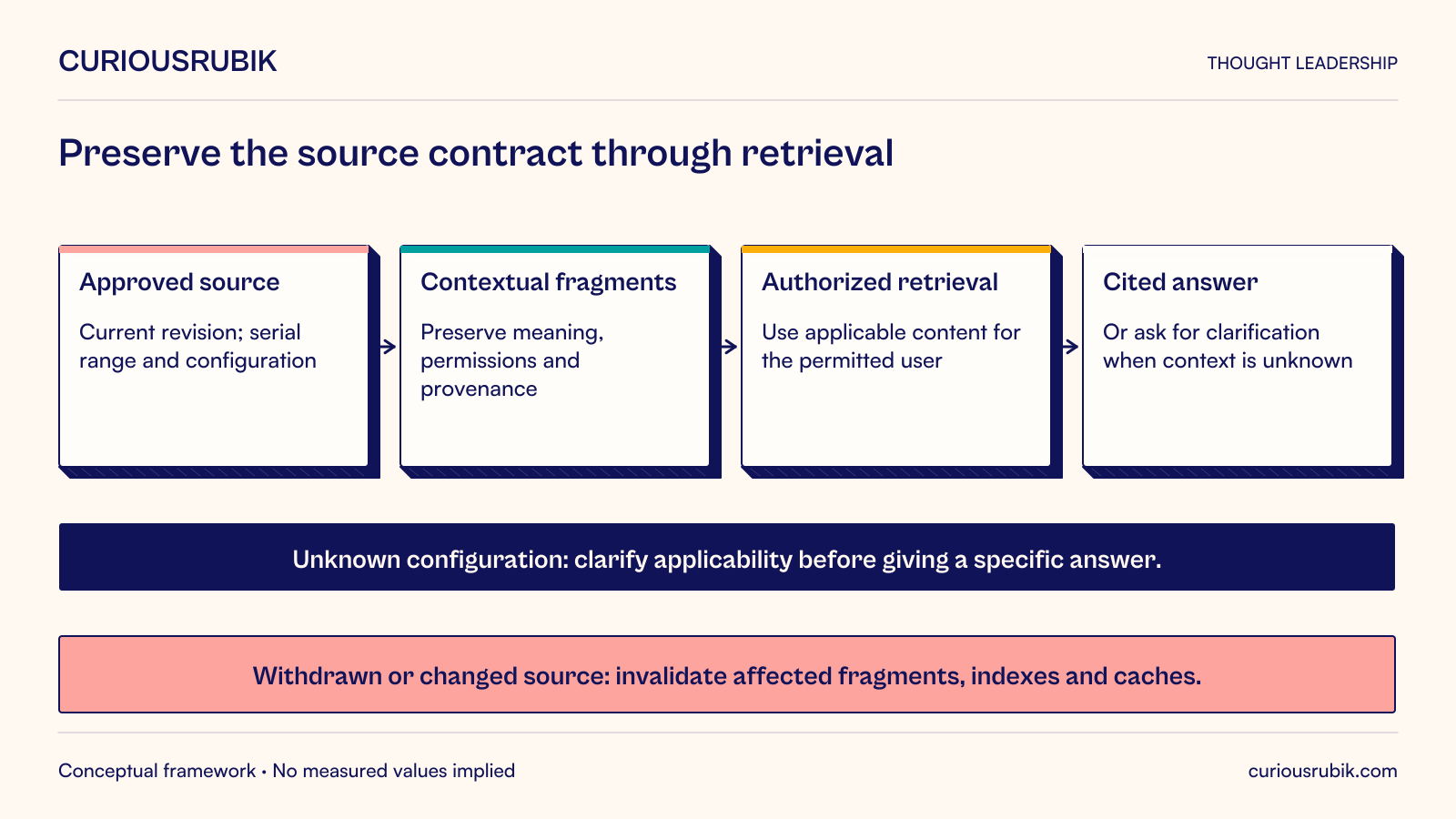
The prepared corpus links both revisions to their approved scope. Retrieval uses the asset context and the employee’s permissions to select candidate sources. If the installed option is unknown and changes applicability, the assistant asks for that fact or refers the question to the responsible owner.
A second problem arises during extraction. A table of specifications spans two pages, with a qualifying heading on the first page and values on the second. If indexing separates the values from the qualification, a retrieved fragment can support an incorrect interpretation. The preparation process needs to retain the table’s meaningful context and source location.
Now revision B is withdrawn for a defined subset of assets after an approved documentation change. The source owner updates the authority record. The ingestion process must propagate that change to affected fragments, retrieval indexes, caches, and any derived answer artifacts governed by the retention policy. Merely replacing the PDF in a folder leaves stale copies elsewhere.
The desired outcome is an answer tied to an applicable, authorized source, or an explicit statement that the necessary applicability cannot be established. The example does not imply that retrieval can infer engineering rules that the organization has never recorded.
Preserve meaning when extracting and dividing content
Inspect extraction quality before indexing. Scanned pages, multi-column layouts, footnotes, diagrams, tables, and symbols can lose meaning during conversion. A model cannot reliably recover an omitted qualifier from a fragment that no longer contains it.
Choose chunk boundaries around useful semantic units where feasible. A chunk is a retrievable portion of the source. It may need a heading, a table label, a definition, or a nearby limitation to remain interpretable. There is no universal chunk size that fits every document type and question.
Attach inherited metadata to each fragment: document identity, version, applicable scope, source location, approval state, and access classification. Preserve a route back to the original so a user can inspect the cited passage in context.
Test extraction with known difficult examples. Ask whether a retrieved fragment retains units, exclusions, conditional language, and table associations. A high count of indexed pages is not a quality measure if the resulting evidence changes meaning.
Carry permissions through the entire retrieval path
Determine which users may access each source and how that authority changes. Apply the appropriate filtering and enforcement before unauthorized content can reach the answer-generation context. Hiding a citation afterward is not sufficient if protected content has already influenced or appeared in the answer.
Account for permissions inherited from folders, groups, document classifications, or the underlying business object. The index needs a reliable way to resolve those rules and respond to changes. A one-time copy of access lists can become stale as people move roles.
Review caches and derived artifacts. An answer generated for an authorized user should not become a shared shortcut that exposes the same source to someone else. Cache keys, invalidation, and access checks need to reflect the actual authorization design.
Minimize sensitive content in diagnostics and evaluation. Engineers need enough information to diagnose retrieval errors, but broad prompt logging can create an additional repository of restricted material. Establish access and retention for those records as part of the corpus design.
Make provenance useful for correction
Record where each fragment came from and which processing steps created it. If an extraction bug affects a table format, the team should be able to identify the impacted fragments and rebuild them without guessing which answers might rely on the source.
W3C’s PROV-O provides concepts for representing and exchanging provenance, including entities, activities, and derivation. It offers a vocabulary for lineage; it does not establish that a source is true or suitable for a particular answer. W3C PROV-O, 2013 Recommendation
Choose a level of lineage that supports real operating questions. The organization should be able to identify the source version, extraction configuration, index release, and relevant answer configuration. It need not retain unnecessary sensitive content merely to make the lineage record appear comprehensive.
Assign ownership for correction. A bad source needs its issuing owner; a failed extraction needs the ingestion team; an access leak needs the appropriate security response. Clear lineage helps route the problem to the right owner instead of asking the model team to solve every defect.
Test retrieval separately from answer generation
Create a question set with independently established applicable sources. Include similar product names, old revisions, unknown configurations, restricted documents, withdrawn material, and questions with no supported answer. The test should reveal whether the right evidence enters the context at all.
Then evaluate how the answer uses that evidence. Does it preserve qualifications? Does it cite the correct version? Does it ask for missing context? Can a user follow the reference and find support for the material statement? A correct retrieval result can still be misrepresented during generation.
Test negative access and change cases, not just successful questions. Remove a user’s permission, withdraw a document, and change an applicability rule. Verify that the resulting behavior matches the intended policy across indexes and caches, within the defined propagation window.
Treat the corpus as an operated product
Give source owners a practical publication and retirement process. Define how changes enter the index, how failures are reported, and what happens while the corpus is incomplete. Users should be able to see when the system lacks a current supported source.
Monitor unanswered questions and wrong-source incidents to identify useful improvements. Do not automatically add every employee-uploaded document to solve a gap. New content still needs authority, permitted use, extraction quality, and ownership.
Start with one document family and a set of questions whose correct references are known. Prove that identity, meaning, applicability, permissions, and withdrawal survive the entire path. Expand the corpus when those controls work. Enterprise data is ready for this kind of AI application when the organization can explain why a particular source was available, applicable, and used for the answer, and can correct that path when it is wrong.