A cleaning-services company opens more customer sites and receives a predictable request for more administration staff. The request may be justified. It may also be compensating for incomplete activation forms, repeated clarification, and inconsistent instructions that grow with every new site. Freezing headcount would hide the problem; hiring without examining the work would preserve it.
Scaling administration economically means reducing avoidable work per accepted business outcome while maintaining necessary service and control. Absolute cost may still rise as the business expands, adds complexity, or reaches a capacity threshold. The useful ambition is to avoid making every increment of growth require the same increment of administrative effort.
The operating leader needs a workload model before choosing automation, centralization, or additional staff. This article develops one for a hypothetical commercial cleaning provider. It separates necessary processing from preventable repeat work and tests whether a proposed improvement really frees capacity rather than transferring the burden elsewhere.
Find what creates administrative demand
List the events that generate work: a new customer site, a contract change, a missing reference, a disputed instruction, a failed handoff, or a request for status. Revenue growth may increase some of these events, but their relationship to sales is not necessarily stable.
Distinguish primary work from corrective work. Establishing an authorized site record is necessary. Asking several times for the same missing start-date information may be preventable. Both consume time, but they suggest different remedies.
Measure complete cases rather than isolated clicks. Include preparation, clarification, correction, approval where required, and the receiving team’s effort. A process can appear efficient at the intake desk while creating substantial cleanup in scheduling or billing.
Use representative cases to identify the drivers. Record what was missing, who could supply it, and why it was not available initially. “Incomplete form” is only the visible symptom if the salesperson has no way to obtain the information before the contract is agreed.
A hypothetical site-activation workload
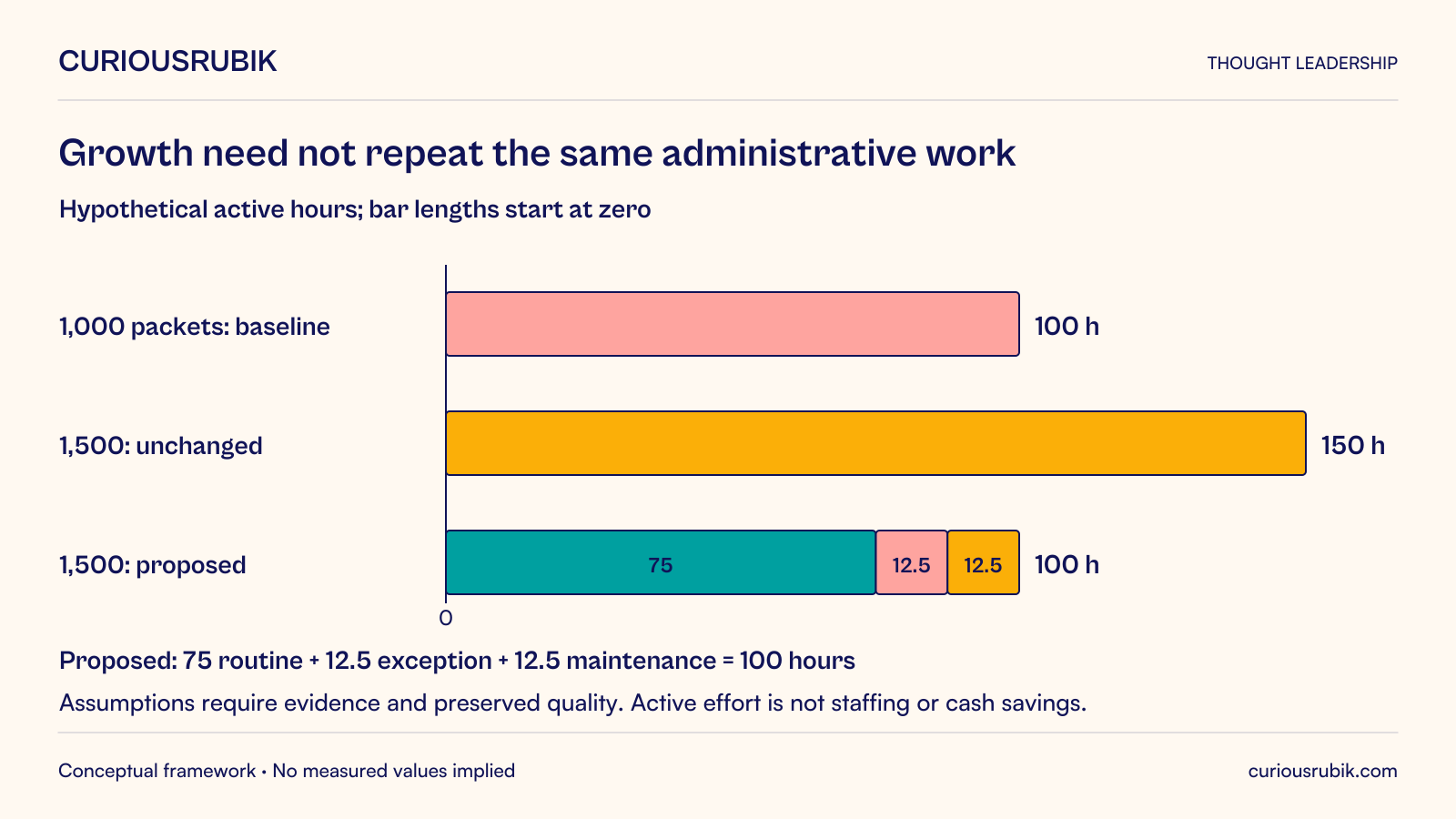
Suppose the cleaning provider activates 1,000 customer sites or defined service changes in a month. In this invented planning example, each accepted packet requires four minutes of routine administrative work. Twenty percent also require ten additional minutes of clarification and correction.
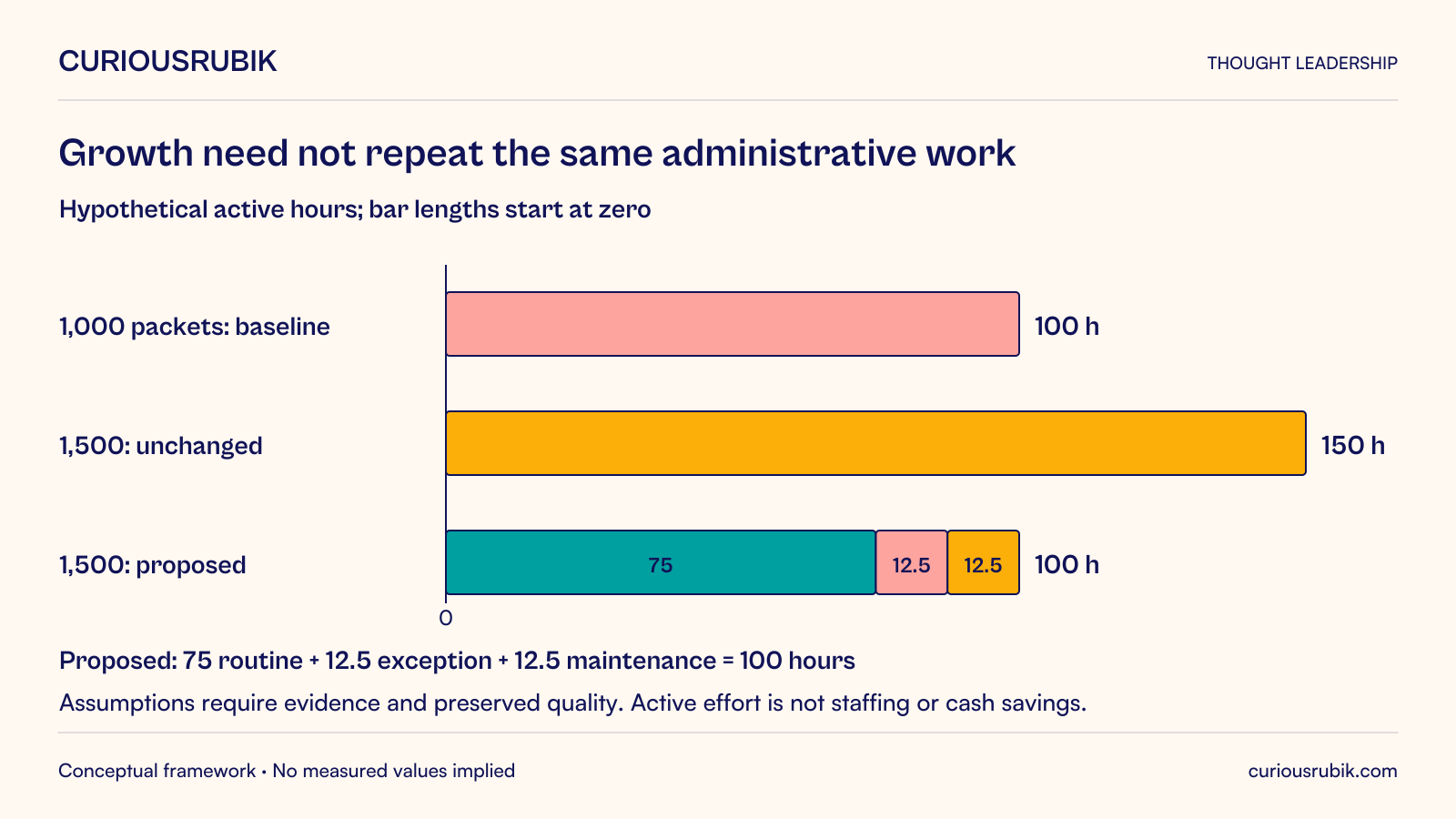
Routine work is 4,000 minutes. The 200 exception packets add 2,000 minutes. Total modeled effort is 6,000 minutes, or 100 hours. These figures describe active administrative effort, not elapsed activation time or a staffing recommendation.
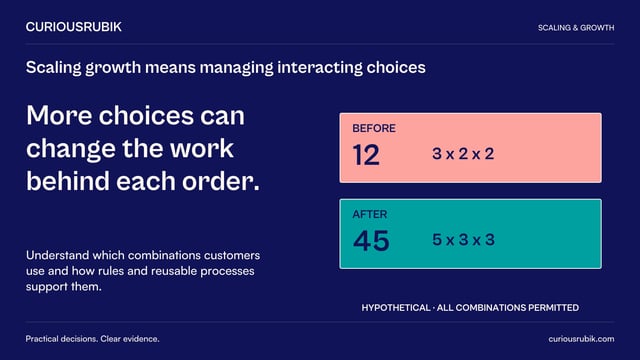
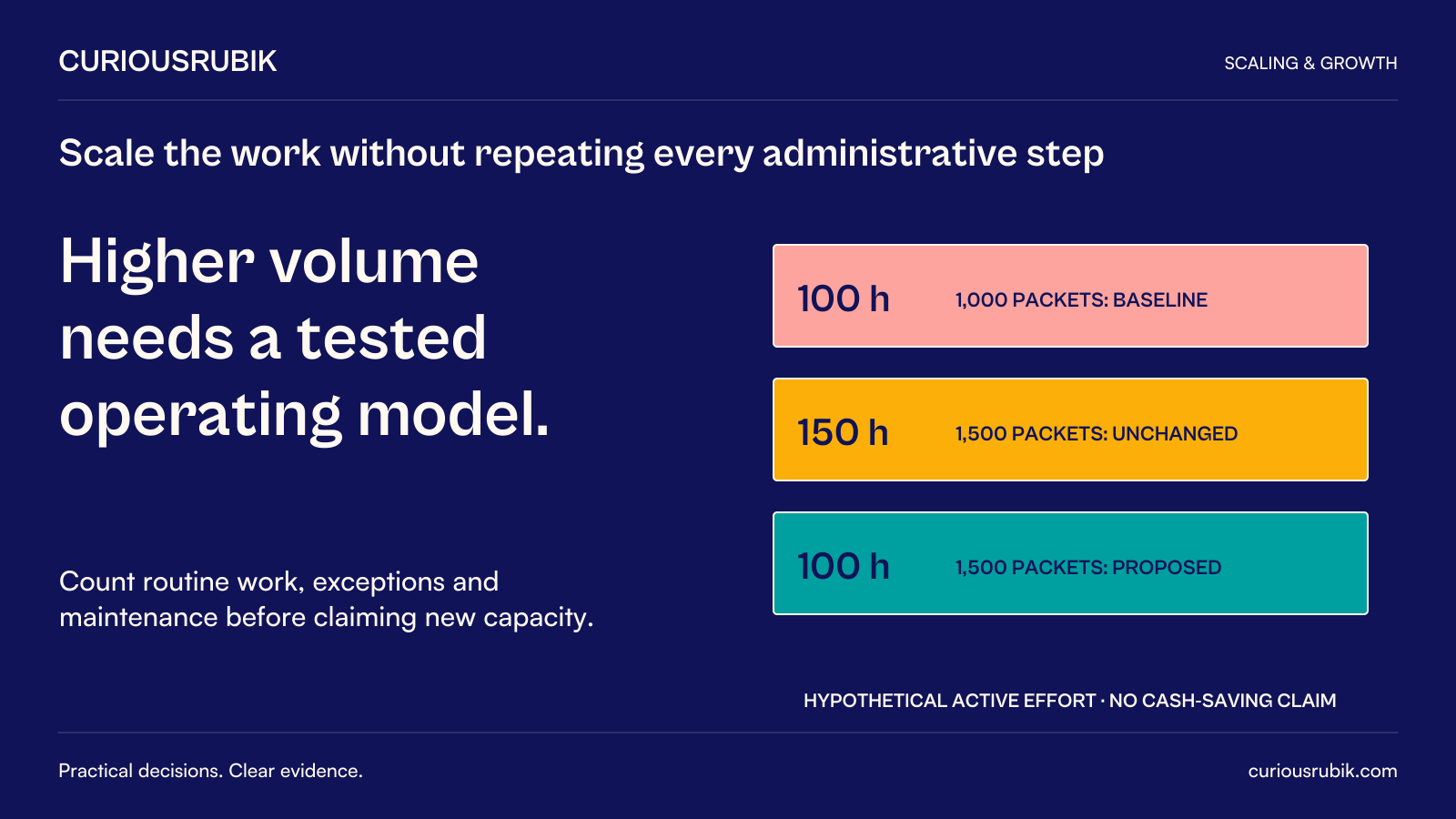
If volume rises to 1,500 packets and the process stays unchanged, modeled effort rises to 150 hours. The company proposes a clearer intake contract and reusable data that reduce routine work to three minutes and the exception share to five percent, while keeping ten minutes per exception for this illustration.
Under those assumptions, routine work becomes 4,500 minutes, or 75 hours. Seventy-five exceptions add 750 minutes, or 12.5 hours. The transaction workload is 87.5 hours. Adding an assumed 12.5 hours for maintaining intake rules and operating checks brings the modeled total to 100 hours at the higher volume.
The example shows a possible mechanism for handling more work without increasing total effort. It does not prove that the assumptions are achievable. If exception frequency or maintenance effort remains higher, the result changes. The pilot must measure both, along with quality and burden on other roles.
The proposed intake contract includes the authorized service scope, site identity, start conditions, appropriate business contact, and billing reference needed by the receiving teams. The company decides who supplies and verifies each fact. A required field alone does not make the information available or accurate.
Prevent repeat work before accelerating it
Improve the point where the information originates. If the customer and account team agree a service change, capture the approved meaning there rather than ask an administrator to reconstruct it from several messages later.
Reuse verified information with clear ownership. A site address or billing reference may already exist, but the process should establish whether it remains applicable. Copying old information automatically can reduce entry while creating errors that are more expensive to correct.
Make exceptions specific. Missing commercial authorization differs from an incorrect site identifier or an unavailable contact. Route each to the person able to resolve it, with enough context to avoid another round of explanation.
GAO’s process-reengineering guidance connects customer needs, performance problems, and process redesign before implementation. Applied here, the lesson is to examine why work exists before investing in a faster administrative sequence. GAO, Business Process Reengineering Assessment Guide, 1997
A process review should also identify work that can stop. Some status reports or duplicate checks may no longer serve a necessary decision. Confirm their protective or contractual purpose before retiring them; low visibility does not mean low value.
Assign a named owner to the upstream repair. If the activation team can identify missing information but cannot change the sales handoff, the same exceptions will continue. Agree what the source team will supply, how it will know a submission was accepted, and what happens when the necessary fact genuinely cannot be established.
Do not count a rejected incomplete request as work eliminated. The customer or colleague still needs a resolution. Follow the case through its eventual accepted outcome and include any effort required outside the administrative queue. Otherwise, a strict intake gate can improve the reported workload simply by moving unfinished work beyond the measurement boundary.
Standardize the reusable core and bound legitimate variation
Define the common outcome and required information across ordinary cases. That can make training, automation, and support more repeatable. Keep the standard focused on what the receiving operation needs rather than every historical field requested by a department.
Allow justified variation through explicit rules. A site with a different service arrangement may require additional information or review. Treating it as a standard packet can produce hidden work; building a unique process for every customer can destroy reuse. Choose the boundary deliberately.
Separate rare specialist work from the routine path where appropriate. The specialist route needs an owner, capacity, and a clear commercial rationale. Its cost should remain visible in the growth plan rather than disappear into the average routine handling time.
Review exception trends. A growing share of supposedly unusual cases may indicate that the standard no longer fits the business. Expanding the offer without redesigning administration can quietly reverse earlier efficiency gains.
Use automation where the work is sufficiently defined
Stable validation, lookup, routing, and status updates can be useful automation candidates. Specify the correct outcome, permitted action, duplicate behavior, and recovery before removing manual work from the routine path.
Keep consequential decisions with their authorized owner unless the business has deliberately approved a controlled rule. An automated activation should not infer missing commercial terms or override a disputed instruction merely to maintain throughput.
Test the difficult cases and the receiving process. An intake tool that accepts a packet successfully has not proved that scheduling and billing can use it. Include amended scope, duplicate requests, missing authority, and interrupted submission in the pilot.
Budget for operation after launch. Someone must maintain validation rules, reference data, exceptions, and support. An automation business case that excludes those responsibilities can make a small transaction saving appear larger than the sustainable benefit.
Protect capacity without confusing effort and headcount
Active work hours are not the same as available staffing hours. Coverage, peaks, absence, skill differences, and non-transaction duties affect the capacity needed. A monthly average should not be used to staff a service that receives concentrated demand at contract-start dates.
Plan for step changes. Growth may eventually require another specialist, support shift, or system capability even after unit effort improves. That does not mean the improvement failed. The business should understand the threshold and prepare rather than rely on continuous overtime.
Separate freed capacity from cash savings. If the same team handles growth, the benefit may be avoided future hiring or more responsive service. A claim about reduced expenditure needs a realizable spending change and an accountable owner.
Do not achieve a favorable administration measure by moving uncounted work to customer-facing staff or customers. Measure their effort and the effect on accuracy. A better distribution of work can be worthwhile, but it should be a deliberate service design rather than an accounting illusion.
Keep service and control in the scaling test
Track accepted activation, correction, timeliness, and unresolved exceptions alongside effort. A lower cost per packet is not an improvement if sites begin under unclear instructions or if errors create later disputes.
Inspect work still open at the end of the period. Delaying difficult packets can make completed-case handling time look better while the backlog grows. Reconcile incoming work, accepted completions, cancellations, and unresolved cases under consistent definitions.
Compare similar workloads and document changes in mix. Larger customers or more complex service variations may require different effort. The model should reflect that reality instead of interpreting every increase as poor productivity.
The cleaning provider can now evaluate additional staff and process investment using the same operating facts. Some hiring may remain necessary, while preventable clarification can be reduced. The right answer is not an indefinite cost freeze. It is a designed relationship between growth, accepted work, quality, and capacity, with assumptions that management can test before committing to the next scale of operation.