The quotation is ready. The business knows what it might buy, but nobody can explain which operating problem the project should solve first. The proposal lists automation benefits while the people doing the work disagree about why orders are delayed.
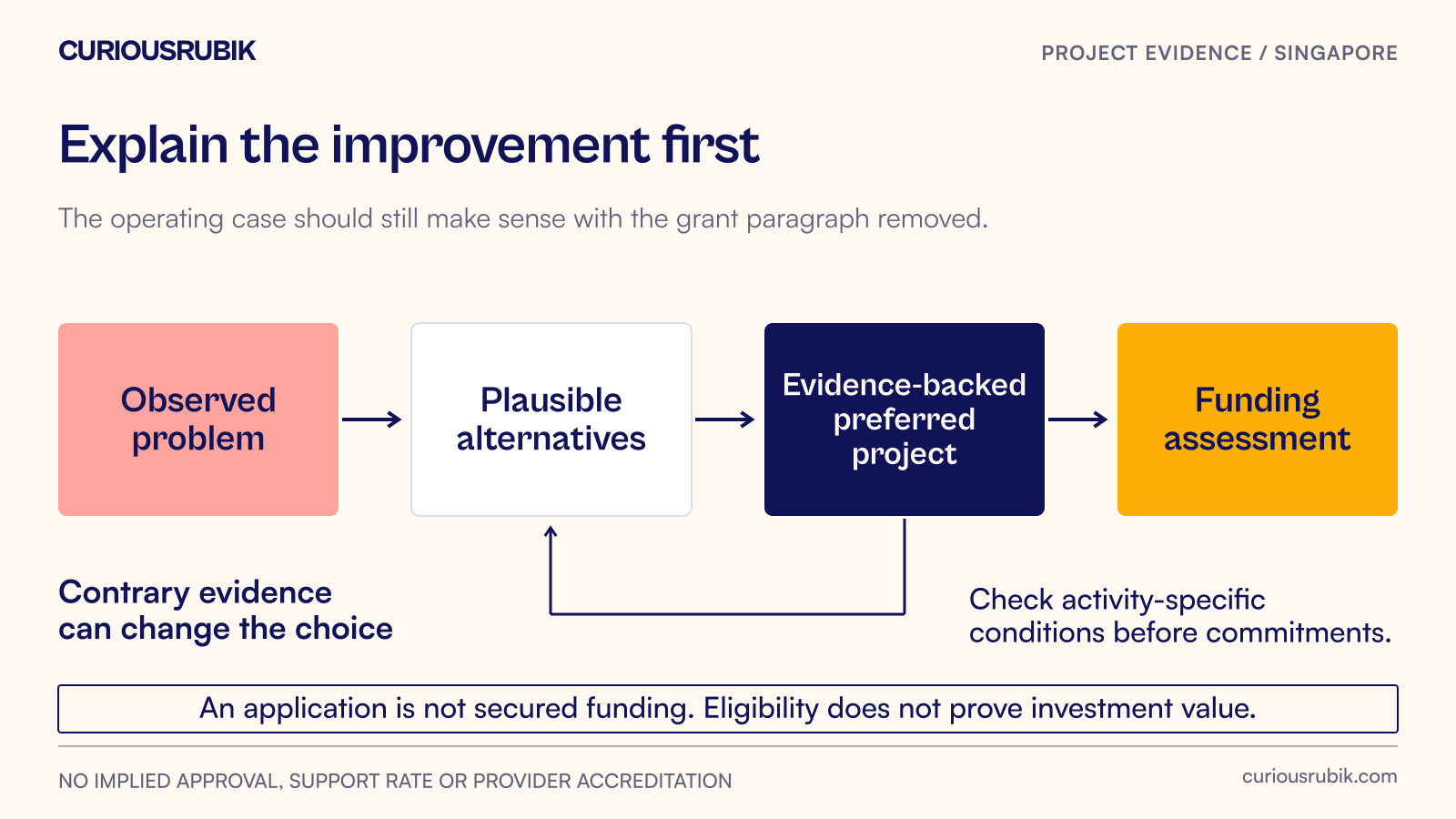
A funding application is easier to assess when the underlying project already makes sense. Start with the observed problem, compare plausible ways to change it and identify the evidence that would justify the preferred option. The funding conditions then shape what support may be available, rather than supplying the project's reason to exist.
Replace the solution description with a decision question
“Automate order fulfilment” is a broad ambition. “Which change would reduce avoidable waiting between a confirmed order and a ready shipment?” is a question that can be investigated.
Define the start and end of the process, the population affected and the result customers or staff need. Distinguish delay from active work. An order waiting a day for a missing instruction presents a different problem from an order requiring an hour of physical handling.
Collect examples that expose the causes. Include ordinary orders, exceptions and work still unfinished. A list of completed orders may omit the very cases creating the biggest problem.
Assign a business owner to the question. The owner should be able to change the relevant work or obtain agreement from the teams involved. A project sponsor who controls only the purchase budget may need an operational partner before the case can become credible.
Compare three changes against the same evidence
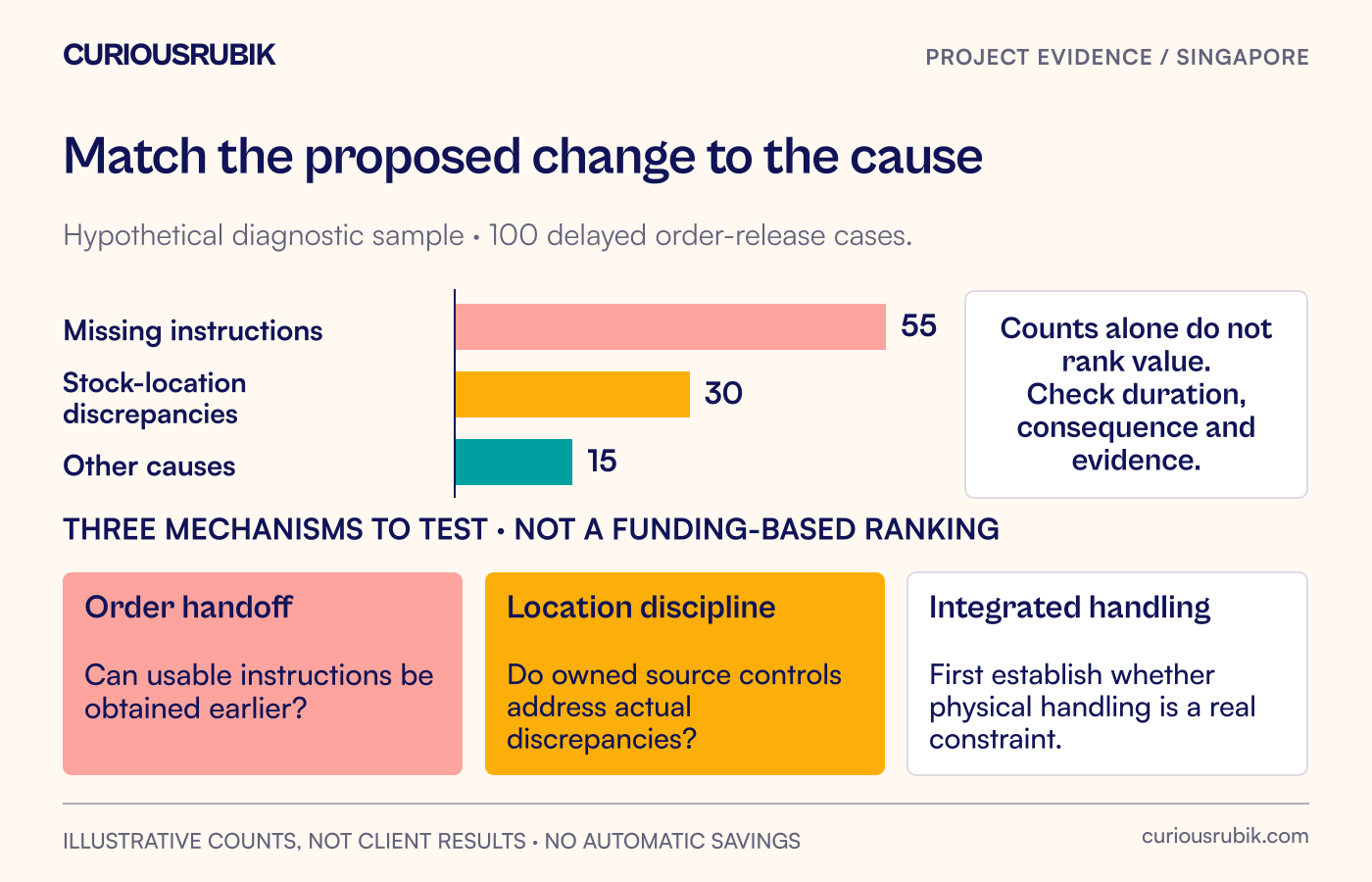
Consider a hypothetical distributor reviewing 100 delayed order-release cases. A checked sample classifies 55 as missing customer instructions, 30 as stock-location discrepancies and 15 as other causes. These invented counts illustrate a diagnostic method, not a measured result or a forecast of preventable delay.
The business is considering three options:
| Option | Proposed mechanism | What must be established |
|---|---|---|
| Improve the order handoff | Capture necessary customer instructions before release preparation | The information can actually be obtained earlier and is usable |
| Repair stock-location discipline | Reduce time searching for goods already recorded as available | Location accuracy is a material cause, with owned source controls |
| Invest in integrated physical automation | Change handling and coordination across relevant operations | Physical handling is a significant constraint and the proposed integration addresses it |
The first option appears relevant to the largest category in this hypothetical sample. That does not prove it is the best investment. The missing instructions may concern a small delay, while the stock discrepancies may cause much longer disruption. Compare consequence, effort, feasibility and the quality of the evidence.
The third option should not be selected merely because a funding activity sounds compatible with it. If the main problem is an instruction the customer has not yet supplied, more sophisticated handling equipment may leave that waiting time intact.
Read the diagram text
CURIOUSRUBIK PROJECT EVIDENCE / SINGAPORE Match the proposed change to the cause Hypothetical diagnostic sample · 100 delayed order-release cases. Missing instructions 55 Stock-location discrepancies 30 Other causes 15 Counts alone do not rank value. Check duration, consequence and evidence. THREE MECHANISMS TO TEST · NOT A FUNDING-BASED RANKING Order handoff Can usable instructions be obtained earlier? Location discipline Do owned source controls address actual discrepancies? Integrated handling First establish whether physical handling is a real constraint. ILLUSTRATIVE COUNTS, NOT CLIENT RESULTS · NO AUTOMATIC SAVINGS curiousrubik.com
Write the evidence that could change your mind
For each option, identify a practical next check. The order-handoff option may need a review with sales and several receiving teams to establish which instructions are known earlier. The stock option may need a controlled sample of physical-to-record discrepancies. The automation option may need a measured handling study and an agreed description of the integrated process.
Set an expected result and a contrary result. If most missing instructions arise only after a customer decision later in the process, the proposed early capture may be unrealistic. If location records are accurate and delays come from access to a shared loading area, a stock-data repair may not address the problem.
This is a useful point to improve the project brief before spending on implementation. A changed recommendation is not failure. It means the evidence has prevented the business from committing to the wrong mechanism.
Keep eligibility timing in mind while investigating. Do not assume that calling paid work a “pilot” or “discovery exercise” keeps it outside relevant grant conditions. Before authorising supplier work or payments, the grant owner should confirm how the actual proposed activity treats those events.
Check the current support route
Enterprise Singapore's EDGE Grant became the route for new applications from 30 September 2026, after EDG, MRA and PSG ceased for new applications on 29 September. Ongoing earlier submissions and projects continue under their applicable arrangements. Old project examples should therefore not be treated as current eligibility instructions for a new application.
EDGE support varies by activity and is reimbursed after the relevant completion and payment conditions. Do not apply a headline support percentage to every line in a quotation or describe an application as funding secured.
The large-scale automation activity, for example, has specific expectations around advanced capability, integration or standardisation across operations and productivity improvement. It also states that work must not have started, nor a payment or deposit been made to a supplier, vendor or third party, before application submission. Those conditions need to be checked against the actual project, alongside all other requirements.
This is not an eligibility determination. The responsible finance or grant owner should use current activity guidance and eventual approval terms. A project may be operationally sensible without qualifying for a particular activity, and eligibility does not prove that it is the best project to undertake.
Give the benefit a person who can demonstrate it
The preferred option should have an outcome owner and a specific proof. “Reduce manual effort” needs an identified task, a baseline and a way to observe whether the work disappeared or moved elsewhere.
For the hypothetical order-handoff option, the sales operations owner might be responsible for complete instructions reaching the release team. The release owner checks whether clarification has actually reduced and whether new intake work offsets the improvement. Finance checks any claimed cash consequence separately.
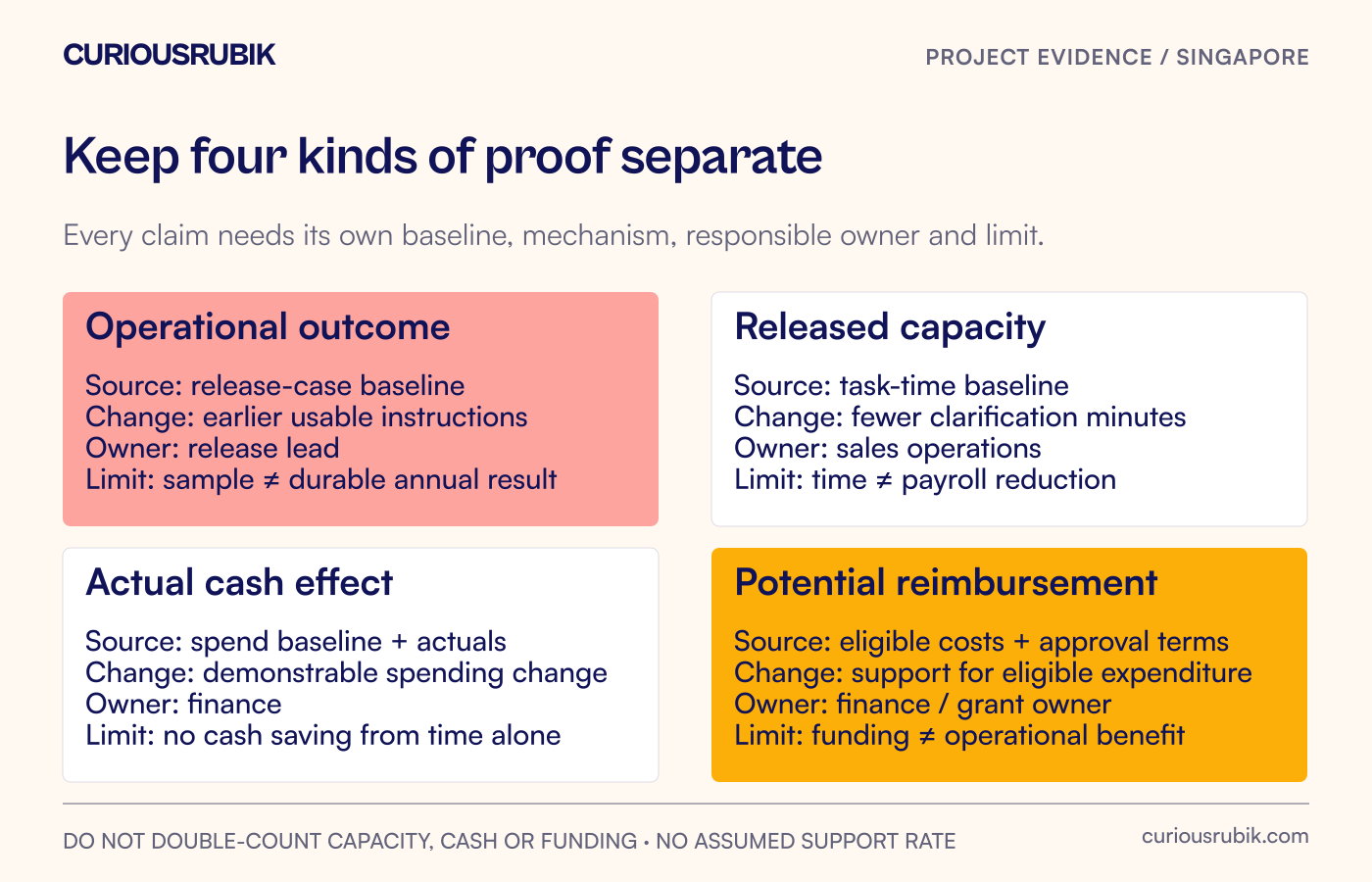
Avoid counting the same change twice. Fewer clarification minutes may create capacity, but that capacity is not also a payroll reduction unless a real spending change follows. A reimbursement is a funding effect, not an operating productivity gain.
A useful benefit record contains the outcome, baseline population and period, measurement method, dependencies, owner and review date. It also records what the measure cannot establish. A short sample may show feasibility without proving a durable annual saving.
Read the diagram text
CURIOUSRUBIK PROJECT EVIDENCE / SINGAPORE Keep four kinds of proof separate Every claim needs its own baseline, mechanism, responsible owner and limit. Operational outcome Source: release-case baseline Change: earlier usable instructions Owner: release lead Limit: sample ≠ durable annual result Released capacity Source: task-time baseline Change: fewer clarification minutes Owner: sales operations Limit: time ≠ payroll reduction Actual cash effect Source: spend baseline + actuals Change: demonstrable spending change Owner: finance Limit: no cash saving from time alone Potential reimbursement Source: eligible costs + approval terms Change: support for eligible expenditure Owner: finance / grant owner Limit: funding ≠ operational benefit DO NOT DOUBLE-COUNT CAPACITY, CASH OR FUNDING · NO ASSUMED SUPPORT RATE curiousrubik.com
Make the project brief usable without the grant paragraph
Before application preparation, the brief should answer six questions:
- What recurring operating problem has been observed?
- Which plausible alternatives were considered, including a simpler change?
- Why is the preferred mechanism supported by the evidence?
- What must change in roles, data, physical work or decisions?
- What will the business spend and contribute, including transition and ongoing work?
- Who will demonstrate the outcome after implementation?
Then add the funding assessment, its unresolved conditions and the cash timing. Keep unsupported costs and uncertain support assumptions visible. Management needs to understand the commitment if reimbursement is lower than hoped, delayed or unavailable.
Do not enlarge the scope with unnecessary features simply to resemble a programme description. Equally, do not remove essential training or source-data repair from the business plan because a cost line may be unsupported. The work still needs an owner and a budget.
Make the next commitment match what is known
If the causal evidence is weak, the next decision may be further analysis rather than a full implementation purchase. If a simpler handoff change addresses the problem, test it through an authorised route that respects the applicable funding conditions. If the integrated investment is justified, document why its additional cost and complexity are necessary.
The application owner and project sponsor should agree which events require another review: a changed operating scope, a revised quotation, a new dependency or a commitment that affects eligibility. Keep the project argument and funding assumptions on the same version.
Before approving the next proposal, remove its grant paragraph and read the operating case again. If the reason to proceed disappears with the subsidy, identify whether the problem is the economics, the evidence or the proposed solution. That is a better decision to resolve before application than after the business has committed to delivery.