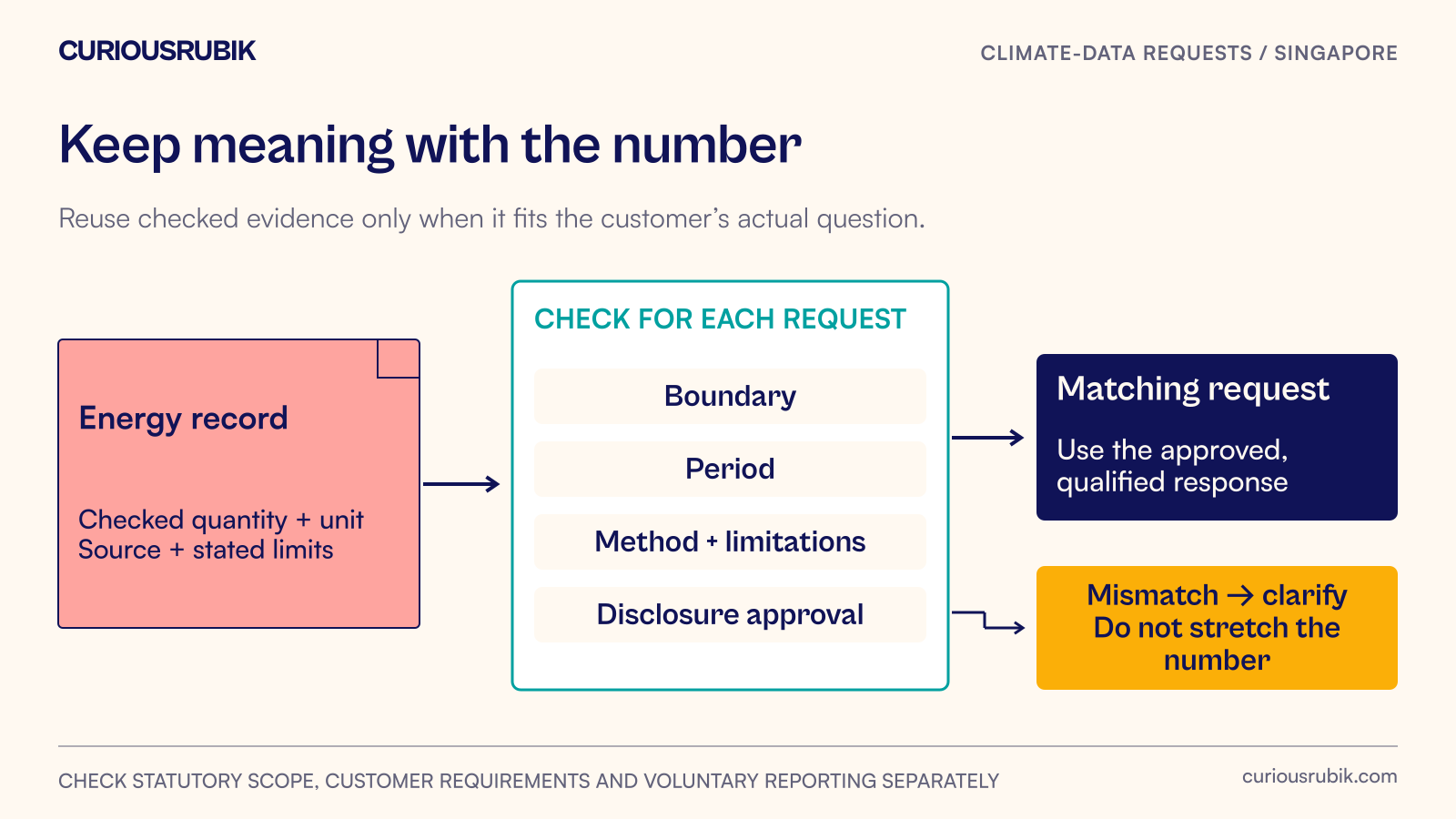
One customer asks for annual electricity use. Another asks for emissions linked to the goods it bought. A third sends a questionnaire about the whole company. Finance, operations and sales each prepare an answer from the same utility bills, but the figures do not mean the same thing.
The useful response is a small, controlled evidence process. Identify the question, reporting boundary, period, source and method before reusing a number. Give one coordinator responsibility for connecting the request to the right data owner and an authorised response, including an honest explanation of what is not yet known.
A customer request is not a universal statutory duty
Singapore's climate-reporting roadmap distinguishes listed companies and qualifying large non-listed companies, with different requirements and timelines. ACRA defines the large non-listed group using both annual revenue of at least S$1 billion and total assets of at least S$500 million, subject to exemptions. Its current roadmap schedules those companies' reporting from financial years starting on or after 1 January 2030.
That does not put every ordinary SME under the same mandatory reporting requirement. A customer's request can instead arise from its own reporting, procurement or contractual needs. The business should establish which of those applies rather than tell staff that “all suppliers must report by law”.
Legal scope, a customer's commercial requirement and a voluntary improvement are separate questions. The appropriate adviser should assess statutory duties, while the commercial owner confirms what the customer actually needs and what the business has agreed to provide.
This distinction does not make customer requests unimportant. It helps the team answer the right question without overstating either its obligation or the completeness of its data.
Clarify the noun before finding the number
“Your carbon data” might mean a company-wide emissions inventory, energy used at one site, a product-level estimate or information about an activity performed for that customer. Those require different boundaries and methods.
Ask which legal entity, sites, activities and period the customer wants. Check whether it seeks measured activity data, calculated emissions or a declaration about a target or policy. Establish the requested unit and format, and who will use the response.
If the customer asks for emissions per unit supplied, total electricity divided by units sold may be an inappropriate allocation. Shared facilities, other products, production versus sales periods and the method requested can all matter. A qualified reviewer should establish the method; a form's empty box is not authority to invent one.
Give unresolved scope questions to the commercial owner early. A short clarification can prevent several teams from preparing incompatible answers under different assumptions.
Work through two meters and three questions
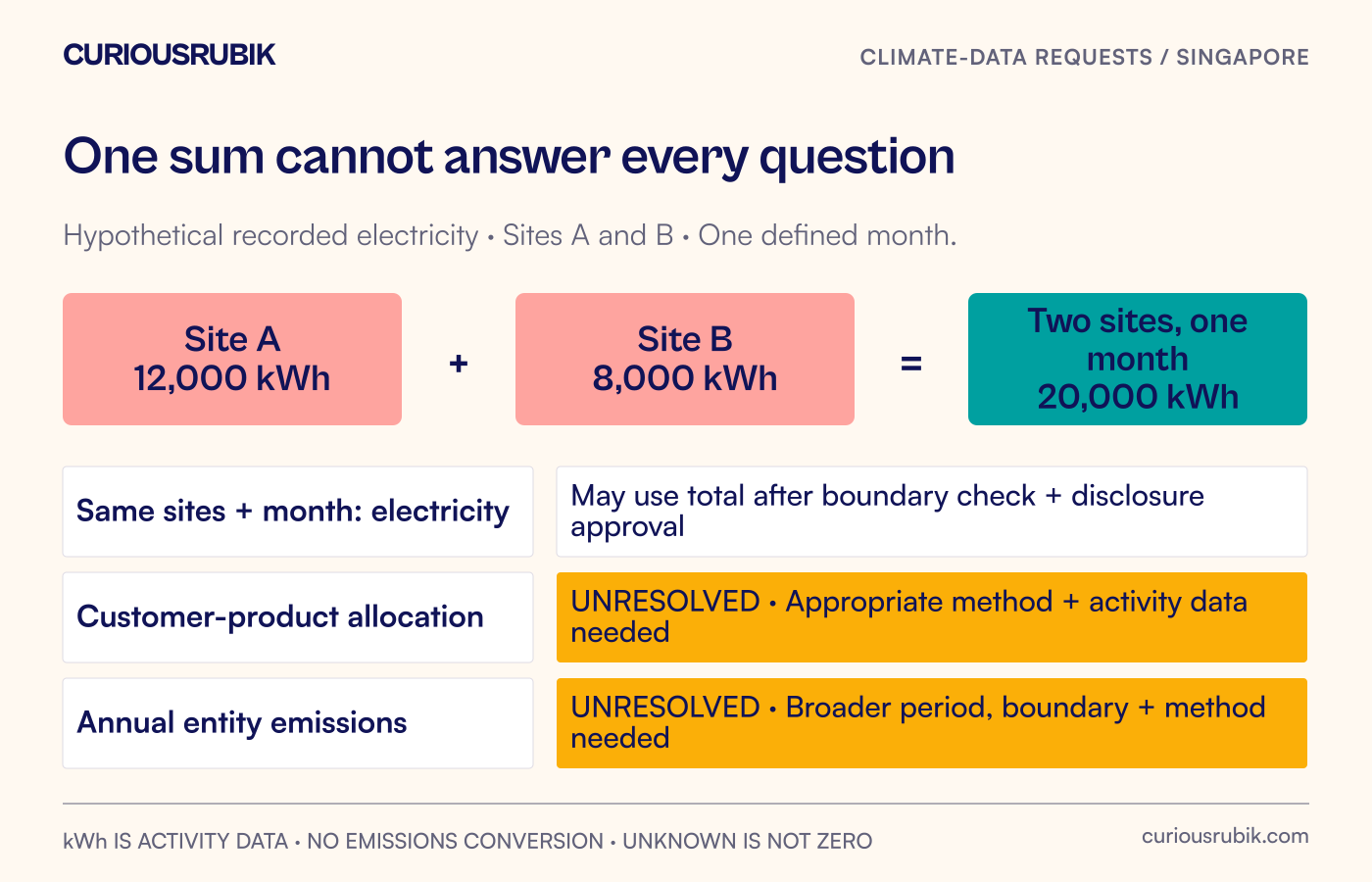
Consider a hypothetical business with two sites. For a defined month, checked utility records show 12,000 kWh at site A and 8,000 kWh at site B. The combined recorded electricity use is 20,000 kWh for those sites and that month. These figures are illustrative activity data, not emissions or a complete company inventory.
Customer one asks for the two sites' electricity use for that same month. Subject to disclosure approval and verification of the requested boundary, the 20,000 kWh figure may answer the question. The response should retain its sites, dates and unit.
Customer two asks for electricity attributable to the products it purchased. The same 20,000 kWh does not answer that question. The business needs an appropriate allocation method and supporting activity information. Until reviewed, the customer-specific amount remains unknown rather than zero.
Customer three asks for annual greenhouse-gas emissions for the legal entity. A single month's electricity from two sites is insufficient. The reviewer needs the relevant period, organisational and activity boundaries, appropriate methods and other required sources. Multiplying the monthly figure by twelve would be an estimate with assumptions, not a measured annual total or an emissions calculation.
The same bills can be useful to all three enquiries without supporting the same answer. Reuse their source references; do not reuse an unqualified result.
Read the diagram text
CURIOUSRUBIK CLIMATE-DATA REQUESTS / SINGAPORE One sum cannot answer every question Hypothetical recorded electricity · Sites A and B · One defined month. Site A 12,000 kWh Site B 8,000 kWh Two sites, one month 20,000 kWh + = Same sites + month: electricity May use total after boundary check + disclosure approval Customer-product allocation UNRESOLVED · Appropriate method + activity data needed Annual entity emissions UNRESOLVED · Broader period, boundary + method needed kWh IS ACTIVITY DATA · NO EMISSIONS CONVERSION · UNKNOWN IS NOT ZERO curiousrubik.com
Create a reusable record with a visible limit
Store each approved data item with enough context for another reviewer to understand it. A useful record contains:
| Field | Example for the hypothetical electricity record |
|---|---|
| Boundary | Sites A and B, within the stated entity scope |
| Period | The exact month covered by the source bills |
| Quantity and unit | 20,000 kWh recorded electricity use |
| Source | Controlled references to the two checked records |
| Method | Sum of the two site quantities, with duplicates and period overlap checked |
| Evidence status | Source records checked; wider inventory completeness not established |
| Limitation | No customer allocation or emissions conversion included |
| Owner and approval | Facilities data owner, relevant reviewer and disclosure approver |
Keep measured or recorded quantities separate from estimates. If a bill contains an estimated reading, preserve that fact. If a later actual reading or correction changes the quantity, update the record through a controlled version and identify responses that used the old one.
A missing record should remain a gap. Do not enter zero because the questionnaire accepts only a number, or silently borrow a prior period. The coordinator can ask the customer for an appropriate way to disclose the limitation.
Separate source checking from method approval
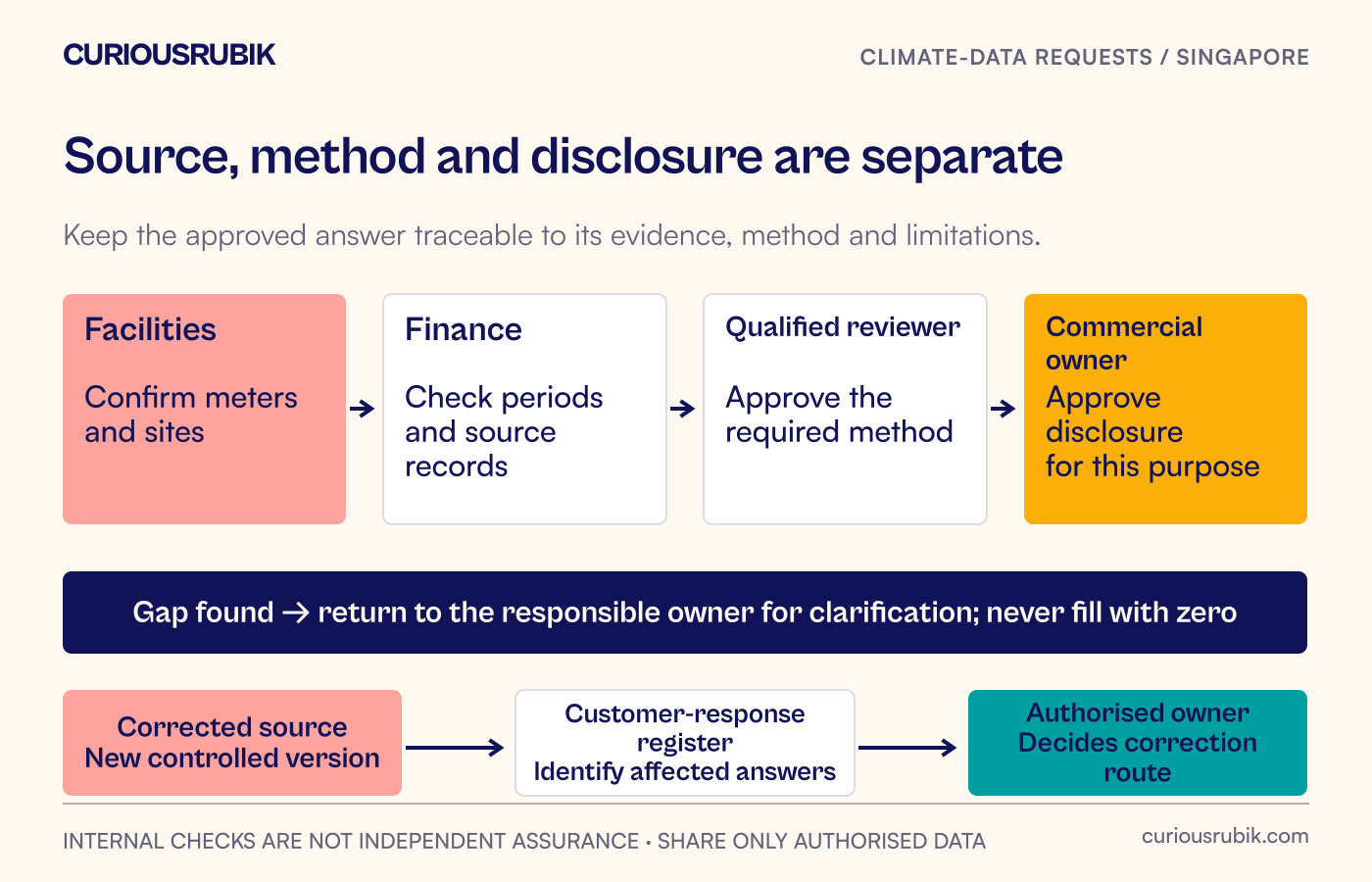
Facilities may confirm which meters and sites the bills cover. Finance may verify the records and period reconciliation. A qualified sustainability reviewer approves the emissions or allocation method where needed. The commercial owner approves what may be disclosed to the customer.
These roles can be combined in a small team where competence and authority permit, but the questions remain different. Matching a bill total does not validate an emissions factor, and an approved method does not prove that every relevant source record was included.
Avoid describing an internal review as independent assurance. Do not use “verified carbon footprint” when the evidence supports only a checked electricity record. The response should say what was checked and where its limits remain.
Protect confidential business information. A customer may need an approved aggregate without needing every utility account identifier, site-access detail or underlying commercial document. Share only the authorised information necessary for the agreed purpose.
Read the diagram text
CURIOUSRUBIK CLIMATE-DATA REQUESTS / SINGAPORE Source, method and disclosure are separate Keep the approved answer traceable to its evidence, method and limitations. Facilities Confirm meters and sites Finance Check periods and source records Qualified reviewer Approve the required method Commercial owner Approve disclosure for this purpose Gap found → return to the responsible owner for clarification; never fill with zero Corrected source New controlled version Customer-response register Identify affected answers Authorised owner Decides correction route INTERNAL CHECKS ARE NOT INDEPENDENT ASSURANCE · SHARE ONLY AUTHORISED DATA curiousrubik.com
Keep a record of what each customer received
A request register should link the question and its version to the approved answer, evidence record, method version, limitations and sending decision. Record who owns any promised follow-up.
If a source correction occurs, the coordinator can then identify affected responses. The appropriate owner decides whether and how a corrected answer should be sent. Without that link, one customer may continue using an old estimate while another receives the corrected figure, with no explanation for the difference.
Do not assume every new questionnaire needs a new calculation. First check whether an approved data item matches the requested boundary and period. Reusing it with its qualifications can reduce work while improving consistency.
Conversely, do not stretch a reusable answer to fit a changed question. A calendar-year request and a financial-year request may overlap without being equivalent. Show the mismatch and obtain the additional records or an agreed limitation.
Let automation assemble evidence without inventing certainty
Automation can extract candidate quantities, detect missing periods, identify duplicate source records and prepare a response using approved data. The reviewer should be able to trace every material number and statement back to its basis.
A generated narrative must not turn “partial data available” into “comprehensive emissions reporting completed”, or a stated ambition into an achieved reduction. Keep unsupported claims out even if they make the questionnaire sound more impressive.
Review repeated requests to see where a modest improvement would help most. It may be consistent meter identification, a reliable period register or an agreed method for a recurring customer question. Start with the evidence gap that actually prevents a useful response.
For the next questionnaire, ask whether the team can explain the boundary, period and method behind each number without reopening several inboxes. A dependable answer includes its limits. That is what lets the business respond efficiently without claiming more than it can support.