
Last reviewed: 10 October 2026. Product details reflect this review date. Availability and behavior can vary by account, role and release.
Editorial ink illustration: Different source records feed a shared reporting folder.
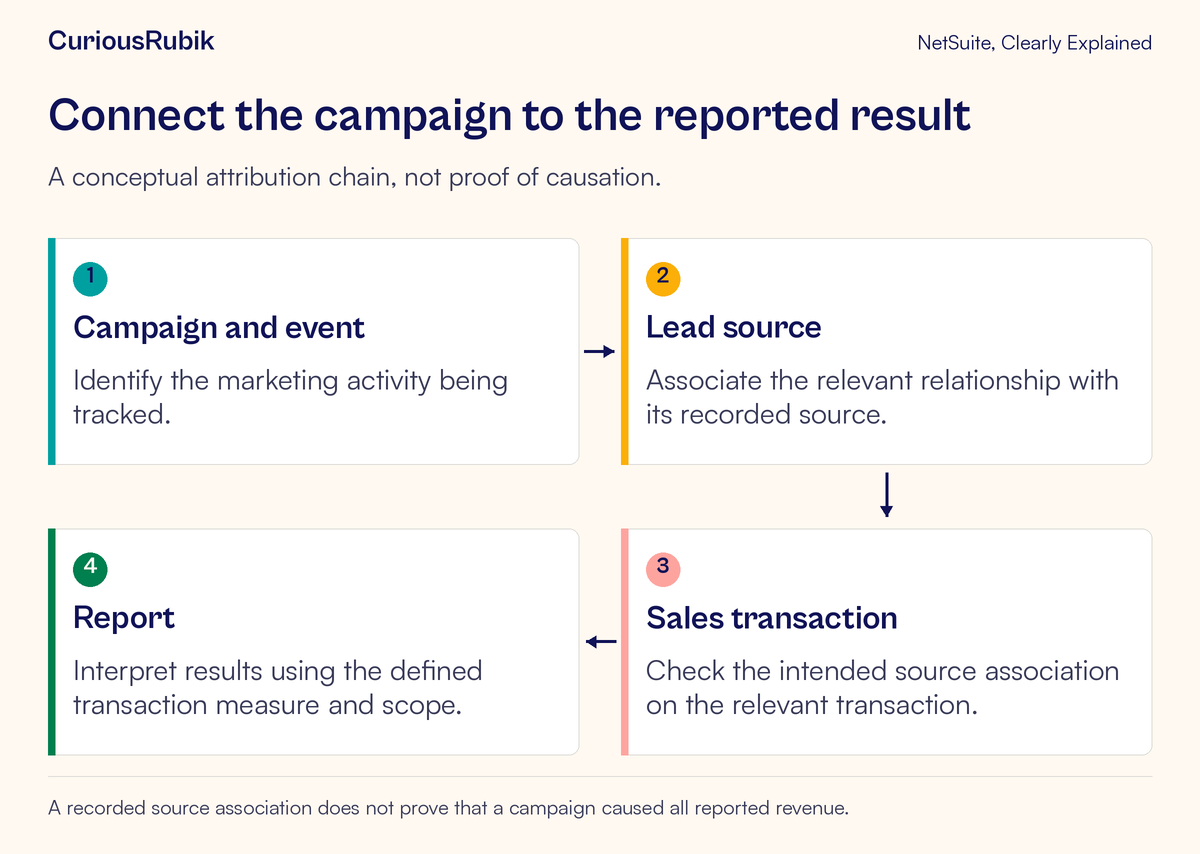
A campaign generated inquiries, and the sales team can point to resulting business. Yet the campaign report shows less activity than expected. Before concluding that marketing failed or the report is broken, check how the lead source is associated with the relationships and transactions being measured.
NetSuite Marketing Automation supports campaigns with individual events across channels. Lead Source connects a campaign to related leads, prospects, customers, and sales transactions. Those recorded associations support campaign and lead-source reporting.
The word “recorded” matters. A report can summarize the associations captured in the account. It cannot reconstruct every conversation the team forgot to record, and an association alone does not establish that the campaign caused all the reported business. This lesson explains how to inspect that chain and separate data completeness from marketing effectiveness.
Distinguish the campaign from an individual event
A campaign describes the broader marketing effort. Events describe the activities used to carry it out, such as an email, a telephone activity, or another supported channel. A campaign with several events should not be interpreted as though every response came from one identical interaction.
Before reviewing results, name the campaign and the particular activity or period under discussion. Ask what the team is trying to learn: whether an event attracted responses, whether those responses became qualified relationships, or whether associated transactions appeared later.
Those are different measurements with different inputs. An inquiry count may concern people or organizations. A transaction measure concerns business events. A response rate needs a defined audience and a definition of response. None of those denominators should be guessed from the report’s headline.
This lesson is a read-and-reconcile exercise. Sending marketing messages requires the organization’s approved audience, consent, and communication process. Verifying attribution does not require launching a new campaign event.
Follow the source on relationships and transactions
A relationship record can have the campaign selected as its Lead Source. Sales transactions can also be associated with a lead source. These are related checks, but one should not be assumed to prove the other.
For a known result, inspect the relevant relationship and the transaction used by the report. Confirm the actual source association on each, the dates involved, and the record types included in the reporting definition.
Do not promise that every source value always flows automatically from a relationship to every later transaction. Entry methods, configured processes, integrations, and subsequent changes deserve account-specific review. The reliable method is to trace the actual example rather than infer the value from an earlier record.
The sales-lifecycle lesson explains the difference between the organization, its contacts, and its opportunities. That distinction is useful here because a new contact or a second opportunity does not necessarily represent a new customer relationship.
Reconcile ten inquiries and two transactions
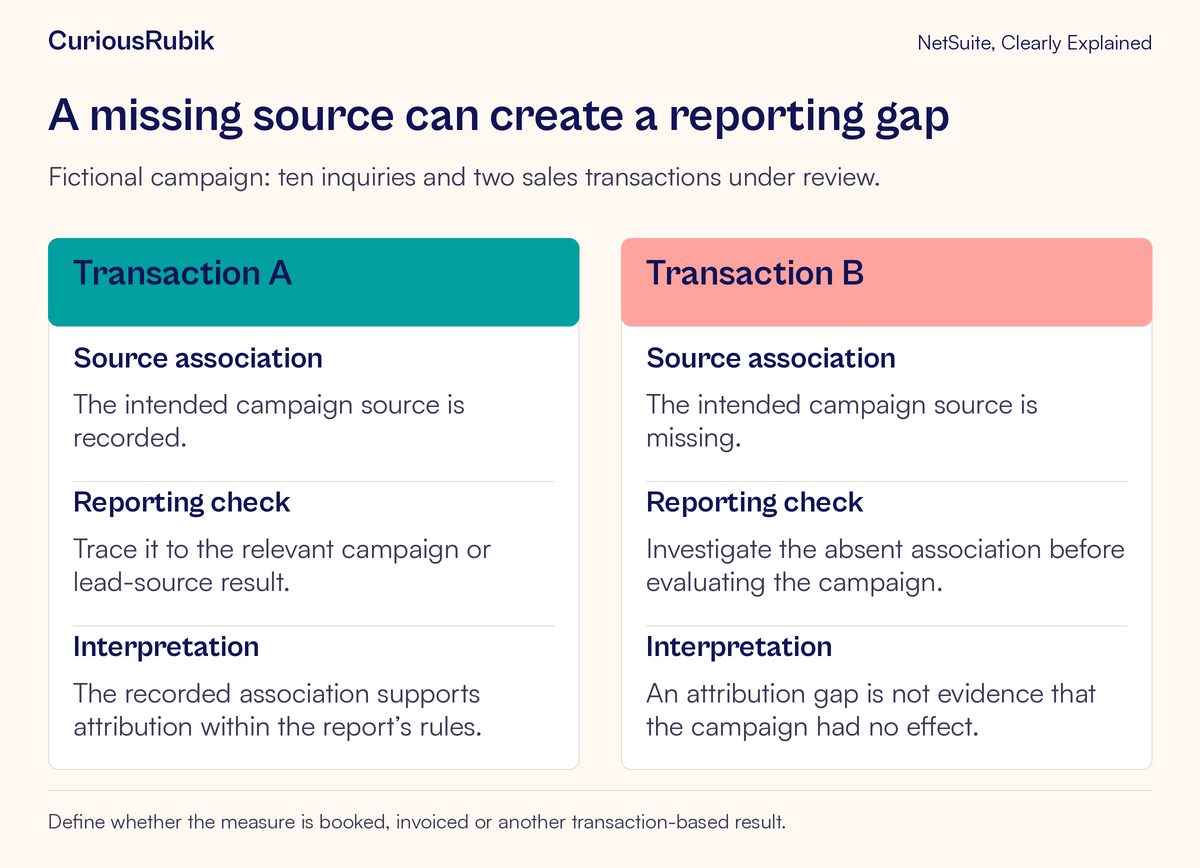
Imagine a fictional campaign has ten inquiries. The team identifies two sales transactions it believes relate to that campaign. Call them Transaction A and Transaction B.
Transaction A has the intended campaign source recorded. Transaction B does not. The reviewer verifies both records against the campaign’s agreed reporting scope. The immediate issue is whether the missing association on B is justified by the evidence and the team’s attribution rules.
Within this small sample, one of the two identified transactions carries the expected source. That is a 50 percent source-completeness observation for these two records. It is not the campaign’s response rate, conversion rate, or return on investment.
The ten inquiries also need a clear counting unit. Two transactions do not automatically mean two distinct converted customers. One customer could have more than one transaction, and an inquiry could be recorded more than once. Check identity and the chosen conversion definition before turning those counts into a percentage.
If B should have the source but does not, the authorized owner can evaluate a correction through the approved process. Record why the source is supported. Do not assign the campaign merely to make its result look better.
If the evidence is inconclusive, keep that uncertainty visible. “Association under review” is more honest than either assuming the campaign had no effect or claiming the transaction as a confirmed campaign result.
Define what the financial result measures
“Campaign revenue” needs a precise definition. Is the report using booked orders, invoices, or another transaction-based measure? What dates and statuses apply? Are amounts expressed on a consistent currency basis? How are relevant adjustments treated?
A transaction association supports inclusion according to a report’s rules. It does not make every associated amount equivalent to recognized revenue or collected cash. Ask the finance and reporting owners to establish the appropriate interpretation for the selected report.
Timing can explain a gap. An inquiry may occur in one month, an order in another, and billing later. Comparing this month’s inquiry count with this month’s invoices can combine different groups of activity unless that is the intended design.
The KPI definition lesson shows how to reconcile different business measures. Apply the same discipline here: identify the event and period before interpreting the amount. If the discussion uses return on investment, establish the cost inputs and the calculation’s scope as well, rather than relying on the name alone.
Separate attribution from evidence of effectiveness
A recorded campaign source tells you how the account associates the relationship or transaction. It does not measure every influence on the buyer’s decision. A person may have encountered several activities, spoken with a representative, and already known the company.
Keep the reporting claim proportionate to the evidence. “These transactions carry this campaign source within the defined report” is defensible when the trace is complete. “This campaign caused every unit of that business” requires a much stronger method than a source field.
This distinction does not make attribution useless. A consistently applied source rule can help teams understand patterns, compare channels, and investigate follow-through. Its usefulness depends on knowing what the rule captures and applying it consistently.
Agree how the team treats competing source information. Does a new event justify changing an existing relationship source? Should a transaction be associated with a different campaign from the original inquiry? These are attribution-governance decisions that need a documented policy and a responsible owner, not ad hoc changes during a results meeting.
Find where the association was lost
If Transaction B lacks the expected source, trace its creation path. Was it entered manually, created from another record, or produced through an integration? What evidence exists at the point where the source should have been selected or reviewed?
Compare B with a similar transaction that is correct. Look for a small meaningful difference in process, rather than immediately redesigning every campaign. The issue may be an omitted field during entry, a mapping decision, a later change, or a reporting filter. Each needs a different fix.
For imported or migrated data, the CSV validation and recovery guide helps frame matching and sample checks. For a disputed later change, the System Notes audit-evidence guide explains how to inspect available change evidence without assuming it supplies the business rationale.
Do not rewrite historical sources in bulk before the team has agreed the rule. A correction may change earlier comparisons and affect other users’ interpretation of a campaign.
Build a repeatable review sample
Choose a manageable set of known inquiries and associated outcomes. Include a correctly tagged example, a missing-source example, and a case that should remain outside the campaign’s attribution scope. Use authorized records and restrict unnecessary personal details in exported evidence.
For each case, record the relationship identifier, relevant transaction identifier, source association, date, report inclusion, and reviewer conclusion. This can be a working reconciliation sheet; it does not require a new customization.
Reconcile the sample after an approved process change. Confirm that intended associations are captured and that unrelated transactions have not been pulled into the campaign. A higher reported total is not automatically a better result if the new rule over-attributes business.
If a custom search supports the review, the transaction-search lesson helps prevent detail rows from inflating counts and amounts. Count the business object the question actually concerns.
End with a useful action, not a bigger claim
A campaign review should produce an understandable conclusion and a next step. It might identify missing source data, an unclear denominator, a timing mismatch, or a genuine operational problem after qualification. Assign the issue to the person who can resolve it.
Before using the result, confirm that the campaign and events are identified, the relationship and transaction sources have been checked, and the measure and period are explicit. Verify a small sample, name the owner of missing associations, and keep consent and sending controls separate from the analytical exercise.
CuriousRubik’s NetSuite optimization services can help connect attribution rules with the sales and marketing handoffs that maintain them. The immediate benefit is a report the team can explain, including what its numbers cannot establish on their own.