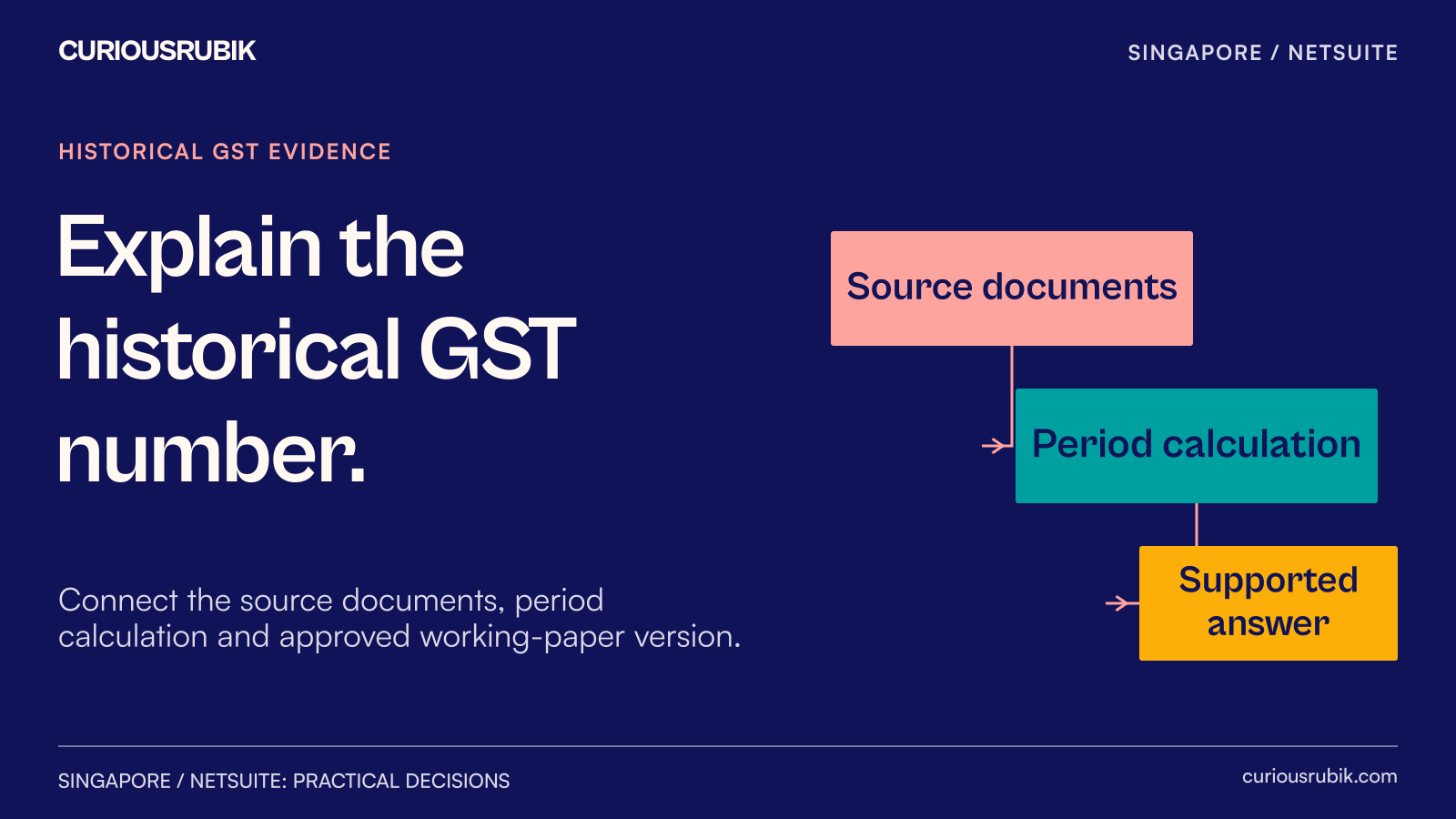
Explain the historical number through its documents and approved working-paper version.
“Why does the retained sales report show SGD 9,000 of output GST when the final working paper shows SGD 8,820?” After a NetSuite migration, finding both files is only the beginning. Finance needs to explain the difference using the original documents, the right report version and the approved treatment recorded at the time.
A historical GST answer should connect a specific question to a reproducible calculation. It should distinguish what the retained evidence proves from what remains unresolved. This is a narrower task than deciding how to operate the legacy archive.
IRAS does not require old transactions to be migrated into replacement accounting software. Relevant records and associated documents must remain retained and retrievable. GST records generally need to be kept for at least five years from the end of the accounting period. Other obligations or holds can require longer retention; this exercise does not authorize deletion.
Give the reviewer a question with a defined boundary
Use this fictional query for an April–June 2025 GST period: “Explain the SGD 180 difference between sales extract SALES-Q2-v1 and final output-tax working paper GST-Q2-final. Show how invoice SG-042 and its credit CN-017 contribute to the result.” All identifiers, figures and operating details are illustrative.
The example supplies an explicit accounting assumption: the responsible tax owner previously approved the SGD 180 credit adjustment in this period, and that decision is retained. This is an input to the exercise, not advice about the correct period for any real credit. If the real treatment is unknown, finance must resolve it separately rather than infer it from this example.
The requested answer concerns output GST for one legal entity and one period. It does not ask the operator to prove every return field, recover a complete customer account or reconstruct the old ERP. Define those boundaries before collecting records, so an attractive invoice image does not become a substitute for the calculation actually requested.
Build the bridge before writing the explanation
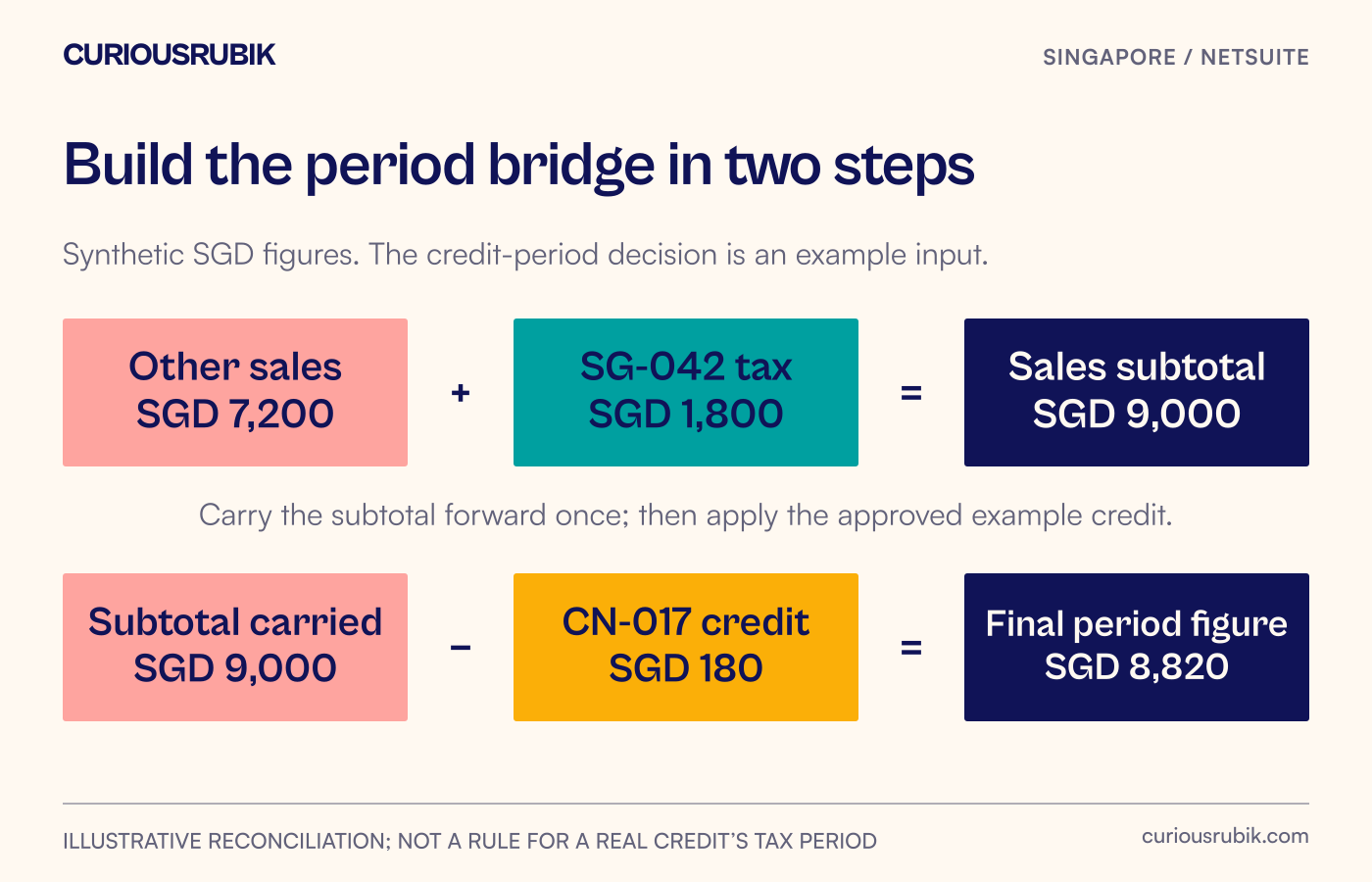
The retained sales extract contains SGD 9,000 of output GST. Within that population, invoice SG-042 contributes SGD 1,800 and the other listed sales contribute SGD 7,200. Credit CN-017 contributes a separately documented reduction of SGD 180 in the final working paper.
The expected bridge is therefore:
| Component in the fictional answer | SGD output GST | Evidence reference |
|---|---|---|
| Other sales in the selected population | 7,200 | SALES-Q2-v1, identified remaining rows |
| Invoice SG-042 | 1,800 | Invoice and matching transaction row |
| Sales extract subtotal | 9,000 | Retained extract definition and total |
| Approved credit CN-017 adjustment | -180 | Credit, decision and working-paper row |
| Final working-paper result | 8,820 | GST-Q2-final |
The subtotal is not another transaction to add. Nor should invoice SG-042 be added to the SGD 9,000 again. These are two views of the same sales population. Show that relationship explicitly, particularly when the source extract and the final working paper use different layouts.
Ask each record to prove one part of the answer
Start with the source invoice. Check the entity, document number, currency and tax amount against its transaction-listing row. An invoice number alone is weak evidence when two entities can use similar numbering. Preserve the original source reference alongside any new NetSuite or archive reference.
Next inspect the credit document and its link to SG-042. Confirm that the amount and identity match the adjustment used in the working paper. A customer account balance may show the financial effect without supplying the document evidence or the explanation for its period treatment.
Then inspect the extract definition. Which entity, date field, record types and statuses produced SALES-Q2-v1? Does it intentionally exclude the separately prepared credit adjustment? A filename containing “Q2” does not establish those selection rules. Retain the relevant field definitions or tax-code meanings where the calculation depends on them.
Finally, connect the approved treatment to the exact working-paper version. The final file should show the SGD 180 adjustment once, and its decision reference should identify the approved period. These relationships explain why the earlier extract and later working paper legitimately differ in this fictional case.
Diagnose the first answer when the evidence breaks
Suppose the operator finds the invoice and both totals. The transaction listing identifies CN-017 and its SGD 180 amount, but the credit attachment points back to the retired application. The operator can reproduce the arithmetic; the source-document support is incomplete.
The draft answer should say precisely that: “The retained figures reconcile by SGD 180, but the original credit has not yet been recovered through the approved route.” It should not say “GST verified.” A typed reconstruction of the credit from the listing would conceal the missing evidence.
A second problem emerges: a file called GST-Q2-review also shows SGD 9,000. Its version history identifies it as an earlier review copy, before the approved credit adjustment. Preserve it as historical context, while identifying GST-Q2-final as the version supporting this answer. Do not overwrite the earlier file to make all totals agree.
Assign the missing credit to the archive owner and the version identification to the finance preparer. Once the source document is recovered, the reviewer checks its identity, the adjustment and the retained approval together. The repair closes these specific evidence gaps; it does not prove every archived document is complete.
Separate a period question from a retrieval problem
Dates often explain why a record seems absent. The document date, posting date, extract timestamp and approved working-paper period can represent different events. List the dates actually used in the answer rather than treating them as interchangeable.
If a credit appears in a different period from the one requested, first locate the retained treatment decision. If it supports that other period, the answer may need a cross-period explanation rather than an archive repair. If the decision is missing or contradictory, refer the treatment question to the tax owner. Do not move the credit merely to reproduce the desired total.
Currency deserves the same discipline. Compare the retained tax amounts in their stated currency. A present-day exchange-rate calculation should not silently replace an original SGD amount or create a new explanation for a historical difference.
Deliver an answer another reviewer can follow
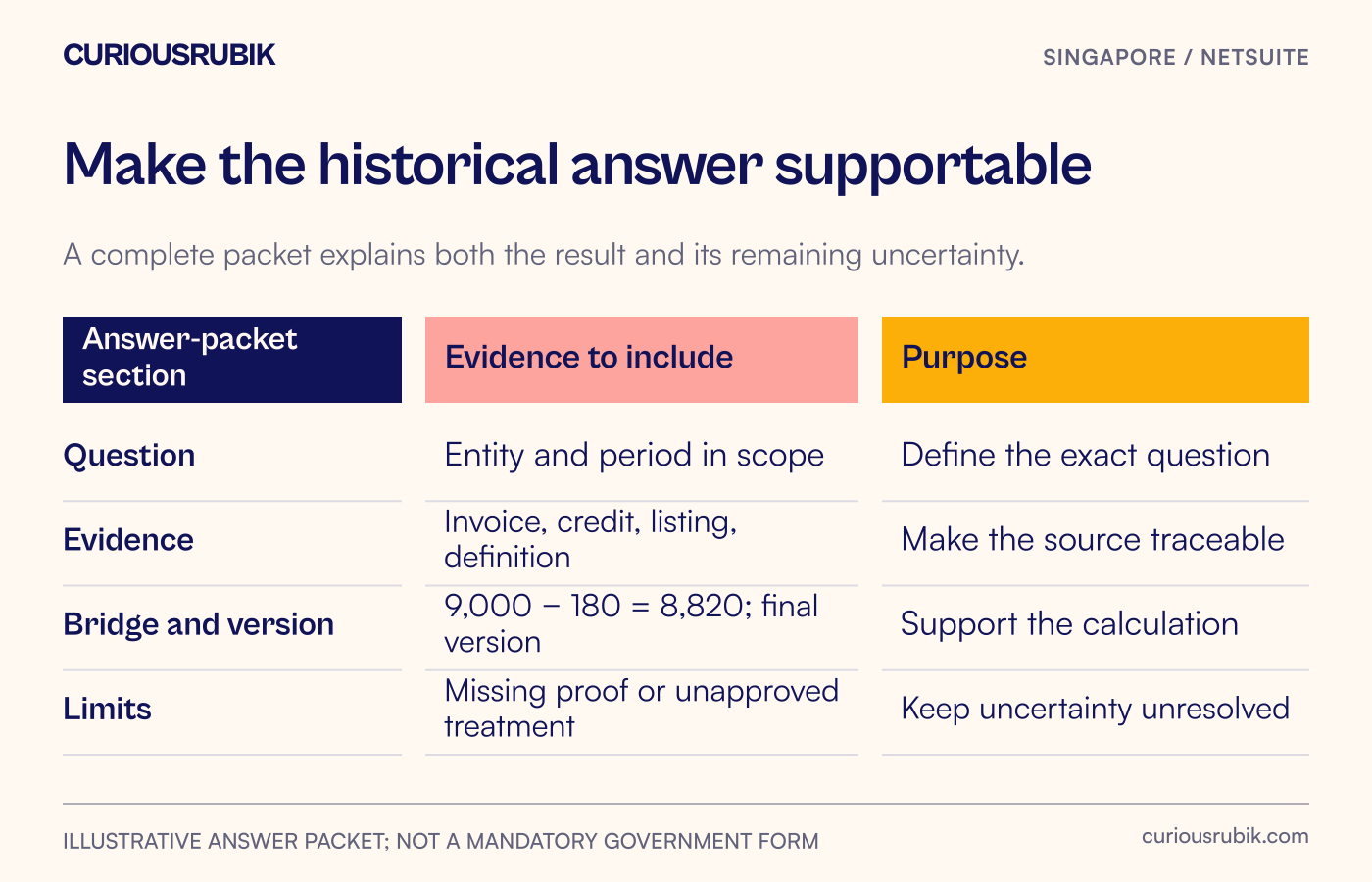
For the fictional case, the completed response explains that SALES-Q2-v1 contains SGD 7,200 from other sales and SGD 1,800 from SG-042. GST-Q2-final applies the separately supported CN-017 reduction of SGD 180, producing SGD 8,820 under the retained approved treatment. The earlier review copy predates that adjustment.
Attach a concise evidence index: source invoice, credit, relevant listing rows, extract definition, final working-paper version and treatment decision. Record who checked the answer and when. Link to controlled records rather than distributing unnecessary copies of the whole archive.
The legacy ERP archive guide covers the wider access and maintenance arrangement. For migration acceptance, use this completed GST query as one concrete test: can finance explain a historical difference from retained evidence, with the assumptions and unresolved questions visible?