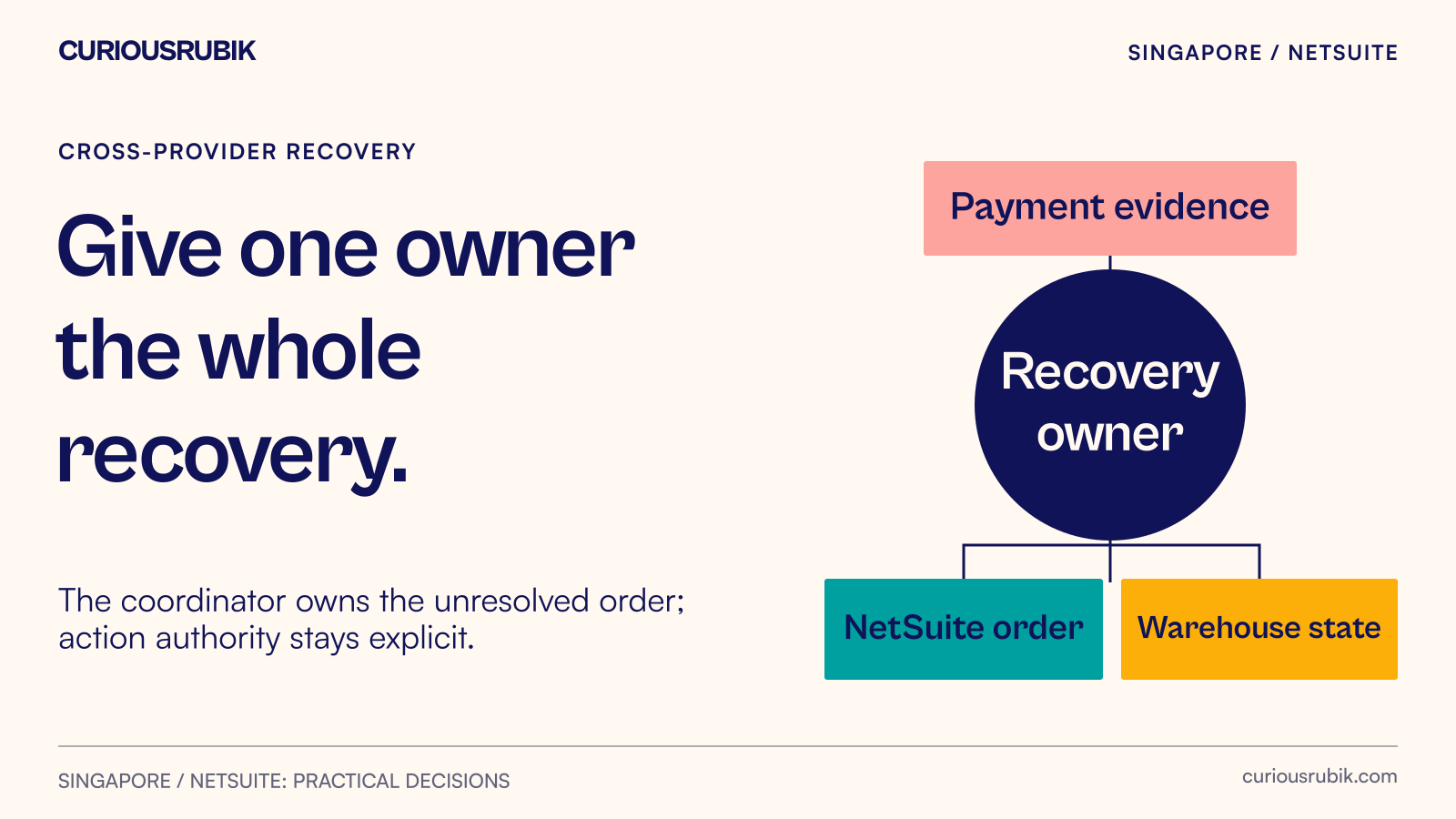
One coordinator owns the unresolved order across provider boundaries.
Assign one business recovery owner for the order, with separate authorities for payment, fulfilment and customer compensation. That person coordinates the evidence and the next decision even when different providers operate the systems. Otherwise a Singapore order desk can receive three technically reasonable explanations while the customer's order remains unresolved.
The recovery contract should describe the business states that matter: whether money was actually captured, whether the correct order exists, whether the warehouse accepted an instruction and whether goods have physically left. It should also state who may change each state. Access to a retry button or transaction form is not enough authority to refund a payment or release a replacement shipment.
A paid order with no confirmed shipment
In this illustrative scenario, a Singapore online seller receives an order fulfilled by a regional 3PL. Its customer sees a payment confirmation. NetSuite contains the order, but customer service sees no shipment reference. The integration monitor reports a warehouse submission whose final outcome is unknown. All businesses and events in this scenario are invented.
The payment operator says its part succeeded. The ERP support team says the order exists. The warehouse team cannot initially find the order under the reference supplied by customer service. A developer proposes resending the warehouse instruction. Customer service proposes cancelling the order and refunding the customer.
Neither proposal is ready for approval. The warehouse could have accepted the original instruction under a different reference. Goods could be picked or dispatched even though the acknowledgement is missing. The payment confirmation must also be interpreted using the provider's actual transaction evidence, because a customer-facing message alone is not the full financial record.
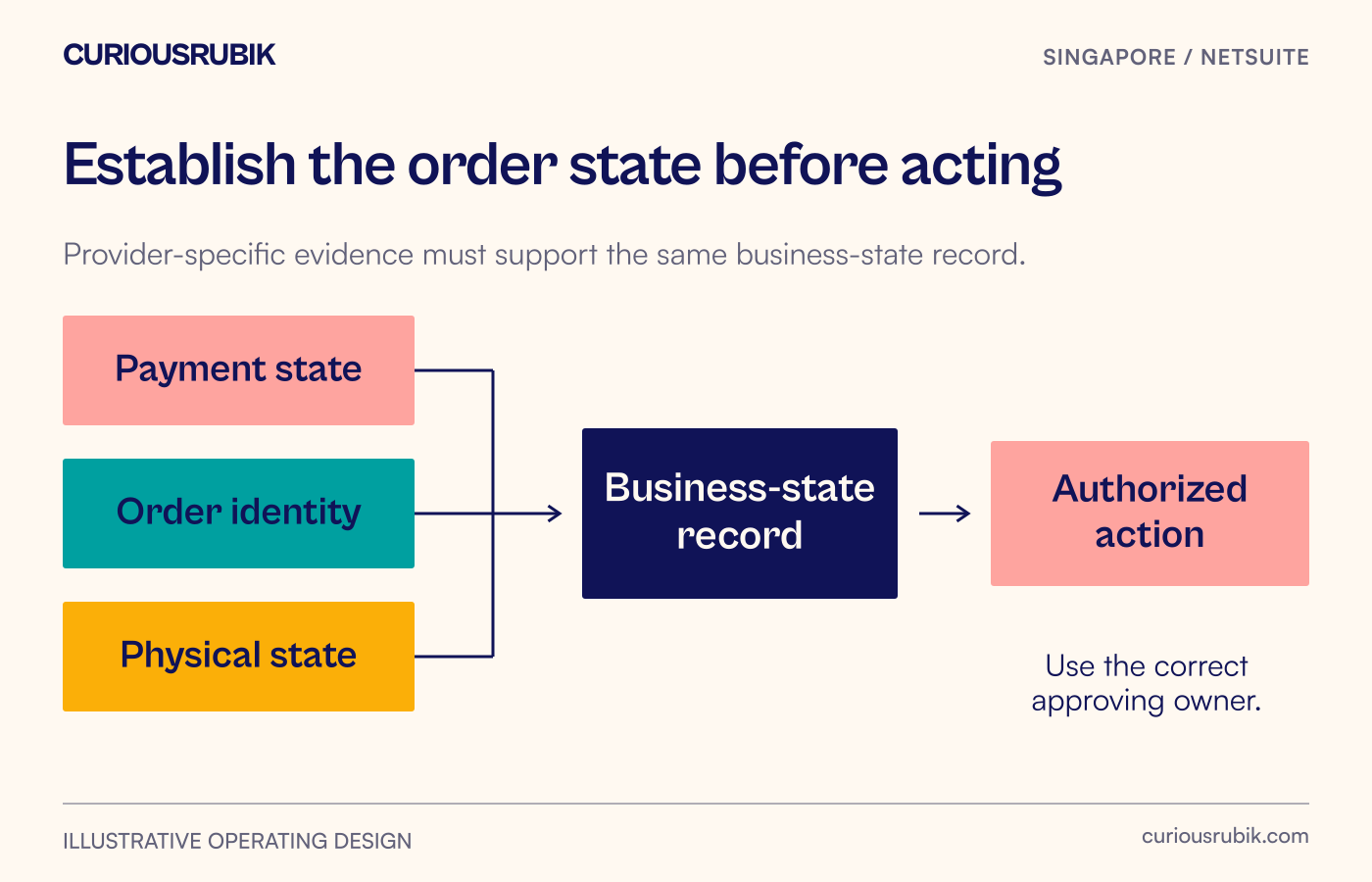
The recovery owner first assembles a business-state record. The objective is to establish what has happened before deciding what should happen next.
The evidence request each team should receive
Ask payments for the provider transaction reference, the authoritative transaction state, amount and currency, and any reversal or refund already recorded. Use the provider's documented meanings. Do not translate every success label into settled cash, or every cancellation label into money returned.
Ask the ERP operator for the specific NetSuite order identity, selling entity, customer reference, relevant lines and the current operational state. Include linked records that matter to the incident, but avoid collecting unrelated customer information.
Ask the integration owner for the warehouse instruction identity, the submitted version, submission time and any known acknowledgement. Their task is to connect the same business instruction across systems, not merely show a successful network request.
Ask the 3PL for its own instruction reference and current physical state, including whether goods are unreleased, picked, dispatched or otherwise constrained. The warehouse owns the evidence of what it has done. The seller's commercial team owns the promise made to the customer.
Preserve event time and evidence-retrieval time separately. A warehouse status retrieved now may describe an earlier event, and the physical state can change while the investigation is underway. Important evidence should therefore carry a timestamp and an identified source.
A recovery authority table
Use four decision rows in the operating contract. The filled example below is a proposed governance model, not a built-in NetSuite permission structure.
- Evidence gathering: the recovery coordinator may request and read the approved operational evidence. Technical teams can investigate within their assigned access. This does not authorize a financial or fulfilment change.
- Re-establishing a missing reference: the integration owner may follow an approved, tested procedure when evidence proves the underlying business action already succeeded. The procedure must preserve the original action rather than create a replacement.
- Releasing or stopping goods: the seller's authorized operations owner approves the action after the 3PL confirms the current physical state and its supported options. A warehouse stop request needs a confirmed outcome.
- Refunding, crediting or compensating: the authorized commercial or finance owner approves the specific amount and treatment under the seller's policy, with payment and accounting follow-through separately verified.
Name a backup for the recovery coordinator and the consequential approvers. A Singapore team supporting regional fulfilment needs coverage for the actual warehouse operating window and escalation route. Do not assume a provider's generic support hours match the period when a shipment can still be stopped.
Work through the three possible findings
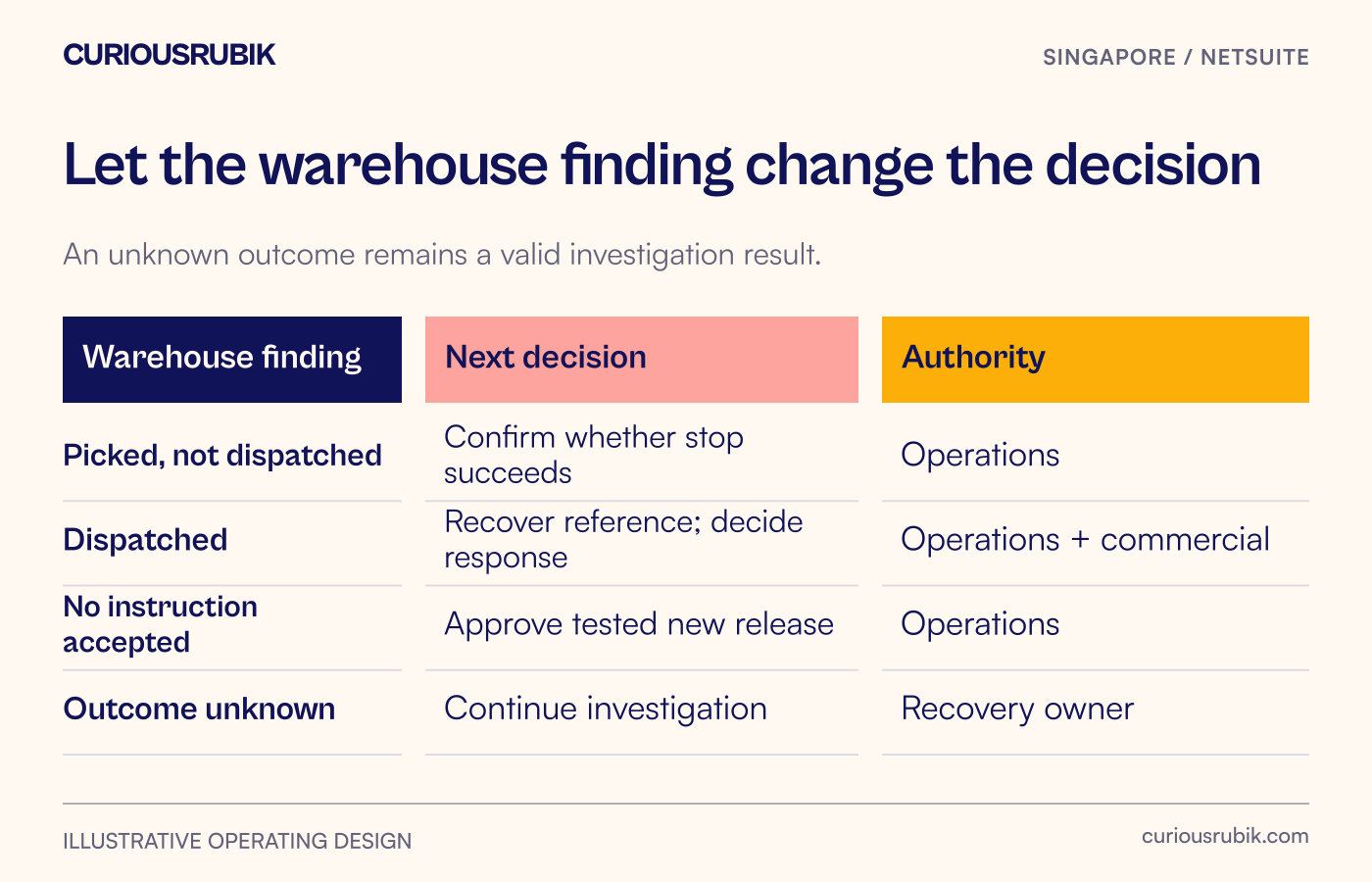
Suppose the 3PL finds the instruction and confirms the goods are picked but not dispatched. The operations owner asks whether a stop is still possible, and the coordinator keeps that request open until the warehouse confirms the outcome. Customer service communicates the known state and avoids promising a refund or replacement that has not been approved.
If the warehouse instead confirms dispatch, resending the order would create an unnecessary risk. The next step is to recover the shipment reference into the agreed systems and determine the appropriate customer response. Any return, refund or goodwill decision follows the seller's approved commercial process rather than being inferred from an earlier missing status.
If the warehouse confirms that no instruction was accepted, the coordinator can present the evidence to the authorized operations owner. A new release may then be appropriate through the tested integration procedure. Before doing so, establish what prevents an old delayed message from creating a second instruction later.
An unresolved warehouse search is a fourth outcome, not proof of absence. Keep the order in investigation with an owner and escalation time. This may be uncomfortable, but inventing certainty can convert a delayed shipment into two conflicting commitments.
What the software can and cannot settle
NetSuite can be part of the order and integration architecture, but the exact records, status mappings and recovery controls depend on the configured account and connected services. Oracle markets NetSuite Integration Platform as an add-on module. Its availability does not establish that a particular seller has licensed it or implemented the required payment and 3PL flows.
Whether the integration uses that platform, another route or custom work, ask for a demonstration of the actual recovery procedure. The design must identify the evidence available at each boundary and the limits of any duplicate protection. Provider-wide claims such as “automatic recovery” are insufficient for a case that may require a human commercial decision.
For technical failure categories and retry design, refer to CuriousRubik's NetSuite API recovery guide. The responsibility addressed here is broader: restoring one customer order when no single provider controls its entire state.
Close the incident against the customer outcome
Define closure evidence before taking corrective action. For a completed delivery route, require the agreed order, payment and shipment references to be consistent and the customer-facing information to be updated through the authorized process. For a cancelled route, require confirmation that the fulfilment instruction is stopped or otherwise resolved and that any approved financial action has reached its defined completion state.
Keep unsettled follow-up visible. A refund request that has been submitted may still require confirmation under the payment provider's process. An order marked cancelled in one system may still have an active warehouse instruction elsewhere. The coordinator should not close the case because the local error message has disappeared.
Rehearse this contract with one paid-but-unshipped test order before the next incident. Ask each team to supply its evidence, identify its action authority and demonstrate the handoff. The result should be a short, usable agreement that lets the Singapore operation recover the customer's order without depending on whichever provider answers first.