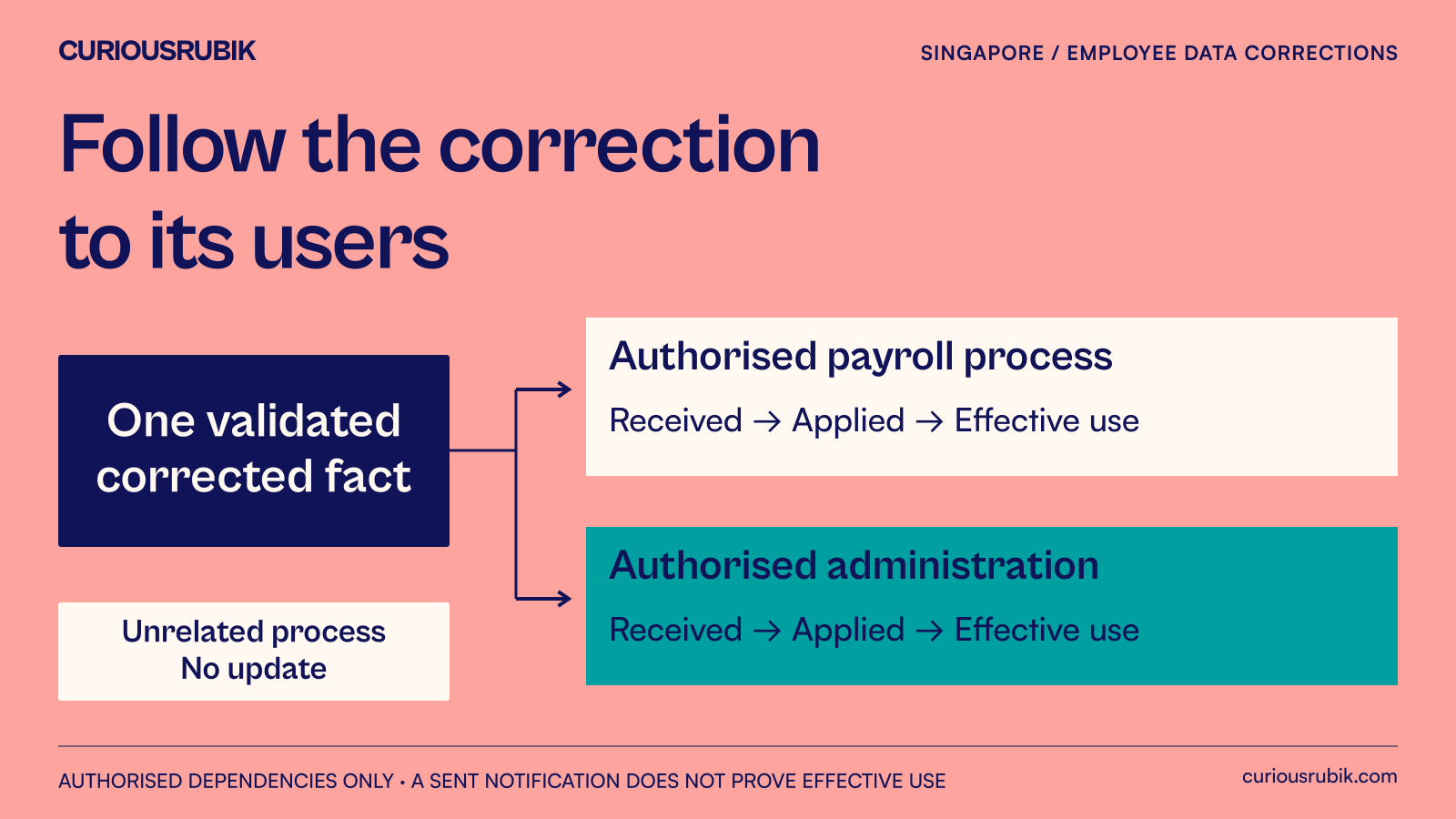
An employee corrects their name with HR. The main record is updated, but the next payslip still uses the old value and a benefits administrator asks the employee to submit the correction again. The field edit succeeded; the operational correction did not.
A reliable process follows an approved correction to the places that legitimately use the fact. It establishes the source, identifies affected outputs, sends only the necessary information and checks that the receiving process is actually using the corrected version.
For a Singapore employer, PDPA accuracy and correction considerations make this more than an administrative convenience. The applicable scope and exceptions still need assessment. The workflow below is a practical way to coordinate the work without spreading every employee detail everywhere.
Test the correction at the point of use
Begin with a hypothetical name correction. HR has verified the relevant request and supporting evidence through its normal process. Instead of asking only whether the HR record changed, ask what the next dependent process will produce.
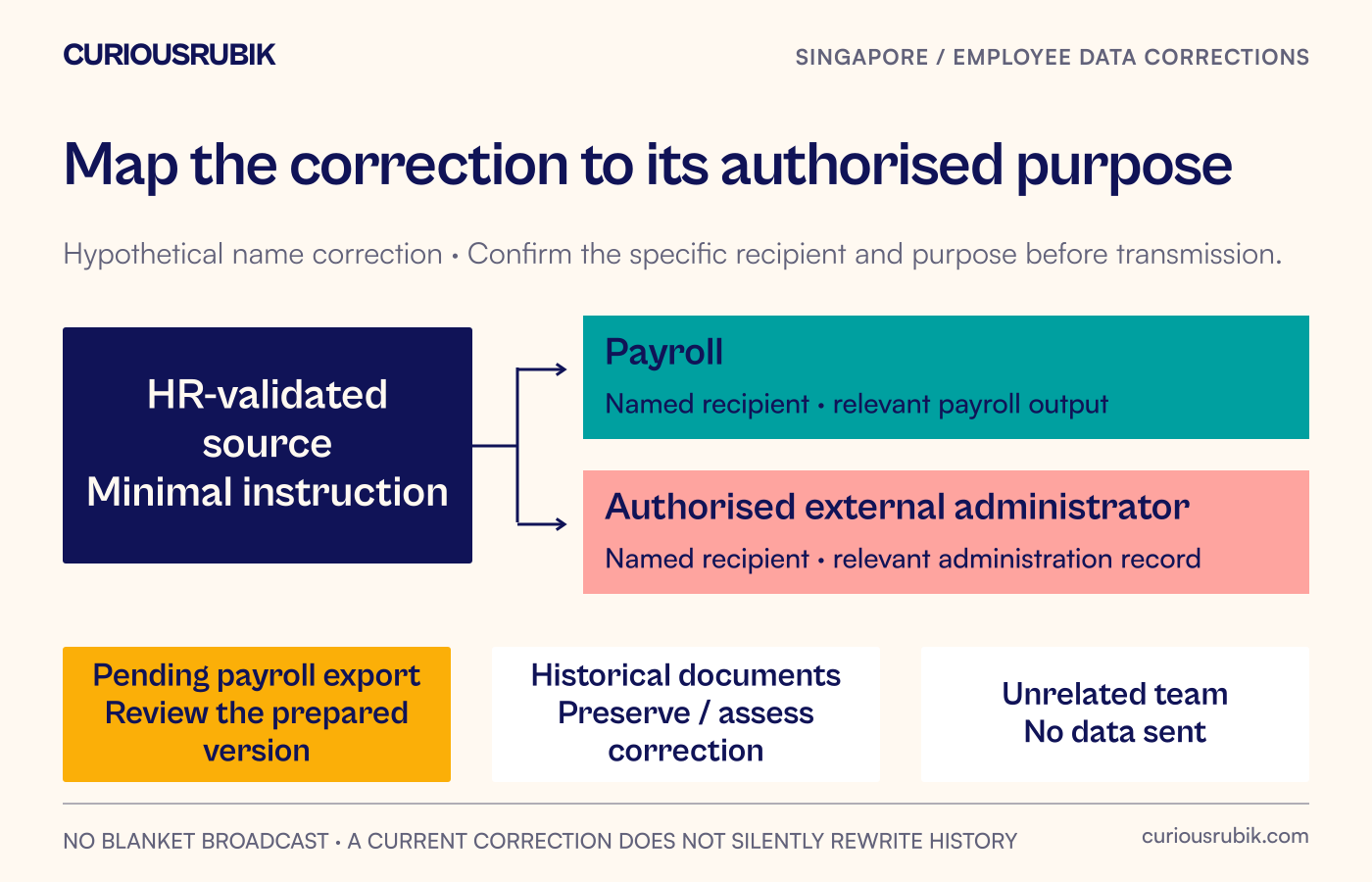
Will payroll use the updated name in its next output? Does an authorised external administrator maintain a separate record? Is a scheduled export still holding an older version? Are there generated documents waiting for release that need review?
This question identifies dependencies that a list of applications may miss. A monthly file can continue carrying the old value even though both the source and receiving record have been corrected, if the export was prepared earlier. An outdated working template can recreate an error after the main correction is complete.
The HR data steward coordinates the correction. Each receiving process owner confirms its own update and the point from which the correct value will be used. The steward should not mark the case closed merely because every notification was sent.
Establish what changed and when it applies
Different requests can look similar. A factual error may require correction. A person's circumstances may have changed from a particular date. A preferred display name may serve a different purpose from the name required on a formal record.
Record the type of change, validated value, relevant effective date and authoritative evidence reference. Where a specialist must determine the appropriate treatment, keep that decision visible. Do not collapse every request into an unrestricted overwrite of all historical occurrences.
For the name example, the payroll owner determines whether an upcoming output needs the updated value and how any previously issued document should be handled under the relevant requirements. A current-record correction does not automatically mean that every past document should be regenerated with no audit trail.
MOM's payslip requirements include the employee's full name for covered employees. That makes payroll an obvious dependent process for a relevant name correction, but it does not establish that every other field held by HR belongs on the payslip or should be copied to the payroll provider.
Map recipients by purpose
Use a correction-impact checklist with the field or fact, processes that use it, authorised recipient, required action and acknowledgement method. Include existing exports, pending outputs and relevant external recipients where the applicable correction duty or business purpose requires action.
PDPC's guidance addresses accuracy, access and correction, including circumstances in which corrections must reach other organisations. Have the privacy owner determine the applicable recipients, timing and exceptions for the actual request. The recommended checklist supports that assessment; it is not a substitute for it.
Share the minimum information needed to identify and apply the correction. A provider may need a case reference, employee identifier and corrected field, without receiving the underlying personal document. Use the organisation's approved transfer method and verify the intended recipient.
Avoid forwarding the original request to a large group for convenience. The request may contain unrelated information or supporting material that those recipients do not need. A concise, authorised correction instruction is often more useful and more controlled.
Read the diagram text
CURIOUSRUBIK SINGAPORE / EMPLOYEE DATA CORRECTIONS Map the correction to its authorised purpose Hypothetical name correction · Confirm the specific recipient and purpose before transmission. HR-validated source Minimal instruction Payroll Named recipient · relevant payroll output Authorised external administrator Named recipient · relevant administration record Pending payroll export Review the prepared version Historical documents Preserve / assess correction Unrelated team No data sent NO BLANKET BROADCAST · A CURRENT CORRECTION DOES NOT SILENTLY REWRITE HISTORY curiousrubik.com
Use acknowledgements that prove the right thing
A receiving process should distinguish received, validated, applied and effective in output. These can be separate events, especially near a payroll or reporting cut-off.
Suppose HR sends the correction after a payroll input file has been approved. The provider acknowledges it but cannot include it without a controlled revision. The payroll owner must decide the appropriate next step, record the affected run and confirm the result. A simple “received” response should not be shown to the employee as “all records updated”.
Keep the original case reference through retries. If a message fails, the steward can check the existing status and resend through the authorised route without creating another competing correction. If two different values arrive, pause the affected update for validation rather than let the latest timestamp decide which one is true.
The acknowledgement register should identify the recipient, instruction version, outcome, effective point and unresolved question. It does not need to duplicate every personal field or store complete evidence documents in the tracking row.
Keep payment instructions on their own verification path
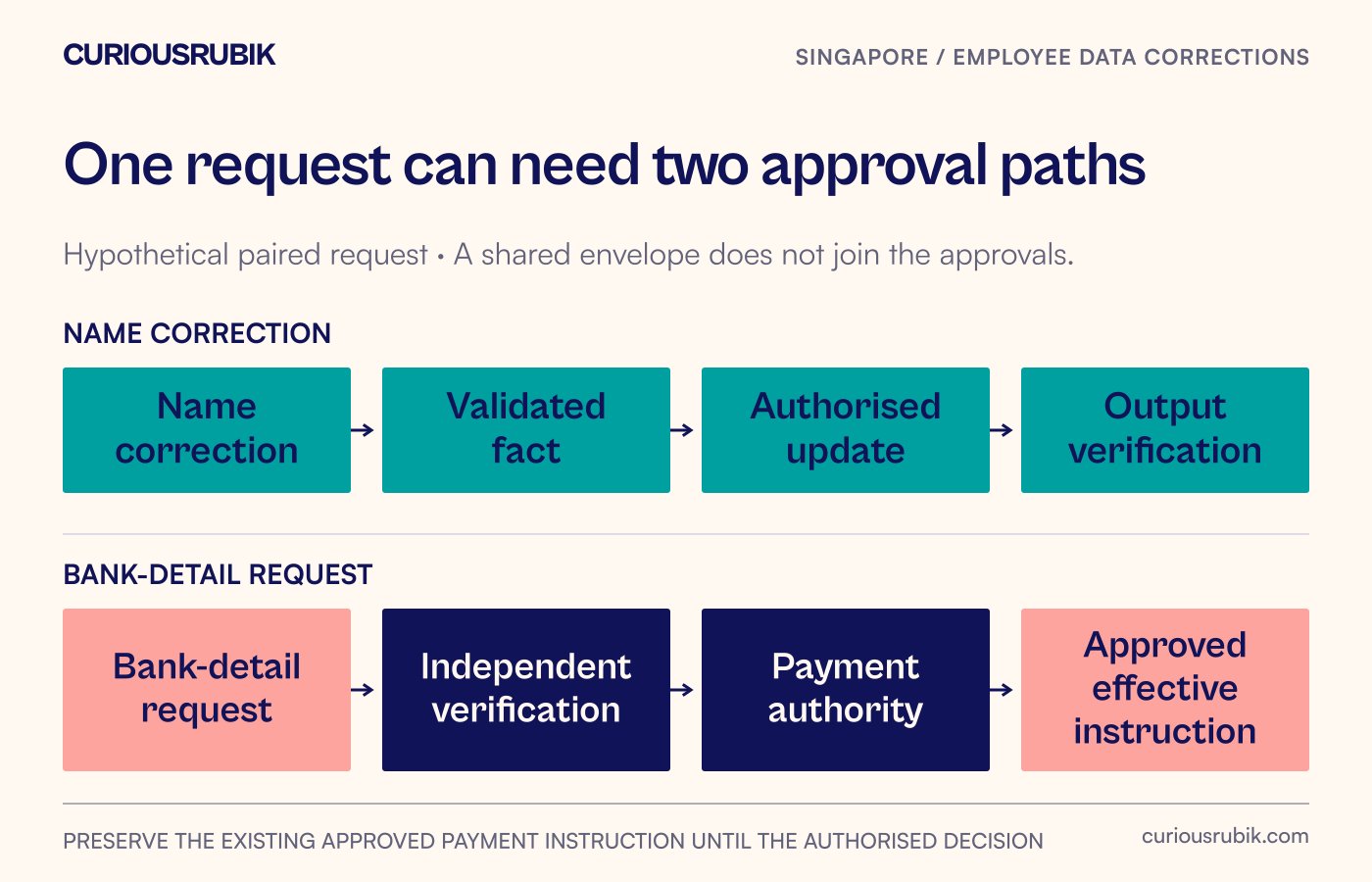
A bank-detail change carries a different operational risk from a display-name correction. Even if both arrive in the same employee request, payment instructions need the organisation's independent verification and approval process before they affect a payment.
Do not let successful validation of one personal detail authorise all other requested changes. A genuine employee may have made an error, or the instruction may have reached the business through a compromised channel. The payment owner needs the evidence required by the applicable control.
This distinction should remain clear in the automation. A validated name change can create appropriate update tasks. A proposed bank change should create the separate verification case and preserve the existing approved payment instruction until the authorised decision is made. The process must also handle a legitimate urgent correction without borrowing another person's credentials or bypassing review.
Read the diagram text
CURIOUSRUBIK SINGAPORE / EMPLOYEE DATA CORRECTIONS One request can need two approval paths Hypothetical paired request · A shared envelope does not join the approvals. NAME CORRECTION Name correction Validated fact Authorised update Output verification BANK-DETAIL REQUEST Bank-detail request Independent verification Payment authority Approved effective instruction PRESERVE THE EXISTING APPROVED PAYMENT INSTRUCTION UNTIL THE AUTHORISED DECISION curiousrubik.com
Preserve necessary history without continuing the mistake
Historical records can be needed to explain what was used at an earlier point. Preserve the relevant version and correction event according to the applicable retention and record requirements. Mark superseded information so that it is not mistaken for the current value.
That is different from leaving stale copies in active use. Identify reusable templates, recurring exports and provider files that can reintroduce the error. If a copy is no longer needed, route it through the authorised retention process rather than retaining it indefinitely as an informal backup.
The correction should also survive a failed update. Keep a visible exception with the receiving owner and next action. Silent partial success can be worse than an obvious failure because HR may reassure the employee while another process continues using the old value.
Close the case with a small verification sample
Automation can identify known dependencies, route approved instructions and alert the steward when acknowledgements are missing. It can compare a later output with the approved correction, subject to appropriate access. It should not infer that every recipient needs every field or decide disputed evidence on its own.
Test a correction through one complete cycle. Confirm the source, the relevant transfer and an actual dependent output. Include a cut-off case, a failed notification and conflicting values in the test so that exceptions have named owners.
Measure stale details still used, repeat requests from the same employee and unnecessary duplication of supporting information. A high count of sent notifications is not the outcome. The useful result is that the corrected fact is used where it should be, history remains explainable and the employee does not have to repair the same error again.