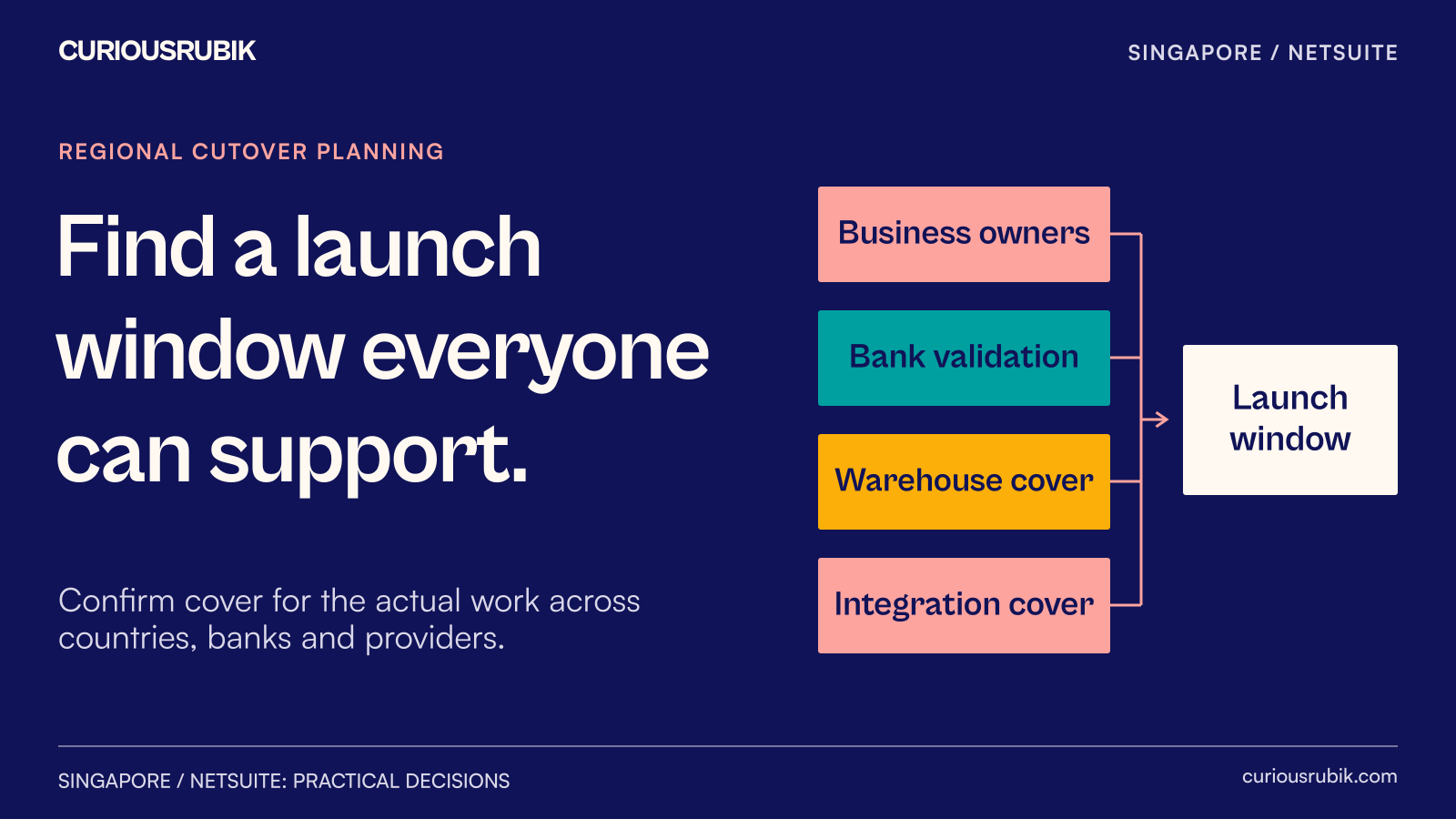
Select a window that supports the whole dependency chain.
A regional NetSuite cutover needs a dependency calendar, not just a Singapore holiday calendar. The useful window is one in which the necessary business owners, banking contacts, warehouse teams and integration providers can perform their specific tasks. A public holiday is a warning to investigate availability; it does not prove that every service is closed or that an employee is available because the date is an ordinary workday.
Start with the last decision that can safely stop the launch. Then work backward through the people, systems and evidence needed to make it. This approach exposes a missing provider commitment before the team begins irreversible or difficult-to-reverse work.
Use published dates as the starting evidence
Singapore's Ministry of Manpower lists Chinese New Year on 6 and 7 February 2027, with Monday 8 February also a public holiday. A Singapore-led project considering that period should therefore examine the availability of headquarters decision-makers and operating teams explicitly.
The dates alone do not settle the cutover. A provider may have a special holiday service arrangement. A finance owner may be on leave before or after the holiday. A regional entity may operate on a different calendar. Banking and settlement arrangements require confirmation for the actual institution, service and transaction type.
Record the source and the date checked in the working calendar. Recheck official calendars and obtain current provider commitments before approving an operational window. Do not substitute last year's holiday pattern, an unofficial calendar or a sales conversation for task-specific confirmation.
Build a calendar of tasks rather than availability labels
Consider a fictional Singapore headquarters with two regional operating teams. Country A runs a trading business through a warehouse provider. Country B runs a service business. The project is comparing two possible cutover windows. The country labels, provider arrangements and times below are illustrative; they are not claims about any country's actual holiday dates or service hours.
The calendar contains one row for each dependency:
- Singapore finance: approve the final reconciliation and release the launch decision. Evidence: named controller and deputy confirm attendance for the decision window. A general “finance available” label is insufficient.
- Country A operations: stop the agreed transaction stream, preserve outstanding references and verify the first post-launch warehouse handoff. Evidence: operating manager confirms staffing and the warehouse provider confirms its own role.
- Country B finance: approve its opening position and identify transactions that must remain in the prior system. Evidence: signed readiness checklist and an available reviewer.
- Banking contact: support the specific file or service validation included in scope. Evidence: written confirmation of the relevant service window and escalation route, including any limitations.
- Integration provider: monitor the agreed messages and investigate exceptions. Evidence: named responder, supported endpoint and confirmed coverage for the first operating cycle.
Add local date, time zone, task start, task end, predecessor, owner, deputy, proof of availability and the latest safe stop time. Store a common reference time alongside local times so a date rollover cannot quietly move a handoff into another team's unavailable period.
Compare two windows with a filled decision record
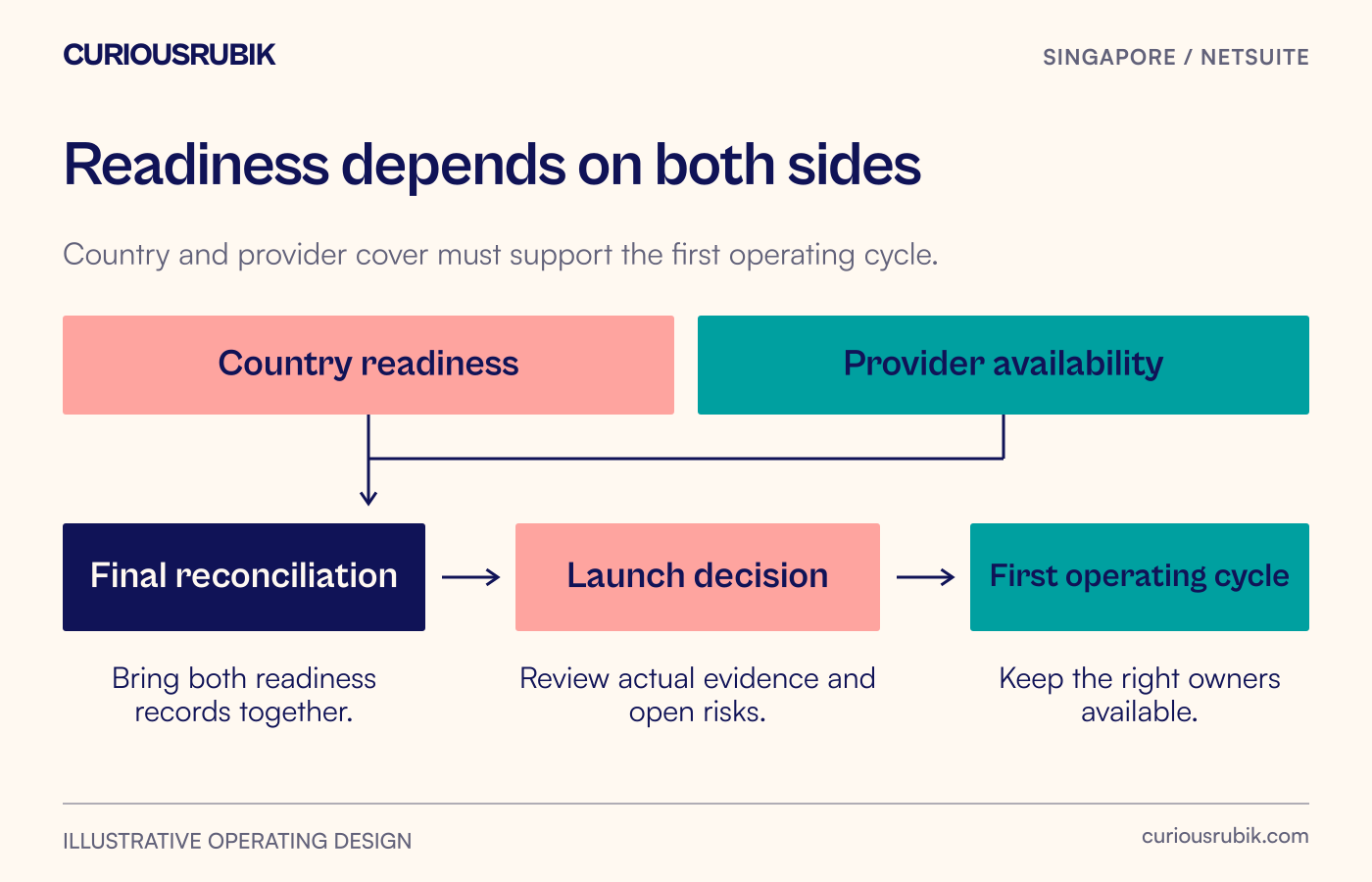
In this illustrative comparison, Window A falls near the Singapore holiday period. Window B is a later candidate whose exact date will be chosen only after current calendars and provider commitments are verified.
Window A: Singapore finance has a named reviewer for the reconciliation. Country A operations can stop transactions, but the warehouse provider has confirmed intake monitoring only; its specialist for rejected messages is unavailable. Country B finance has no confirmed deputy. The proposed banking validation remains unconfirmed.
Window B: Singapore finance and both country owners have confirmed the required review windows. The warehouse provider has named an exception specialist. The banking contact has confirmed the particular validation in scope. The integration provider has confirmed monitoring through the first operating cycle.
The preliminary recommendation is Window B, subject to final readiness evidence. Window A has several unresolved dependencies even though some people can work. The decision is based on the tasks the project needs, not a general rule against holiday cutovers.
Now add a business consequence: the fictional trading entity has a customer commitment that makes Window B less convenient. The sponsor can investigate another window, change the approved transaction boundary or accept a properly assessed business delay. It cannot make the warehouse specialist available by changing a status cell to green.
Put the fallback decision before the freeze
A cutover plan should distinguish postponing the start from recovering after work has begun. They require different evidence. Before the transaction freeze, the team may be able to retain the existing operating plan. After migration, interface activation or new production transactions, a return to the old process may be more complicated.
For each consequential step, identify what has changed, what can be reversed, what needs reconciliation and who approves recovery. Avoid using “rollback” as a single promise covering configuration, data, external messages and real-world activity. An earlier configuration version does not explain how to resolve transactions already sent elsewhere.
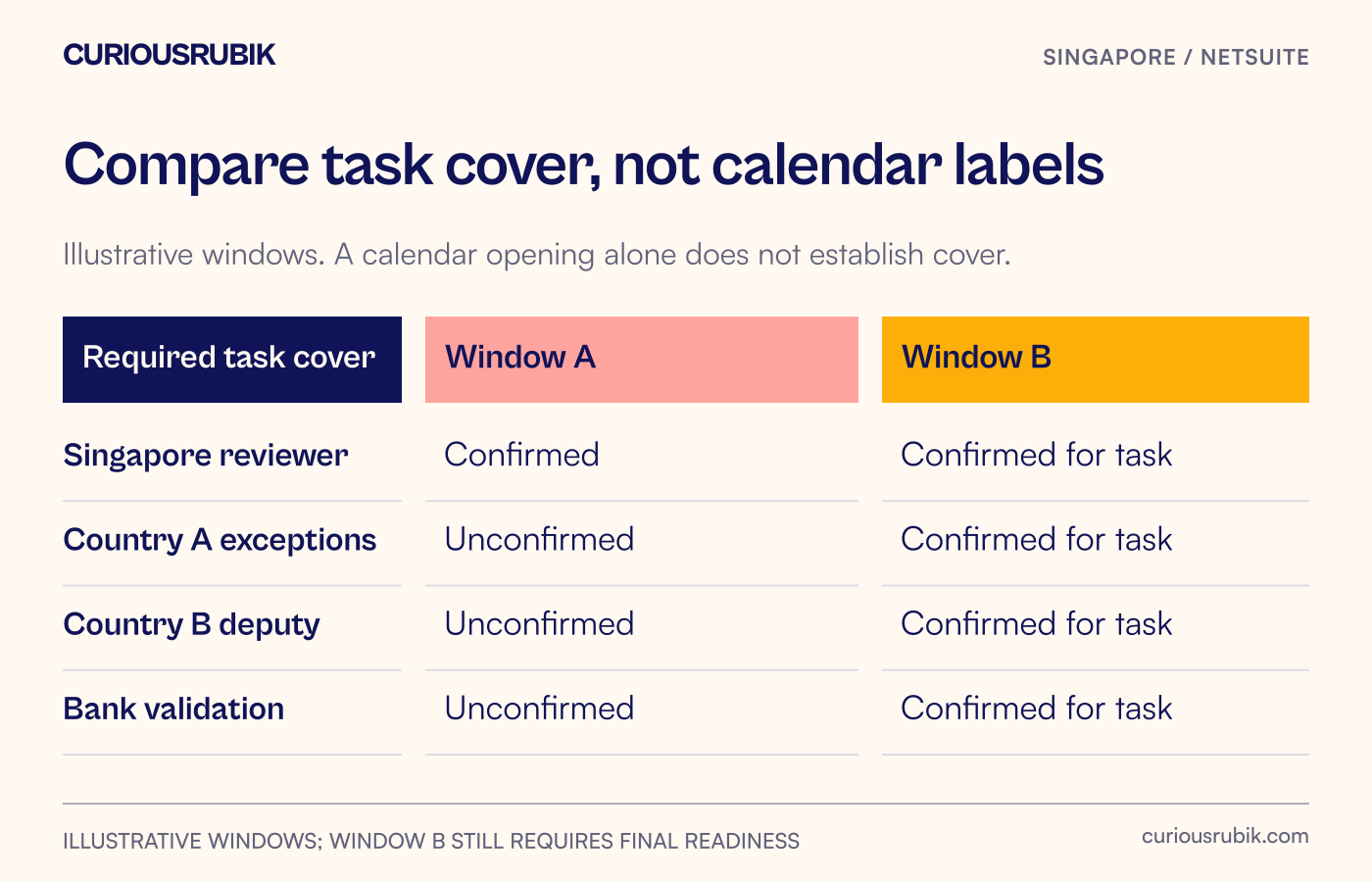
In the fictional plan, the final go/no-go checkpoint occurs before the agreed freeze. The Singapore sponsor owns the overall decision. Each country owner confirms its readiness, finance approves reconciliation evidence, and technical owners report the state of their dependencies. A designated deputy can act only within documented authority.
If the bank validation is still unconfirmed at that checkpoint, its owner records the consequence and the available alternatives. The sponsor makes the decision before the team proceeds into the dependent step. Silence from a provider is treated as missing evidence.
Protect the first operating cycle too
The quietest migration window may be followed by the busiest unsupported morning. Include the first customer order, first receipt, first payment-related task and first reporting review that matter to the agreed scope. Ask who will be available to recognize a problem and authorize the next action.
Also check whether multiple teams depend on one specialist. A person may appear available on three rows while being unable to handle simultaneous exceptions. The calendar should show task conflicts as well as absences.
NetSuite OneWorld can support a regional entity structure, but scheduling people and external services remains a project responsibility. The system cannot supply a missing local approver or change a provider's contracted availability.
Before approving NetSuite implementation plans, request the dependency calendar with its evidence and stop points. For Singapore-led regional operations, a sound launch window is one the entire operating chain can support, including the first exceptions after go-live.