NetSuite Data Warehouse Integration with Reliable Incremental Loads
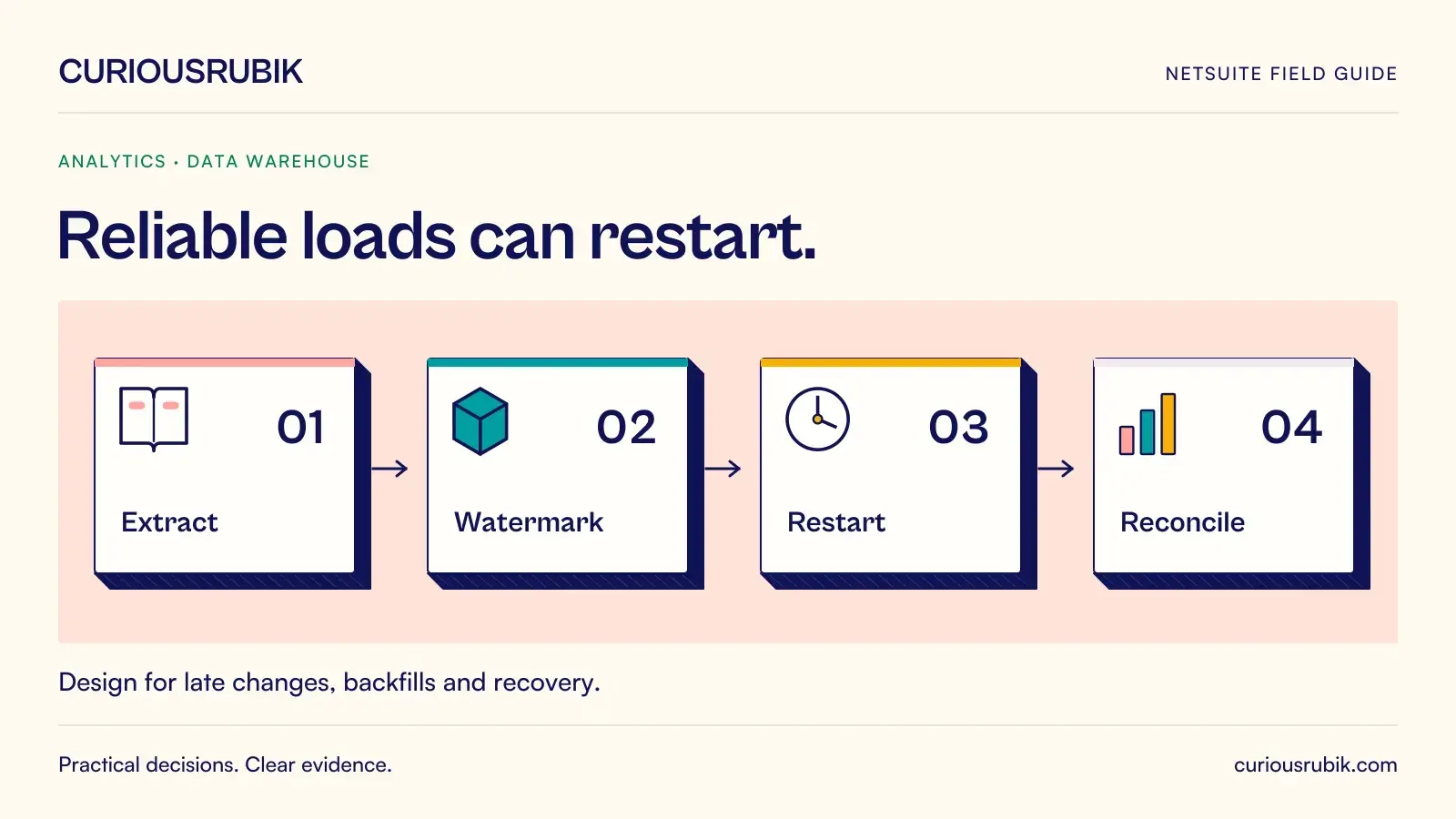
A warehouse can contain every extracted NetSuite record and still report the wrong financial result. It may miss a late line change, retain a deleted source record, combine accounting books, or publish only part of a refresh. Reliable reporting requires separate controls for extraction completeness and accounting meaning.
Design NetSuite data warehouse integration around explicit data scope, repeatable incremental logic, deletion handling, and controlled backfills. Then reconcile the reporting layer against finance-approved totals. This makes the pipeline explainable when a familiar number changes and prevents successful processing logs from becoming the only evidence of completeness.
Define the scope and grain of each dataset
Start with the questions the warehouse must answer. Inventory availability, order fulfillment, revenue postings, and customer balances need different records and different row grains. A broad request for “all transactions” is not a sufficient specification.
For each dataset, identify the source channel, record types, keys, relationships, required fields, update behavior, and approved audience. Confirm that the chosen extraction method supports the necessary data under the intended role and account features. Query access and record-service access are separate capabilities.
Define raw, prepared, and reporting layers. The raw layer preserves authorized source evidence and extraction context. The prepared layer resolves keys and applies documented transformations. The reporting layer expresses approved business measures. Keeping these purposes distinct helps locate a difference without rewriting source evidence to match a desired result.
Record retention and privacy requirements alongside technical scope. Copying data into a warehouse creates a new access boundary. Source permissions alone do not establish who may query, export, or retain the extracted data.
Make incremental logic restartable
An incremental load needs a reliable change signal, a stable ordering method, and a checkpoint that advances only after the intended batch is durably accepted. Verify how the chosen source exposes changes rather than assuming every relevant update changes one parent timestamp.
A practical design records the extraction boundary, batch identifier, row counts, and destination commit state. If a load stops, the next run should know which work is complete and which must be replayed. An acknowledged source page is not necessarily a committed destination batch.
Consider a hypothetical watermark at 10:00 UTC. The next run reads changes through 10:15 and overlaps the previous window by five minutes. Repeated records are merged using verified keys and change precedence. The overlap helps capture certain timing effects, but its duration must be justified by observed source behavior; it does not guarantee detection of every possible late change.
If several records share a timestamp, use a verified tie-breaking or paging strategy. A boundary based on “greater than the last timestamp” can skip records with the same timestamp if the extraction stops midway through that group.
Test late changes at the right level
Create a synthetic transaction, load it, and then make a permitted change to a relevant line or related record. Confirm that the next extraction detects the change and updates the intended warehouse row exactly once.
Repeat the test for an older transaction changed after the normal reporting window. If the pipeline only revisits recent transaction dates, the change may be missed even though its modification time is new. Separate the business date from the change-detection boundary.
For a hypothetical monthly expense dataset, a transaction posted in the prior month receives an approved classification correction this month. The warehouse should retain an explainable history or update the current representation according to its design. The reporting owner decides whether previously published snapshots remain fixed or are restated.
Do not let the extraction team make that accounting decision implicitly by choosing a merge strategy. Historical representation is part of the report contract.
Distinguish deletions from inactivation and missing access
A source record absent from the next incremental batch is not proof that it was deleted. It may be unchanged, outside the filter, hidden by a role change, or unavailable during a failed extract.
Verify whether a supported deletion signal exists for the required record types and extraction channel. Deletion tracking is not universal across every source and feature configuration. Where a reliable signal is unavailable, evaluate periodic scoped comparisons or another approved completeness control.
Use explicit warehouse states where appropriate: active, inactive, deleted at source, or unresolved. Preserve the evidence behind a state change. Do not physically remove historical records solely because one source query returned fewer rows.
A synthetic deletion test should remove an approved test record, run the detection process, and confirm that the warehouse represents the change as designed. An inactivation test should produce a distinguishable result. A denied-access test should raise an access or completeness exception rather than marking the entire excluded population deleted.
Backfill without corrupting current processing
A backfill introduces historical data while ordinary changes may continue. Define its date or key boundaries, source snapshot assumptions, processing priority, and merge precedence. Otherwise, an older backfill row can overwrite a more recent incremental change.
For a hypothetical backfill of January through March, identify the source boundary and assign a distinct batch lineage. Let the current incremental flow continue only if the two processes can coordinate writes safely. Reconcile each period separately and prevent incomplete historical partitions from appearing as finished reporting data.
Test an interrupted backfill. Resume from a verified checkpoint and compare unique keys, counts, and totals. Rerunning the same backfill should not double the data. Also test a correction occurring while the backfill is in progress and establish which version wins.
Reconcile records and accounting separately
Raw completeness checks answer whether the intended source population arrived. They include unique-key counts, expected partitions, missing references, duplicate rows, and change-boundary coverage. These controls can pass while the financial model remains wrong.
Accounting checks answer whether the transformed measure matches its approved meaning. Align subsidiary, accounting book, posting period, currency, account scope, and treatment of adjustments with the comparison report. Review joins that connect transaction, line, and accounting detail.
For a synthetic example, 120 source accounting rows total 18,500 in one agreed currency and book. The warehouse receives all 120 rows, but a dimension join duplicates ten rows worth 2,000. Extraction is complete while the reporting total is 20,500. The fix belongs in the model, not in an arbitrary source filter that removes the difference.
Retain both sets of controls with the batch. Publish data only after the relevant checks pass or after an authorized owner accepts a clearly described limitation.
Questions about warehouse reliability
Is a modified timestamp enough for incremental loading?
Only if its behavior covers the required changes and the paging and checkpoint logic handle boundaries safely. Test related-record updates, identical timestamps, late changes, and interrupted loads before relying on it.
Should deleted records disappear from historical reports?
That depends on the approved reporting and retention design. Preserve enough lineage to explain the change. Finance and data owners should decide how historical snapshots and current-state reports represent deletion.
How often should a full comparison run?
Choose a frequency based on source limitations, consequence of missing data, and processing cost. A periodic comparison can complement incremental controls, but it should have a defined scope and an owner for differences.
Does a balanced ledger total prove every record arrived?
No. Missing and duplicated amounts can offset each other. Combine financial controls with unique-key, population, and relationship checks. Different tests reveal different classes of error.
Design the controls before expanding the pipeline
CuriousRubik can help scope a warehouse integration review around one dataset's watermark, deletion behavior, and finance controls. A tested incremental and backfill contract provides a practical foundation for broader reporting.