Last reviewed: 10 October 2026. Product details reflect this review date. Availability and behavior can vary by account, role and release.
Editorial ink illustration: A recurring-activity dial and a period gauge are connected but measure different things.
An unexpected subscription invoice is easier to investigate when you can trace how its amount was built. Start with the customer arrangement, inspect the subscription and pricing, identify the effective dates, and follow the resulting charges into the invoice.
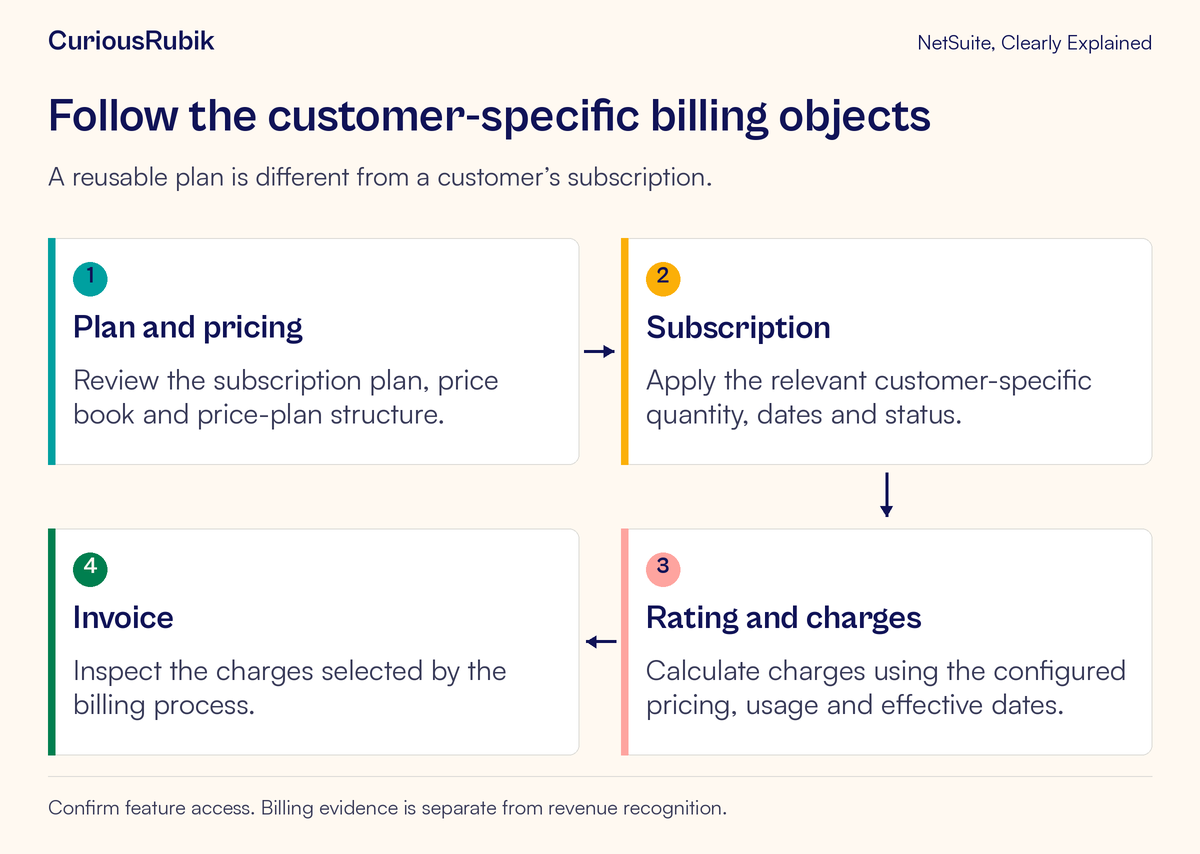
SuiteBilling uses several related records for this work. A subscription plan describes a reusable offering. A customer subscription holds the particular arrangement. Rating calculates charges, and billing turns eligible charges into invoices. Each stage answers a different question.
This lesson is for billing administrators and finance users. It follows a fictional service subscription through a mid-cycle quantity change. Confirm SuiteBilling availability, configured features, and role permissions before using the method. Physical-item subscription scenarios require their own supported-functionality review; the example here is a service.
Begin with the agreement you need to bill
Before inspecting records, summarize what the customer agreed to buy. Identify the service, quantity or usage basis, price, billing frequency, start date, and any approved changes. An invoice can be mathematically consistent with its configuration while the configuration fails to represent the agreement.
Separate the subscription term from the billing cycle. A customer may have an agreement covering a longer period while being billed monthly. Also identify whether the price is recurring, usage-based, or another supported structure. Do not infer the calculation from an invoice description alone.
Use the approved commercial record as the business reference and the subscription records as the system evidence. If the two differ, name the difference before deciding whether the issue is pricing setup, an effective date, missing usage, or invoice selection.
This keeps the investigation focused. “The invoice is too high” becomes a question such as “Which quantity and rate were used after the approved change date?”
Separate the reusable offering from the customer subscription
A subscription plan is a reusable structure for the items included in an offering. It can include renewal information and links to pricing. The plan is useful for establishing a consistent starting point, but it is not itself one customer's bill.
A subscription is customer-specific. It identifies the relevant items, quantities, pricing, and dates for that customer's arrangement. Confirm the customer and subscription identifier rather than searching only for a plan name shared by many customers.
A price book organizes pricing for the offering, while price plans define the prices and supported pricing structures. One subscription plan can have more than one associated price book. That makes it important to inspect which pricing actually applies to the customer subscription.
These records should form a traceable chain. The reviewer should be able to explain which offering was selected, which pricing it uses, and how the customer's particular quantity and dates fit that structure.
Rating produces the charge calculation
Rating creates charges for subscription lines using the relevant quantity, pricing, usage, effective dates, and subscription or line status. A change to one of those inputs can affect the result even if the headline monthly rate stays the same.
Certain subscription actions trigger rating. Rating can also be run on demand or scheduled through billing operations. The fact that a subscription was saved does not, on its own, tell you which charge results are ready to inspect; check the relevant processing state and output.
Treat a charge as evidence of what the billing calculation produced. It is a stage to inspect before jumping to the invoice total. If the charge is unexpected, work back to its inputs. If the charge is correct but the invoice is unexpected, investigate how billing selected and presented it.
A billing operation can automate rating and invoicing work. Automation connects the stages, but it does not make the stages interchangeable. You still need to know whether the question concerns the calculation, the resulting charge, or the invoice.
Put a mid-cycle change on a timeline
Consider an invented service called Equipment Insight, billed for access to a monitoring service. The fictional agreement starts with ten service units at USD 40 per unit per month. For a complete unchanged monthly period, those stated inputs imply USD 400 before tax or other adjustments.
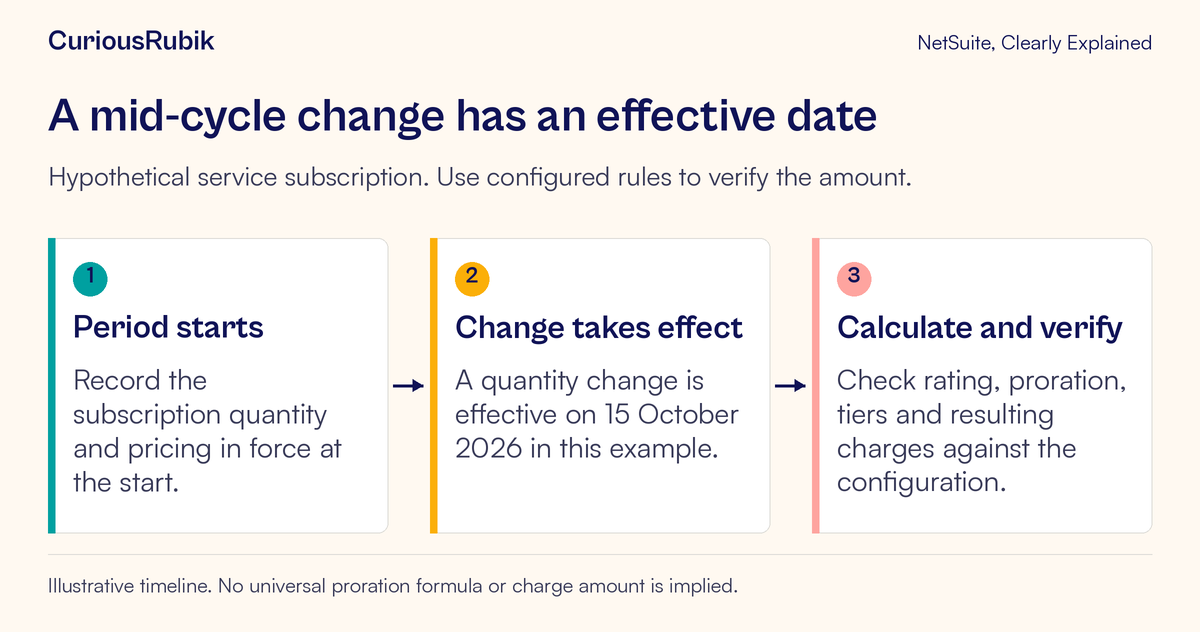
The customer approves an increase from ten units to twelve, effective 15 October 2026. The billing administrator needs to determine how the October charge should reflect that change.
The date matters as much as the quantity. A change entered on 10 October with an effective date of 15 October describes a different business event from a change effective immediately. Record both the approved effective date and the relevant system change, rather than using the entry date as a substitute.
For an active subscription, supported changes are handled through the appropriate change order. Change orders can alter status, pricing, quantity, or other supported aspects, and they take effect according to their effective dates and rules.
In this example, the reviewer traces the approved quantity change to the applicable change order and subscription line. They confirm that the original quantity, new quantity, and effective date agree with the approved request.
Do not invent the prorated amount
It is tempting to divide a month in half and calculate a blended total immediately. That can be wrong. Proration, billing frequency, tiers, price structure, and the timing of the change need to be checked against the configuration.
The lesson therefore does not prescribe an October charge amount. The number to verify is whatever the configured rules should produce for the agreed dates and quantities. The reviewer documents those rules, independently checks the expected calculation, and compares it with the resulting charges.
If the October total differs from USD 400, that difference is not automatically an error. The subscription changed during the period. The useful question is whether the difference follows the approved quantity change and configured calculation rules.
Check the resulting charges before the invoice
The reviewer confirms that the relevant rating has completed and inspects the charge records associated with the subscription and period. They identify which amounts relate to the pre-change and post-change conditions, or how the configured pricing represents the change.
They then trace those charges into the invoice. If an expected charge is absent from the invoice, the investigation moves to the billing process and eligibility for that run. If the charge itself is wrong, the investigation remains with subscription inputs, dates, pricing, and rating.
This sequence avoids editing an invoice to hide a subscription problem that could recur next month. Any correction should address the responsible record or process under the organization's approved controls.
Inspect status and usage when a charge is missing
A subscription can exist without every line being ready to produce the charge a user expects. Check the subscription and line status, activation timing, applicable dates, and the event that should have caused rating.
For usage-based billing, verify the relevant usage records and their relationship to the line and billing period. An estimated operational quantity, a submitted usage record, and usage included in the charge calculation are different pieces of evidence.
Also distinguish an incomplete rating process from a completed process with unexpected output. Repeatedly changing the subscription to force another result can make the history harder to interpret. Preserve the original conditions and have the billing owner inspect the processing state before retrying or correcting anything.
Use a small authorized test case when investigating a configuration change. Include the ordinary recurring period and one meaningful exception, such as the mid-cycle change. Record the expected amount only after the pricing and date rules are clear.
Keep invoice, payment, and revenue questions separate
An invoice establishes what has been billed through that transaction. It does not establish that the customer paid. Payment and application need their own records, as explained in customer payments and invoice balances.
Billing also does not establish when revenue should be recognized. SuiteBilling can work with revenue-recognition capabilities, but the recognition treatment depends on the applicable setup and finance policy. Inspect that process separately rather than equating an invoice date with a recognition conclusion.
The lesson on revenue arrangements, plans, and journals covers that separate record chain. Keeping the chains distinct prevents a correct billing result from being presented as proof that every accounting step is complete.
Give the reviewer a reproducible explanation
A useful billing investigation names the customer subscription, affected line, period, pricing reference, quantity or usage, and relevant change order. It then identifies the resulting charge and invoice records.
State the expected result and how it was derived. For the fictional example, that includes the ten-to-twelve quantity change and the 15 October effective date, together with the verified proration or other pricing rules. Avoid a conclusion based only on a screenshot of the invoice total.
If the evidence is incomplete, say which stage remains unresolved. “The approved quantity change is present, but the October charge calculation has not yet been verified” tells the billing owner what to do next. “Subscription issue” does not.
Retain the original evidence before a correction, then rerun the relevant test and review the next affected period. A mid-cycle fix can influence both the immediate bill and future recurring charges.
Your subscription-to-invoice checklist
- Confirm the customer agreement and subscription identifier
- Separate the subscription term from its billing cycle
- Identify the plan, price book, and applicable price plan
- Verify quantity, usage, status, and effective dates
- Trace an active-subscription change through the appropriate change order
- Establish the expected calculation from configured rules
- Confirm the rating result and inspect the charge records
- Trace the relevant charges into the invoice
- Check payment and revenue recognition separately when needed
- Preserve the explanation and retest after an authorized correction
The invoice becomes easier to explain when every amount has a traceable origin. Follow the customer arrangement through the subscription and calculation first, then inspect what the billing process actually invoiced.
For help improving subscription billing checks and exception handling, explore CuriousRubik's NetSuite optimization services.