Last reviewed: 10 October 2026. Product details reflect this review date. Availability and behavior can vary by account, role and release.
Editorial ink illustration: A clock, a completed-stage model and a recurring-service drum show different timing concepts.
A finance analyst sees a revenue arrangement for a customer transaction and a plan with amounts assigned to future periods. They expect the income statement to show the first amount immediately. When it does not, they assume the arrangement failed.
The missing distinction is between records that describe obligations, records that plan recognition and transactions that post to the general ledger. NetSuite Advanced Revenue Management, or ARM, uses several connected objects for these purposes.
This guide follows one small illustrative amount through those objects. It explains what each object proves and what the reviewer still needs to check. Recognition policy, performance obligations and accounting treatment must be approved by qualified finance personnel; the example is not a prescribed policy.
Confirm the revenue feature and your role
This article concerns Advanced Revenue Management (Essentials). Advanced Revenue Management (Revenue Allocation) is a separate add-on to Essentials. Do not assume that an account using ARM has allocation functionality enabled or licensed.
Classic Revenue Recognition has a different setup and workflow. Moving from classic recognition to ARM requires a supported transition with qualified assistance. It should not be treated as a casual feature toggle in an existing production account.
Check the role used for the review. Enabling ARM Essentials adds revenue manager and revenue accountant roles, with different setup responsibilities. Permissions remain configurable. Neither standard role includes Journal Approval by default when the accounting preference requires journal approval.
This means a user may be able to process revenue records without being the person authorized to approve the resulting journal. Keep preparation, approval and accounting-policy ownership clear in the training exercise.
Where OneWorld or Multi-Book Accounting is involved, identify the subsidiary and accounting book relevant to the review. A result from a different scope is not a valid comparison merely because the customer or source transaction looks familiar.
Begin with the underlying business promise
Start by identifying the source transaction or event and what the business has promised to deliver. Record the customer, relevant items, amounts and dates needed for the approved revenue treatment.
The system configuration must reflect the finance team’s interpretation of those obligations. A well-formed record cannot, by itself, establish that the underlying accounting judgment is correct.
For a teaching exercise, choose one source with a simple approved pattern. Avoid starting with a large contract containing amendments, several obligations and complex allocations. A small case makes the connections easier to inspect and the assumptions easier to challenge.
Keep billing and cash collection in view as related but distinct activity. An invoice documents billing. A payment documents receipt or application of cash. Neither alone proves that the same amount has been recognized as revenue in the same period.
Arrangement: the non-posting record of obligations
A revenue arrangement records information about customer performance obligations for allocation and recognition. It is a non-posting transaction. Its existence does not, on its own, create revenue in the ledger.
ARM can create arrangements from eligible sources, including supported approved sales transactions. The source’s eligibility and processing conditions matter; do not assume that every transaction creates an arrangement in exactly the same way or at the same moment.
When reviewing an arrangement, identify its source and the intended business scope. Ask whether it contains the obligations expected for this example, whether relevant amounts and dates agree with the source, and whether any required approval or processing remains outstanding.
The arrangement gives the reviewer a place to understand the revenue structure. It is not a substitute for inspecting the plans and posted entries that follow.
Element: the individual obligation within the arrangement
Revenue elements appear as lines on an arrangement and correspond to individual source lines representing performance obligations.
For the learner, the important question is, “Which obligation does this element represent?” Trace it to the relevant source line instead of interpreting the arrangement total in isolation.
If an arrangement contains several elements, each may have different recognition timing or treatment. Adding the elements together before inspecting those differences can hide the reason the current period’s revenue differs from the billed total.
Allocation, where configured and available, adds another possible difference between a billed line and the amount assigned for recognition. That difference must be understood through the approved allocation setup, not corrected merely to make two numbers look equal.
Rule: the configured pattern behind the plan
A revenue recognition rule defines how a recognition plan is generated. Its settings can include the recognition method, amount source and sources for the start and end dates.
Those settings turn an approved accounting pattern into system behavior. They do not decide the accounting policy independently. The finance owner should be able to explain why the selected rule fits the obligation.
A useful review records the rule name alongside its relevant settings and intended outcome. Names such as “standard” or “monthly” are insufficient evidence by themselves. Inspect the actual configured pattern and the resulting periods and amounts.
Once a rule has been used to generate a revenue plan, it cannot generally be edited except for its name, and it cannot be deleted. That is another reason to test configuration deliberately and use the supported change process rather than assuming a shared rule can be casually rewritten later.
Plan: which periods and amounts are expected?
A recognition plan identifies the intended posting periods and amounts. Its creation depends on the configured event and update process. For example, an actual plan may wait for a relevant billing or fulfillment event rather than appearing as soon as an arrangement exists.
Distinguish forecast plans from actual plans. Forecast plans support forecasting. Actual plans control revenue posting when recognition journals are generated. An element can have more than one actual plan, so do not assume a universal one-element, one-plan relationship.
A forecast may exist before the actual plan is ready. Editing a forecast also does not automatically change the actual plan. Label the plan type when discussing a discrepancy with another reviewer.
Check that the required accounting periods exist, that the dates reflect the intended pattern, and that the amount being planned is the correct amount for the element. If these inputs are wrong, journal generation is not the place to hide the problem.
Work through a 1,200 example
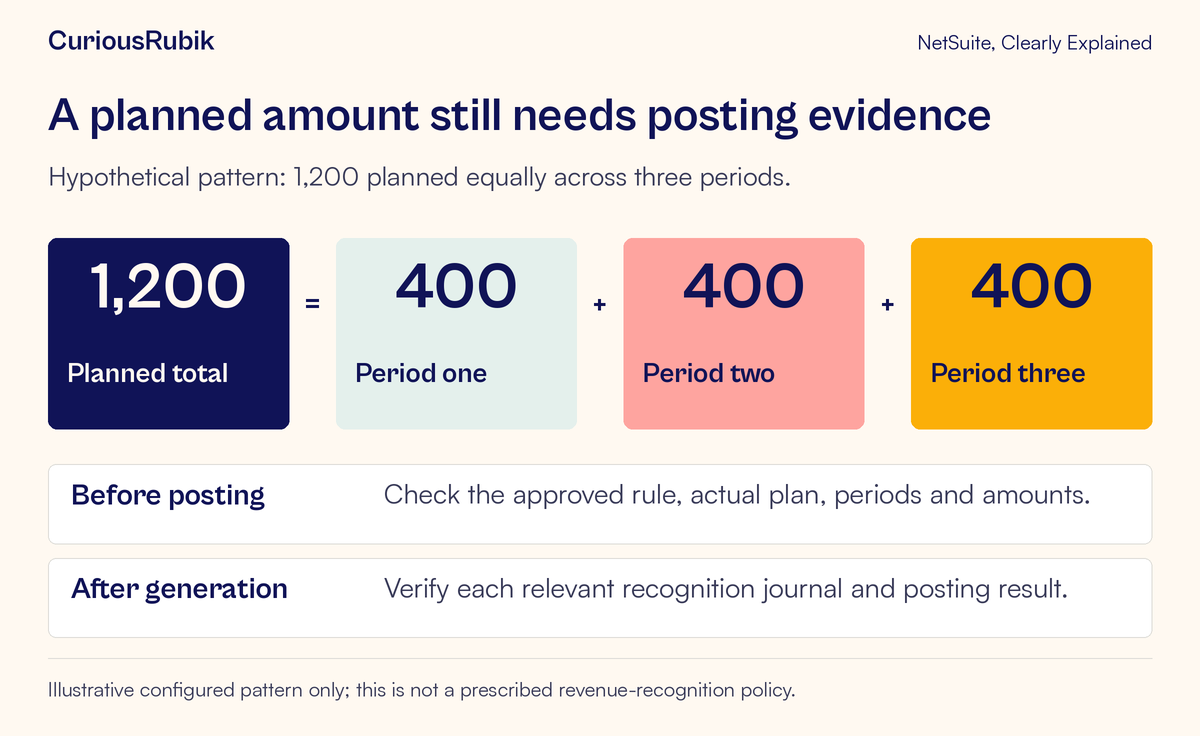
Assume an invented service obligation with an amount of 1,200 in one currency. For this exercise only, qualified finance personnel have approved an equal three-period pattern, and the configuration is assumed to implement that pattern without proration, foreign-exchange differences or other adjustments.
The illustrative actual plan contains 400 in period one, 400 in period two and 400 in period three. The arithmetic is 1,200 divided by three. It teaches the distinction between planning and posting, not which recognition method should be used for a real contract.
At this point, the plan can be reviewed against the approved pattern. It does not yet prove that any 400 amount has reached the ledger.
For period one, the authorized team must complete the applicable recognition-journal process. The reviewer then checks the generated journal, required approval, actual posting period, account and amount. Only after verifying the posted result should they conclude that the expected period-one recognition occurred.
Suppose the journal exists but is pending approval. The correct finding is that journal preparation occurred while posting remains incomplete under the relevant approval process. Regenerating the same amount without checking status could create another problem.
Suppose the journal posts to a different period. Investigate period availability, approval timing and the relevant preferences. Do not change the report date or the source plan simply to conceal the difference. Locked and closed accounting periods explains the surrounding controls.
Trace the journal into the ledger
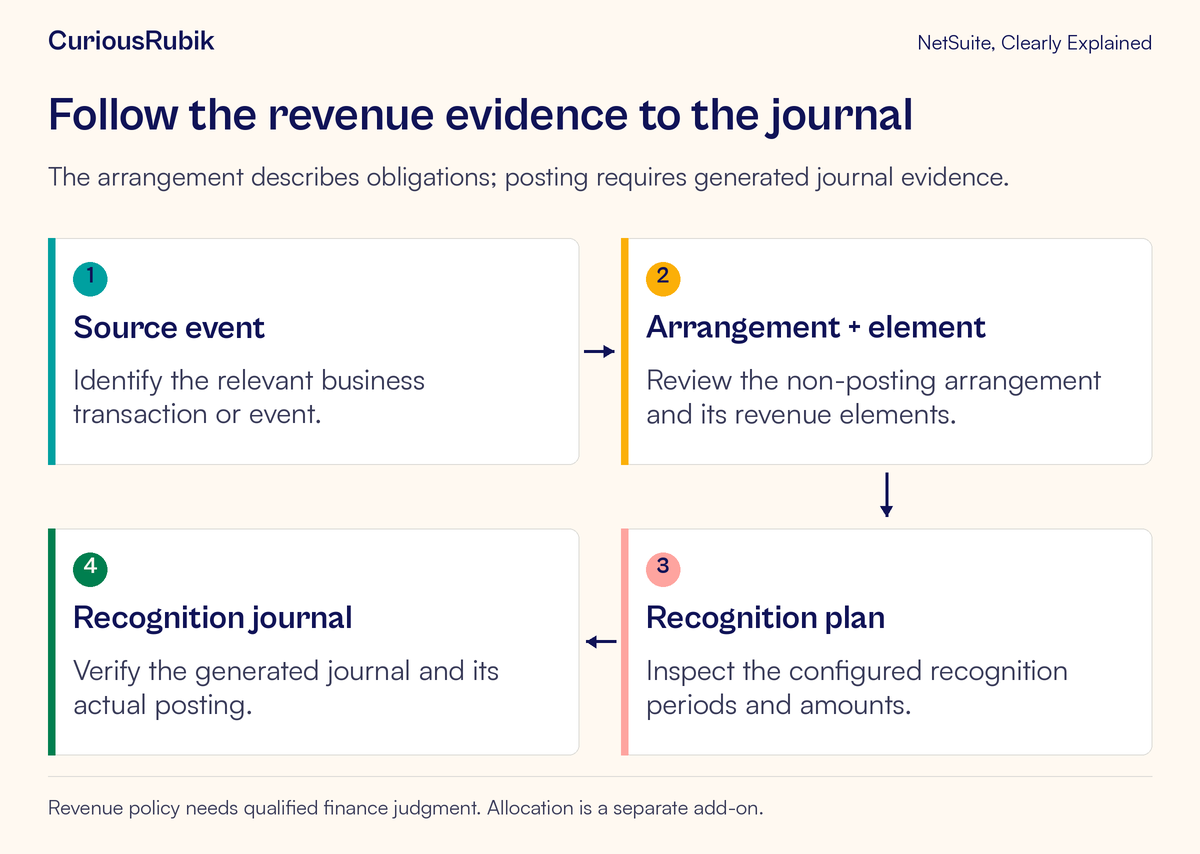
Revenue recognition journals are generated from the applicable actual plans. The arrangement’s Related Records subtab includes links to associated recognition journals, providing one route for tracing the connection.
A generated journal may post immediately or require approval, depending on the account and user context. Inspect the actual result instead of treating “generated” and “posted” as equivalent statuses.
Journal presentation can also be summarized or detailed according to configuration. One journal may represent more than one plan. Use the supporting detail to identify your example’s contribution; do not expect a separate journal for every element in every account.
Reconcile within a consistent period, subsidiary, book and currency context. Then compare the expected recognition with the relevant ledger and reporting evidence. If an amount differs, first establish that both sides of the comparison measure the same thing.
Keep a short trace for the exercise: source, arrangement, element, actual plan, generated journal and verified posting. This is a review worksheet, not a claim that every account presents the chain in one built-in screen.
Investigate the missing link
If the element or arrangement is absent, inspect source eligibility, approvals and the relevant processing status. Avoid creating a manual replacement before establishing what has already run.
If a forecast exists but an actual plan does not, check the plan type and configured triggering event. A forecast is not evidence that the actual recognition conditions have been met.
If the plan exists but the ledger amount is absent, inspect journal generation, approval, posting period and any relevant hold or error. Follow the specific failed stage rather than restarting the whole process indiscriminately.
If the recognized amount differs from billing, inspect the obligation, allocated amount where applicable, dates and rule. A difference can be expected under the approved pattern; it can also reveal a setup problem. The finance owner decides which explanation is valid.
For supporting review techniques, see NetSuite audit evidence for journal and master-data changes and roles and permissions for controlled access.
A revenue-review checklist
- The correct revenue feature, subsidiary and book context are confirmed.
- The source and performance obligation are understood by the finance owner.
- The arrangement and element match that approved interpretation.
- The actual plan is distinguished from any forecast.
- The configured rule, amount and period pattern have been checked.
- Journal generation, approval and posting have each been verified.
- The ledger comparison uses the same scope and currency basis.
If the connections are unclear in your account, explore CuriousRubik NetSuite optimization. A focused review can begin with one obligation and the exact stage where the expected evidence stops.