A sale is not operationally handed over when the account executive sends an email. It is handed over when the receiving team can begin the correct work, under the correct terms, with the information and authority it needs. That difference explains why a company can record a deal as won while delivery, finance and customer success still spend days discovering what was promised.
For a COO and sales leader, the cost of a weak handoff is broader than time spent asking questions. It can include avoidable rework, delayed activation, resource rescheduling and commitments that nobody is equipped to fulfill. Some costs are measurable immediately; others are exposures that need investigation before they become financial claims.
The most useful improvement is a defined acceptance boundary between commercial commitment and operational execution. Build that boundary around the receiving team’s next decision, rather than an ever-growing list of fields the seller must complete.
Identify what actually transfers
A handoff transfers several things at once: the accepted scope, customer context relevant to delivery, evidence of approval, responsibility for the next action and unresolved assumptions. A document attachment may carry some of these, but not all.
Separate facts from interpretations. The customer’s signed scope is different from the seller’s expectation that the customer will expand later. A confirmed start-date requirement is different from a date discussed provisionally. A known installation constraint is different from a concern awaiting technical assessment.
Version matters. If the receiving team uses an older proposal, a perfectly complete checklist can still launch the wrong work. Link the handoff to the accepted arrangement and its approved amendments. Give the receiving team a way to verify which records are authoritative.
Provenance is a useful supporting concept. The W3C’s 2013 PROV overview describes information about the entities, activities and people involved in producing data as useful for assessing reliability and trust. A sales handoff does not need to implement the full PROV model, but it should make the origin and approval of important facts traceable. W3C PROV overview.
Find the receiving decision
Ask the receiving team what it must decide immediately after acceptance. A delivery manager may need to assign skills and sequence work. Finance may need to establish billing instructions. Customer success may need to agree the first meaningful customer outcome. These decisions require overlapping but different information.
A generic handoff form can become bloated because it tries to answer every future question at once. Instead, define a minimum usable package for each transition and make supporting context accessible. The minimum should be sufficient for the next authorized action, not merely convenient for the sender.
For example, a delivery team may need the approved scope, locations, dependencies, acceptance evidence, promised dates and named customer counterpart. It may not need every marketing interaction from the preceding year. Conversely, a critical verbal commitment should not disappear simply because it lacks a standard field; it should be resolved and recorded by the appropriate owner before execution relies on it.
This approach reduces unnecessary data collection while making consequential omissions harder to ignore.
Use an acceptance state with an exception route
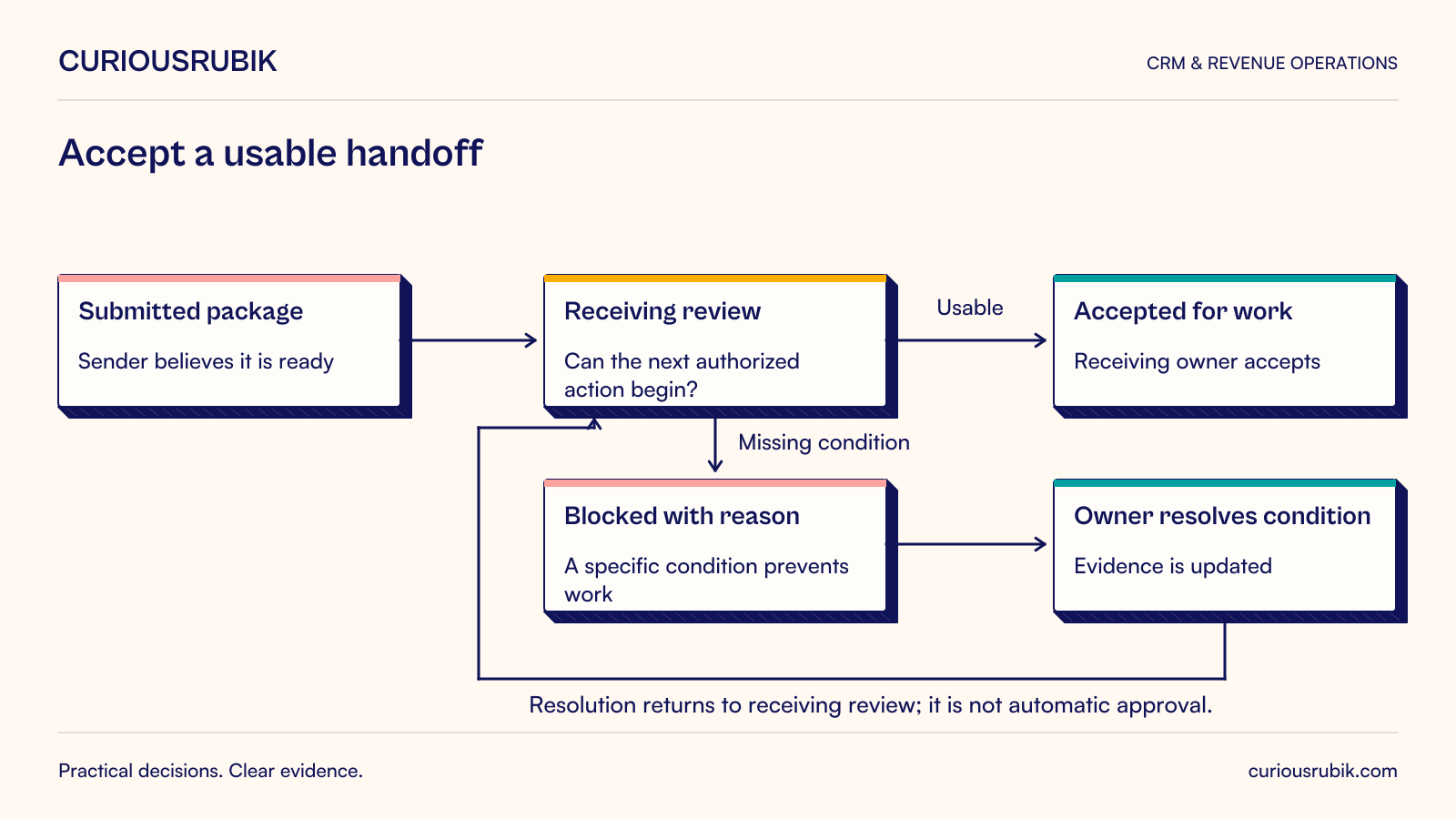
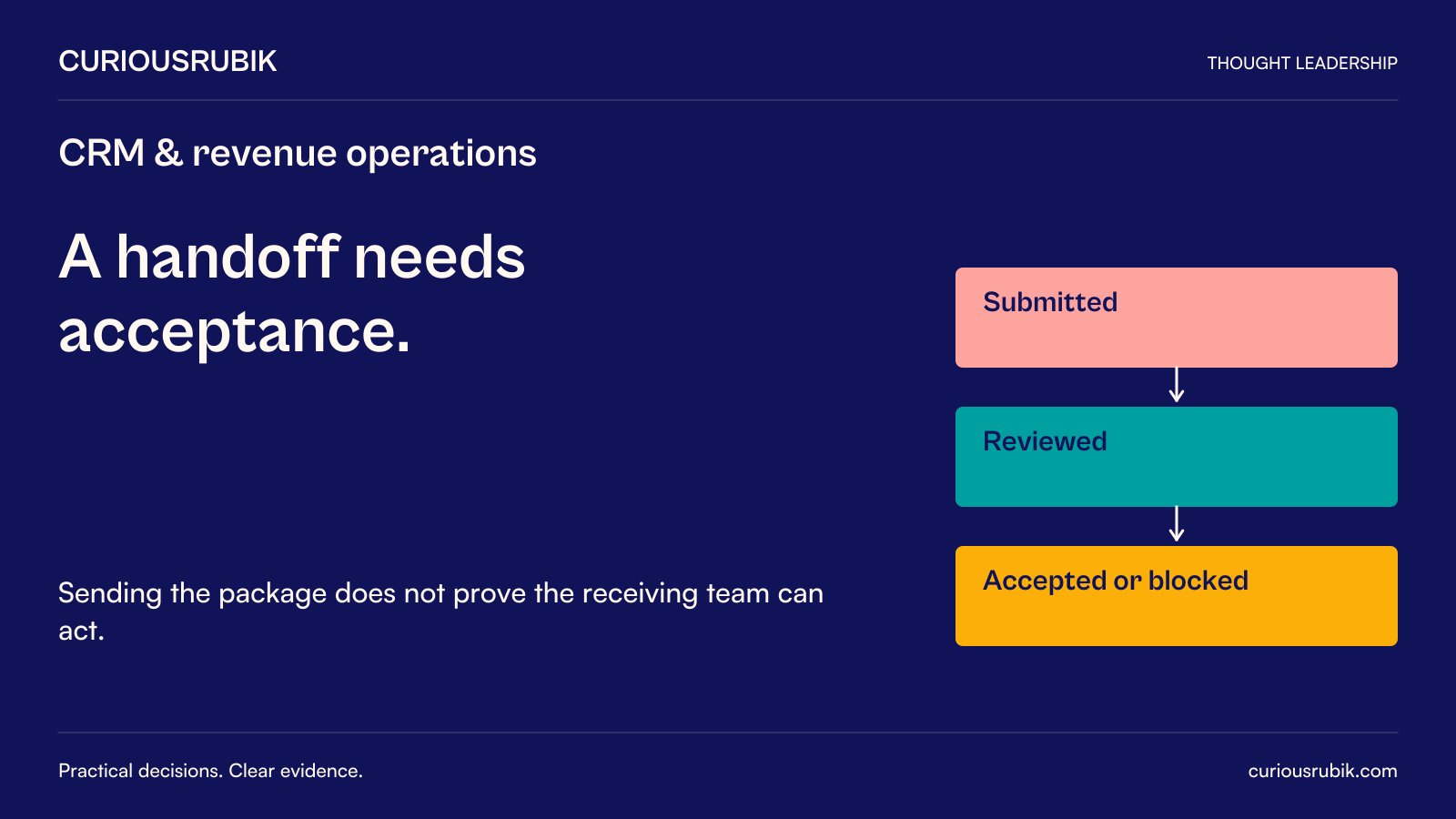
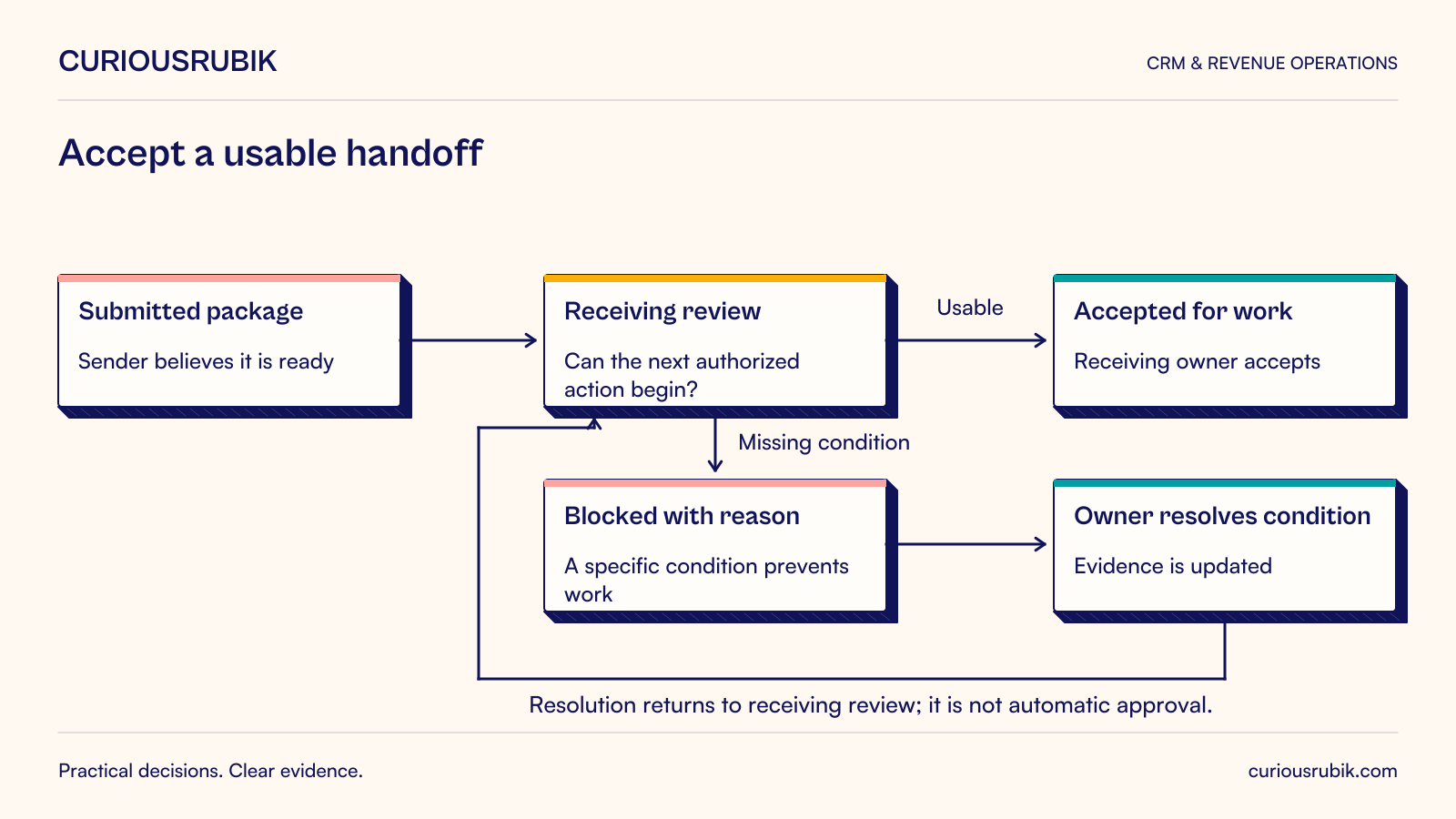
Create a visible distinction between submitted, accepted and blocked. Submitted means the sender believes the package is ready. Accepted means the receiving owner can begin the defined work. Blocked means a specific condition prevents that action.
Acceptance should not become a way for departments to reject responsibility indefinitely. Define response expectations, valid reasons for blocking, escalation authority and what work can proceed safely while an issue is resolved. A missing optional preference should not stop essential preparation if the operating rules allow it.
Likewise, do not use automatic acceptance after a timeout unless the business has deliberately assessed the risk. Silence does not prove that a team has reviewed an unusual promise or has the required capacity.
Record unresolved assumptions with owners and deadlines. Some work can begin under an explicit assumption, but the decision to do so belongs to someone with authority to accept the consequence. The handoff record should show that decision instead of burying it in meeting notes.
A project example exposes the cost categories
Consider a hypothetical commercial-interiors firm delivering office fit-outs. The figures are invented to illustrate measurement, not drawn from a client. In a month, twelve newly won projects enter delivery. Four require clarification because the handoff lacks a confirmed site-access window or includes conflicting finish specifications.
Each of those four cases takes three hours of combined sales, project-management and estimating effort to reconstruct and confirm the facts. The observed clarification workload is twelve hours. At an assumed blended internal rate of $50 per hour, its capacity value is $600. That is not automatically $600 of incremental cash expense, because existing staff may have performed the work within their paid schedules.
One project also incurs a separately verified $300 rescheduling charge from an external supplier. That charge is an incremental cash item in the hypothetical example. It should be recorded separately from internal capacity rather than mixed into an unexplained savings total.
The start date of another project moves by two days. The elapsed delay is operationally important, but it cannot simply be multiplied by the entire team’s hourly rate. The company must establish who was actually idle, whether other work was substituted and whether any additional cost or customer consequence occurred.
The team finds two causes. Site access was discussed but never confirmed with the customer’s facilities contact. Finish specifications changed after the proposal, but the delivery package still linked the earlier version. The remedies differ: an explicit prerequisite for site readiness and a controlled reference to the accepted specification.
A generic instruction to “communicate better” would miss both mechanisms.
Measure the handoff from both sides
Track time from submission to acceptance, the share accepted without material clarification and the age of blocked items. Define material clarification as something that prevents or changes the next authorized action, rather than any question asked by the receiving team.
Pair those measures with downstream reopening. If a team accepts packages quickly but later discovers scope conflicts, apparent handoff speed has improved while quality has deteriorated. Review a sample of accepted records to see whether the receiving team could actually use them.
Record handling time and elapsed waiting time separately. Handling time informs workload. Waiting time informs customer and scheduling consequences. Both matter, but they should not be added together as if they were the same economic quantity.
Do not use the metrics only to rank senders. A high rejection rate may reflect unclear acceptance rules, an overloaded receiving team or changing customer requirements. The review should identify the process cause before assigning individual blame.
Align incentives with a usable commitment
If sales is rewarded only for signature and delivery is rewarded only for avoiding risk, the handoff can become a negotiation between incompatible incentives. The answer is not necessarily a new compensation formula. Start by making the shared outcome explicit: accepted business that can be delivered under the agreed terms.
Give sales early access to feasibility guidance and standard commercial options. A handoff review at the end of a long sales cycle is too late to discover that an unusual promise cannot be supported. Involve the receiving team before the commitment when the deal crosses defined risk or complexity boundaries.
Keep routine work fast. Standard offerings with complete, current evidence should not require a meeting for every handoff. Reserve deeper review for genuinely unusual scope, dependencies or terms. The acceptance process should make a clean deal easier to execute.
Maintain a route for commercially valuable exceptions. The right owner can accept a nonstandard arrangement with a documented plan and resources. The failure is allowing the exception to enter operations without that decision.
Improve one boundary before redesigning everything
Choose a handoff with visible friction, such as sales to project delivery or sales to billing setup. Review a representative set of recent cases with both teams. Reconstruct what was missing, why it mattered and whether the information was available earlier.
Then test a narrow change: a version-controlled scope reference, a receiving-owner acceptance step or a clearly defined readiness condition. Avoid adding fields unless they change a decision or prevent a specific failure. Remove duplicate entry where an authoritative source already exists.
After several comparable cycles, assess clarification effort, elapsed delay, reopened work and customer consequences. Keep the findings proportional to the evidence. A small sample can reveal a useful failure mechanism without proving a company-wide annual saving.
A well-designed sales handoff protects the value of the sale after the celebration. It preserves what was agreed, exposes what remains uncertain and gives the receiving team a usable starting point. That is how a commercial commitment becomes dependable operational work.