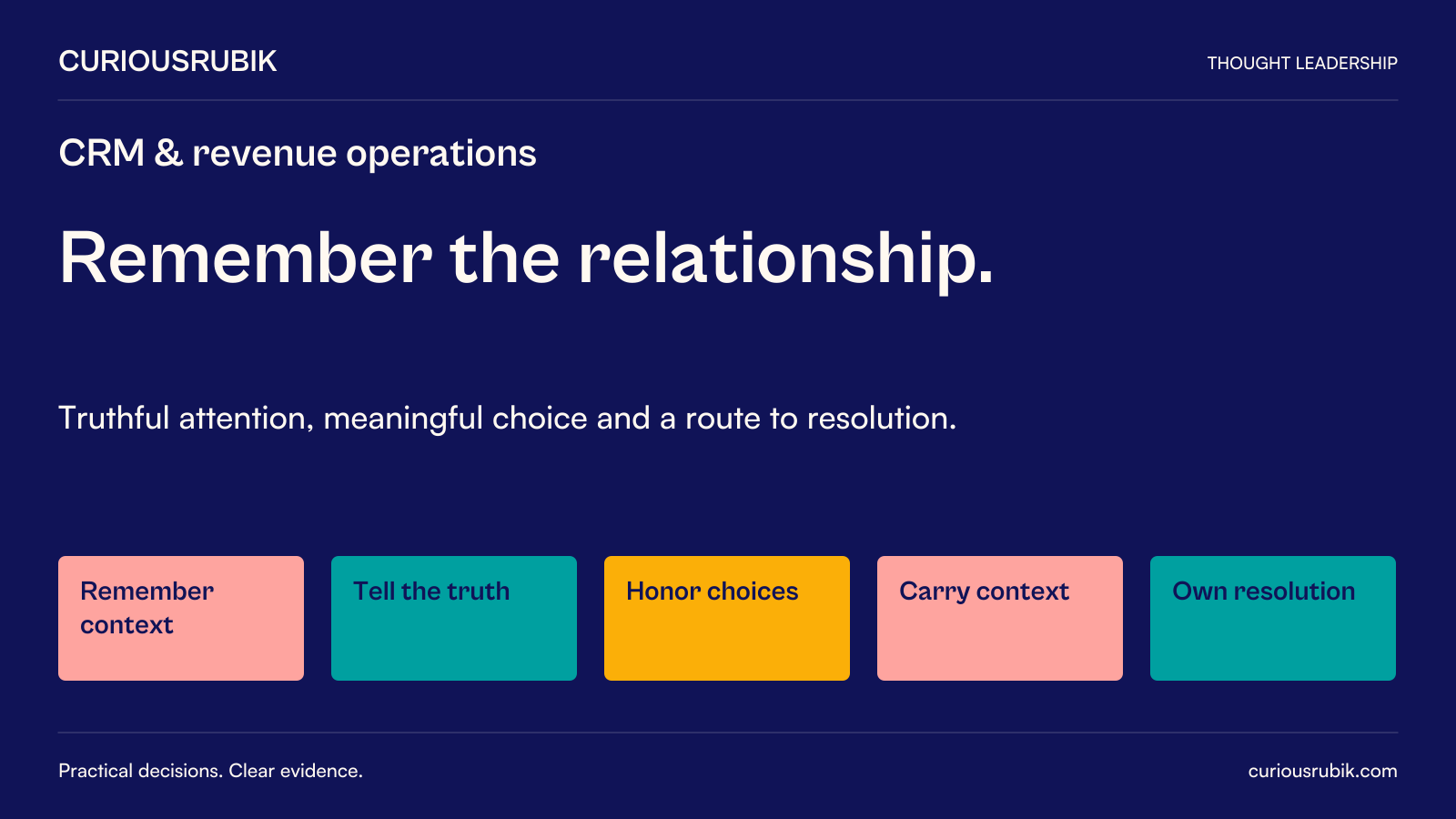
A customer may welcome an automated reminder and dislike a personally typed message. The difference is often whether the communication remembers the situation, tells the truth, offers a useful choice and leads to someone who can resolve the issue. A human signature does not make an irrelevant interaction thoughtful.
For a sales leader, this suggests a different way to evaluate automation. Start with the experience the customer must have, then decide which parts technology can support. Counting messages sent or minutes saved will miss the damage caused when the business asks a customer to repeat themselves, claims attention it did not provide or makes it difficult to escape an inappropriate sequence.
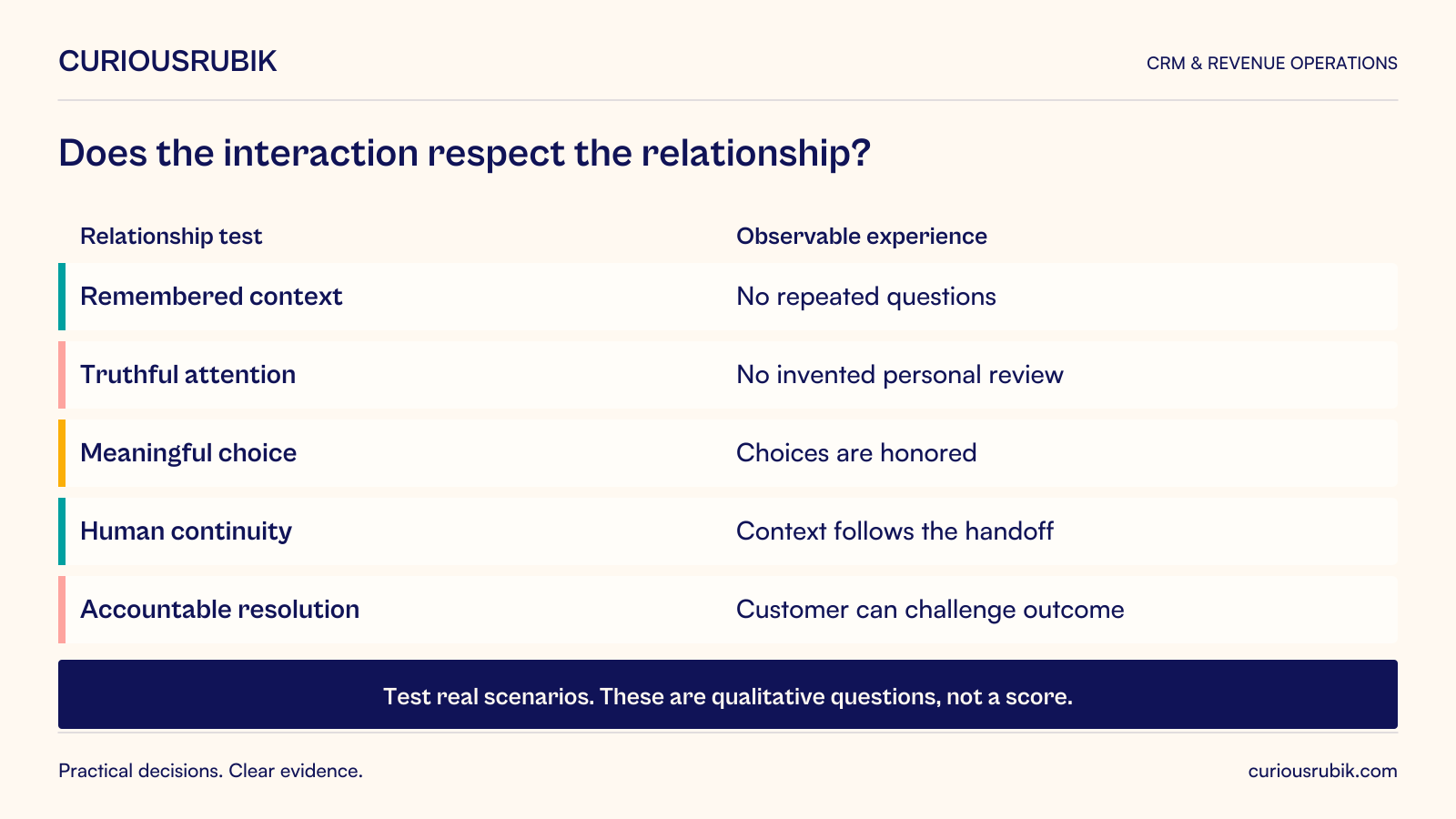
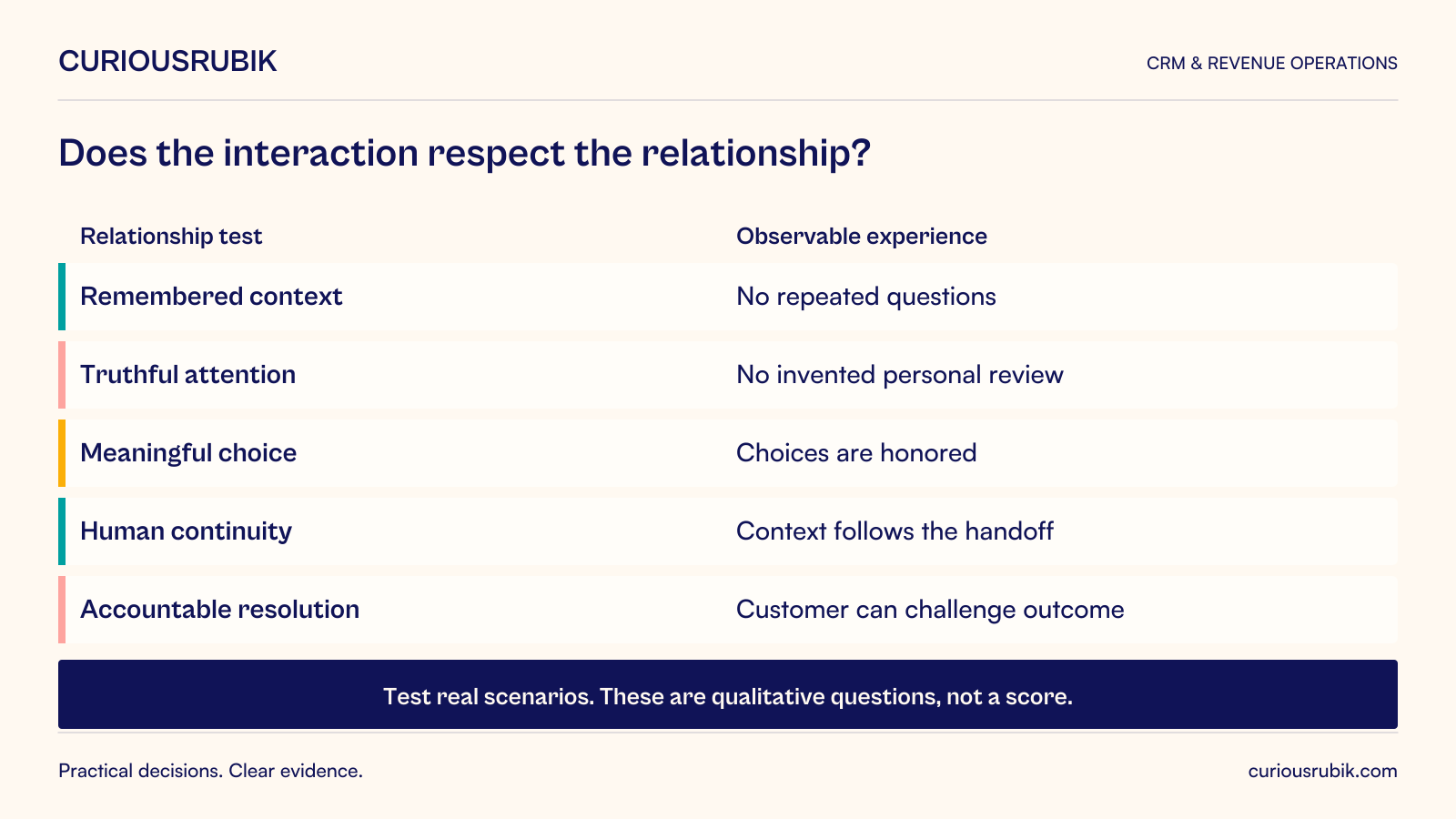
The relationship test in this article asks five practical questions: does the interaction remember relevant context, represent attention truthfully, preserve meaningful choice, carry context into a human conversation and provide accountable resolution? It is a proposed evaluation aid, not a validated satisfaction score or a promise of higher conversion.
Remember the situation before adding personal detail
Personalization is frequently confused with mentioning a name, company or industry. Those details can help orient a message, but they do not demonstrate understanding. A customer who has already explained a delivery concern needs that concern acknowledged more than they need another sentence about their sector.
Relevant memory is selective. The system should preserve the current question, commitments already made, information supplied and any agreed timing. It should not accumulate unrelated personal details in the hope that they make messages feel intimate. The business needs appropriate permissions, access and retention practices for the information it uses.
Test a proposed interaction against the last meaningful exchange. Does it ask for something already provided? Does it contradict an agreed pause? Does it assume a problem was resolved when the record only shows that a ticket was closed? These are concrete defects that a team can find before sending more communication.
Where context is incomplete, a truthful question is preferable to invented familiarity. “I can see your request is still open; which of these two times works for a discussion?” is different from claiming that a specialist has reviewed the case. Only make that claim when the review actually happened.
Represent attention truthfully
Automated language can create a misleading impression without stating an obvious factual error. Phrases such as “I personally reviewed your account” or “I selected this especially for you” imply human work or judgment. If the system merely applied a rule to a segment, those statements should not appear.
The alternative does not need to sound mechanical. A message can state the relevant fact and useful action directly: the agreement is approaching its end date, a requested document is available or an account owner is ready to discuss an unresolved question. It should not manufacture enthusiasm, familiarity or certainty to make the interaction sound warmer.
The same standard applies to AI-generated summaries. A fluent description of the customer’s priorities may contain an inference rather than a confirmed preference. Label the distinction for the employee reviewing it and avoid presenting the inference to the customer as something they definitely said.
NIST’s January 2023 AI Risk Management Framework discusses AI as a socio-technical system and includes accountability, transparency and human-AI interaction. It is voluntary general guidance, not a certification of a sales workflow. Its relevance here is the need to evaluate how the system’s behavior affects people in the actual context of use. NIST AI RMF 1.0.
Give the customer a meaningful choice
An interaction is not customer-centered merely because it contains a button. The available choices must fit the situation. A renewal message that offers only “accept” or “book a sales call” may frustrate someone who needs to correct a contact, change scope or resolve an existing issue first.
Identify the most plausible reasons the customer cannot take the preferred action. Offer a clear route for those cases without requiring them to decode internal department boundaries. The route can be a concise reply instruction or a well-designed form; it does not need a complex interface.
Respect the choice after it is made. If the customer asks to discuss scope later, the next interaction should reflect that agreement. A sequence that acknowledges the request and then continues unchanged teaches the customer that the choice was cosmetic.
Commercial preferences and legal communication requirements need the appropriate organizational controls. This relationship test does not replace those obligations. It asks whether the experience remains useful and respectful even when a message is technically permitted.
Compare two renewal interactions
Consider a hypothetical maintenance provider preparing a renewal discussion. The customer has an unresolved question about a recent repair and has moved one service location. The following messages are illustrative examples, not records of a real customer exchange.
A weak message reads: “I’ve personally reviewed your account, and we’re delighted you’ve had another excellent year. Renew now to keep the same fast response at every location.” It fails several tests. No personal review has occurred, satisfaction is assumed despite the unresolved issue, and the response-time promise has not been checked against the new location.
A more useful message reads: “Your maintenance agreement is due for review next month. Your question about the recent repair is still open, and we also need to confirm coverage for the new location. Would you prefer to address those points with your account owner before discussing renewal options?”
The second message is better only if its facts and available route are true. The system must know the agreement timing, accurately identify the open question and connect the customer to an account owner who can use that context. Polite wording cannot compensate for a dead-end handoff.
If the customer replies that the repair question has already been resolved, the organization should correct its record and acknowledge the correction. It should not force the customer to prove the same point repeatedly. The interaction has revealed a data-quality issue that should improve future communication.
If the customer instead wants a smaller scope, that choice should reach the person authorized to discuss it. An expansion-oriented sequence should not continue treating the customer as a candidate for a larger package while the reduction request waits in another system.
Carry context into the human conversation
The transition from automation to a person is a decisive moment. Customers are often willing to use a self-service route when they expect it to save time. That advantage disappears if they must restart the conversation after requesting help.
Give the receiving employee a concise handoff: what the customer is trying to decide, what information they supplied, what the system already said, what remains unresolved and why the case was escalated. Link the underlying evidence so the employee can verify consequential details.
Do not make the handoff summary a source of new fiction. Separate the customer’s words, known account facts and the system’s interpretation. An employee should be able to reject an incorrect inference without losing the rest of the context.
The customer should know what will happen next. If the business can commit to a response window, state it accurately. If it cannot, avoid a precise promise that the receiving team has not accepted. Where the matter changes owner, preserve responsibility until the next owner actually takes it.
Close the loop with an accountable result
A relationship is weakened when the system records a completed task while the customer’s issue remains unresolved. “Message sent,” “case routed” and “customer helped” are different outcomes.
Define what completion means for the interaction. A requested document is available and correct. A coverage question has an authorized answer. A renewal change has reached an agreed disposition. The appropriate result may be that the offering does not fit, or that the customer chooses not to continue.
Allow the customer to challenge the result. A closed case should not make it impossible to explain that the answer was incomplete. Provide an accessible route back to an accountable person and retain the relevant history.
This does not require every communication to become a long conversation. Routine interactions can remain brief when the facts are clear and the customer can obtain help when needed. The goal is dependable resolution, not maximum human contact.
Evaluate the experience with real scenarios
Before expanding an automation, review a small set of representative interactions from the customer’s perspective. Include a straightforward request, a corrected record, a complaint, a changed contact and a request to pause or alter the commercial discussion.
For each scenario, answer the five relationship questions with evidence. What context was remembered? Which statements about attention were true? What choices were offered and honored? What did the receiving employee know? Who could resolve the matter? Avoid turning the answers into an apparently scientific aggregate score without validation.
Then observe the pilot. Useful measures include repeated-information requests, unnecessary duplicate messages, successful context transfer and reopenings caused by incomplete answers. Pair them with customer feedback and review of actual examples. A declining complaint count alone may mean customers have given up responding.
Keep efficiency measurement honest. Include the effort to correct records, review generated content, handle exceptions and maintain the workflow. Technical authority, reliable execution and stop conditions remain necessary; the related CRM automation article covers those design decisions in depth. Relationship quality adds a different test: whether the resulting interaction makes sense to the customer.
Start with one communication that customers regularly find repetitive or unhelpful. Redesign its context, choices and resolution path before increasing its volume. Sales automation preserves the human relationship when it makes the business more attentive in observable ways, even when no person manually performs every step.