A large pipeline can contain very little information about what the sales team should do next. Several opportunities may depend on the same unconfirmed budget decision. Others may remain open because nobody has recorded that the project stopped. A substantial total can coexist with a shortage of credible, actionable buying processes.
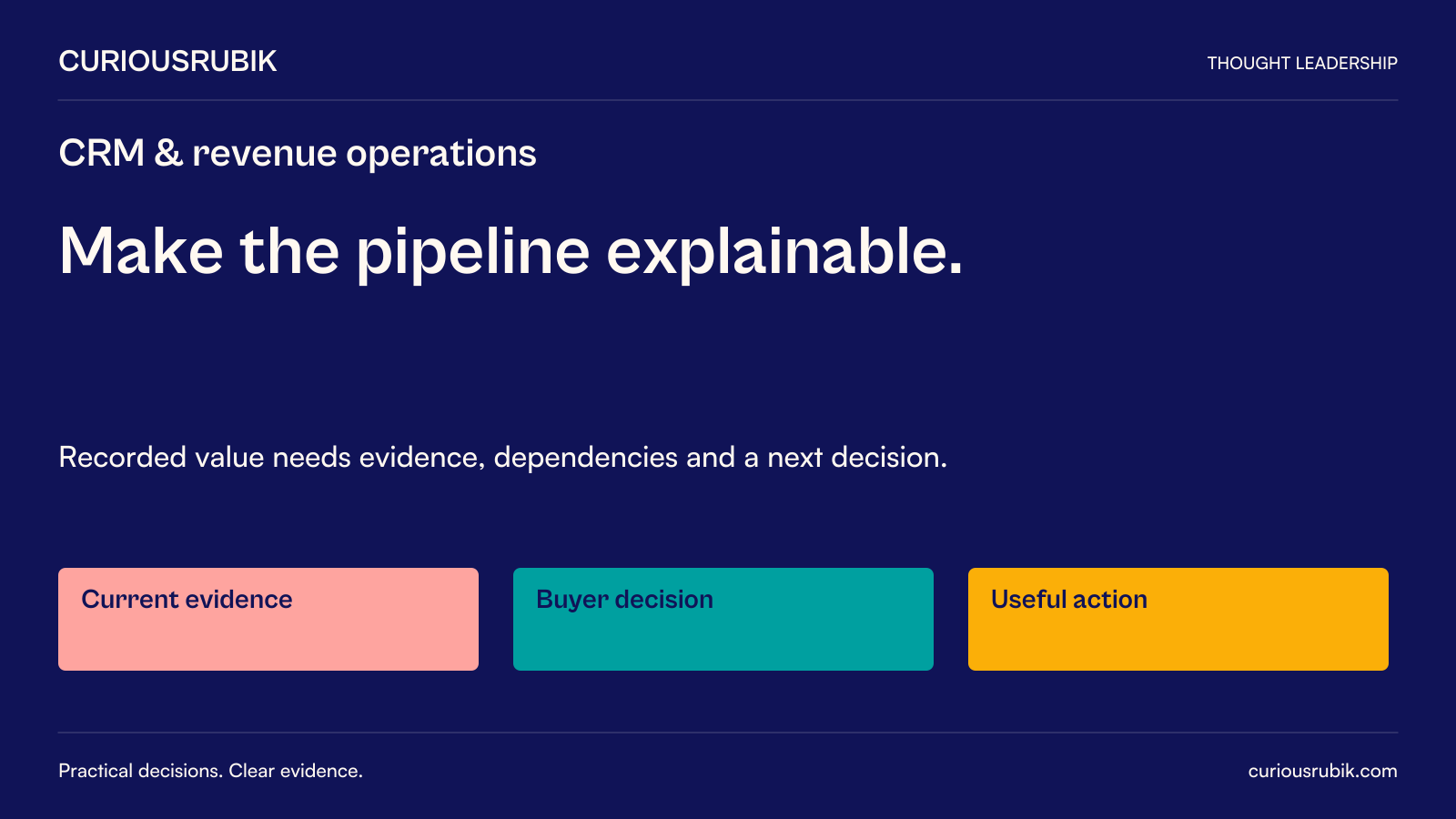
Pipeline visibility means being able to explain the state, evidence, uncertainty and next decision of the opportunities that matter. For a sales leader allocating scarce presales, executive or implementation capacity, that explanation is more useful than a total value alone. Pipeline size remains relevant, but it becomes meaningful only when its composition and limitations are visible.
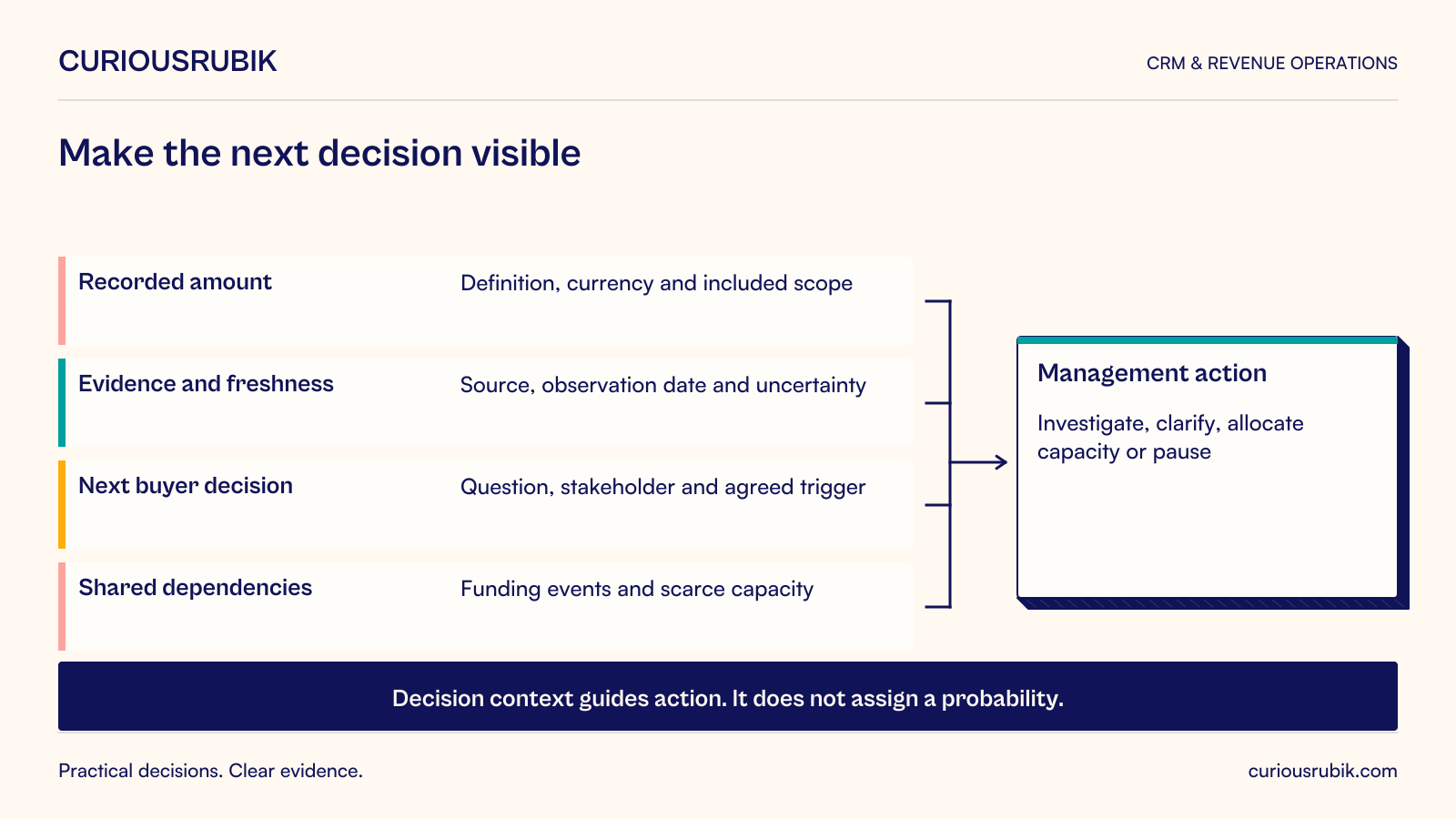
The practical objective is to create a portfolio view that supports action: which opportunities merit additional effort, which require clarification, which should be paused and which depend on risks shared across several deals.
Ask what the pipeline number contains
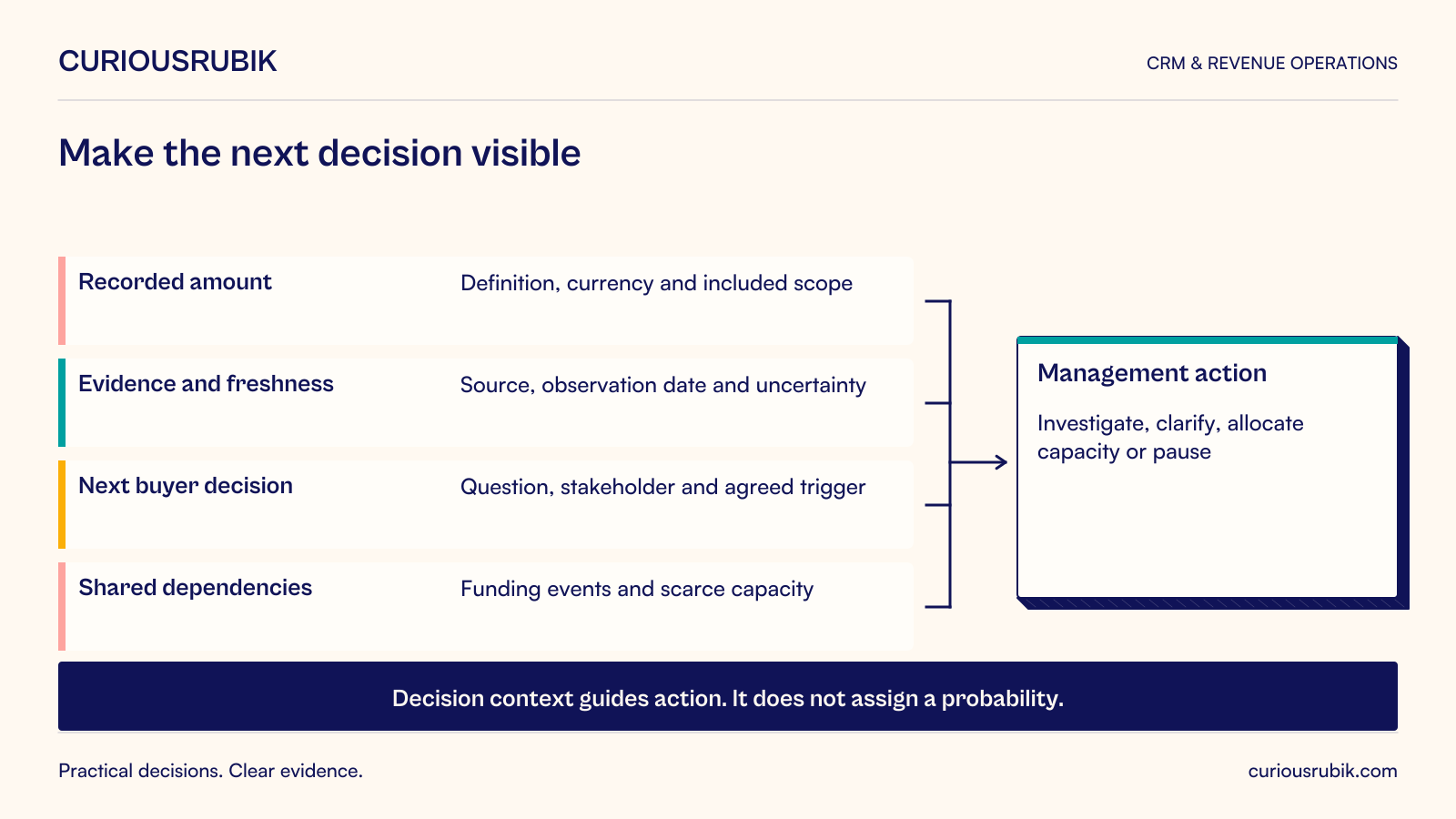
Begin with definitions. Does the total include unqualified inquiries, partner-sourced leads, existing-customer expansions, renewals, optional contract years or multiple competing proposals for the same purchase? Are amounts expressed in a common currency using a stated convention? Are mutually exclusive alternatives counted as if they could all be won?
These choices can change the total without changing the underlying opportunity. The point is not to impose one universal definition. It is to make the company’s definition stable, explicit and appropriate to the decision.
Separate the recorded commercial amount from the expected outcome. An opportunity value is not automatically an expected booking, a revenue forecast or a cash forecast. Even a probability-weighted total depends on the quality and applicability of its probabilities and on the period being predicted.
Keep the target separate too. A coverage ratio comparing pipeline with target can be a descriptive management measure, but a chosen ratio does not prove the target is achievable. The meaning changes with conversion, deal size, timing and the mix of opportunities. Avoid treating an inherited rule of thumb as a validated requirement for every team.
Make the evidence behind the stage visible
A stage should summarize evidence rather than replace it. If an opportunity is labeled “negotiation,” the manager should be able to see what is being negotiated, by whom, against which version of the proposal and what remains unresolved.
Define a few stage conditions that reflect the buying process. For a complex service, a meaningful milestone might be agreement on the problem, confirmation of the decision process or review of a viable scope. For a repeat product purchase, the relevant evidence may be different. Do not force unlike motions into the same detailed stage sequence merely to simplify a dashboard.
Record the origin and age of the evidence. A budget discussion from six months ago may no longer support today’s assumptions. A seller’s interpretation of a customer’s remark should not be presented as a confirmed customer commitment. Both can be useful if labeled accurately.
Visibility also includes missing evidence. A blank field may be more honest than a guessed date entered to satisfy validation. The workflow should make uncertainty actionable, with a next question and owner, rather than encouraging employees to manufacture completeness.
Distinguish activity from movement
A record can accumulate meetings, emails and tasks without moving the buyer toward a decision. Activity helps explain the team’s effort, but does not by itself establish commercial progress.
Look for changes in the buyer’s decision state. Has the customer agreed what must be solved? Has a necessary stakeholder evaluated the proposal? Has a material uncertainty been resolved? Has the purchasing process become clearer? A completed seller task matters when it contributes to one of those changes.
Conversely, an opportunity may legitimately remain quiet while the customer follows an agreed planning timetable. A universal rule that treats every week without contact as failure can create unnecessary outreach. Assess inactivity against the known next event and the reliability of that information.
Preserve stage history and changes to expected dates. Repeated movement of a close date can indicate weak qualification, but it can also reflect a known change in the customer’s program. The history should prompt an explanation, not an automatic accusation.
A portfolio example changes the resource discussion
Consider a hypothetical team with $2 million in recorded opportunity value. The figures are illustrative. Two opportunities account for $1.2 million and both depend on the same customer’s unapproved capital program. Eight other opportunities total $800,000 and involve separate buyers with different next decisions.
The large opportunities may be attractive. Their shared dependency nevertheless matters. If the capital program is delayed, both can move together. A dashboard that displays ten independent-looking rows conceals that concentration.
Now suppose the two large opportunities each request a customized demonstration requiring the same specialist. One has a confirmed technical evaluation date and agreed questions. The other has no identified evaluation audience or decision timetable. Deal size alone would give both equal priority; visibility suggests funding the defined evaluation first and clarifying the second request before committing scarce capacity.
Among the eight smaller opportunities, one has a clear customer need but an unresolved delivery-location constraint. Another has been inactive since the customer’s project sponsor left. They need different actions: an operational feasibility check for the first, and a requalification conversation or pause for the second.
Nothing in this example proves which deal will close. It demonstrates a more defensible allocation of effort. The team can explain why it is investing, what evidence it expects to learn and when it will reconsider the commitment.
Review the pipeline as a set of decisions
Organize the review around decisions management can make. Which opportunity needs executive sponsorship? Which requires technical validation? Which needs a commercial exception? Which should release capacity because the buying process is no longer active?
For each, ask the seller to state the current hypothesis and the evidence that would change it. “The customer is evaluating the proposal this month” becomes more useful when paired with the scheduled review, responsible stakeholder and unresolved criteria. If the evidence is absent, agree how to obtain it rather than debating confidence indefinitely.
Use a short record of the decision, owner and expected next evidence. Avoid reviewing every field on every deal each week. Deep review is most valuable where the opportunity is material, uncertain, resource-intensive or changing rapidly.
Keep the process safe enough for bad news to arrive early. If removing a weak opportunity is treated as failure regardless of context, pipeline inflation becomes rational behavior. Managers should distinguish poor execution from improved recognition that an opportunity is not currently viable.
Build useful views without overcomplicating the system
Start with four views: composition, movement, dependencies and intervention. Composition shows the mix of opportunity types, amounts and stages. Movement shows entries, exits, stage changes and date changes over a defined period. Dependencies reveal shared customers, funding events, partners or scarce internal resources. Intervention shows the decisions and help needed now.
Do not assume every dependency can be captured automatically. A seller may know that two purchases rely on the same committee even when their account records differ. Provide a way to record that relationship, with a clear explanation and review date.
Use access controls appropriate to commercial sensitivity. Broad visibility does not mean every employee needs every price, negotiation note or contact detail. A manager may need aggregated concentration while a deal team needs the underlying record.
Maintain a clear correction route. When the team learns an amount was duplicated or a stage misclassified, correct the record while preserving enough history to understand prior reports. Silent historical rewriting can make trend analysis misleading.
Evaluate whether visibility improves decisions
Measure whether the new view changes actions and whether those actions help. Examples include reducing repeated requests for the same evidence, identifying shared dependencies earlier or allocating specialist time to opportunities with a defined evaluation need. These are operational outcomes that can be investigated directly.
Do not infer improved forecasting merely because the pipeline appears cleaner. Forecast performance needs separate evaluation at a fixed horizon against actual outcomes. Hyndman and Athanasopoulos emphasize that forecast accuracy must be assessed using information not used to fit the model; historical fit alone is insufficient. The same discipline warns against rebuilding past pipeline views using facts learned later. Forecast evaluation.
Review samples of paused and removed opportunities as well as active ones. A strict qualification process can make a pipeline look efficient by excluding valuable early-stage work. The right treatment may be a separate development queue rather than deletion or neglect.
The first improvement is usually a better question, not a new chart. Select the opportunities consuming the most scarce resources and ask whether each has a current buyer decision, credible supporting evidence and a useful next action. A smaller but explainable pipeline can support better management than a larger collection of amounts that nobody can defend. Growth in pipeline value should then follow a stronger understanding of what the business is actually pursuing.