A business process becomes autonomous when it can observe a situation, choose among permitted actions, execute them, and assess the result without a person approving every routine step. That capability can be built with rules, optimization, AI, or a combination. Autonomy describes delegated operation, not a particular technology.
The opportunity is to reduce the delay between a recognized need and an appropriate response. The risk is that a process can act repeatedly on a mistaken assumption, exceed its intended authority, or continue operating after the conditions that made delegation reasonable have disappeared.
The sensible enterprise objective is bounded autonomy. Define where the process may act, what must remain true, what it may spend or change, and when it must stop. This article presents a design argument for that operating model, not a forecast that every business process should or will become autonomous.
Distinguish autonomy from an unattended script
A scheduled script can run without supervision while doing only a fixed sequence. An autonomous process makes some decisions about how to reach a defined outcome within its permitted scope.
The distinction is not absolute. A rules-based replenishment process may make useful bounded decisions, while an AI assistant may only prepare suggestions for a human. More advanced language generation does not automatically imply more appropriate authority.
Describe the autonomy in concrete terms. Can the process select a supplier from an approved list, change a delivery date within an agreed window, or create an internal work request? Which facts must it verify first? Which actions remain reserved?
Avoid describing a system as autonomous simply because the user interface is conversational or because it invokes several tools. The business needs an exact account of delegated decisions and effects.
Define the operating envelope before the objective
A broad objective such as “minimize stockouts” is incomplete. Pursuing it without limits could produce excessive purchases, storage problems, or commitments the business cannot support.
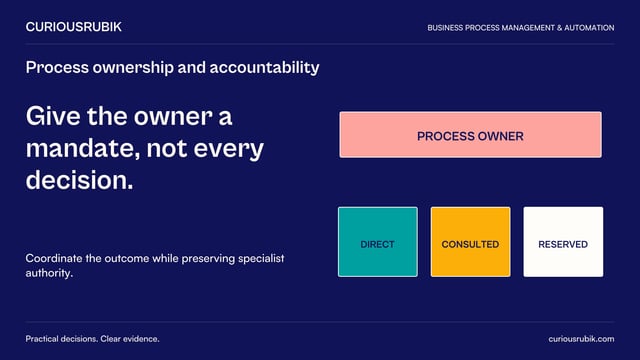
The operating envelope should define eligible work, authorized resources, allowed actions, limits, evidence freshness, and stop conditions. It should also identify the accountable business owner and the role that handles cases outside the envelope.
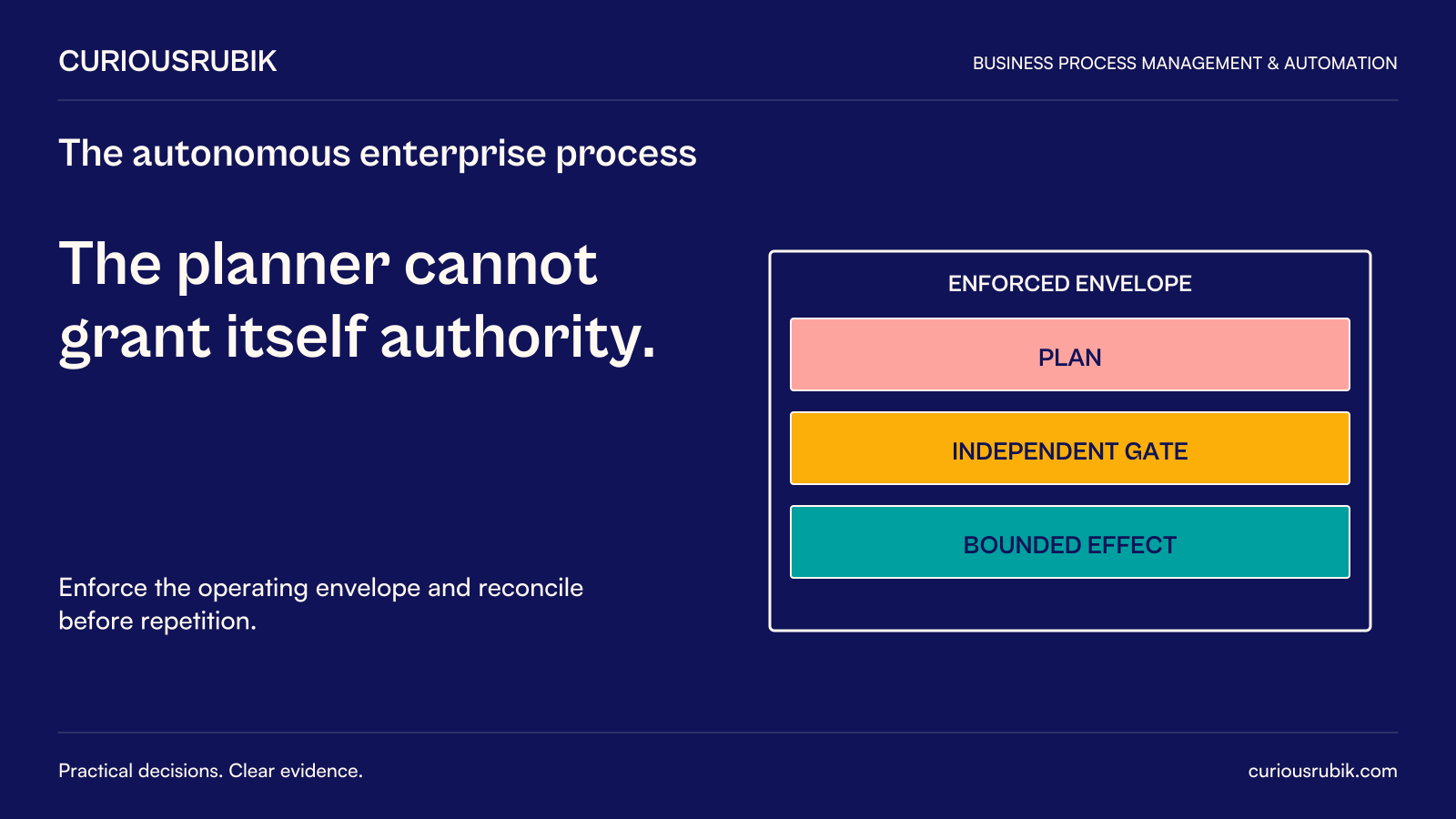
Treat constraints as enforceable controls, not merely instructions in a prompt. A system should not be able to expand its own purchasing authority or grant itself access because doing so would make the objective easier to achieve.
NIST SP 800-53 includes least-privilege controls that limit access to what is needed for assigned functions. Applied to autonomous business execution, the practical implication is to give each component only the capabilities needed for its bounded task. This is an architectural application, not a claim that the publication supplies a complete autonomy standard. NIST SP 800-53 Revision 5.
Keep business invariants outside discretionary planning
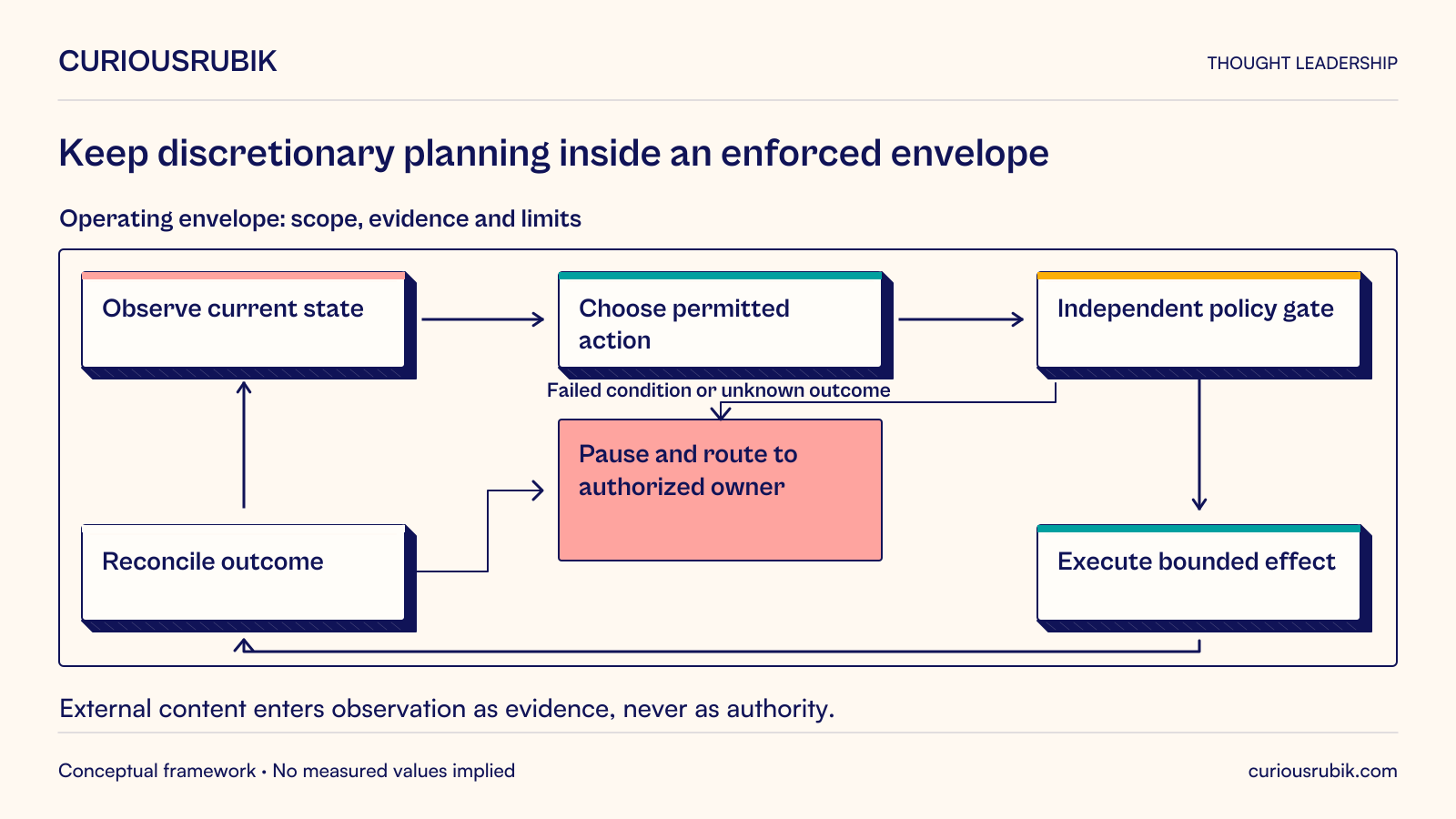
An invariant is a condition that must remain true regardless of which permitted path the process chooses. Examples include an approved supplier relationship, a valid budget boundary, a single authorized order for a given replenishment need, or a prohibition on changing protected master data.
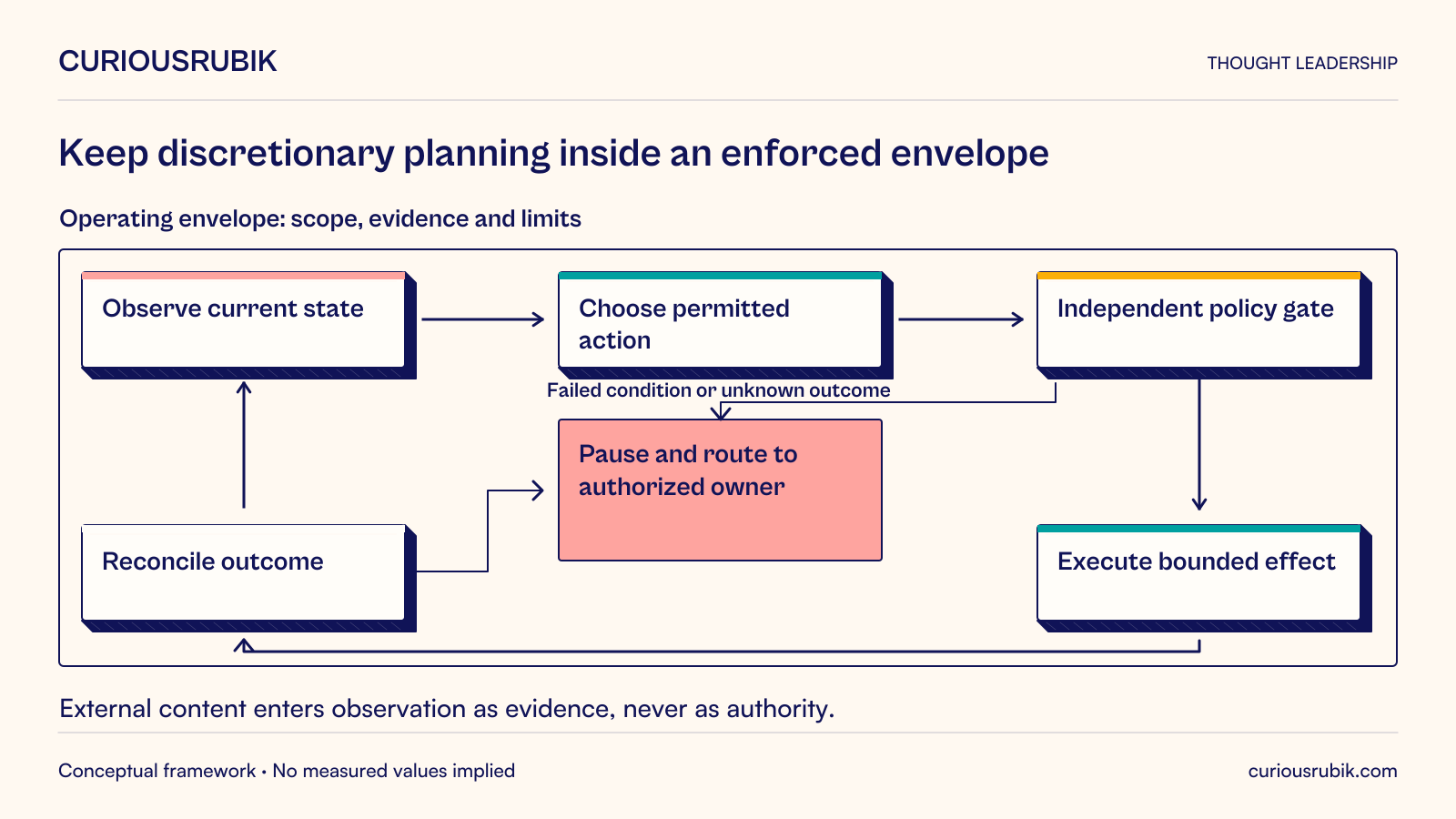
Use independent validation before consequential actions. The component proposing an action should not be the sole authority deciding whether the action is permitted. Separate business-policy enforcement from the model or planner where the consequence warrants it.
Record the version of the policy and evidence used. If the process’s authority changes while work is pending, define whether the action must be reevaluated. A proposal made under yesterday’s limits should not automatically execute after those limits have been withdrawn.
This separation allows the enterprise to improve planning capability without relaxing its controls every time the underlying model changes.
A maintenance operator delegates routine consumables replenishment
Consider a hypothetical company maintaining commercial properties. Its sites use a defined catalog of ordinary consumables. Staff spend time reviewing stock levels and preparing repeat requests from approved suppliers.
The first autonomous scope is deliberately narrow. The process may prepare and place replenishment orders for specified catalog items, suppliers, locations, and approved spending boundaries under the company’s authorization policy. It cannot introduce a new supplier, change payment details, substitute an unapproved item, or make a new contractual commitment outside that policy.
Before acting, it checks usable stock, outstanding orders, expected consumption under the approved planning method, and the freshness of those records. It distinguishes an order placed from goods actually received. A delayed acknowledgment creates an uncertain state requiring reconciliation rather than an automatic second purchase.
An independent action gate checks supplier eligibility, item identity, quantity, budget, and duplicate-order conditions. Cases outside the envelope go to a purchasing owner with the relevant evidence and proposed options.
The pilot includes a late receipt, an item-code change, an unavailable stock feed, an unexpected demand increase, and a supplier message suggesting a substitution. External messages are treated as information to assess, not permission to change the process’s authority.
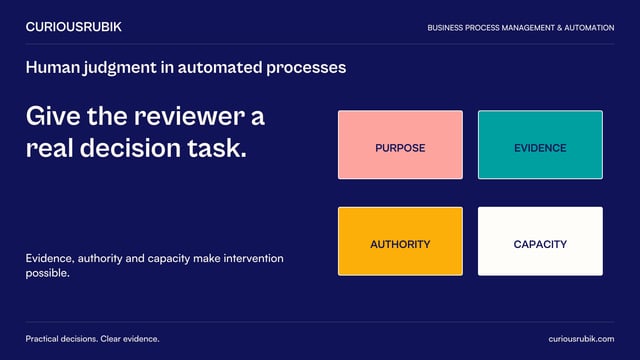
The process stops affected actions when it cannot establish current state or when exception handling exceeds the agreed operating capacity. A person can continue through an authorized fallback without allowing the automation to quietly widen its limits.
This hypothetical example illustrates a bounded operational delegation. It does not recommend a universal spending threshold or claim that autonomous replenishment produces a particular cost reduction.
Observe state before choosing an action
Autonomy depends on an adequate understanding of the environment. A process that sees only part of the state may make a locally reasonable decision that conflicts with another system’s work.
Identify the facts needed for each action and their acceptable age. Stock, reservations, open orders, and received goods are different quantities. A combined dashboard total can conceal those distinctions.
Represent unknown state explicitly. If an interface fails, the process should know whether it can use a dated value, must request confirmation, or must pause. Treating missing information as zero or as “no issue” can produce systematic errors.
Account for concurrent activity. A person or another process may act on the same case. Use appropriate locking, version checks, reservations, or reconciliation so two actors do not independently make incompatible commitments.
Plan for partial completion and irreversible effects
A multi-step process may succeed in one system and fail in another. An order may be placed while the internal status update fails. A customer notification may be sent before a later validation detects an error.
Define the recovery model for each effect. Some steps can be retried safely, some can be reversed, and some require a compensating action or human resolution. A technical rollback does not erase an external commitment.
Record stable action identifiers and completed effects. Repeated execution should not duplicate orders, tasks, or messages. When the outcome is uncertain, reconcile rather than assuming failure.
Keep the ability to stop separate from the normal planning path. Operators need a tested way to contain a faulty process, preserve evidence, and resume only the cases that are safe to continue.
Evaluate behavior across the whole loop
A correct individual recommendation does not prove that a process can operate responsibly over time. Repeated actions, changing state, external feedback, and recovery can create failures that a single demonstration misses.
NIST’s AI Risk Management Framework 1.0 treats risk management as ongoing and context-sensitive. For processes that use AI, this supports evaluation of the deployed operating loop and its consequences, rather than relying only on model-level performance. NIST AI RMF 1.0.
Test ordinary work and adversarial conditions: stale evidence, conflicting records, duplicate triggers, unexpected inputs, unavailable tools, and attempts by external content to redirect the task. Assess whether the process respects its authority when a goal becomes difficult to achieve.
Measure useful completion, unauthorized-action prevention, exception quality, recovery effort, and harm relevant to the domain. A high completion rate can be misleading if the process achieves it by ignoring important constraints.
Expand scope through evidence rather than enthusiasm
Begin with work whose state is understandable, actions are bounded, and failure can be contained. A narrow routine process may offer meaningful value without broad decision freedom.
Use staged operating modes where appropriate: observe without acting, prepare proposals, execute a limited set of authorized cases, and expand only after evidence supports the change. These are possible deployment techniques, not a mandatory maturity ladder.
Define expansion criteria in advance. The business should know which errors would block rollout, what response capacity is required, and which changes demand renewed approval. Do not allow a successful pilot to authorize unrelated actions by implication.
Some domains or decisions should remain human-led because of their consequences, uncertainty, or legal requirements. The organization should obtain qualified advice where regulated or high-impact decisions are involved. Technical feasibility does not settle the appropriateness of delegation.
Budget for supervision and maintenance
Autonomy changes human work rather than eliminating it. People define policy, maintain data, investigate exceptions, review outcomes, and respond to unusual situations.
Estimate those obligations before calculating value. If the remaining cases are rare but highly complex, they may require more expertise than the routine work that disappeared. Preserve the capability to handle them.
Monitor changes in demand, suppliers, products, and operating policy. A stable process can become unsafe when its assumptions change. Assign an owner to review whether the envelope remains appropriate and to retire obsolete permissions or workflows.
Include dependency changes in testing. A new interface version, model, or data source can alter behavior even when the business objective is unchanged. Treat the release as an operating change with evidence requirements proportionate to its consequence.
The buyer’s test for credible autonomy
Ask suppliers to state the exact delegated actions, prohibited actions, required evidence, independent controls, and stop conditions. Request demonstrations of uncertain completion and out-of-scope input, not only successful task execution.
Inspect the evidence available after an incident. Can the business reconstruct the state observed, the action proposed, the policy decision, and the external effect? Can it identify affected cases and resume safely?
Compare the proposal with simpler automation. If a deterministic workflow can achieve the outcome with less uncertainty and operating burden, autonomy may add little value. Use flexibility where the business actually needs it.
Autonomous processes can become useful operating participants when their authority is explicit and their behavior remains observable and recoverable. The enterprise should delegate a bounded job with enforceable conditions, not hand over a broad ambition and hope the system interprets it wisely.