Choose the next improvement through evidence, dependencies and capacity.
Fund the improvement that removes a consequential, evidenced problem and has a credible path into daily use. For a Singapore regional headquarters, that means comparing the demands of group finance with the work done by country teams, warehouses and customer service. The loudest request and the most attractive dashboard can both lose to a smaller change that makes several other improvements possible.
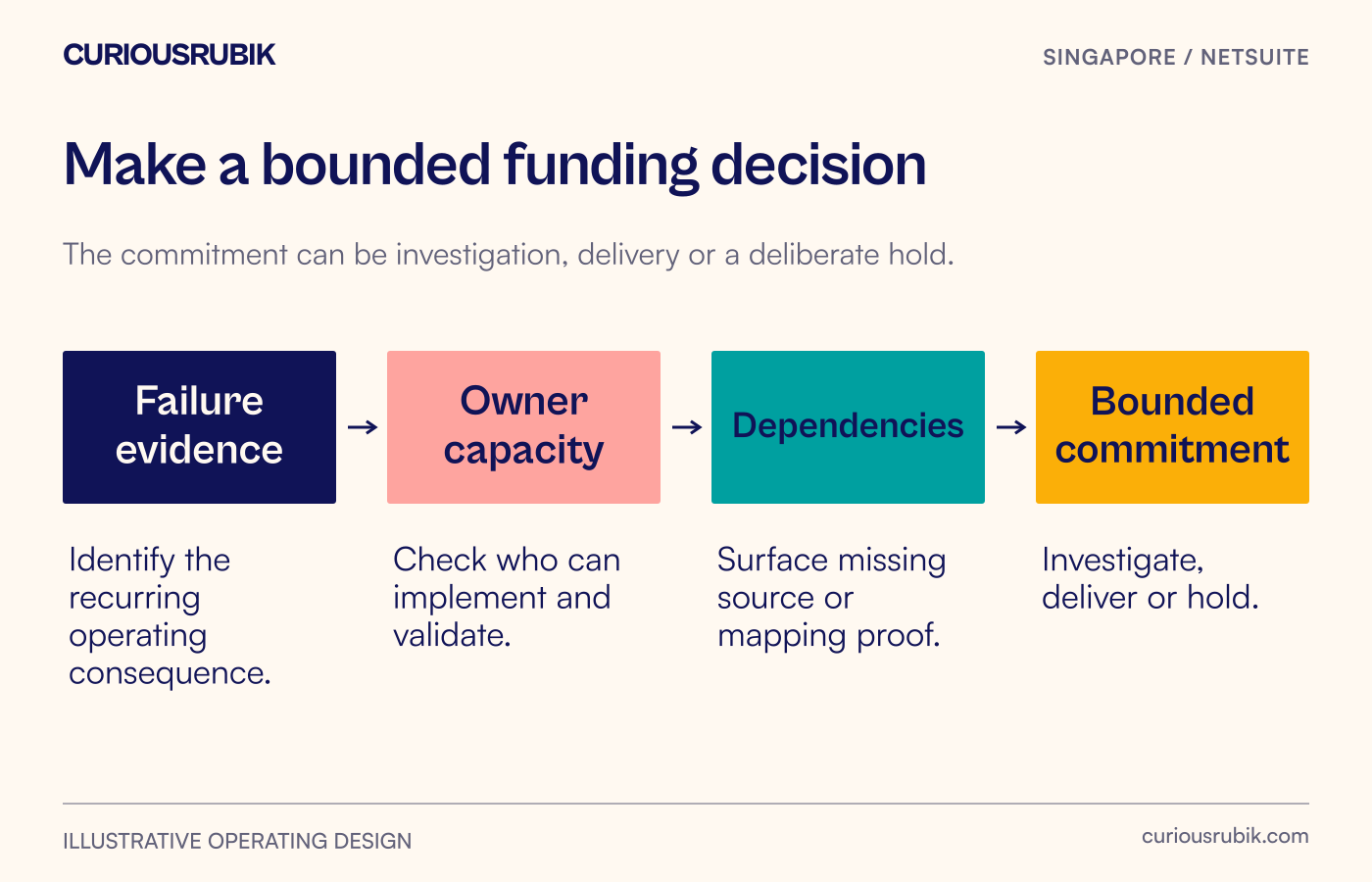
The difficult part is making that judgment visible. An optimization backlog should show what is going wrong, who carries the consequence, what must change first and whether the receiving team can adopt the result. A score helps organize the discussion. It cannot compensate for missing evidence or an unavailable business owner.
Put three real decisions on the table
Consider this illustrative scenario. A Singapore-based distributor manages its group finance from Singapore and uses country operations teams in Malaysia and Thailand. The businesses, requests and scores below are invented to demonstrate a method; they are not customer results or benchmarks.
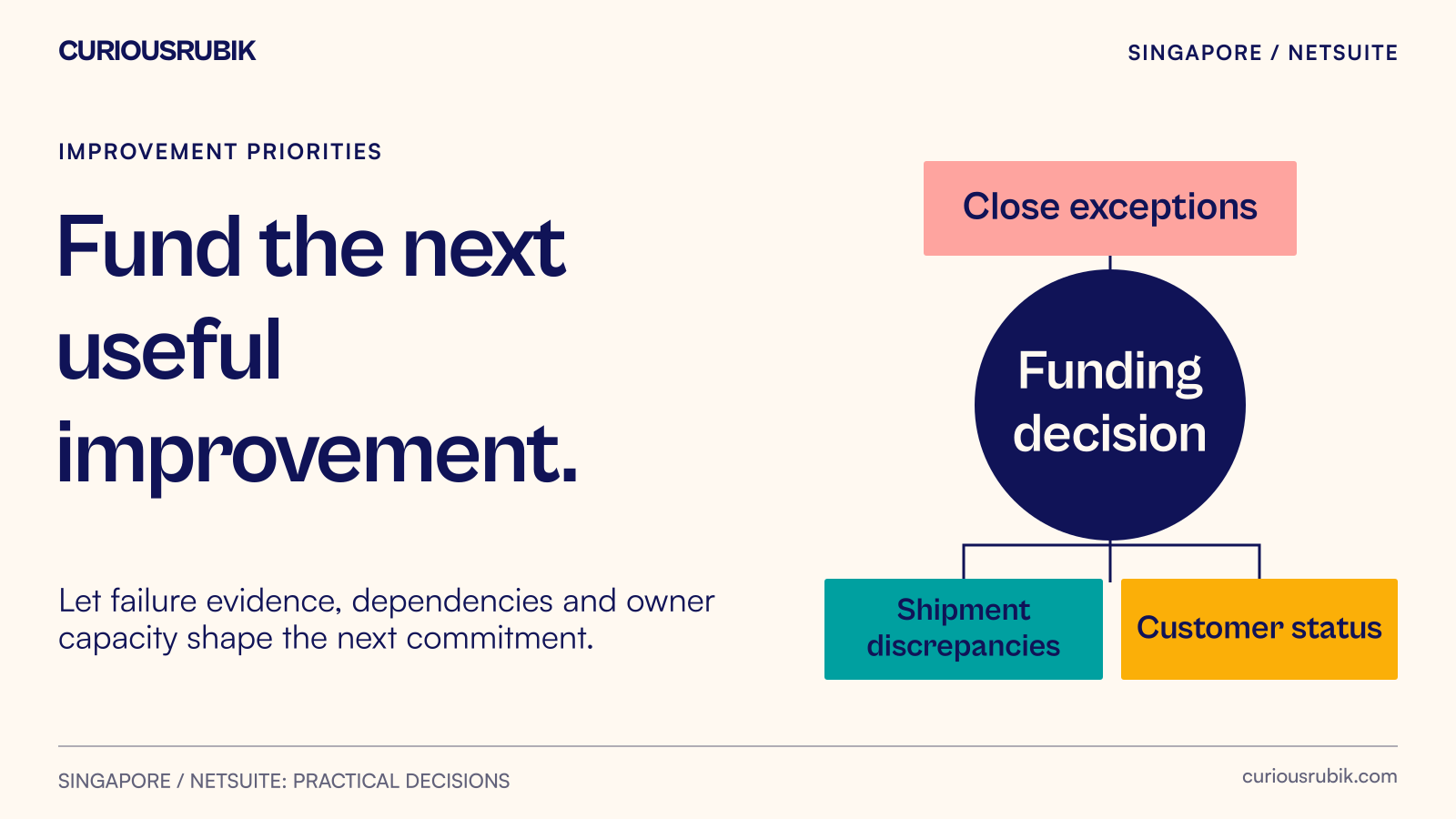
The controller wants an automated close exception report. The warehouse manager wants clearer handling of shipment discrepancies. Customer service wants a self-service order-status view. Each sponsor calls their request urgent, but the supporting evidence differs.
Finance can show a set of recurring unexplained differences, with named preparers and an agreed definition of completion. Warehouse staff can show orders whose shipment messages arrive against the wrong item reference. Customer service has a list of status enquiries, but the desired view would depend on those same warehouse messages being trustworthy.
Singapore HQ also has a capacity constraint: the regional operations analyst is needed to define both the warehouse rules and the customer-facing status language. Funding both projects together would not make that person available twice. The analyst's attention belongs in the investment decision, even when it does not appear as an external invoice.
The proposed sequence is therefore to fund a bounded warehouse investigation and the ready finance improvement, while holding the status view at discovery. The status request remains valuable. Its first investment is to prove which status can safely be shown, rather than commission an interface around uncertain data.
A scoring card with visible limits
Use four fields for every request. Record consequence and evidence confidence on a simple three-point scale. Record delivery effort as an estimate range supported by a technical review. Record readiness as a gate: ready, conditional or blocked.
For this worked example, consequence means the seriousness of an unresolved operating failure: 1 is local inconvenience, 2 repeatedly interrupts a team, and 3 can distort a material decision or prevent a committed service. Evidence confidence means 1 for anecdotes, 2 for a sampled pattern and 3 for a reproducible population. These are the fictional group's definitions, not standard NetSuite ratings.
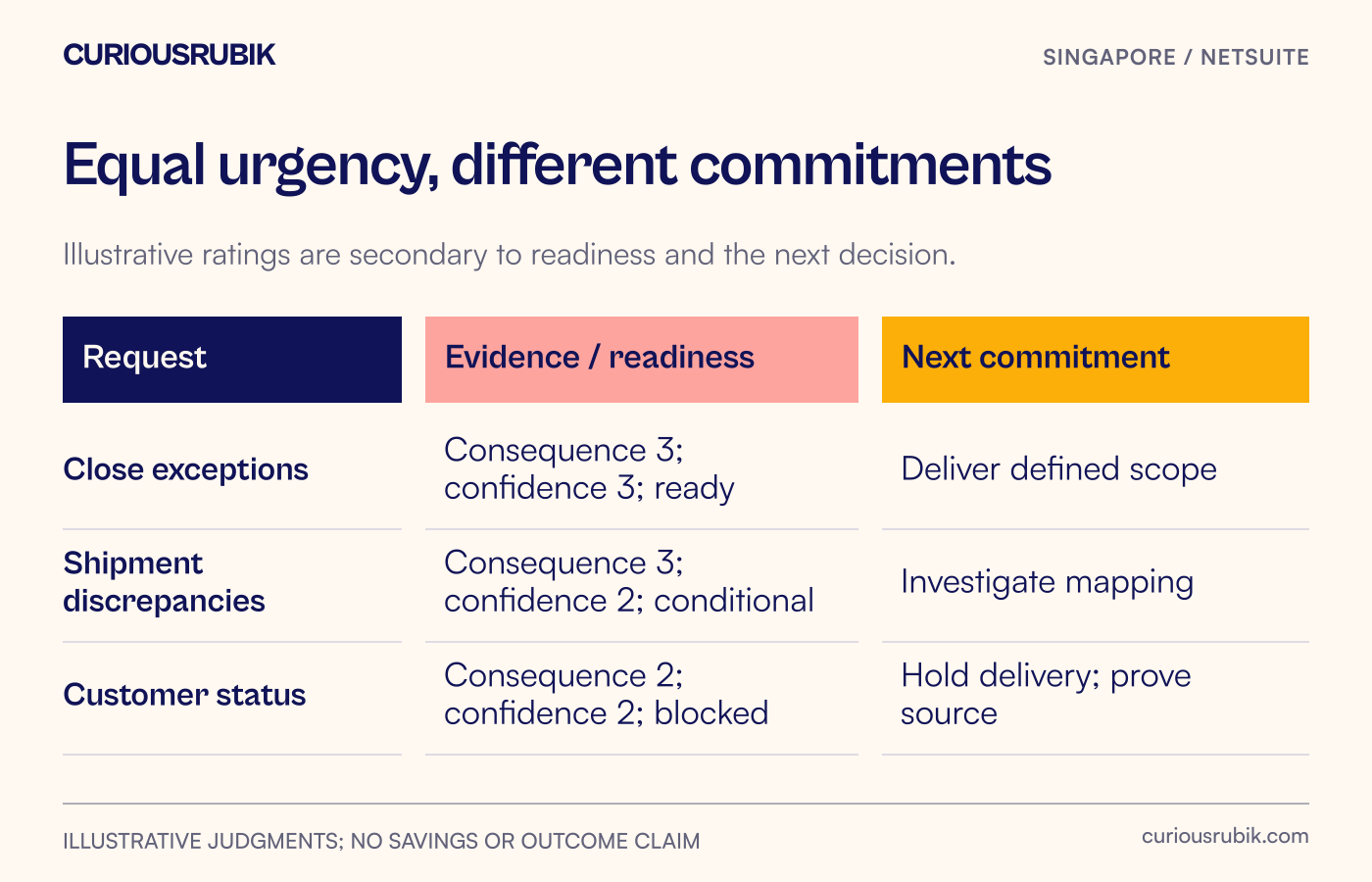
The filled card reads as follows:
- Close exceptions: consequence 3, confidence 3, ready. Finance has defined the report population and assigned a reviewer. The technical estimate still needs to separate configuration from any custom logic.
- Shipment discrepancies: consequence 3, confidence 2, conditional. The sample establishes a problem; the full affected population and mapping owner remain to be confirmed. Approve investigation before a broad rebuild.
- Customer status view: consequence 2, confidence 2, blocked for delivery. Its source-status definition depends on the shipment work, and its operational owner has not agreed what customers should see during an exception.
Complete the card with effort and owner capacity. In this fictional review, finance work is classed as low effort after inspecting the current report, with a preparer and reviewer available. The warehouse investigation is medium effort because it needs source-message analysis and provider participation; operations has reserved the analyst for that investigation only. The status view remains unestimated until its source rules are agreed, and its acceptance owner is unavailable. These are illustrative judgments, not delivery estimates. Each classification carries the reviewed scope, estimator and unresolved assumptions.
Do not add the numbers and automatically fund the highest total. A serious issue with weak evidence may deserve immediate containment and a short investigation. A fully evidenced improvement may still wait because its owner cannot test it. Keep these decisions separate so uncertainty does not disappear inside a weighted average.
Estimate the whole operating change
Ask the technical lead to divide effort into investigation, configuration or build, data correction, testing, deployment and handover. Then ask the business owner for their contribution: rule decisions, representative cases, acceptance sessions and changes to working instructions.
A finance report may be technically small but require substantial agreement about which differences belong in it. A warehouse fix may touch an integration owned by another provider. An order-status view may require a separate product, licence or development scope. Those facts change the decision before any work begins.
Keep product support and improvement delivery distinct in the budget. Oracle documents its own support offerings and partner-support arrangements, but a support entitlement does not establish the scope or commercial terms of a particular optimization engagement. Confirm the actual agreement instead of assuming a support case includes process redesign, custom development or country-team training.
Request estimates against the same acceptance conditions. “Fix shipment mapping” leaves too much open. “Demonstrate correct item and quantity identification for agreed shipment cases, including a correction and a duplicate message, then hand over exception ownership” gives estimators something concrete to assess. Ask them to state excluded providers, environments and records.
Attach a benefit-evidence plan to the money
The benefit plan should fit the change. For the close report, the controller might track how many items enter the queue, how long they remain unexplained and whether the same discrepancy returns. Record the source of each measure and compare similar close populations. A shorter queue is not a benefit if difficult cases were silently excluded.
For shipment discrepancies, operations should observe whether the same error category recurs and whether staff can resolve it using the agreed evidence. Customer service should check whether fewer enquiries require a warehouse investigation. This tests the dependency that justified delaying the status view.
Separate observations from financial claims. Minutes saved by a sampled user do not become cash savings merely by multiplying them across the region. The finance owner must decide whether time is actually released, absorbed by additional work or offset by a new support burden. Until then, describe the result as an operational measure.
Keep a stop rule beside the success rule
A backlog becomes healthier when a funded investigation can recommend doing less. In the scenario, suppose the warehouse evidence shows that staff use an obsolete item file outside the integration. The next useful action may be retiring that file and clarifying ownership. Continuing with the original connector rebuild would spend money on the wrong cause.
Write a decision point into each commitment. For the shipment investigation, require an affected-population summary, the authoritative item reference and a proposed correction route. If those cannot be established, the sponsor must choose whether to fund additional investigation or narrow the goal. Do not let an open question become an indefinite project by default.
Also record what would move a deferred request forward. The customer-status view becomes eligible when source meanings are agreed, exceptions have an owner and representative users can explain the proposed language. That is a concrete dependency, not a vague instruction to revisit the idea later.
Run the next funding meeting around evidence
Before the meeting, ask each sponsor for one failed business journey, its current workaround and the smallest change that could improve it. Bring the people who supply dependencies and the people who must accept the result. Keep country differences visible: a central report owner cannot promise that every warehouse uses the same identifiers or operating hours.
The meeting should leave three records: the commitment being funded, the evidence that will justify the next decision and the work deliberately waiting. Review those records when the evidence arrives or a material assumption changes. A fixed ranking should not survive the discovery that its benefits or dependencies were misunderstood.
For the wider sequence, CuriousRubik's guide to building a digital transformation roadmap connects operating outcomes with dependencies. The immediate step is smaller: take the next three NetSuite requests and make their consequence, evidence, owner capacity and acceptance conditions comparable. That gives Singapore HQ a defensible reason to fund one improvement before another.